Kernig's sign
Kernig's sign is a test used in physical examination to look for evidence of irritation of the meninges. The test involves flexing the thighs at the hip, and the knees, at 90 degree angles, and assessing whether subsequent extension of the knee is painful (leading to resistance), in which case it is deemed positive.[1] This may indicate subarachnoid haemorrhage or meningitis.[2] Patients may also show opisthotonus—spasm of the whole body that leads to legs and head being bent back and body bowed forward.[3]
| Kernig's sign | |
|---|---|
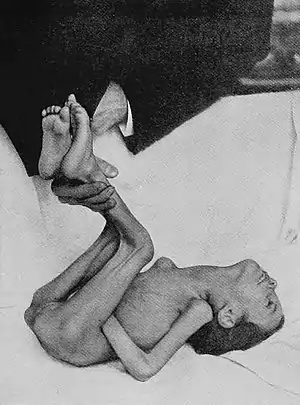 | |
| Positive Kernig's sign in cerebrospinal meningitis | |
| Differential diagnosis | subarachnoid hemorrhage or meningitis |
Name
The test is named after Woldemar Kernig (1840–1917), a Russian neurologist.
See also
References
- Kernig VM (1882). "Ein Krankheitssymptom der acuten Meningitis". St Petersb Med Wochensch. 7: 398.
- O'Connor, Simon; Talley, Nicholas Joseph (2001). Clinical Examination: A Systematic Guide to Physical Diagnosis. Cambridge, MA: Blackwell Publishers. p. 363. ISBN 0-632-05971-0.
- Shahade, Arati; De Jesus, Orlando (2020), "Opisthotonus", StatPearls, Treasure Island (FL): StatPearls Publishing, PMID 32644596, retrieved 2021-01-10
This article is issued from Wikipedia. The text is licensed under Creative Commons - Attribution - Sharealike. Additional terms may apply for the media files.