Khen Shish
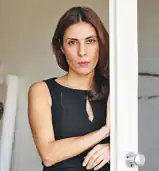
Khen Shish (Hebrew: חן שיש; born 1970) is an Israeli painter and installation artist.[1]
Khen Shish | |
|---|---|
חן שיש | |
 | |
| Born | 1970 |
| Nationality | Israeli |
| Website | www |
Biography
.jpg.webp)
Khen Shish was born in Safed to parents of Tunisian-Jewish origin. She studied art at the Art Institute, Oranim Academic College, Tivon, receiving a BFA in 1995. After graduation, she spent several years in Europe, living in Paris, London, Rome, and Berlin. In 1998, she returned to Israel, and completed an MFA at the Bezalel Academy of Arts and Design and the Hebrew University, Jerusalem (1997-1999). Shish is also a graduate of the New Seminar for Visual Culture, Criticism, and Theory, Camera Obscura School of Art, Tel Aviv (2000-2001).
Art career
Shish works in a wide range of techniques. Her oeuvre includes paintings, drawings, collage, works executed on television screens, large-scale wall paintings, and installations. Her works introduce expressive sites oscillating between chaos and horror, nature and culture, refinement and excess, frugal and Baroque. Her works have been exhibited in leading museums and galleries in Israel and abroad. Shish currently resides in Tel Aviv with her daughter Tamar-Louise.
Influences
Shish's work reveals diverse influences and sources of inspiration, including popular culture: cultural heroes such as Bruce Lee, Egyptian cinema stars, horror movies, handicrafts, round the world travel, outsider art, Arabian Nights, Zen chants, and ancient synagogues. Other influences originate in theoretical texts and prose: Julia Kristeva's Black Sun and Powers of Horror; Joseph Conrad's The Nigger of the "Narcissus", The Mirror of the Sea, and Heart of Darkness; Jorge Luis Borges's Seven Nights and The Craft of Verse.
Motifs
"During the acquaintance phase with Shish's artistic world," curator Ruth Direktor wrote, "one ought to linger on the image most present in her works – present, metamorphosed, reemerging in the form of another image: The eye. Eyes. Countless eyes. The eye sometimes appears as a leaf; it may, all of a sudden, float on its own on a large pink canvas. At times it is torn from a self-portrait photograph or crossed out with aggressive masking-tape strips. It incarnates into the image of a light bulb. It can be identified in the hangman's noose, while at other times it is a flower. It is at once poetic and violent. The violence is directed primarily toward itself: a plucked, torn, absent, covered eye. At the same time, the empty gaze directed at the viewer from the works is startling and deterring. Inevitably the viewer becomes a part of the reign of terror of what Bataille calls 'the gelded eye'."[2]
Khen | Djamila project
The Khen | Djamila project was installed as part of the exhibition "Mother Tongue" at the Museum of Art, Ein Harod (curator: Tal Ben Zvi) and at Wigmore Fine Arts, London. In the catalogue text, Ben Zvi wrote: "The project began in 1999 with a journey to London, where Shish moved into a primarily Arab immigrant neighborhood, presented herself as 'Djamila from Tunis,' and collected fragments of random encounters with second-generation Arab exiles. Some fell in love with her, gave her photographs, and wrote her letters. In 2002, she traveled to London once again, as well as to Paris, this time documenting the journey. She declared Djamila dead 'in the Twins' (9/11), but forced to contend with her Arab persona when people spoke to her in Arabic. Shish assembled her identity—born of these journeys and the gaps between them—into an installation. Postcards, objects, papers, collages, and stickers tell the story of the deconstruction and reconstruction of an identity. Together, they form a powerful Mizrahi female 'Self.' Postcards of Arab movie stars bought at the Arab World Institute in Paris, were cut up and reassembled. In one collage, Muhammad Abdel Wahab can be made out sitting on the legs of a Moroccan woman whose feet are decorated with Henna. Other works are based on papers photocopied at the Pompidou Center in Paris. Shish photocopied pages out of art books, and scribbled on them in Hebrew: 'Kusit from Tunis' and in English 'Tunisian' and 'Tunis.' The photocopied images have no accompanying text that might attest to their origins, nor do they bear any explanatory captions or artists' signatures. Thus, Shish appropriates art history in the service of her personal narrative."[3]
Painting, drawing, black
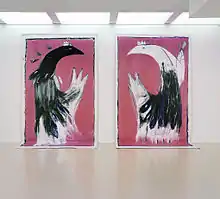
Shish's oeuvre includes a series of large-scale paintings, over twenty meters wide, marked by their black color. These works have been described as monumental tributes to Expressionist art. Some of them overflow onto the museum floor, ostensibly attesting to their infinite quality, reflecting a daring practice, rare in the art world. The color black, which plays a major role here, offers a key through which to observe these works, be lured by them and even sucked in. In her catalogue essay for Shish's exhibition "In the Black Distance" (with Lea Nikel), curator Naomi Aviv wrote: "In Khen Shish’s work black is a default choice, a given. Like using a pen for writing. Through the years, black has come to be identified with her painting, sometimes turning into dim pink underlying spontaneous images in black. Even when she recently started using deep, dark green, blue or purple, they have been seen as an extension of the black family – engendering also her wide use of gold, which often replaces the surface's white."[4]
Awards and recognition
- 2013 Landau Foundation Prize for Painting
- 2009 The Ministry of Culture and Sport Award[5]
- 2007 Legacy Heritage Fund Prize, Tel Aviv Museum of Art
- 2007 Artist in Residence, Cité des Arts, Paris
- 2004 Young Artist Award, Ministry of Culture and Sport
- 2004 America-Israel Cultural Foundation Grant for a stay abroad
- 2003 Eugen Kolb Foundation Award, Tel Aviv Museum of Art
- 1999 The Anglo-Israeli Photographic Award (Multi-Exposure): grant to make a project in London
- 1996-1998 America-Israel Cultural Foundation Scholarships
- 1994 America-Israel Cultural Foundation Scholarship
Selected solo exhibitions
- 2021 "Lucky Chameleon", Schechter Gallery, curator: Drorit Gur Arie
- 2019 "Deliberately Random", Ticho House Gallery, The Israel Museum, Jerusalem, curator: Timna Seligman[6]
- 2017 "Shut Up!", Haifa Museum of Art, Haifa, curator: Svetlana Reingold
- 2015 "De Kooning and Me - Family", The Gallery of Kibbutz Beeri, curator: Ziva Yalin
- 2013 "All The Tears I cried For You", Gordon Gallery booth at Fresh Paint Art Fair 6, Tel Aviv
- 2009 "Ornements et plis", Hagalleria, Paris
- 2008 "This Damned Heart of Mine", Habers Gallery, Vienna
- 2008 "Nerves Sing" at Alon Segev Gallery, Tel Aviv[7]
- 2000 "Buongiorno Giotto", Department of Photography Gallery, Bezalel Academy of Art and Design, Jerusalem
- 1995 Installation at the Protestant Church, Wadi Nisnas, Haifa
Selected group exhibitions
- 2021 "Digging Down", Bible Lands Museum Jerusalem, curator: Shira Fridman
- 2021 "The 4th Mediterranean Biennale - Living Together - Crossing Borders", Haifa, curator: Belu-Simion Fainaru
- 2016 "(Dis)Place", Ashdod Art Museum, Curators: Yuval Beaton and Roni Cohen-Binyamini
- 2011 "The Museum Presents Itself — Israeli Art from the Museum Collection", Tel Aviv Museum of Art, Tel Aviv; curator: Ellen Ginton
- 2008 "Near and Apparent: Connections and Contexts from the Benno Kalev Collection", The Open Museum, Tefen industrial Park; curator: Ruth Ofek
- 2007 "Looking at the Trees and Seeing More than the Forest: from Raffi Lavie's House", Givon Art Gallery, Tel Aviv
- 1998 "The House in Musrara 3", Musrara Gallery, Jerusalem; curator: Rachel Sukman
- 1997 "Artic: Recipients of the America-Israel Cultural Foundation Scholarships", Museum of Israeli Art, Ramat Gan
- 1995 "Artic: Recipients of the America-Israel Cultural Foundation Scholarships", The Genia Schreiber University Art Gallery, Tel Aviv University
Personal life
She had a daughter at age 42, which she says has impacted her mindset.[8]
See also
References
- "4 Contemporary Female Artists To Keep An Eye On In 2021". NoCamels. 2020-12-27. Retrieved 2021-12-07.
- Ruti Direktor, "On Excess and Renunciation," in exh. cat. Khen Shish: I Was Kidnapped by Indians, trans. Daria Kassovsky [The Art Gallery, University of Haifa, 2006], p. 74
- Tal Ben Zvi, "Deferring Language as a Theme in the Work of Mizrahi Artists," exh. cat. Mother Tongue, trans. Rachel Lea Jones [Ein Harod: Museum of Art, 2002], p. 172.
- Naomi Aviv, exh. cat. Lea Nikel and Khen Shish: In the Black Distance, trans. Michal Sapir [Ashdod, Israel: Ashdod Art Museum, 2010], p. 132.
- "Archived copy". Archived from the original on 2014-10-04. Retrieved 2013-01-20.CS1 maint: archived copy as title (link)
- "Art, the artist and the viewer". The Jerusalem Post | JPost.com. Retrieved 2021-12-07.
- Ktzia Alon, "Khen Shish's Pink-Black Theology, or: the Visual Presentation of Un-naming," in exh. cat. Khen Shish: Nerves Sing, trans. Daria Kassovsky [Tel Aviv: Alon Segev Gallery, 2008].
- "The art of motherhood". The Jerusalem Post | JPost.com. Retrieved 2021-12-07.
External links
- Khen Shish's official web site
- Khen Shish at Artsy website
- Khen Shish at Artis website
- Khen Shish at Anna Marra Contemporanea website
- Khen Shish at The Israeli Museum website
- Khen Shish at Haifa Museum of Art
Authority control  | |
|---|---|
| General | |
| National libraries | |
| Art research institutes | |
| Other | |