Khimshiashvili
Khimshiashvili (Georgian: ხიმშიაშვილი) was a surname of the Georgian noble families, with their bases in the regions of Kakheti and Adjara.Princedom of Adjara, Akhaltsikhe & Kakheti in Eastern Georgia: A Kakhetian family was princely nobility of Georgia and, then, of the Russian Empire, while the Adjarian Khimshiashvili were important frontier beys under the Ottoman Empire and wielded noticeable influence in this part of southwestern Caucasus throughout the 19th century. The Russians rendered their family name as Khimshiyev (Russian: Химшиев) and as Adzharsky (Аджарский, "of Adjara"), while to the Turks they came to be known as Hamşioğlu.
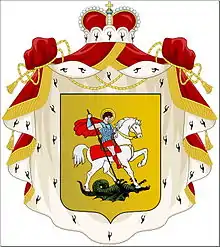
In Kakheti
The Khimshiashvili were purportedly descended from the Abazasdze family, which first appears in the Georgian annals in the 11th century. Their likely eponymous forefather, Khimshia Abazasdze, fought Timur's invading army in 1399 and then was granted by the king of Georgia lands in Kakheti.[1] According to the historian Cyril Toumanoff, the latter-day Kakhetian noble family of Khimshiashvili descended from these "Abazads of Marili".[2] The Khimshiashvili are included in the list of the Kakhetian princes (tavadi) attached to the Russo–Georgian Treaty of Georgievsk of 1783. On Russian annexation of Georgia, they had their rank (knyaz) recognized by the new regime, officially in 1850.[3] Many of the Khimshiashvili pursued military careers, such as Georgy Khimshiyev (1836–1917), general of artillery in the Imperial Russian ranks,[4] and Gogi Khimshiashvili (1892–1923), colonel in the Georgian service, who was executed by the Soviet regime.[5]
In Adjara
Origin
Khimshiashvili (Georgian: ხიმშიაშვილი) was a Georgian very oldest noble family,known from the eleventh (XI) century.
They were Princedom of Adjara & Kakheti in eastern Georgia, with their "KNIAZ" and Prince-Master of the Horse; Lord High Constable titles. Also some of family members sometimes was recognized Russian General by the Russian Empires. Some of family's members was appointed Vezir of Sultan and/or "Pasha" by Ottoman's Sultans. Khimshiashvili family was also called DUKE of Aragvi, Gurelli and Akhaltsikhe. Their root was came from most strong, and noble name of Georgia: Khimshi Zedginidze* and his generation was called Khimshiashvili.*
The House of Zevdginidze (ზევდგინიძე) or Zedginidze (ზედგინიძე), Khimshiashvili (ხიმშიაშვილი)** which subsequently assumed the name of its principal office-fief, of Amilakhvari (Prince-Master of the Horse Lord High Constable), is traceable in the province of Upper Kartli (now Inner Kartli) to the middle of the fourteenth century. A family legend holds it, though, that they descend from a Roman officer who accompanied Pompey on his Caucasian campaign in 65 BC. His descendants are said to have attained to Georgian nobility in the 11th century.
Since then they are called Amikhvarais and are divided by several names:
1. Revazis shvili [shvili-son, child];
2.Khimshiashvili
2.Qaikhosros shvili;
3. Bezhanis shvili;
4. Erastis shvili and his nephews;
5. Givis shvili.
Rise and fall
The first documented Adjarian Khimshiashvili was Abdullah Bey, killed during his raid into the neighboring Georgian Principality of Guria in 1784. His son Selim Bey sought to bring all of Ottoman Georgia under his rule and staged a coup in Akhaltsikhe in order to gain control of the Eyalet of Childir. After Selim's death in an Ottoman punitive expedition in 1815, his sons and successors, especially, Ahmed Bey, cooperated with the Ottoman government and extended their influence over the territory from the Gurian hills to the Oltu Çay. The Ottomans had to rely on these beys in their efforts to counter the Russian expansion. During the Russo-Turkish War (1828–29), they posed more threat to the Russians than the Ottoman "new model" army operating in the Caucasus. During the following two decades, the Ottoman government's "westernizing" tanzimat eliminated the semi-autonomous rule of derebeys.[6][7][8] A revolt against this policy led by Kor Hussein Bey Khimshiashvili was put down in the 1840s.[9] Eventually, Şerif Bey of Adjara, a Khimshiashvili, defected to the Russians during the war of 1877–78 and, thereby, was able to retain his property after the Russian takeover of Adjara. After the Russian Revolution of 1917 and the Soviet invasion of Georgia in 1921, many of his numerous descendants fled to Turkey, where they still live as Hamşioğlu.[10]
References
- Minorsky, Vladimir (1930). "Transcaucasica". Journal Asiatique (in French). 217: 104–107.
- Toumanoff, Cyril (1963). Studies in Christian Caucasian history. Washington, DC: Georgetown University Press. p. 272.
- Списки титулованным родам и лицам Российской империи [Lists of the Titled Families and Persons of the Russian Empire] (in Russian). St. Petersburg: Department of Heraldry of the Governing Senate. 1892. p. 90.
- Gogitidze, Mamuka (2001). Грузинский Генералитет 1699–1921 [Georgian generals 1699–1921] (in Russian). Kiev. pp. 145–146. ISBN 966-02-2254-8.
- Kereselidze, Lia (2010). "One person out of fifteen…". The Archival Bulletin. 9: 37–38.
- Allen, W.E.D. (August 1929). "The March-lands of Georgia". The Geographical Journal. 74 (2): 143, 152. doi:10.2307/1785312. JSTOR 1785312.
- Allen, William Edward David; Muratoff, Paul (1953). Caucasian Battlefields: A History of the Wars on the Turco-Caucasian Border 1828–1921. Cambridge University Press. pp. 23, 31, 33, 42.
- Umikashvili, Petre (26 May 1877). "ოსმალოს საქართველო" [Ottoman Georgia] (PDF). Iveria (in Georgian). 13: 12–14.
- Yilmaz, Özgür (August 2014). "Tanzimat Döneminde İsyancı Bir Ayan Profili: Acaralı Kör Hüseyin Bey Hadisesi" [A Rebel Ayan Profile in the Tanzimat Period: The Incident of Kör Hüseyin Bey of Adjara]. Belleten (in Turkish). 78 (282): 611–657.
- Turmanidze, Otar (2013). "შერიფ ხიმშიაშვილის მეურნეობა" [Sherif Khimshiashvili Farming] (PDF). South-West Georgia. Conference Materials (in Georgian). 3: 41–43. ISSN 2298-0776.
![Списки титулованным родам и лицам Российской империи [Lists of the Titled Families and Persons of the Russian Empire]](https://commons.wikimedia.org/wiki/File:Khimshiev_(Spiski,_p._90).JPG)