Pythian Temple and James Pythian Theater
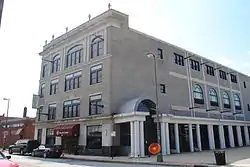
The Pythian Temple and James Pythian Theater is an historic building in the King-Lincoln Bronzeville neighborhood of Columbus, Ohio.
Pythian Temple and James Pythian Theater | |
 | |
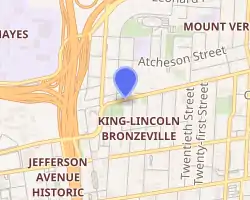
Interactive map highlighting the building's location | |
| Location | 861-867 Mt. Vernon Ave., Columbus, Ohio |
|---|---|
| Coordinates | 39°58′16″N 82°58′44″W |
| Area | less than one acre |
| Built | 1925 |
| Architect | Evans & Plato; LeVeque, L.L. |
| Architectural style | Colonial Revival |
| NRHP reference No. | 83004295[1] |
| CRHP No. | CR-18 |
| Significant dates | |
| Added to NRHP | November 25, 1983 |
| Designated CRHP | April 4, 1983 |
History
The Pythian Temple was designed in the in the Colonial Revival architectural style by Samuel Plato, an African-American architect, and the only example of his work in Columbus.[2][1] It was financed by the Knights of Pythias, a Black fraternal organization, and opened in 1926 and could accommodate roughly 1,000 people with a theatre, retail, offices, and lodge rooms. It quickly became the center of entertainment in the neighorhood, hosting performers including Cab Calloway, Count Basie, Duke Ellington and the Cotton Club Dancers.[3]
It was added to the National Register of Historic Places on November 25, 1983 under the name "York Rite Masonic Temple."[1]
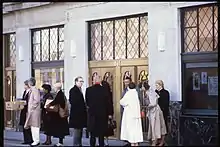
In 1987, the temple was renovated by African-American owned architecture firm Moody Nolan to combine with Garfield Elementary School. The complex was renamed as the Martin Luther King Jr. Performing and Cultural Arts Complex,[3] in memory of Dr. Martin Luther King, Jr.[4]
The building was listed as one of the most endangered sites in the city, in Columbus Landmarks' 2021 list.[2] The King Arts Complex vacated the building in 2019, and a portion of it was listed for sale in 2020.[5] In July 2021, the temple was entered a purchase agreement with the owners by Maroon Arts Group, a Black-led nonprofit based in the neighborhood. The group entered the agreement after the community expressed a desire to save the building.[3]
References
- "National Register Information System". National Register of Historic Places. National Park Service. March 13, 2009.
- "2021 Most Endangered Sites – Columbus Landmarks". Retrieved 2021-12-04.
- "The Columbus Dispatch". www.dispatch.com. Retrieved 2021-12-04.
- The King Arts Complex history Archived 2009-07-22 at the Wayback Machine
- "Pythian building, formerly part of King Arts Complex, listed for sale". 10-TV. July 28, 2020. Retrieved 2021-12-04.
External links
 Media related to King Arts Complex at Wikimedia Commons