Kiyohime
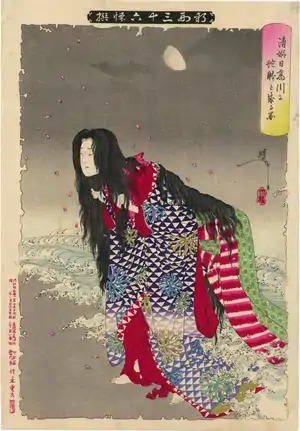
Kiyohime (清姫) (or just Kiyo) in Japanese folklore is a character in the story of Anchin and Kiyohime. In this story, she fell in love with a Buddhist monk named Anchin, but after her interest in the monk was rejected, she chased after him and transformed into a serpent in a rage, before killing him in a bell where he had hidden in the Dōjō-ji temple.[3]
Early sources
The story originally appeared in two collections of setsuwa or tales, Dainihonkoku hokekyō kenki (c. 1040) and Konjaku Monogatarishū (c. 1120).[4][5]
The text in the former work is written down in kanbun (Chinese text),[6][7] while the text in the Konjaku Monogatarishū entitled "How a Monk of the Dōjōji in the Province of Kii copied the Lotus Sutra and Brought Salvation to Serpents" is of virtually identical content,[8][9] only expanded into Japanese.[10]
This old version tells the story of an unnamed young widow (or young unmarried house mistress[11][lower-alpha 1])[12][13] who desired the attention of an unnamed handsome monk travelling on a pilgrimage route to a Shugendō shrine in Kumano on the Kii Peninsula. The monk, in an attempt to avoid meeting her, chose a different route on the return journey, and the woman died in grief when she found out that he was deliberately avoiding her. After her death, a great serpent emerged from her bedchamber and it pursued the monk before killing him in a bell in the Dōjō-ji temple where he had hidden. Years later the monk appeared in a dream of a senior priest begging him to copy a chapter of the Lotus Sutra to release him and the serpent from their suffering in their rebirths, which was duly done and they were both reborn in separate heavens.[14] Another version is found in Genkō Shakusho c. 1332.[15] The name Kiyohime did not appear in these early versions, Anchin (安珍) however was named as the monk in Genkō Shakusho.[16]
A version of the story is told in an emaki scroll from the Muromachi period titled Dōjōji engi emaki ("Illustrated legend of Dōjōji", c. 15th century).[16] In this version, the woman in the tale was the daughter-in-law of the owner of a home in Manago in the Muro district named Steward of Seiji. The name Seiji (清次) can also be read as Kiyotsugu, which is the origin of the name Kiyohime found in later versions of the tale.[17] The name Kiyohime did not appear until the 18th century, in the narrative of a joruri (ballad drama) titled Dojo-ji genzai uroko (道成寺現在蛇鱗, The Scales of Dojoji, A Modern Version) that was first performed in 1742.[18] Some later versions also used different names for Anchin and Kiyohime, or that she was the daughter of an innkeeper Shōji Kiyotsugu and other variations.[19][20]


Popular versions
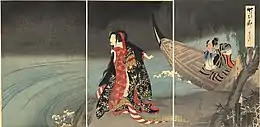
There are some variations in different versions of the story. In the popular versions, the family of Kiyohime provided lodging for traveling priests, who passed by on their way to a shrine famous for ascetic practices. One day, a handsome visiting priest named Anchin lodged at the house while on a pilgrimage. In some versions, he fell in love with the beautiful Kiyohime, but after a time he overcame his passions and refrained from further meetings. In other versions Anchin resisted her attention from the start, and avoided her house on his return journey.
Kiyohime became furious by his rejection and pursued him in rage. At the edge of the Hidaka River, Anchin asked a boatman to help him to cross the river, but told him not to let her cross with his boat. When Kiyohime saw that Anchin was escaping her, she jumped into the river and started to swim after him. While swimming in the torrent of the Hidaka river, she transformed into a large serpent or dragon because of her rage. When Anchin saw her coming after him in her monstrous new form, he ran into the temple called Dōjō-ji. He asked the priests of Dōjō-ji for help and they hid him under the bonshō bell of the temple. However, the serpent smelled him hiding inside the bell and started to coil around it. She banged the bell loudly several times with her tail, then gave a great belch of fire so powerful that it melted the bell and killed Anchin.[21]
Cultural references
The tale of Anchin and Kiyohime forms the basis of a collection of plays termed Dōjōji mono (Dōjō-ji Temple plays), depicting an event some years after the temple bell was destroyed. These plays include the Noh play Dōjōji and the Kabuki dance drama Musume Dōjōji.[19]
Kiyohime appears in the mobile game Fate/Grand Order as both a Berserker, and Lancer class servant, both incarnations with a madness/insanity related skill.
She also appears in the Megami Tensei video game series as a demon.
In the video game For Honor, the Aramusha character has a customizable sword gear set named "Kiyohime's Embrace" complete with serpent scales on the blade hilts, and marks running down the blades as if they were partly melted.
In the mobile game onmyoji, Kiyohime is represented as a fire-spitting snake-like shikigami, one of the collectable spirits, and an occasional villain in the game's storyline.
In the anime series My-HiME, Kiyohime is the Child (a part-spiritual, part-mechanical creature) of Shizuru Fujino, one of the 12 HiMEs. In her final confrontation with fellow HiME Natsuki Kuga, with whom she is romantically obsessed, Shizuru drops a bell on her.
In the anime series Dragon Ball Z, a filler character named "Princess Snake" may be based on Kiyohime. She falls in love with Goku while the latter is travelling on the Snake Way. After Goku rejects her, she transforms into a giant fire-breathing snake, and tries to eat him.
Explanatory notes
- It is remarked by Mabuchi et al. that the term kafu here does not necessarily imply widow, as is usually the case in modern Japanese speech.
References
- Citations
- Ashkenazi, Michael (2003), "Snakes", Handbook of Japanese Mythology, ABC-CLIO, pp. 252–253, ISBN 9781576074671
- Tsukioka, Yoshitoshi (2018), Shingata sanjūrokkaisen 新形三十六怪撰 (in Japanese), Edo Rekishi Library
- Ikumi Kaminishi (2005). Explaining Pictures: Buddhist Propaganda And Etoki Storytelling in Japan. University of Hawai'i Press. p. 119. ISBN 978-0824826970.
- Mabuchi, Kunisaki & Inagaki (2008), pp. 4
- Szostak, John D. (2013), "6 Artistic Flowering: the Second and Third Kokuten Exhibitions. §Kagaku: Hidaka River (1919) and Forest in Nara (1920)", Painting Circles: Tsuchida Bakusen and Nihonga Collectives in Early Twentieth Century Japan, BRILL, ISBN 9789004249455, p. 168 and note 38
- Hamashita (1998), p. 130.
- Honchō hokke genki 本朝法華驗記 , Book 2, "No. 129 Kii no kuni Muro-gun no akujo 第百廿九 紀伊國牟婁郡惡女". Reprinted in: Yashiro (1908). "Dōjōji-kō 道成寺考", Enseki jisshu 燕石十種 pp. 450-451; Hanawa, Hokiichi (ed.), "Honchō hokke genki ge" 本朝法華驗記 下, Zoku Gunsho ruijū 8jō (den-bu) 続群書類従 8上(伝部), pp. 199–200
- Mitamura (1911), p. 275
- Shimura, Kunihiro (1989), Igyō no densetsu: denshō bungakukō 異形の伝説: 伝承文学考, Kokusho kankōkai, pp. 14–15
- Hamashita (1998), p. 130
- Mabuchi, Kunisaki & Konno (1971).
- Konjaku monogatarishū Book 14, 3. Dōjōji no sō, hokekyō wo utsushite hebi wo sukuu koto 紀伊國道成寺僧寫法華救蛇. Reprinted in: Yashiro (1908). "Dōjōji-kō 道成寺考", Enseki jisshu 燕石十種 pp. 450-453; "Kii no kuni Dōjōji no sō.., etc. Tale No. 3" 紀伊國道成寺僧寫二法花一救レ虵語第三, Konjaku monogatari 今昔物語(源隆国), Keizai zasshisha, 1901, pp. 753–756; Mabuchi, Kunisaki & Inagaki (2008), pp. 38–49
- Ury tr. (1993), Ch. 14. "[nav_26!/4/2/4[ch14]/2/1:0 3 How a Monk of the Dōjōji in the Province of Kii Copied the Lotus Sutra and Brought Salvation to Serpents]".
- Susan Blakeley Klein (1991). "When the Moon Strikes the Bell: Desire and Enlightenment in the Noh Play Dojoji". The Journal of Japanese Studies. 17 (2): 291–322. doi:10.2307/132744. JSTOR 132744.
- Kokan, Shiren (1624), Genkō shakusho 元亨釈書 (in Japanese), Book 19, fol. 15b
- Skord Waters, Virginia (1997). "Sex, Lies, and the Illustrated Scroll: The Dōjōji Engi Emaki". Monumenta Nipponica. 52 (1): 59–84. doi:10.2307/2385487. JSTOR 2385487.
- Skord Waters, Virginia (1997). "Sex, Lies, and the Illustrated Scroll: The Dōjōji Engi Emaki". Monumenta Nipponica. 52 (1): 75. doi:10.2307/2385487. JSTOR 2385487.
- "The Legend of Anchin and Kiyohime (安珍・清姫伝説) - Japanese Wiki Corpus".
- Leiter, Samuel L. (2014). Historical Dictionary of Japanese Traditional Theatre (2nd ed.). Rowman & Littlefield Publishers. pp. 86–87. ISBN 978-1442239111.
- Betty True Jones (1983). "Dance as Cultural Heritage: Selected papers from the ADG-CORD Conference 1978". Congress on Research in Dance: 33.
- Ueda Akinari (6 August 2012). Ugetsu Monogatari or Tales of Moonlight and Rain (Routledge Revivals): A Complete English Version of the Eighteenth-Century Japanese collection of Tales of the Supernatural. Routledge. pp. 252–. ISBN 978-1-136-81032-9.
- Bibliography
- Hamashita, Masahiro (March 1998), "Dōjōji no <onna>: heynyō no bikaku" 「道成寺」の<女>-変容の美学, Joseigaku hyōron: Women's studies forum (in Japanese), Kobe College, 12: 127–148, doi:10.18878/00002190, ISSN 0913-6630
- Mabuchi, Kazuo; Kunisaki, Fumimaro; Inagaki, Taiichi, eds. (2008), "Dōjōji no sō, hokekyō wo utsushite hebi wo sukuu koto (Book 14, no. 3)" 道成寺の僧、法華経を写して蛇を救うこと(巻一四ノ三), Konjaku monogatari 今昔物語集 (in Japanese), Shogakukan, pp. 38–49
- Mabuchi, Kazuo; Kunisaki, Fumimaro; Konno, Tōru, eds. (1971), Konjaku monogatarishū 今昔物語集, 日本古典文学全集 21 (in Japanese), 1, Shogakukan
- Mitamura, Engyo (1911), "Kyō-ganoko Musume Dōjōji" 京鹿子娘道成寺, Shibai to shijitsu 芝居と史實 (in Japanese), Seikyosha, pp. 271–294
- Ury, Marian (1993), "Ch. 14. 3 How a Monk of the Dōjōji in the Province of Kii Copied the Lotus Sutra and Brought Salvation to Serpents", Tales of Times Now Past: Sixty-Two Stories from a Medieval Japanese Collection. A translation of sixty-two key stories from the Konjaku Monogatari, Open access edition funded by the National Endowment for the Humanities / Andrew W. Mellon Foundation Humanities Open Book Program, ISBN 978-0-472-90211-8
- Yashiro, Hirokata (1908), "Dōjōjikō" 道成寺考, in Iwamoto, Sashichi (ed.), Enseki jisshu 燕石十種 (in Japanese), 3, Kokusho kankōkai, pp. 450–461