Klaus Schwab
Klaus Martin Schwab (German pronunciation: [klaʊs ˈmaʁtiːn ʃvaːp]; born 30 March 1938) is a German engineer and economist best known as the founder and executive chairman of the World Economic Forum.
Klaus Schwab | |
|---|---|
.jpg.webp) Schwab in 2008 | |
| Born | 30 March 1938 Ravensburg, Germany |
| Education | |
| Occupation | Founder and executive chairman, World Economic Forum |
| Spouse(s) | Hilde Schwab (m. 1971) |
| Children | 2 |
Early life
Schwab attended 1st and 2nd grade at the primary school in the Wädenswil district of Au ZH, in Swizerland. Later, the family moved again to Germany.[1] Schwab attended the Spohn-Gymnasium in Ravensburg until his Abitur in 1957.[2][3]
In 1961, he graduated as a mechanical engineer from Swiss Federal Institute of Technology in Zurich.[3] He was awarded a doctorate in engineering from ETH Zurich with the title: Der längerfristige Exportkredit als betriebswirtschaftliches Problem des Maschinenbaues (The longer-term export credit as a business problem in mechanical engineering).[4] a doctorate in economics from the University of Fribourg,[5] and a Master of Public Administration degree from the John F. Kennedy School of Government at Harvard University.[6]
Career
Schwab was professor of business policy at the University of Geneva from 1972 to 2003, and since then, has been an Honorary Professor there.[3] Since 1979, he has published the Global Competitiveness Report, an annual report assessing the potential for increasing productivity and economic growth of countries around the world, written by a team of economists. The report is based on a methodology developed by Schwab, measuring competitiveness not only in terms of productivity but also based on sustainability criteria.[7]
During the earlier years of his career, he was on a number of company boards, such as The Swatch Group, The Daily Mail Group, and Vontobel Holding. He is a former member of the steering committee of the Bilderberg Group.[8]
WEF and other foundations
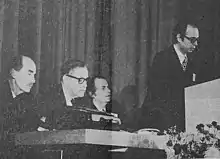
In 1971, Schwab founded the European Management Forum,[9] which in 1987 became the World Economic Forum—often referred to simply as "Davos", the name of the town where the forum is hosted each year. He founded the WEF in 1971, the same year in which he published Moderne Unternehmensführung im Maschinenbau[10] (Modern Enterprise Management in Mechanical Engineering). In that book, he argued that the management of a modern enterprise must serve not only shareholders but all stakeholders (die Interessenten), to achieve long-term growth and prosperity. Schwab has championed the multistakeholder concept since the WEF's inception. In 2015, the WEF was formally recognised by the Swiss Government as an "international body".[11]
Schwab had originally appointed José María Figueres as CEO and his potential successor at the World Economic Forum. In October 2004, the WEF however gained attention through the resignation of Figueres[12] over the undeclared receipt of more than US$900,000 in consultancy fees from the French telecommunications firm Alcatel.[13] Transparency International had highlighted this incident in their Global Corruption Report in 2006.[14]
In 2004, Schwab created a new foundation using the US$1 million prize money from the Dan David Prize.[15] In 2011, he founded the Global Shapers Community, a global network of local communities, or "hubs", of young people aged 20 to 30 who are exceptional in their potential, achievements and drive to make a contribute to their communities. As of September 2021, there were 444 Hubs with 10,600 Shapers.[16]
Personal life
Schwab has been married since 1971 to Schaffhauser Hilde Schwab. The couple live in Switzerland and have two adult children, Nicole Schwab, co-founder of the Gender Equality Project in 2009, and Olivier Schwab, who is married to a Chinese woman and heads the WEF office in Beijing.[17]
In September 2019, the Federal President of Swiss Confederation, Ueli Maurer, suggested to the Federal Council that Klaus Schwab, who has lived in Switzerland for 60 years, be granted Swiss citizenship and a Swiss passport, based on the cantonal citizenship law. Although Schwab has Swiss parents, the President of the Swiss Confederation Simonetta Sommaruga rejected the application. The Federal Office of Justice from the department of Karin Keller-Sutter (FDP) ultimately rejected the granting of citizenship.[17]
Criticism
Salary level and lack of financial transparency
While Schwab had declared to see excessively high management salaries as "no longer socially acceptable",[18] his own annual salary of about one million Swiss Francs has been repeatedly addressed by the media. The Swiss radio and television corporation SRF reflected this salary level in the context of ongoing public contributions to the WEF and the fact that the Forum does not pay any federal taxes.[19] Moreover, the former Frankfurter Allgemeine Zeitung journalist Jürgen Dunsch criticized that financial reports of the WEF as institution headed by Klaus Schwab were not very transparent since neither income nor expenditures were broken down.[20]

Capture of democratic structures and institutions
Schwab as publisher of the World Economic Forum's 2010 "Global Redesign" report postulates that a globalized world is best managed by a self-selected coalition of multinational corporations, governments (including through the UN system) and select civil society organizations (CSOs).[21] He argues that governments no longer are "the overwhelmingly dominant actors on the world stage" and that “the time has come for a new stakeholder paradigm of international governance”. The WEF's vision includes a "public-private" UN, in which certain specialized agencies would operate under joint State and non-State governance systems.[22]
According to the Transnational Institute (TNI), the Forum is hence planning to replace a recognised democratic model with a model where a self-selected group of "stakeholders" make decisions on behalf of the people.[23] The think tank summarises that we are increasingly entering a world where gatherings such as Davos are "a silent global coup d'etat" to capture governance.[24]
Controversy with Davos municipality
In June 2021, Schwab sharply criticised the "profiteering", "complacency" and "lack of commitment" by the municipality of Davos in relation to the WEF annual meeting. He mentioned that the preparation of the COVID-related meeting in Singapore in 2021/2022[25] had created an alternative to its Swiss host and sees the chance that the annual meeting will stay in Davos between 40 and 70 per cent.[26][27]
Awards and honours
Schwab has been the recipient of seventeen honorary doctorates,[3] including ones from the London School of Economics,[28] the National University of Singapore,[29] the Korea Advanced Institute of Science and Technology,[30] and over a dozen other universities.
His other awards include:
- In 1997, he received the Knight of the Légion d'Honneur of France.[3]
- In 2001, he received the Candlelight Award from then U.N. Secretary-General Kofi Annan (New York, 2001).[31]
- In 2006, he was knighted by Queen Elizabeth (Knight Commander of the Order of St Michael and St George).[3]
- In 2012, he received the Grand Cross with Star of the National Order of Germany.[3]
- In 2013, he received The Grand Cordon of the Order of the Rising Sun of Japan.
- In October 2017, he became the 45th Honorary Doctor of Kaunas University of Technology[32]
- In 2018, he received the China Reform Friendship Medal for "promoting China's international economic exchanges and cooperation".[33]
Books
Schwab has authored and co-authored several books:
- The Fourth Industrial Revolution. Geneva: World Economic Forum (2016). ISBN 978-1944835019.
- Shaping the Future of the Fourth Industrial Revolution. New York: Crown Publishing Group (2018).
- COVID-19: The Great Reset, with Thierry Malleret. Forum Publishing (2020). ISBN 978-2940631124.
- Stakeholder Capitalism: A Global Economy that Works for Progress, People and Planet. Hoboken, New Jersey: Wiley (2021).
References
- Patrik Müller, Andreas Maurer. An impossible gift: Why the naturalisation of WEF founder Klaus Schwab will fail. Aargauer Zeitung, 20 August 2019.
- Jürgen Dunsch: Host of the Mighty: Klaus Schwab and the World Economic Forum in Davos. FinanzBuch Verlag 2016. p. 26f.
- "Professor Klaus Schwab" (PDF). World Economic Forum.
- "Der längerfristige Exportkredit als betriebswirtschaftliches Problem des Maschinenbaues". Research Collection (in German). ETH Zürich. Retrieved 26 November 2020.
- "Some of our Graduates". Faculty of Management, Economics and Social Sciences, University of Fribourg. Retrieved 26 November 2020.
- "Improving the State of the World: a Conversation with Klaus Schwab". The Institute of Politics at Harvard University. Retrieved 26 November 2020.
- "Global Competitiveness | World Economic Forum-Global Competitiveness". Weforum. Retrieved 25 January 2012.
- "Former Steering Committee Members". bilderbergmeetings.org. Bilderberg Group. Archived from the original on 2 February 2014. Retrieved 8 February 2014.
- Pigman, Geoffrey Allen (2007). The World Economic Forum : a multi-stakeholder approach to global governance. London: Routledge. pp. 6–22. ISBN 978-0-415-70204-1.
- Schwab, Klaus (1971). Moderne Unternehmensführung im Maschinenbau (PDF).
- "Agreement signed with the WEF". The portal of the Swiss government. Retrieved 5 June 2020.
- "CEO resigns". World Economic Forum.
- "WEF director resigns over undeclared fees". SWI swissinfo.ch.
- "Global Corruption Report 2006 - Transparency International, Page 147" (PDF). Global Corruption Report 2006 - Transparency International.
- "Klaus Schwab". Dan David Prize. 25 November 2021. Retrieved 25 November 2021.
- "Global Shapers". globalshapers.org. Retrieved 19 September 2021.
- Bernaudon, Sylvie (31 May 2012). "Les 20 femmes qui font la Suisse". Tamedia Publications. Bilan - B Economie. Retrieved 28 November 2021.
- Meck, Georg (20 January 2013). "Zu hohe Managergehälter sind nicht mehr sozial verträglich". Carsten Knop Berthold Kohler Jürgen Kaube Gerald Braunberger. Frankfurter Allgemeine Zeitung. Retrieved 7 December 2021.
- "Knurrende Zustimmung vom Ständerat zu WEF-Geldern". SRG SSR. Schweizer Radio und Fernsehen. 11 June 2021. Retrieved 7 December 2021.
- Busse, Caspar (17 January 2017). "Das Weltwirtschaftsforum ist zu einer Geldmaschine geworden" [The World Economic Forum has become a money machine]. Süddeutsche Zeitung (in German).
- "Everybody's business: strengthening international cooperation in a more interdependent world – report of the global redesign initiative" (PDF). World Economic Forum. May 2010. Retrieved 17 August 2021.
- Martens, Jens (2020). "The Role of Public and Private Actors and Means in Implementing the SDGs: Reclaiming the Public Policy Space for Sustainable Development and Human Rights". Sustainable Development Goals and Human Rights. Interdisciplinary Studies in Human Rights. 5. Cham: Springer. pp. 207–220. doi:10.1007/978-3-030-30469-0_12. ISBN 978-3-030-30468-3. Retrieved 17 August 2021.
- "Davos and its danger to Democracy". Transnational Institute. 18 January 2016. Retrieved 17 August 2021.
- "Davos and its danger to Democracy". Transnational Institute. 18 January 2016. Retrieved 17 August 2021.
- Bosley, Catherine (17 May 2021). "WEF Cancels Singapore Meeting as Pandemic Haunts Global Event". Bloomberg.
- Pöschl, Fabian (25 June 2021). "WEF-Chef Klaus Schwab droht Davos wegen überrissener Preise". 20 Minuten (in German).
- "WEF-Gründer Klaus Schwab kritisiert Davos scharf". Blick (in German). 24 June 2021.
- "Honorary Graduates" (PDF). lse.ac.uk. Retrieved 26 November 2020.
- "NUS confers highest honour on World Economic Forum Founder and Executive Chairman Prof Klaus Schwab and social service champion Gerard Ee". nus.edu.sg. Retrieved 26 November 2020.
- "Klaus Schwab to Receive Doctorate from KAIST University". kaist.ac.kr. Retrieved 26 November 2020.
- "SECRETARY-GENERAL PAYS TRIBUTE TO FOUNDER/PRESIDENT OF WORLD ECONOMIC FORUM". UN.org. Retrieved 26 November 2020.
- "Professor Klaus Schwab, the Founder of WEF to Become the 45th Honorary Doctor of KTU". Archived from the original on 22 December 2020.
- "10 foreigners given medals for roles in reform, opening-up". www.chinadaily.com.cn. Archived from the original on 22 December 2020.
External links
 Media related to Klaus Schwab at Wikimedia Commons
- Klaus Schwab on Twitter

- Appearances on C-SPAN
Authority control | |
|---|---|
| General | |
| National libraries | |
| Other | |