Yoshio Kodama
Yoshio Kodama (児玉 誉士夫, Kodama Yoshio, February 18, 1911 – January 17, 1984)[2] was a Japanese right-wing ultranationalist and a prominent figure in the rise of organized crime in Japan. The most famous kuromaku, or behind-the-scenes power broker, of the 20th century, he was active in Japan's political arena and criminal underworld from the 1930s to the 1970s, and became enormously wealthy through his involvement in smuggling operations.[3]
Yoshio Kodama | |
|---|---|
児玉 誉士夫 | |
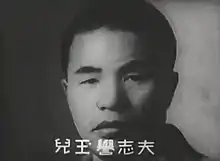 A young Yoshio Kodama, in 1946 documentary Japan's Tragedy | |
| Born | February 18, 1911 |
| Died | January 17, 1984 (aged 72) Tokyo, Japan |
| Occupation | Businessman and organized crime fixer, drug dealer, spy, yakuza |
| Spouse(s) | Sayoko (?-1958)[1] |
| Children | Hagiwara Kichitaro (eldest son) (児玉博隆), Morihiro Kodama (third son) (児玉守弘) |
| Criminal charge | terrorist, suspected war criminal, bribery |
| Penalty | criminal, terrorist, (he spent a total of six and half years in prisons). |
Early life
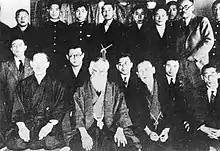
Born in Nihonmatsu, Fukushima, Japan, Kodama lived with relatives in Japanese-occupied Korea early in his life.[4] Kodama was the fifth son of a bankrupt Nihonmatsu businessman. In 1920 he was sent to live with distant relatives in Korea and lived there for three years. He was treated badly, suffered from isolation and had to do child labor in a steel mill.[5]
At the age of twelve he fled to Japan and came into contact with yakuza, who adopted him as a protégé. His first tasks were, for example, to beat up trade unionists who organized demonstrations against unworthy working conditions. For this reason he practiced karate. In this milieu he got to know the Japanese secret societies and ultra-nationalist parties whose aim was the expansion of Japan to all of East Asia.
As a youth, he joined a variety of right-wing nationalist groups. At the end of the 1920s he joined the secret society Gen'yōsha. In 1929, he joined Bin Akao's "National Foundation Society" (建国会, Kenkokukai). In 1929, during a parade, he tried to give Emperor Hirohito a self-written appeal for increased patriotism. However, he was intercepted by the security forces and arrested for his role in the "Direct Appeal to the Emperor Incident" (天皇直訴事件, Tennō Jikiso Jiken). He was imprisoned for six months. During this time in prison he wrote his first book, a primer for fanatical Japanese nationalists. After his release from prison, he joined Tatsuo Tsukui's Radical Patriotic Party (急進愛国党, Kyūshin Aikokutō). Toyama Mitsuru sent him to Manchuria , where he was involved in the suppression of the anti-Japanese resistance under Kenji Doihara. A few months later, Kodama returned to Japan. In 1931, Kodama was imprisoned again for his role in the "Diet Pamphlet Distribution Case" (国会ビラ撒き事件, Kokkai Biramaki Jiken). He was released in 1932.
Ultra nationalist terrorist and yakuza
In 1933, Kodama formed his own ultranationalist group called the Independent Youth Society (独立青年社, Dokuritsu Seinensha), which planned to assassinate various Japanese politicians.[6] Its main activity was opium export from Japan to Korea and Manchuria to break the resistance of the local population against the Japanese rule.[7] His group, in collaboration with the group Tenkōkai (天 行 会, "Society for Heavenly Action") was responsible for the murder of three Japanese politicians who advocated the peaceful coexistence of Japan, Korea and China.[7] In 1934, Kodama was in the planning of an assassination attempt on the Prime Minister Saitō Makoto involved. Kodama's plot was uncovered, the attack was prevented by the Japanese police and Kodama was arrested. He served a prison term of three and half years. He was released from Fuchū prison at the instigation of Kenji Doihara, before the outbreak of the Second Sino-Japanese War in April 1937.
Second Sino-Japanese War and the Pacific War
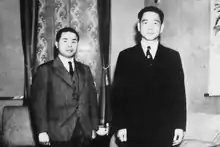
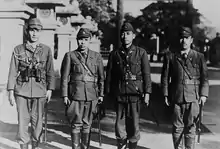
After his release from prison, he joined the Imperial Japanese Army. His position within the Japanese military apparatus is often unclear, as he was treated as an irregular collaborator by all branches of service at different times.[8] After the conquest of Shanghai by Japanese troops, he was stationed there and worked with Kenji Doihara.[9] Among other things, he was in 1939 a bodyguard for the Chinese won by Kenji Doihara collaborator Wang Jingwei. During his work he met the vice admiral and later founder of the Kamikaze units Takijirō Ōnishi, with whom he built a good friendship.
From 1939 to 1941 he traveled through China as a Japanese spy and built up a network that included various triads collaborating with the Japanese.[6] Like other Japanese secret service agents, he founded his own Kodama special department (Kodama-Kikan), which, thanks to his relationship with Admiral Ōnishi, had an exclusive contract with the aviation forces of the Imperial Japanese Navy for the use of airplanes.
Due to these prerequisites, Kodama was able to use what he himself described as "self-sacrificing youth",[10] plunder on a large scale in Manchuria and China and sell the stolen goods at high profit in Japan. Kodama himself later regarded his activity as purely idealistic and patriotic.[11] Thanks to his idealism, he was until 1945 one of the richest men in Asia with assets equivalent to $175 million US dollars. Kodama was very brutal in his raids. Whenever he came to a Chinese village, he personally murdered the headmaster or some other important person in order to expedite the return of all valuables.
Towards the end of the Pacific War, Kodama was promoted to Rear Admiral in the Imperial Japanese Navy.[12] He made the acquaintance of Ichirō Kōno, a politician who later belonged to the LDP, who explained to him the system of party politics in Japan and who was to be responsible for the organization of the Tokyo Summer Olympics in the 1960s.[13]
Post-War detention in Sugamo Prison
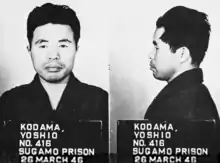
At the end of World War II, the defeat of Japan initially represented an enormous setback for Kodama. Shortly after the announcement of the unconditional surrender of Japan on August 15, 1945, he witnessed the ritual suicide of Admiral Ōnishi, but was subsequently unable to bring himself to commit seppuku.[14] A little later he acted as an advisor to the Japanese interim government of Prince Naruhiko Higashikuni.[15] Since Kodama feared the confiscation of his property by the US occupation authorities, he gave parts of it to the Yakuza chief Karoku Tsuji.[13] Other possessions were kept on the grounds of the Imperial Palace in Tokyo.
In March 1946, Kodama was arrested by the United States as a suspected Class A war criminal.[16][4][7] He was held in Sugamo Prison with Ryoichi Sasakawa, where the two formed a long friendship.[16] Kodama also formed a close relationship with fellow suspected Class-A war criminal (and future prime minister) Nobusuke Kishi.[17][7] Since he had a lot of time, Kodama was able to keep himself up to date on current events and far-reaching political changes in East Asia in all available daily newspapers. He realized that the new democratic forces in Japan were weak, observing that "in the midst of all this rapid change, there is one thing which is lagging behind. This is parliamentary power."[18]
Kodama saw this power vacuum as an opportunity for his future advancement. During his imprisonment he established important relationships with political and economic figures that were to be very useful to him after his release from Sugamo. These acquaintances included, for example, the businessman Ryōichi Sasakawa, who once stated "I am the world's richest fascist".[19][lower-alpha 1] A few years later, the future Japanese Prime Minister Nobusuke Kishi and other politicians founded the Liberal Democratic Party.[7] While imprisoned, Kodama wrote Sugamo Diary (a chronicle of his experience in prison) and I Was Defeated (an autobiographical work).[20]
Like many other alleged Japanese war criminals, Kodama was recruited from the US G-2 (Intelligence) under Charles A. Willoughby while in custody.[21] In 1948, the US intelligence community was able to drop all charges against him on the condition that he would support all anti-communist activities of the G-2 CIC division in Asia.[21] On December 24, 1948, he left Sugamo Prison as a free man and was never imprisoned again for the rest of his life. Kodama spent a total of six and a half years of his life in prisons. Kodama, being a right-wing ultranationalist, eagerly obliged, using his fortune and network of contacts to quell labor disputes, root out Communist sympathizers and otherwise fight socialist activities in Japan. In 1949, the CIA paid him to smuggle a shipment of tungsten out of China.[22] The shipment never arrived but Kodama kept his money.[22] In the 1950s and 1960s, the CIA spent millions to support the Liberal Democratic Party, for intelligence gathering and to make Japan a bulwark against communism in Asia.[3] Yoshio Kodama was a political fixer and became an important CIA contact who secretly financed conservatives.[3]
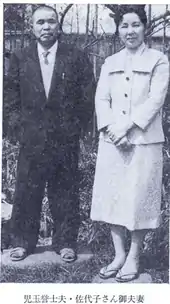
Kodama had a wife called Sayoko.[1][23] It is said that after Kodama was released from prison, former prosecutor Tadashi Hanai delivered a small amount of money and children's kimonos without seeing it.[1][23] Sayoko died in a car accident in the spring of 1958.[1][23]
Organized crime
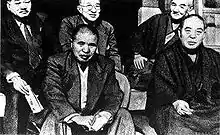
Kodama used his power in the yakuza to suppress anything he deemed the least bit communist or anti-nationalist. In 1947 he ordered the Meiraki-gumi, an affiliated gang, to break up a labour movement at the Hokutan coal mine. He also offered his support to the anti-communist right-wing Liberal Democratic Party.[2][4]
In 1955 the Liberal Democratic Party (LDP) was founded by the union (Hoshu Gōdō, 'Conservative Fusion') of the Liberal Party and the Democratic Party. The party leader and Japanese Prime Minister Ichirō Hatoyama owed his political rise largely to Kodama. The entire leadership of the party was in close contact with Kodama. Organized crime became the de facto government of Japan and Kodama had taken the position of Kuromaku, the Éminence grise of Japanese politics. Together with other important people of the Japanese (far)-right, he was a member of the "All-Japanese Conference of Patriotic Associations" (全 日本 愛国者 団 体 会議, Zen-nihon aikokushadantai kaigi, or Zen'ai Kaigi).[24]
On behalf of his yakuza colleagues, Kodama, because of his influence, arranged hundreds of bribes and black deals with the Japanese authorities and alliances between various yakuza factions.[7] Conversely, the Japanese politicians turned to him if they had problems. An example of this is the planned state visit by US President Dwight D. Eisenhower in 1960, in connection with the revision of U.S.-Japan Security Treaty (known as Anpo in Japanese), intended to cement the U.S.-Japan alliance.[17] In an effort to prevent the ratification of the treaty and prevent Eisenhower's visit, a coalition of left-leaning opposition groups and civic organizations carried out the massive 1960 Anpo Protests.[25] As the protests drastically escalated in June 1960, now-Prime Minister Nobusuke Kishi asked his old friend Kodama to organize right-wing thugs and yakuza gangsters as a private police force to secure the streets for Eisenhower's visit.[17] Kodama obliged, preparing a "Welcoming Ike to Japan Mobilization Plan" which he claimed would be able to put nearly 150,000 young rightists on the streets in order to "protect" President Eisenhower from left-wing protesters.[17] Kodama's detailed plan promised to mobilize exactly 146,879 men, whereas Japan's National Police Agency later estimated that he could realistically mobilize at most 120,506.[26] As a result, around 28,000 yakuza from different gangs organized a security service on their own and in cooperation with the police.[27] Right-wing groups also staged counter-protests in favor of the Treaty.[28] However, due to the violent June 15th Incident, in which female university student Michiko Kanba was killed, Kishi was forced to cancel Eisenhower's visit and Kodama's force was not needed.[29]
In April 1961, Kodama formed his own faction within the Zen'ai Kaigi called Seinen Shiso Kenkyu-kai (Society for the Study of Youth Ideology), which represented a hard core within the umbrella organization, mainly Yakuza. At the end of the 1960s, the Shiso Kenkyu-kai split from the Zen'ai Kaigi. Its members received military training and were used to intimidate and murder unpopular journalists and book authors. One of the victims of this organization was the journalist Hisatomo Takemori (久 友 竹 森), whose book entitled Black Money was not published after massive threats.[30]
Kodama was able to grow his retained fortune until the mid-1970s. He owned shares in Hisayuki Machii's Ginza nightclub empire, a shipping company, a baseball team, a film studio, and several sports magazines.[31]
| Part of a series on |
| Neo-fascism |
|---|
 |
 Politics portal Politics portal |
Lockheed scandal and senior years
Kodama was also involved in a number of scandals in the post-war era, many of which involved United States businesses and the CIA. Most notable of these was the Lockheed L-1011 sales scandal in the 1970s, which effectively marked the end of his career.[2][32] When Kodama became aware of the lockheed bribes through contact with Tanaka, it had unimagined consequences for him. Japanese journalists launched a merciless campaign against Kodama, police investigators carried out house searches and confiscated incriminating papers that he had not destroyed. Kodama became unpopular on the Japanese right. The bribes in the interests of the US company Lockheed-Martin were viewed as treason,[7] and it was suggested that he commit seppuku.
In June 1977 Kodama was brought on trial for bribery, but it was dragged off again and again until his death. The network of politics and yakuza, which became known as "Kuroi Kiri" (Black Fog) in the 1990s, remained largely unaffected by the scandal.[7]
After the Lockheed scandal, disillusioned ultranationalist Roman Porno film actor Mitsuyasu Maeno attempted to assassinate Kodama by flying a Piper PA-28 Cherokee plane kamikaze-style into his mansion in Setagaya Ward’s Todoroki.[33] The attempt failed.[34] Maeno hit the second floor of Kodama's mansion and Maeno died in the plane crash, but Kodama was unharmed in a different room while recovering from a stroke.[33]
During this period, Kodama used his underworld connections to help unite the various gangs, which had greatly proliferated in the years immediately following World War II. The short-lived Kanto-kai was the most prominent example of these efforts. He also brokered a truce between the Yamaguchi-gumi and the Tosei-kai, headed by his colleague Hisayuki Machii.
After the lawsuit was opened, Kodama did not leave his home and pretended to be in poor health. Kodama died naturally in his sleep of a stroke in Tokyo on January 17, 1984.[2]
Footnotes
- However, Ryōichi Kodama also seems to have got on his nerves in Sugamo Prison, as he was very happy about the arrival of new cell mates "who will curb Ryōichi's ego somewhat."
References
Citations
- "萩原吉太郎 交遊抄(2)". ぴゅあ☆ぴゅあ1949. February 22, 2012. Archived from the original on November 14, 2021.
- Saxon, Wolfgang (January 18, 1984). "YOSHIO KODAMA; WAS RIGHTIST". New York Times. Retrieved December 8, 2014.
- Weiner, Tim (October 9, 1994). "C.I.A. Spent Millions to Support Japanese Right in 50's and 60's". The New York Times. Archived from the original on November 6, 2021.
- "JAPAN Yoshio KODAMA Rightist Leader" (PDF). Central Intelligence Agency. 2005. Retrieved December 8, 2014.
- Kaplan & Dubro 2003, p. 64.
- Kaplan & Dubro 2003, p. 51.
- Southwell 2009, p. 70.
- Hori: Uyoku Jiten
- Kodama 1960, p. 240.
- Herold: Die Macht der Yakuza, p. 155
- Kodama, I Was Defeated
- Weiner 2007, p. 116.
- Kaplan & Dubro 2003, p. 67.
- Kodama 1960, p. 23.
- Kaplan & Dubro 2003, p. 66.
- Kaplan & Dubro 2003, p. 63.
- Kapur 2018, p. 250.
- Kodama 1960, p. 158.
- "The Godfather-san", TIME, August 26, 1974, archived from the original on March 4, 2008, retrieved 2007-10-22
- Kaplan & Dubro 2003, p. 50.
- Kaplan & Dubro 2003.
- Frances, Catherine. "Big in Japan: Yoshio Kodama". Metropolis. Retrieved December 8, 2014.
- 『一財界人、書き留め置き候 - 萩原吉太郎』("A business person, a note-taking note-Kichitaro Hagiwara"). Kodansha(講談社). 1980.
- Kaplan & Dubro 2003, p. 87.
- Kapur 2018, pp. 17–19.
- Kapur 2018, p. 306n67.
- Kawamura: Yakuza, pp. 32, 119
- Kapur 2018, p. 248.
- Kapur 2018, pp. 31–33, 250.
- Kaplan & Dubro 2003, pp. 88–89.
- Kaplan & Dubro 2003, p. 79.
- Kaplan & Dubro 2003, pp. 85, 93.
- "Japan rewind: 40 years since the porn star's kamikaze attack in Tokyo". Tokyo Reporter. June 10, 2016. Archived from the original on March 23, 2021.
- "'Banzai!' Porno Actor In Kamikaze Attack On Japanese Right-Winger". Kingsport Times-News. Kingsport, Tennessee: Sandusky Newspapers. Associated Press. 1976-03-24. p. 2–A.
Works cited
- Kaplan, David E.; Dubro, Alec (2003). Yakuza: Japan's Criminal Underworld. University of California Press. ISBN 978-0520274907.
- Kapur, Nick (2018). Japan at the Crossroads: Conflict and Compromise after Anpo. Cambridge, Massachusetts: Harvard University Press. ISBN 9780674988484.
- Kodama, Yoshio (1960). Sugamo Diary. Tokyo.
- Southwell, David (2009). The History of Organized Crime. London: Carlton Books. ISBN 978-1847323194.
- Weiner, Tim (2007). Legacy of Ashes: The History of the CIA. Doubleday. ISBN 978-0385514453.
Further reading
- Richard Deacon: Kempei Tai - A History of the Japanese Secret Service. Beaufort Books New York, ISBN 0-8253-0131-9
- Anja Herold: Die Macht der Yakuza. Geo Epoche Nr. 48, Gruner & Jahr, Hamburg 28. März 2011, S. 142–159; ISBN 978-3-652-00029-1
- 社会問題研究会 (Social Problems Research Group): 右翼事典: 民族派の全貌; Transcription: "Uyoku jiten: minzoku ha zenbō"; Translation: "Lexicon of the Japanese Right: Complete Overview of the Fraction"; Futabasha, Tōkyō, 1970
- Gabriele Kawamura: Yakuza – Gesellschaftliche Bedingungen organisierter Kriminalität in Japan. Centaurus Verlag, Pfaffenweiler 1994, ISBN 3-89085-898-8
- 竹森久朝 (Takemori, Hisaakira): "見えざる政府: 児玉誉士夫とその黒の人脈"; Transcription: "Miezaru seifu: Kodama Yoshio to sono kuro no jinmyaku"; Translation: "Government's Transparent Theater: Kodama Yoshio's Excellent Relationship". Shiraishi Shoten, Shōwa 51, Tōkyō [1976]
- S. Noma (Hrsg.): Kodama Yoshio. In: Japan. An Illustrated Encyclopedia. Kodansha, 1993, ISBN 4-06-205938-X. S. 804.
- Hunter, Janet: "Kodama Yoshio." In: Concise Dictionary of Modern Japanese History. Kodansha International. 1984. ISBN 4-7700-1193-8.
- Anonymous author: 黒幕・児玉誉士夫: 自民党にからまりつく不気味な影 / 每日新聞政治部編; Transcription: "Kuromaku, Kodama Yoshio: Jimintō ni karamaritsuku bukimi na kage / Mainichi Shinbun Seijibu hen"; Translation: Eminence Gray Kodama Yoshio: The Liberal Democratic Party and the two sides of its sinister chief gurus acting out of the shadows / volume of the Mainichi Shinbun series on politics ". Ēru Shuppansha / Yell books, Shōwa 51, Tōkyō [1976]