Komusō
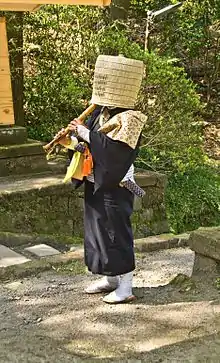
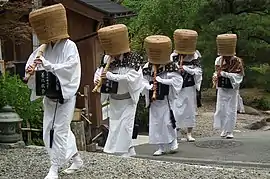
The komusō (虚無僧/こむそう) (also romanized komusou or komuso) were a group of Japanese mendicant monks of the Fuke school of Zen Buddhism who flourished during the Edo period of 1603–1867.[1] Komusō were characterized by a straw basket (a sedge or reed hood known as a tengai) worn on the head, manifesting the absence of specific ego but also used for being able to travel incognito.[2] They were also known for playing solo pieces on the shakuhachi (a type of Japanese bamboo flute). These pieces, called honkyoku ("fundamental pieces"), were played during a meditative practice called suizen, for alms, as a method of attaining enlightenment, and as a healing modality.
| Part of a series on |
| Fuke Zen |
|---|
 |
| People |
|
| Philosophy |
| Places |
|
| Topics |
| Literature |
|
During the Meiji period (1868-1912), the Japanese government introduced reforms abolishing the Fuke sect. Records of their musical repertoire survived, and are being revived in the 21st century.
History
According to a legend from 1795, a Japanese priest returned from China in the middle of the 13th century and purportedly brought the shakuhachi with him, though this is considered to be a fabricated origin story intended to establish an authentic background.
Though the komusō named their sect Fuke-shū, the sect was never acknowledged as a sect or a sub-sect of Rinzai Zen Buddhism. 'Fuke' is the Japanese name for Puhua, a peer of Linji Yixuan (Rinzai), a Zen teacher from China in the 9th century. Puhua is also mentioned in the Rinzai Analects as a rather strange person, who would walk around ringing a bell to summon others to enlightenment.
Some of the komusō in the Edo-period Japan (1603–1867) practiced suizen, meditation through the meditative blowing of a shakuhachi, as opposed to zazen, which is meditation through quiet sitting as practiced by most Zen followers. Literally meaning "blowing Zen", suizen pieces (known as honkyoku) prioritized precise breathing control as a function of Zen mindfulness. These honkyoku seem to go back to the 17th century, and the oldest record of any named honkyoku piece is from 1664 in the Shichiku shoshin-shū ("Collection of pieces for beginners of strings and bamboo"). In this text, pieces like Kyō Renbo, Goro and Yoshino are mentioned, but not any of the so-called three classics (Mukaiji/Mukaiji reibo, Kokū/Kokū Reibo, Kyorei/Shin no Kyorei).
The first appearance of komusō is in the 17th century, and their assumed predecessors are mentioned in paintings and texts from around 1500 and during the 16th century. There is no historical evidence of any earlier tradition of shakuhachi-playing monks, and it is recorded that in 1518 the shakuhachi was by some treated as an instrument belonging to the court musicians (gagaku).[3]
Travel around Japan was heavily restricted in the Edo period, but the komusō monks managed to wrangle a rare exemption from the Tokugawa shogunate, most likely for political reasons. There had been several uproars including masterless samurai (rōnin) during the first half of the 17th century, and by acknowledging the komusō (who by their own regulations had to be of samurai descent) the authorities thought they would be able to control such rōnin. To be given a free pass in these times was a highly unusual and very special exemption from the travel restrictions, and some researchers argue that the komusō had to report back to the central government about the condition in the provinces.[4]
When the Tokugawa shogunate came into power over a unified Japan at the beginning of the 17th century, the komusō came under official government criticism for the first time. Because many new komusō had formerly been samurai disenfranchised during the Sengoku period (16th century) who were now lay clergy, the potential for trouble was obvious. Because many of the monks were former samurai, and had become rōnin when their masters were defeated—most likely by the shogunate and their allies—the komusō (now greater in numbers than ever) were seen as untrustworthy and destabilizing to the new shogunate.
Etymology
komusō (虚無僧) means "priest of nothingness" or "monk of emptiness"; the first two characters, kyomu (虚無) (or komu) means "nothingness, emptiness", with kyo (虚) (or ko) means "nothing, empty, false", and mu (無) meaning "nothing, without". The last character, sō (僧), means "priest, monk".
The priests first known as komusō were referred to as such with the meaning of "straw-mat monk"; later, different characters were used for the same pronunciation, resulting in komusō meaning "priest of nothingness" or "monk of emptiness". The earliest komusō, predecessors of the later "priests of nothingness", were poor beggar monks without any social status in society. The later komusō, on the other hand, had to be of samurai family, even though the practice of teaching shakuhachi to townspeople had become very popular already in the early 18th century.
Flute
The shakuhachi flute was the instrument used to achieve the desired state of meditation by komusō. The instrument derives its name from its size. Shaku is an old unit of measure close to 1 foot (30 cm). Hachi means eight, which in this case represents a measure of eight-tenths of a shaku. True shakuhachi are made of bamboo and can be very expensive.
Disguise and outfit
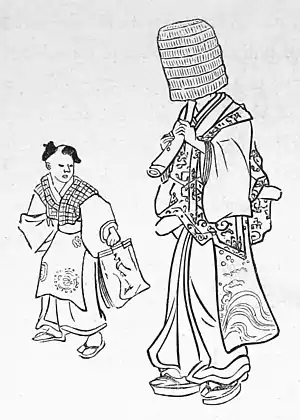
Komusō wore a tengai (天蓋), a type of woven straw hat or kasa, which completely covered their head like an overturned basket. The idea was that the wearing of such a hat removed the ego of the wearer, whilst also concealing their identity. Further, the government granted the komusō the rare privilege to freely travel the country without hindrance; one reason doing so may have been an interest on behalf of the shogunate to receive first-hand information about conditions in the provinces, the collection of such information made possible by the concealed nature of the komusō.[5]
Komusō wore kimono - especially of a five-crested, formal mon-tsuki style - and obi, as well as an o-kuwara, a rakusu-like garment worn over the shoulders. Komusō would wear a secondary shakuhachi to accompany their primary flute, possibly as a replacement for the samurai's wakizashi; their primary shakuhachi, usually a 1.8 size instrument (I shaku ha sun), would be pitched in what would today be considered D or D flat.
Komusō wore inro from their belt - a container for medicine, tobacco and other items - kyahan shin coverings above their tabi socks and waraji sandals, and a hachimaki headband, covered by the tengai. They wore tekou, hand-and-forearm covers, a fusa tassel, and carried a gebako, a box used for collecting alms and holding documents.
Historical end
After the Tokugawa shogunate fell to the loyal forces of the Emperor, komusō temples and their monks were abolished in 1871. Practice of the shakuhachi, however, survived.
References
- Blomberg, Catharina (1994). The heart of the warrior: origins and religious background of the Samurai System in Feudal Japan. Catharina Blomberg. pp. 101–103. ISBN 1-873410-13-1.
- Nishiyama, Matsunosuke; Groemer, Gerald (1997). Edo culture: daily life and diversions in urban Japan, 1600-1868. University of Hawaii Press. p. 124. ISBN 0-8248-1736-2.
- See Linder, Gunnar Jinmei (2012). Deconstructing Traditional Japanese Music: A Study on Shakuhachi, Historical Authenticity and Transmission of Tradition. Stockholm University, PhD Diss.
- Turnbull, Stephen R. (2005). Warriors of medieval Japan. Osprey publishing. p. 160. ISBN 1-84176-864-2.
- "Komuso: Japanese Zen Priest", 2008 article by David Michael Weber
- Liner notes from the music CD Komuso: The Healing Art of Zen Shakuhachi, Ronnie Nyogetsu Seldin, shakuhachi. 2000, The Relaxation Company
External links
 |
Wikimedia Commons has media related to Komusō. |