Koron (music)
The koron (Persian: کرن), meaning "less than lower in pitch", is a symbol used in traditional Persian music in order to lower or "flatten" a written note by an interval smaller than a semitone (broadly corresponding to a quarter tone, or specifically a half flat). It is used to alter the pitch of a written note, similar to that of a sharp or a flat.[1] It is written as a line with an open triangular head at the top-right. The koron symbol is positioned in the same manner as other accidentals in Western music, and can even be used in key signatures (see example below).


In the early 20th century, Iranian master musician Alinaghi Vaziri established the standard usage of this symbol in written music.[2] It is used for notating many of the microtones found in traditional Persian music.[2] A note so altered can be labeled as the note's letter, followed by "koron" (e.g., "B koron", "D koron", etc.).
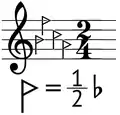 Koron in music notation
See also
- Persian traditional music
- Dastgah
- Quarter tone
- Koron at Wiktionary
- Sori, the 1/4 step sharp accidental
References
- Farhat, Hormoz (2004). The Dastgah Concept in Persian Music. Cambridge University Press. p. 26. ISBN 0-521-54206-5.
- Maryam Pirnazar (July 16, 2013). "Reza Vali: An Iranian Composer to Watch and - of course - to Hear". payvand.com.
For transcription of the micro-tones, I use the standard notation of the micro-tones, the Sori and the Koron, which were developed during early 20th century by the Persian master Alinaghi Vaziri.
External links
- persian accidentals in the SMuFL glyph (Standard Music Font Layout)