Kösem Sultan
Kösem Sultan (Ottoman Turkish: كوسم سلطان, IPA: [cœˈsɛm suɫˈtan]) (c. 1589[1] – 2 September 1651[2]) also known as Mahpeyker Sultan[3][4] (Turkish pronunciation: [mahpejˈkɛɾ suɫˈtan]; from the Persian compound ماه پيكر Māh-peyker) was an Ottoman sultana and regent who effectively ruled the Ottoman Empire from 1623 to 1632, and then later from 1640 until her assassination in 1651. She became one of the most powerful and influential women in Ottoman history as well as a prominent figure during the era known as the Sultanate of Women.[5]
| Kösem Sultan | |||||
|---|---|---|---|---|---|
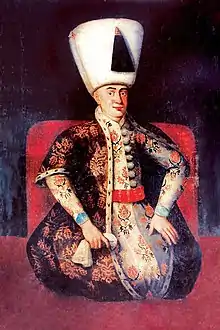
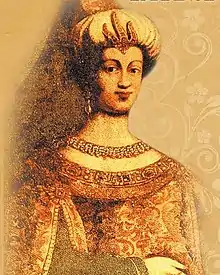
.jpg.webp) Posthumous portrait by an unknown painter, 17-18th century | |||||
| Valide Sultan of the Ottoman Empire | |||||
| Tenure | 10 September 1623 – 2 September 1651 | ||||
| Predecessor | Halime Sultan | ||||
| Successor | Turhan Sultan | ||||
| Haseki Sultan of the Ottoman Empire (Imperial Consort) | |||||
| Tenure | 26 November 1605 – 22 November 1617 | ||||
| Predecessor | Safiye Sultan | ||||
| Successor | Ayşe Sultan | ||||
| Regent of the Ottoman Empire | |||||
| 1st Tenure | 10 September 1623 – 18 May 1632 | ||||
| 2nd Tenure | 9 February 1640 – 8 August 1648 | ||||
| 3rd Tenure | 8 August 1648 – 2 September 1651 | ||||
| Born | c. 1589[1] Tinos, Republic of Venice | ||||
| Died | 2 September 1651 (aged 61–62) Constantinople, Ottoman Empire | ||||
| Burial | |||||
| Spouse | |||||
| Issue more... | |||||
| |||||
| House | Ottoman (by marriage) | ||||
| Religion | Sunni Islam (raised Greek Orthodox) | ||||
Born in Tinos (then part of the Republic of Venice, now Greece) to a Greek Orthodox priest, she was kidnapped at the age of 15 and sold as a slave by the Bosnian Beylerbey before being sent to the Imperial Harem in Constantinople. She rose to prominence early in Ahmed I's reign as part of a series of changes to the hierarchy of the Imperial Harem. As a Haseki Sultan (legal wife of Ahmed I), her influence over the Sultan increased in the following years, and it is said that she acted as one of his advisers. She was credited by many historians for her attempts to persuade Ahmed I to spare the life of his younger brother, Mustafa, thereby issuing a decree officially halting the centuries-old practice of fratricide in the Ottoman Empire. After the death of Ahmed I, she was briefly banished to the Old Palace (Eski Sarayı) during the reigns of her brother-in-law, Mustafa I, and son-in-law, Osman II.
Following Murad IV’s accession to the Ottoman throne in 1623, Kösem was thrust into the political arena, becoming the first official regent (naib-i-sultanat) of the Ottoman Empire. As regent, she rose to immense notoriety and affection among her subjects and wielded extraordinary political power in the Ottoman Empire. Even after being forced to step down as regent, she was still involved in some politics and court affairs despite her son's opposition. Following Murad IV’s death in 1640, she was re-appointed as regent for her incompetent son, Ibrahim I. She sought to rule in his place by encouraging Ibrahim I to entertain himself with his concubines. Although, in 1644, she conspired to overthrow Ibrahim I in favor of his son, Mehmed, with the backing of the Grand Vizier Salih Pasha and other senior Ottoman officials, but she did not succeed. When a coup d'état broke out against Ibrahim I in 1648, she gave her consent to Ibrahim I's execution. Kösem was re-appointed as regent for her grandson, Mehmed IV. However, her daughter-in-law, Turhan Sultan, began to exert what she saw to be her rightful authority. As a result, Kösem conspired to overthrow Mehmed IV and replace him with another of her grandsons, which led to her assassination in 1651. She was buried in the mausoleum of her husband, Ahmed I, in Sultan Ahmed Mosque.
Kösem lived in the Ottoman Empire as a courtier during the reign of six sultans: Ahmed I, Mustafa I, Osman II, Murad IV, Ibrahim, and Mehmed IV. After her death, she was known by the names "Valide-i Muazzama" (magnificent mother), "Vālide-i Maḳtūle" (murdered mother), and "Vālide-i Şehīde" (martyred mother).[6]
Early life
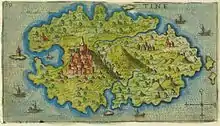
Kösem was of Greek descent,[1][7] the daughter of a Greek Orthodox priest on the island of Tinos whose maiden name was Anastasia.[8][9][10] At the age of 15, she was kidnapped during one of the Ottoman-Venetian maritime campaigns and bought as a slave by the Bosnian Beylerbey or a high-ranking Ottoman official. Noting her beauty and intelligence, she was sent to Constantinople to join a cohort of other slave girls marked by their striking appearance or intelligence to be trained in the harem of Sultan Ahmed I as an imperial court lady.[11][12]
Haseki Sultan, the Imperial Consort
Kösem rose to prominence early in Ahmed's reign as part of a series of changes to the hierarchy of the imperial harem. Safiye Sultan, Ahmed's once-powerful grandmother and manager of the harem, was deprived of power and banished to the Old Palace (Eski Saray) in January 1604, and Handan Sultan, Ahmed's mother and Valide Sultan, died in November of the following year.[4]
Upon her arrival at the Imperial Harem, she was taught religion, mathematics, embroidery, singing, music and literature. Most importantly, she was taught the ins and outs of the political dynamics of the Empire. Months later, her beauty and intelligence drew Ahmed's attention, and she became his leading haseki in 1605. Upon her conversion to Islam, her name was changed to Mahpeyker,[13] and later by Sultan Ahmed I to Kösem,[12] meaning "leader of the herd", indicating Kösem's leadership and political intelligence.
As a Haseki Sultan to Ahmed, Kösem was considered his favorite consort and gave birth to many of his children.[4] During her time as Haseki Sultan she received 1,000 aspers a day.[14] As the mother to a number of princesses she had the right to arrange their marriages which were of political use.[4] Venetian ambassador Simon Contarini mentions Kösem in his report in 1612 and portrays her as:
"[A woman] of beauty and shrewdness, and furthermore ... of many talents, she sings excellently, whence she continues to be extremely well loved by the king ... Not that she is respected by all, but she is listened to in some matters and is the favorite of the king, who wants her beside him continually."[4]
.jpg.webp)
Contarini reported in 1612 that the Sultan ordered a woman to be beaten for having irritated Kösem. She may have been Kösem's fellow consort Mahfiruz, mother of Ahmed's eldest son Osman.[15]
An English traveller, George Sandys, who was visiting Constantinople, probably in the early 1610s, recorded Kösem's name as "Casek Cadoun" (presumably Haseki Kadın) and believed that she was “a witch beyond beauty." He claimed that the Sultan had a "passionate" love for Kösem. He emphasized that this was the result of witchcraft. Sandys goes on to characterize her as a woman with "a delicate and at the same time shy nature."[16]
Kösem also made efforts to keep her brother-in-law Mustafa safe from execution, and may have regarded Mahfiruz as a rival intent on lobbying in favor of her own son.[15] After Mahfiruz's apparent expulsion from the palace, probably in the mid-1610s, Kösem and Osman grew fond of each other. She used to let him join her in carriage rides where he showed himself to the crowd, but once this came to Ahmed's attention he forbade any conversation between them.[17] Eventually Ahmed interfered with this relationship between Osman and Kösem: the Venetian ambassador Bertuccio Valier reported in 1616 that the Sultan did not allow the two eldest princes (Osman and Mehmed) to converse with Kösem. His motive perhaps, as Valier speculated, was fear that the princes' security was threatened by Kösem's well-known ambitions for her own sons.[15]
Kösem's influence over the Sultan increased in the following years and it is said that she acted as one of his advisers.[4] However, she refrained from involving herself constantly in serious issues as the Sultan refused to be overshadowed by his wife.[4] Kösem is sometimes accused of trying to save her own position and influence throughout her long career "rather than that of the sultan or of the dynasty".[18] According to Cristoforo Valier in 1616:
“Her circumspection was presumably intended at averting the sultan's displeasure, who was keen to avoid seeming ruled by a woman, as his father had been. She can do what she wishes with the King and possesses his heart absolutely, nor is anything ever denied to her."
Contarini noted, however, that Kösem "restrains herself with great wisdom from speaking [to the sultan] too frequently of serious matters and affairs of state.”[4]
Kösem also had a long career as a guardian of şehzades (princes). It is possible that the significant modifications in the pattern of succession to the throne during Ahmed's time owed something to her efforts. She must have realized the personal gain that might stem from the transition to seniority coupled with the fact that she was no longer haseki but had a son "in waiting". According to the Venetian ambassador, Simon Contarini, Kösem "lobbied to spare Mustafa the fate of fratricide with the ulterior goal of saving her own son from the same fate."[19]
Death of Ahmed I
Sultan Ahmed I died on 22 November 1617 at the age of 27. His corpse was laid to rest close in Sultan Ahmed Mosque, Istanbul. The same day, the question of who would take his place on the throne arose. Şehzade Musafa and Şehzade Osman were the most popular choices. When a Sultan died, however, one of his sons was supposed to take the throne, according to the pedestals. After hours of deliberation in the Ottoman court, state officials finally decided to declare Şehzade Mustafa as the Sultan, who was older and had the best claim to the Ottoman throne.[20] During Ahmed's reign, he adopted the laws of succession to the throne. The Darüsaade Agha expressed his concern to the Ottoman court, citing that Mustafa was mentally imbalanced.
Retirement at the Old Palace
Kösem retired in the Old Palace during the reign of her brother-in-law Mustafa I and step-son Osman II.[20]
Due to the emergence of seniority as the principle of succession, which meant that a prince's mother might mark time in the Old Palace between the death of her master and the accession of her son, Kösem was able to maintain her Haseki status and daily stipend of 1,000 aspers during her retirement there;[21] still, after the end of Kösem's tenure as haseki, the position lost its prominence. During her retirement, she met Safiye Sultan.[18]
Mustafa I's 1st reign
Initially, Mustafa refused to reign as Sultan, claiming that he was uninterested in state concerns, however, the statesman decided to ignore the matter. Kösem held considerable power during the reign of her brother-in-law. However, he was overthrown on 26 February 1618, just 96 days after ascending to the throne, and was replaced by Şehzade Osman, the son of Ahmed and Mahfiruz Hatice Sultan.[20]
Osman II's reign
According to John Freely, Osman's mother, Mahfiruz Hatun, who had now presumably become Valide Sultan, was empowered by the Ulema to act as regent for her son, because of his youth. Mahfiruz Hatun immediately used her powers to have Kösem evicted from the Harem and confined to the Eski Saray.[22] However, many historians believe that Mahfiruz Hatun died before her son’s accession to the throne.[23]
In 1619, Osman paid Kösem a three-day visit at the Old Palace, thus manifesting his special fondness for her. Even if their relation was cultivated, though, it did not yield consequential results for the young sultan, whose most exceptional weakness was the lack of a Valide Sultan to lobby in his favour.[17]
Even though Osman was only a teenager, he felt uneasy with Kösem's involvement in state issues. He did not, however, ignore Kösem, who grew up with her and had always admired her.[20][24]
Osman, ambitious and brave, launched a military war against Poland, which had interfered in Ottoman vassal principalities Moldavia and Walachia. Recognizing that his failure at Chocim in 1621 was partly due to the Janissary corps' lack of discipline and degeneracy, he punished them by lowering their pay and closing their coffee shops.[24] Then he claimed his intention to go on a pilgrimage to Mecca, but his true goal was to form a new army in Egypt and Syria to depose the Janissaries. When the Janissaries learned of the plot and were already enraged by Osman's prior tactics. On 18 May 1622, they revolted, ousted Osman on 19 May 1622, and murdered him the next day.[20]
Mustafa I's 2nd reign
The same day, Sultan Mustafa I was installed to reign for a transitional time so that Murad could manage the Ottoman state's affairs, but Mustafa I was unable to do so. Kösem eventually reached an agreement with the ministers to correct the situation, isolate Mustafa I, and install her son, Murad, as Sultan of the Ottoman Empire.[20][24]
Valide Sultan
Murad IV's reign
Kösem came back in power when her son ascended to the throne on 10 September 1623 as Murad IV. Since her son was a minor, she was appointed not only as a Valide Sultan but also as a formal regent (naib-i-sultanat) during his minority, from her son's ascension on 10 September 1623 until 18 May 1632.[20]
The Ottoman Government sent a letter to the Republic of Venice in 1623 to officially declare Murad IV's accession to the throne. Kösem was addressed as Valide Sultan in the letter, which wrote: "Her Majesty the Sultana Valide […] for the late Sultan Ahmed, whom Allah took with him, was a very important person and he loved her so much that he honored her by marrying her." The letter further indicates that Kösem would rule in her son’s name: “We have great hope and faith in the Valide Sultan, who - among all women enjoying the position - is distinguished by maturity and virtue of character.”[25]
Shortly after Murad's enthronement in 1623, a Venetian ambassadorial message remarked on Kösem's political experience:
"[A]ll power and authority [is with] the mother, a woman completely different from that of Sultan Mustafa, in the prime of life and of lofty mind and spirit, [who] often took part in the government during the reign of her husband.”[26]
Roe, the English envoy, wrote a month before the Venetian despatch, predicting that the new sultan would be "gouemed by his mother, who gouemed his father, a man of spirit and witt."[26]
First regency (1623–1632)
During most of Murad's early reign, his mother, Kösem, essentially ruled through him and effectively ran the empire, attending meetings of the divan (cabinet) from behind a curtain. It is clear from her correspondence with the Grand Vizier Kemankeş Kara Ali Pasha that Kösem wanted to rule as a regent by accompanying her son to every event so that she would appear in the audience room of the divan with him also. She made this request to the Vizier, who, in turn, did not allow Kösem to do so, citing traditions and asked her to forget this. Kösem at that time agreed to this and worked from the background. She would meet with foreign ambassadors from other countries to discuss international treaties. She was in charge of appointing political figures and overseeing the state's administration. She also formed friendships with statesmen, judges, and other court figures. The leading pashas wrote their letters directly to her, which also proves that every thread ran together in the hands of Kösem. In essence, she was actually steering instead of her son, not along with her son.[27]
In one letter, the Valide Sultan wrote, “You say that attention must be paid to provisions for the campaign. If it were up to me, it would have been taken care of long ago. There is no shortcoming on either my or my son’s part.” In another, she sends good news: “You wrote about the provisions. If I were able to, I would procure and dispatch them immediately. I am doing everything I can, my son likewise. God willing, it is intended that this Friday ten million aspers will be forwarded to Üsküdar, if all goes well. The rest of the provisions have been loaded onto ships.” Bayram Pasha, the governor of Egypt and Kösem’s son-in-law, wrote directly to the Valide Sultan on a number of issues, and she communicated the contents of the governor’s letters to the Grand Vizier Hafız Ahmed Pasha along with her own comments on these matters. Among the problems discussed cussed were delays in the provision of gunpowder, the troublesome situation in the Yemen, and shortfalls in the province’s revenue (in 1625 Egypt sent only half of its normal revenue because of the ravages of a plague known in Egyptian annals as “the plague of Bayram Pasha”). The extensive cooperation between Grand Vizier Hafız Ahmed Pasha and the Valide Sultan is suggested by Kösem’s frank comment to the former: “You really give me a headache. But I give you an awful headache too. How many times have I asked myself. ‘I wonder if he’s getting sick of me’? ‘But what else can we do?”[28]
Murad's criticism of Kösem's foreign policy was evident during this period of her regency. In 1625, Murad vocally objected his mother’s truce with the Spanish Empire; the treaty was called back on the Sultan’s orders.[29]
Serial marriages of a royal princess occurred frequently in the Ottoman dynasty in the century after Suleiman the Magnificent, allowing the royal family to establish a network of alliances with the most powerful of the pashas. Kösem, in particular, used her daughters to help maintain herself in power for nearly half a century. As she wrote to the Grand Vizier Hafiz Ahmet Pasha in 1626, a few months before he became her daughter Ayşe Sultan‘s third husband: 'Whenever you're ready, let me know and I'll act accordingly. We'll take care of you right away. I have a princess ready. I'll do just as I did when I sent out my Fatma.'[30]
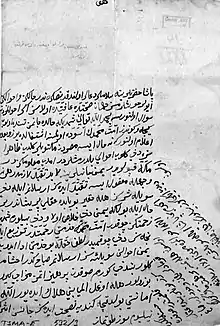
In 1627, the Ottomans lost Aden and Lahej. Kösem expressed her concerns regarding the situation in Yemen and Murad's health in one of her letters to the Grand Vizier Damat Pasha. It also implies that the sultana is frustrated by her lack of direct control over important decisions; she wrote to the Grand Vizier Damat Pasha:
"Letters have come from Egypt—apparently to you too—which describe the situation there. Something absolutely must be done about Yemen—it's the gate to Mecca. You must do whatever you can. You'll talk to my son about this. I tell you, my mind is completely distraught over this [the Yemen situation].... It is going to cause you great difficulty, but you will earn God's mercy through service to the community of Muhammad. How are you getting along with salary payments? Is there much left? With the grace of God, you will take care of that obligation and then take up the Yemen situation. My son leaves in the morning and comes back at night, I never see him. He won't stay out of the cold, he's going to get sick again. I tell you, this grieving over the child is destroying me. Talk to him, when you get a chance. He must take care of himself. What can I do—he won't listen. He's just gotten out of a sickbed and he's walking around in the cold. All this has destroyed my peace of mind. All I wish is for him to stay alive. At least try to do something about Yemen. May God help us with this situation we are in.... You two know what's best."[31]
The next year, Murad was twice ill to the point where his life was in peril, according to a Venetian ambassadorial message from September 1628. Another letter expresses the similar worry that the young sultan be counseled and chastised by the Grand Vizier Hüsrev Pasha, if not by Kösem herself. It also implies that Kösem was getting information about events outside the palace from Murad rather than directly:
“I heard from my son that he had written you and warned you that [your steward] is not a man of good intentions. Is it true that he is giving you a bad name? To a degree it is a pasha's own men who cause his bad reputation. May God give them the reward they deserve. I'm not referring to anything specific. A friend is one who tells a person his faults to his face. I wouldn't wish ill on any of you. May God protect us all from evil. I wish you would listen to me and have them stop practicing the javelin in the Hippodrome. Why can't they go play in Langa? My son loves it, I lose my mind over it. Whoever says it's good for him is lying. Caution him about it, but not right away. What can I do? My words are bitter to him now. Just let him stay alive, he is vital to all of us. I have so many troubles I can't begin to write them all. You must give him as much advice as you can—if he doesn't listen to one thing, he'll listen to another.”[32]
In the following year, Murad moved to break Kösem's damad ties with Admiral Hüseyin Pasha, the spouse of her daughter Fatima. Murad had the marriage dissolved after becoming enraged by his mother's excessive support for the Pasha. Hüseyin Pasha had benefited from the protection of both the powerful chief black eunuch and the Valide Sultan. Murad's move against the otherwise successful admiral may have stemmed from his wish to break free from the influence of his inner palace advisers and exercise authority over the government's most influential officers. Kösem is said to have tried to satisfy her son with a gift of ornately dressed horses and a banquet of ten thousand aspers.[33]
Removal from office
.jpg.webp)
In 1632, Kösem's 9-year term of office ended as a result of her son, Murad, removing her from the political scene quickly, after Murad decided not to allow any power to interfere in his administration of the empire, and ordered Kösem to cut off her contacts with his statesmen, and threatened her with exclusion and exile away from the capital if she did not comply; this was probably a response to the May 1632 uprising in Constantinople. Murad was compulsively trying to keep his mother away from politics, and it is clear from his actions that he was disturbed by his mother’s great influence. That is why, as soon as he took power under his own control, Murad sought to replace his mother’s loyal men, so that he could begin his monopoly by withdrawing himself from his mother’s influence. However, Kösem acted as the Valide Sultan, in which she had great power in the court and her own rooms (always adjacent to her son's) and state staff, and administering the harem and dealing with her charitable projects.[34][35][36]
During the early years of Murad’s sultanate, the Empire fell into anarchy; the Safavid Empire invaded Iraq almost immediately, Northern Anatolia erupted in revolts, and in 1632 the Janissaries stormed the palace and killed the Grand Vizier Ahmed Pasha, among others. Murad feared suffering the same fate as his elder brother, Osman II, and decided to assert his power. He later tried to quell the corruption that had grown during the reigns of previous sultans, and that had not been checked while his mother was ruling through proxy. His absolute rule started around 1632, when he took the authority and repressed all the tyrants, and he re-established the supremacy of sultan.[36]
Kösem tried to influence her son in every possible way and tried to cushion her son’s aggressive actions with her own charities. Even though Murad didn’t really heed the her suggestions, but his mother, Kösem never gave up; she continued to attend meetings of the divan (cabinet) from behind a curtain and tried to support her some in government and social affairs. Thus, for example, when Murad was away from Constantinople, she thoroughly reported that someone had not followed his orders. Kösem was also in constant contact with officers and officials, and even bribed soldiers and Janissaries in order to further influence Murad's reign. In one instance, Murad asked his mother to head a diplomatic mission with the Crimean Khan.[36]
During Murad's departure on a royal advance through the area near Bursa in 1634, Kösem moved quickly to safeguard him from a threat of sedition. Murad's execution of an Iznik judge for a minor offense sparked such outrage among Constantinople's religious hierarchy that reports began to circulate that the mufti Ahizade Hüseyin Efendi was stirring up sentiment against the sultan and plotting hot overthrow him. When the Valide Sultan learned about the accusations against the mufti, she promptly sent word to Murad to return to the capital as soon as possible. The unfortunate Hüseyin Efendi was strangled before proof of his innocence could reach the irate sultan. This was the first execution of a mufti in the history of the Ottoman state.[37]
Angelo Alessandri, secretary to Venetian envoy Pietro Foscarini, who claimed to have seen Kösem later in life in 1637, characterizes her as follows:
“..this lady, of Greek origin, is now about 45 years old, very beautiful and has delicate features. A person with a good heart, interesting amusements and pleasures, virtuous, wise and reasonable. Majestic, with wide horizons."[38]
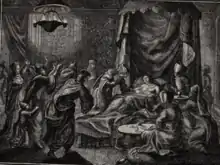
Following the capture of Baghdad from the Safavids in 1638, Kösem was a key figure in the celebrations surrounding her son Murad's triumphal return to Constantinople. The Valide Sultan retraced her path after processing out of Constantinople to welcome Murad in İzmit, two days' journey from the city, while the Sultan returned by sea. She rode in a carriage draped with gold fabric, its wheels studded, and spokes fully coated in gold, preceded by viziers and high-ranking religious authorities on gorgeously caparisoned horses. Twelve additional carriages followed the Valide Sultan's carriage, most likely transporting members of the harem.[39]
During Murad’s final chaotic years, Kösem managed to convince Murad from preventing the murder of his sole surviving brother Ibrahim, by arguing that he was ‘too mad to be a threat', but failed to save the lives of her two other sons, Şehzade Süleyman and Şehzade Kasım, heir apparent to the Ottoman throne since 1635.[34]
Ibrahim I's reign
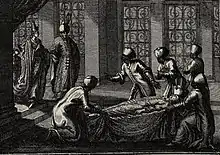
One of Kösem's two last surviving sons, Ibrahim, lived in terror of being the next of his brothers to be executed by Murad's order. Murad's liver cirrhosis had left him terminally ill. The sultan's dying wish was to have Ibrahim killed in the final days of his reign. Despite the fact that the House of Osman was in complete disarray, Murad informed his statesmen that he did not want a maniac as sultan. His life was only saved by the intercession of his mother Kösem.[1] After Murad's death in 1640, Ibrahim was left the sole surviving prince of the dynasty. Upon being asked by the Grand Vizier Mustafa Pasha to assume the sultanate, Ibrahim suspected Murad was still alive and plotting to trap him. It took the combined persuasion of Kösem and the Grand Vizier Mustafa Pasha to make Ibrahim accept the throne. For instance, Kösem had ordered his brother's corpse to be displayed before him, and she even threatened Ibrahim that he may face ‘strangulation, not inauguration' if he had refused to be crowned the sultan of the Ottoman Empire.[24]
Second regency (1640–1648)
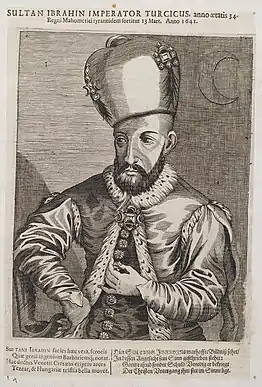
When Ibrahim succeeded his brother in 1640, he proved too mentally unstable to rule. This enabled Kösem to continue in power. He was encouraged by his mother to distract himself with harem girls. The distractions of the harem allowed Kösem to gain power and rule in his name.[1]
As Ibrahim retreated from politics, he turned increasingly to his harem for comfort and pleasure. During his sultanate, the harem achieved new levels of luxury in perfumes, textiles and jewellery. Ibrahim's love of women and furs led him to have a room entirely lined with lynx and sable. Because of his infatuation with furs, the French dubbed him "Le Fou de' Fourrures."
The heifer-like woman described by Cantemir was an Armenian from the Bosphorus village of Arnavutkoy, who is said to have weighed nearly 330 pounds. According to Rycaut, Ibrahim became so infatuated with his new love that he couldn't deny her anything, which led to her downfall because she incurred the wrath of Kösem: ‘By these particulars the Queen Mother becoming jealous, one day inviting her to Dinner, caused her to be Strangled, and persuaded Ibrahim that she died suddenly of a violent Sickness, at which the poor Man was greatly afflicted.'[40]
According to one historian, "Ibrahim allegedly kidnapped a girl, held her as a slave in his harem for many days, and then returned her to her father". Despite his inappropriate behavior, Kösem helped to provide him with virgins and overweight women, for whom he craved. In one instance, when Ibrahim allegedly tried to rape a concubine, the concubine spurned him and threatened to stab him with a dagger if he persisted. Their struggle was overheard by Kösem, who reprimanded Ibrahim and allowed the woman to escape the harem.[24][41][42]
In the early 1640s, Kösem triumphed over a concubine of her recently deceased son Murad in a dispute over the marital fortunes of Kaya Sultan, the concubine's thirteen-year-old daughter and Kösem's granddaughter. Kaya Sultan wanted to marry one of her own political friends, the previous sultan's sword-bearer, but Kösem's nominee, Melek Ahmed, won out.[43]
Kösem kept track of the misdeeds of her "aggressive tax collectors," who were responsible for her massive hass income in order to boost their own take. Sarih ül-Menarzade, a historian who disapproved of Kösem's position and fortune, was quoted by Mustafa Naima as saying:
"The valide sultan's stewards... collected incalculable amounts of money. The peasants of the Ottoman domains suffered much violence and disaster on account of the excessive taxes, but because of their fear of the stewards, they were unable to inform the valide sultan or anyone else of their situation."[44]
Kösem did have a less compatible relationship with Grand Vizier Musa Pasha than she had with the previous Grand Viziers of Murad's early reign. Kösem was a clever and experienced politician, now in her second regency and fourth decade of political engagement. The competition between the two was reported by the Venetian ambassador Alvise Contarini:
"In the present government, to the extent that this son's capabilities are less, she is held in greater esteem [than at the end of Murad's reign]. And thus, with her commanding affairs within the palace and the grand vezir [commanding] those outside, it happens quite often that these two rulers come up against each other and in doing so take offense at each other, so that one can say that in appearance they are in accord but secretly each is trying to bring about the downfall of the other."[45]
Cinci Hoca, a minor religious figure with occult powers who was brought into the palace to compensate for the sultan's lack of successors. Cinci Hoca was a spiritualist and fraud who worked his way into the palace under the invitation of Kösem to cure her son, Ibrahim. The sultan rewarded Cinci Hoca with a chief justiceship, the second highest ulema position, as a reward for his achievements. When Kösem lost control of the Sultan, Cinci Hoca’s appointment was just one of numerous examples of the overturning of authority and procedure at court.[46][44] According to Naima:
“[T]he valide sultan would sometimes speak affectionately, giving counsel to the... padishah. But because he paid no attention to her, she became reluctant to talk with him, and for a long while resided in the gardens near Topkapi. During this time the padishah became angry as a result of some rumors and sent the grand vezir Ahmed Pasha to exile the valide sultan to the garden of Iskender (thereby breaking the hearts of all, great and small.”[47]
After becoming regent, Kösem was required to distribute service pay to the Janissaries in accordance with Ottoman tradition, but there was no money left in the treasury. She had attempted to obtain this money from Cinci Hoca, but Cinci Hoca had not responded positively. She had later explained this situation to the Janissaries as “I want to distribute your service pay but Cinci Hoca does not allow me” and caused the Janissaries to consider Cinci Hoca as an enemy and kill him.[48] Due to a lack of funds in the treasury, Kösem and her allies urged Ibrahim to launch a naval assault on the Venetian-controlled island of Crete. The Ottomans defeated the Venetians in the Cretan War (1645–1669) after years of fighting for control over the island.[49]
In the following years, Kösem attended a conference with leading viziers at the entrance to the harem. The Agha of the Janissaries, who complained to Kösem about Ibrahim's failure to quell the ongoing rebellions in the Balkans region, wrote to Kösem:
"Gracious mistress, the folly and madness of the Padishah have put the world in danger; the infidels have taken forty castles on the frontiers of Bosnia and are blockading the Dardanelles with eighty ships while the Padishah thinks only of pleasure, debauch and selling offices."
Simultaneously, Ibrahim humiliated his sisters Ayşe, Fatma, and Hanzade, as well as his niece Kaya, subordinating them to his concubines, whom he gave their land and jewels. He also forced his sisters and niece to work as maids for his wife Hümaşah Sultan. This infuriated Kösem, who turned against Ibrahim.[42]
Plot to depose Ibrahim I
Ibrahim's behaviour sparked talks of deposing the sultan. In September 1647, the newly placed Grand Vizier Salih Pasha, Kösem, and the şeyhülislam Abdürrahim Efendi plotted to depose the sultan. The şeyhülislam deferred to Kösem in the matter of her son's deposition, aware that she needed to be consulted before any final decision was made. They informed the Valide Sultan that all of the statesmen were in favor of Ibrahim’s deposition and that they were prepared to swear allegiance to Ibrahim's son, Mehmed, the eldest prince. But Kösem hesitated, likely out of maternal instinct. She begged the coconspirators to consider leaving her son in possession of the throne under the guardianship of the şeyhülislam and the Grand Vizier Salih Pasha.[50]
A few days later, Ibrahim was made aware of the attempt to topple him. As a response, the Grand Vizier Salih Pasha was executed and Kösem was exiled from the harem. Initially, Ibrahim planned to have Kösem exiled to the island of Rhodes, but this indignity was resisted by his hasekis, and the sentence commuted to exile in one of the imperial gardens in the capital.[46] Kösem has been accused of encouraging Ibrahim's desire in reproduction by diverting him with cuncubines so that she might take over the country. But, at least initially, her motivation was to ensure the dynasty's survival. Moreover, Kösem, like others, despised Ibrahim's concubines' excessive influence over public matters. During the closing months of Ibrahim's reign, Kösem was thrust back into the position of dynasty protector when the Janissary aghas, who were going to demand the resignation of the unpopular Grand Vizier Ahmed Pasha, warned her to take great care to safeguard the princes' safety.[51]
The next year, the Janissaries and members of the ulema revolted. Ibrahim then lost his temper and fled into the arms of his mother, begging her to protect him. Kösem persuaded him to abdicate, whereupon the Janissaries installed Ibrahim's eldest son as Mehmed IV.[52]
The Valide Sultan's resistance had another purpose, it enabled for the practice of important political arguments. "Wasn't every single one of you raised up through the benevolence of the Ottoman dynasty?" Kösem asked the statesmen, emphasizing the need of dynasty allegiance. They replied with a holy law imperative: “a mentally ill person cannot lead the ummah, the community of Muslim believers.” The statesmen used a tactic at one point in the debate: they addressed the Valide Sultan as umm al-mu'minin, "mother of the [Muslim] believers." This honorific title, given to the wives of the Prophet Muhammad by Qur'anic revelation, gave Kösem an identity that allowed her to extend her maternal function as mentor/guardian beyond her son and the dynasty to the empire.[51] Hanifezade, an Ottoman judge, appealed to her not as a mother but as a stateswoman:
“Oh, royal lady, we have come hither, fully relying on your grace, and on your compassionate solicitude for the servants of God. You are not only the mother of the sultan; you are the mother also of all true believers. Put an end to this state of trouble; the sooner the better. The enemy has the upper hand in battle. At home, the traffic in places and ranks has no bounds. The Padishah, absorbed in satisfying his passions, removes himself farther and farther from the path of laws. The call to prayers from the minarets of the Mosque of Aya Sofia is drowned in the noise of fifes, and flutes, and cymbals from the palace. No one can speak counsel without danger to the speaker: you have yourself proved it. The markets are plundered. The innocent are put to death. Favorite slaves govern the world.”[50]
The Valide Sultan made one more effort, and said, "All this is the doing of wicked ministers. They shall be removed; and only good and wise men shall be set in their stead." "What will that avail?" replied Hanifezade, an Ottoman judge, "Has not the Sultan put to death good and gallant men who served him, such as were Mustafa Pasha and Yusuf Pasha, the conqueror of Canea?" "But how," urged Kösem, "is it possible to place a child of seven years upon the throne?" Hanefizade answered: "In the opinion of our wise men of the law, a madman ought not to reign, whatever be his age; but rather let a child, that is gifted with reason, be upon the throne. If the sovereign be a rational being, though an infant, a wise Vizier may restore order to the world; but a grown-up Sultan, who is without sense, ruins all things by murder, by abomination, by corruption, and prodigality." "So be it, then," said Kösem; "I will fetch my grandson, Mehmed, and place the turban on his head." She agreed to surrender when they promised not to murder Ibrahim, but instead imprison him. On 8 August 1648, Ibrahim was dethroned, seized and imprisoned in Topkapı Palace.[1][53] Kösem gave consent to her son's fall, saying "In the end he will leave neither you nor me alive. We will lose control of the government. The whole society is in ruins. Have him removed from the throne immediately."[54][55]
The newly placed Grand Vizier Sofu Mehmed Pasha, petitioned the Sheikh ul-Islam for a fatwā sanctioning Ibrahim's execution. It was granted, with the message "if there are two caliphs, kill one of them." Kösem also gave her consent and two executioners were immediately sent.[56] As the executioners drew closer, it was reported that Ibrahim's last words were: "Is there no one among those who have eaten my bread who will take pity on me and protect me? These cruel men have come to kill me. Mercy! Mercy!"[57] Ibrahim was strangled to death on 18 August 1648.[58]
Büyük Valide Sultan
Mehmed IV's reign
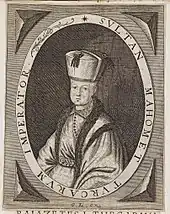
Eventually, Kösem rushed to the divan and presented her seven-year-old grandson, Mehmed, with the words "Here he is!, see what you can do with him!" Thus, she declared herself regent for the third time. When a group of government authorities insisted that the palace send the Sultan's seven-year-old son to be enthroned in a mosque, Kösem refused and demanded that they instead come to the palace. Her rejection was based on the fact that no sultan had ever been enthroned in a mosque before. Her purpose was undoubtedly in part to compel the situation to occur so that she could have some influence over the outcome.[59][60]
Third regency (1648–1651)
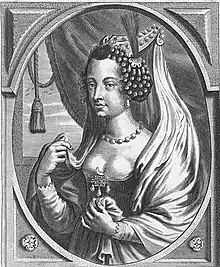
As the senior Valide Sultan, Kösem continued to be incredibly powerful. During this particular stage of her regency, she had supreme control over the Ottoman Empire. She also accumulated a massive fortune through tax farming, owning and leasing commercial buildings, and investing extensively in diverse economic activities. She styled herself as Büyük Valide "the Great Valide Sultan" or “the Great grandmother” in 1649.[61]
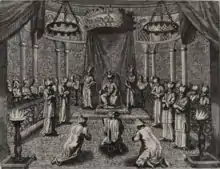
At the head of the Ottoman Empire stood the child sultan, Mehmed IV. During the beginning of Mehmed IV‘s reign, Kösem would usually sit beside the Sultan, concealed behind a curtain, if the Sultan's presence was needed at the divan. During an imperial audience, a foreign ambassador recorded the child sultan turning to his grandmother and asking: “What answer should I give?” The answer is then conveyed to him.[62] Her candor outweighed her caution; to those who felt uneasy with Mehmed IV’s handling over the sultanate, Kösem would chastise the statesmen in abrasive tones in front of their faces: "Have I made you vizier to spend your time in gardens and vineyards: Devote yourself to the affairs of the empire and let me hear no more of your deportments!"[57]
Rivalry with Turhan Sultan
With Mehmed's ascendancy, the position of Valide Sultan should have gone to his mother Turhan Sultan. However, Turhan Sultan was overlooked due to her youth and inexperience. Instead, Kösem was reinstated to this high position since she was requested by leading statesmen to continue on as regent to the child sultan, her seven-year-old grandson Mehmed IV, instead of retiring and giving her position to the mother of Ibrahim's successor. Turhan, on the other hand, began to exert what she saw to be her rightful authority.[63]
According to Abdülaziz Efendi, then the chief justice of Rumeli and a central figure in the dynastic upheavals of the time, it was considered prudent to appoint the more experienced woman regent in contravention of tradition:
"It being an ancient custom that upon the accession of a new sultan the mother of the previous sultan remove to the Old Palace and thus give up her honored office, the elder valide requested permission to retire to a life of seclusion. But because the loving mother of the [new] sultan was still young and truly ignorant of the state of the world, it was thought that if she were in control of government, there would result the possibility of harm to the welfare of the state. Therefore the elder valide was reappointed for a while longer to the duty of training and guardianship, and it was considered appropriate to re-new the assignment of crown lands to the valide sultan."[64][65]
However, Kösem's interpretation of her mission does not appear to have been widely accepted. She inherited direct sultanic authority as a politician, undoubtedly one of the most experienced and informed of the ruling elite. It was unavoidable that Kösem would fight with Grand Vizier Mehmed Pasha, who appears to have seen himself as both regent and temporary ruler. According to the historian Naima, the Grand Vizier was misled by "certain would-be doctors of religion" who quoted legal texts to the effect that the guardian of a minor sultan was entitled to exercise the prerogatives of sovereignty.
The Grand Vizier Mehmed Pasha despised Kösem's absolute authority and control over the government, as Naima noted on the Grand Vizier Mehmed Pasha's futile hope that he, rather than the Sultan's grandmother, would act as regent to the young Mehmed IV. He bragged: "the soldiers of this exalted state respect only the honor of inherited nobility."[66]
In any event, the Grand Vizier Mehmed Pasha was unable to resist the power of Kösem and her Janissary allies. During an imperial audience to which all leading statesmen were summoned, the Sultan, with his grandmother seated at his side behind a curtain, dismissed Sofu Mehmed Pasha and appointed the Agha of the Janissaries, Kara Murad Pasha, to the vacant office. Speaking from behind the curtain, Kösem defended her role and silenced her critics in a speech the vehemence of which surprised all present. She cited the former Grand Vizier's shortcomings, including his plans to assassinate her, to which she commented:
"Thanks to God, I have lived through four reigns and I have governed myself for a long while. The world will be neither reformed nor destroyed by my death."[64]
She then chastised Abdülaziz Efendi, ally of the former Grand Vizier, by referring to his rebuke of Mehmed IV:
"When certain imperial commands have been issued, they have said [to the sultan], ‘my dear, who taught you to say these things?' Such patronizing behavior towards sultans is impermissible! And what if the sultan is instructed?"
In Naima's words, Abdülaziz Efendi "drowned in the sea of mortification."[67]
It was Mehmed IV's mother, Turhan Sultan, who proved to be Kösem's nemesis. When she was about 12 years old, Turhan was sent to the Topkapı Palace as a gift from the khan of Crimea to Kösem.[68][69] It was probably Kösem who gave Turhan Sultan to Ibrahim as a concubine. Turhan turned out to be too ambitious a woman to lose such a high position without a fight. In her struggle to become Valide Sultan, Turhan was supported by the chief black eunuch in her household and the incumbent Grand Vizier, while Kösem was supported by the Janissary Corps. Although Kösem's position as Valide Sultan and regent was seen as the best for the government, the people resented the influence of the Janissaries on the government.[2]
Plot to depose Mehmed IV
In this power struggle, Kösem planned to dethrone Mehmed IV and replace him with another young grandson. According to one historian, this switching had more to do with replacing an ambitious daughter-in-law with one who was more easily controlled. According to Mustafa Naima, Kösem secretly asked the palace guards to leave the palace gates open so that Janissaries could sneak in and kill Turhan Sultan in her chambers. Additionally, Kösem gave two bottles of poisoned sherbet to Uveys Agha, the head helva (sweets) maker in the palace kitchen, to serve to the young Mehmed IV. She promised Uveys Agha a promotion if he succeeded in poisoning the Sultan. The day before enacting the plan, however, one of Kösem's slaves, Meleki Hatun, betrayed her and revealed the plot to Turhan Sultan, and the plan failed.[2][20]
Assassination
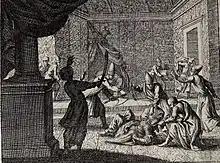
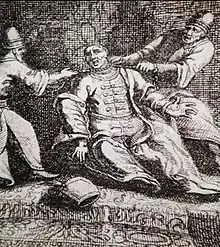
On 2 September 1651, a large group of Turhan Sultan's armed followers led by Süleyman Agha, the chief black eunuch of the Imperial Harem, approached Kösem's apartment, which was guarded by over three hundred armed Janissaries. When Kösem's chief private guard spoke up for Kösem and said, “What have you to do with the Valide Sultan? Are you worthy to open your mouths against her serene Name?” while refusing to let the assassins in her chambers, it is stated that his head was split apart with an axe and his blood was splattered across the plush carpets in front of the child Sultan.[70] The Sultan, probably with his mother beside him, then signed his grandmother's death warrant, ordering that she should be strangled "but neither cut with a sword nor bruised with blows”. Kösem, hoping the Jannissries were on their way to come to her aid, shouted from within her apartment: "Have they come?" "Yes, they have come," Süleyman Agha responded, hoping to deceive her. Kösem, on the other hand, recognized his voice and fled. Süleyman Agha and the armed men then broke into her apartment, swiftly killing the other guards on their way.[20][71]
The only person they found inside the apartment was an old woman who served as Kösem's buffoon. The woman was armed with a pistol, which she pointed at them while they questioned her about the whereabouts of Kösem. The woman replied that she was the “Valide Sultan” and then fired at them before they disposed of her.[72]
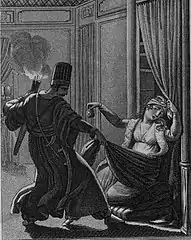
Kösem is said to have hidden in a cupboard in the wall of a staircase in the Valide's apartment. A piece of dress protruding under the door betrayed her to a halberdier. One of her assailants, Kucuk Mehmed Agha, found her and dragged her out by her long braids and started beating her. She tried to bribe the pages, but they just robbed her and brutally stripped her off her jewellery and other valuables, as described by Paul Rycaut:
“There were two great Jewels at her [Queen grandmother] ear, they immediately tore them thence. They were two Diamonds of the bigness of Chestnuts cut angularly, and beneath each Diamond was a Ruby, those earrings were given to her by Sultan Ahmed in the time of her most flourishing age, and his greatest affection. Such Jewels cannot be found in all the Great Turks treasure, and were esteemed by the most skilful Jewellers worth a years Revenue of Grand Cairo.”[73]
Süleyman Aga then had Kösem dragged by her feet to the gateway leading from the harem into the Third Court, where he ordered his men to kill her. She resisted and fought back. As a result, it took four men to subdue and strangle her, she is said to have struggled so much that blood spurted out of her ears and nose and soiled the murderer's clothes:
“There were four that strangled her; but being young Executioners, laboured long to dispatch her, till at length the Queen leaving to struggle, lay stretched out and was supposed to be dead, and to crying, “she is dead, she is dead!”, ran to carry the News thereof to his Majesty [Mehmed IV]; but being scarce out of fight, the Queen raised herself up, and turned her head about; upon which the Executioners being again called back, the Cord was a second time applyed, and wrung so hard with the haft of a hatchet, that at length she was dispatched, and the News carried to the Royal Chamber.”[74]
'The massacred Valide', as she became known, left 2,700 shawls, twenty chests of gold and a lasting reputation in the city for piety and generosity.[75][72] Then, as Paul Rycaut writes:
“The Black Eunuchs immediately took up the Corpse, and in a reverent manner laid it stretched forth in the Royal Mosch; which about 400 of the Queens Slaves encompassing round about with bowlings and lamentations, tearing the hair from their heads after their barbarous fashion, moved compassion in all the Court.”[72]
The Ottoman renegade Bobovi, relying on an informant in the harem, stated that Kösem was strangled with her own hair.[76]
On September 2 1651, Kösem's body was taken from Topkapi to the Old Palace (Eski Sarayı) and then buried in the mausoleum of her husband Ahmed I.[77]
Aftermath
When news of Kösem's death became public on September 3 1651, the people of Constantinople spontaneously observed three days of mourning.[75] Beginning the following day, Constantinople's mosques and markets were closed for three days. The assassination of Kösem sparked a political uproar and a wave of retaliation. The first phase was the assassination of Kösem's Janissary supporters and the demise of the faction they led, which had ruled the country during Kösem's three-year regency over Mehmed. In the second phase, public outrage over the purge prompted Turhan's new royal administration to dismiss the Grand Vizier Abaza Pasha who had carried out the executions. By this time, a huge crowd had gathered by the gates of Topkapi Palace, the Sultan summoned his statesmen and the palace functionaries to the audience. Fired up, the crowd blamed the Janissaries for Kösem's murder and swore to avenge it.[78]
Around this particular period of time, Kaya Sultan, Murad IV's daughter and Kösem's paternal granddaughter, condemned Abaza Siyavuş Pasha's apparent role in Kösem's assassination:
“You tyrant Siyavuş! You murdered my grandmother, your lord Murad's mother. Aren't you and my kinsmen? […] By the soul of my grandfather [Sultan Ahmed I] I will curse you, and you will get no pleasure from this seal."[79]
More famously, Ayşe Sultan, Kösem's daughter, is believed to have apprehended those suspected of murdering her mother, which consisted of both eunuchs and concubines, most notably Meleki Hatun, and turned them over to the Janissaries, where they were executed. It was said that she witnessed the execution of her mother's alleged murderers.[80]

Evliya Çelebi, a famous Ottoman traveler, writer, and admirer of Kösem Sultan, described the regicide:
“The mother of the world, wife of Sultan Ahmed (I); mother of Osman (II), Orhan, Bayezid, Murad (IV), and Ibrahim; the grand Kösem Valide—was strangled by the Chief Black Eunuch Div Süleyman Agha. He did it by twisting her braids around her neck. So that gracious benefactress was martyred. When the Istanbul populace heard of this they closed the mosques and the bazaars for three days and nights. There was a huge commotion. Several hundred people were put to death, secretly and publicly, and Istanbul was in a tumult."[81]
It was reported that twenty boxes loaded with gold coins were discovered in the Büyük Valide Han that Kösem had built. The valide sultans' cash fortune could be transformed into profit: for example, in 1664, the profit on cash investments accounted for nearly two-thirds of the revenue of the endowment established for Safiye Sultan's Karamanlu mosque. In addition to directly endowing funds, the valide sultans are likely to have utilized their funds to acquire the above-mentioned urban assets. The valide sultan's riches and business transactions were so broad that her many agents might become very wealthy and enjoy popular esteem. When recording in his history the death of Kösem's steward, Koja Behram, Naima commented:
“The afore-mentioned Behram Kethiida enjoyed great prestige and distinction and wealth. As the manager of all the affairs of the valide sultan and the pious institutions she had established, and as an extremely trustworthy man, he acquired a great deal of wealth and property. But his children and his grandchildren did not maintain the high stature he had enjoyed, and his wealth and property were squandered.”[44]
Charities

Kösem made charities and donations both for people and ruling class in the state. She would leave the palace in disguise every year in the Islamic month of Rajab to personally arrange for the release of imprisoned debtors and other offenders (excluding murderers) by paying their debts or recompense for their crimes.[82] She supplied the trousseaus of daughters of poor families and servant girls trained by her, wedded them and won their confidence. She had Çinili Mosque (tr) and a school near it constructed in Üsküdar in 1640 and she also had the small mosques and fountain of the Valide madrasa of Anadolu Kavağı, fountain in Yenikapı, Valide Han mosques, fountains in Beşiktaş and Eyüp and Valide Caravanserai in Çakmakçilar Yokuşu built. It is also known that she had also laid fountains built outside the capital.[83]
Kösem established a foundation to meet the needs of pilgrims in need of water, to assist the poor in Haremeyn, and to have the Koran read in this place. She also funded the construction of Büyük Valide Han in Constantinople, which served a variety of purposes, including providing accommodation for foreign traders, storing goods or merchandise, housing artisan workshops, and providing offices from which to conduct business.[84]
She financed irrigation works in Egypt and provided relief for the poor people of Mecca. Kösem was renowned for her charity work and for freeing her slaves after 3 years of service..
Legacy
Despite her notoriety as a woman who does not know mercy or compassion for the sake of government and power, Kösem was known among the Ottoman state's citizens for her charitable work, which served as a kind of self-cleansing or false reconciliation, but in any case succeeded in stabilizing the mental image that she desired.
In the introduction to the English translation of the novel Histoire d'Osman premier du nom, XIXe empereur des Turcs, et de l'impératrice Aphendina Ashada, by Madame de Gomez in 1736, describing the life of Osman II, John William states that Kösem was "one of the most active in politics and enterprising women of her time, which she achieved by insidious intrigues from ambitious motives.”[85]
Michel Baudier, a contemporary French writer, presents her as a woman politician "enjoying well-deserved authority." Jean-Baptiste Tavernier, another French contemporary, described her as "a woman very wise and well-versed in state affairs.”[86]
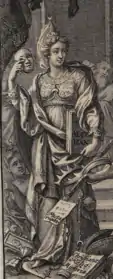
Kösem had a good sense of winning people. She often distributed donations to those in need, and visited prisons every year, where she paid the debt of those who were imprisoned for debt; She spent a lot of money on impoverished girls' weddings and other humanitarian deeds, such as handing out gold coins to the destitute in the Ottoman capital during state celebrations and religious holidays; she freed her own slaves after two years of service and took care of their marriages. Her charity is undoubted, but it is also important to mention that she regarded her former servants as a kind of spies. She kept their husbands in check through the women who were extremely loyal to her. She did not depend upon advisers and counsel in apportioning these good deeds, but visited herself hospitals, schools, mosques and even churches.[87] Thus, in addition to helping many with a good heart, in some cases, these charitable acts also served her own interests. This was not uncommon anyway, every other sultana used these marriages to serve their own interests.[36]
She also ordered the construction of a grand mosque in the Üsküdar district of Istanbul, one of the city's most famous neighborhoods, and spent a lot of money on it to make it an architectural masterpiece, as well as allocating a lot of porcelain and porcelain to decorate it.
The chronogram that appears on the gate of the Çinili mosque's courtyard reads:
“Mother of Sultan Ibrahim Khan, her Majesty of the Sultana, the most munificent mother of the sultan: She constructed this divine edifice as an act of charity. Lo, let it be a house of prayer for the servants of God! May they be summoned to God's mercy at the five times [of prayer]! May it be a halting place for worshippers and ascetics! She built a school, fountain, bath and fountain, for which let God grant her favor and benevolence! Philanthropists and those who worship in it, O God, take them into the eternal Paradises! The charitable work of the sultan's mother was completed in [the Islamic year] one thousand fifty [1640-41].”
She set aside cash from a solemn pause indicated in a waqfah dated 1640, where many funds were stopped to spend on the needy and the poor who reside on the way to Mecca, as well as numerous funds sent to Mecca and Medina every Hajj season to distribute to the destitute there and fed all of Constantinople's starving people at soup kitchens she established. People referred to her as the 'hand of deus ex machina'. She was fond of saying, 'I show my anger to the palace, my milk to the public'.
Her judgments had such an impact that noblemen in her empire vowed that no woman would ever be so influential again after she died.
Issue
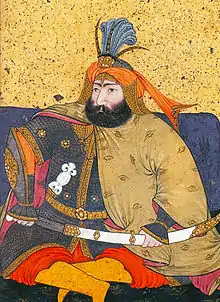
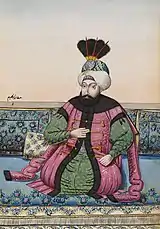
Kösem's sons were:
- Şehzade Mehmed[88] [89] (11 March 1605 - 12 January 1621), disputed son of Kösem and Ahmed.
- Murad IV[88][89] (26/27 July 1612 – 8 February 1640), sultan from 20 January 1623 until his death
- Şehzade Süleyman[88][4] (1613 – murdered 27 July 1635).
- Şehzade Kasım[88][89] (early 1614 – 17 February 1638), heir apparent since 1635
- Ibrahim[88][89] (5 November 1615 – 18 August 1648), sultan from 9 February 1640 until 12 August 1648
In popular culture
- Genç Osman ve Sultan Murat Han (1962) movie, starring Muhterem Nur as Kösem Sultan
- IV. Murat (1980) TV series, starring Ayten Gökçer as Kösem Sultan
- Istanbul Kanatlarımın Altında (1996) movie, starring Zuhal Olcay as Kösem Sultan
- Ankara Theatre (2013–2014 season) Özlem Ersönmez as Kösem Sultan.
- Mahpeyker: Kösem Sultan (2010), starring Damla Sönmez (as young Kösem) and Selda Alkor (as old Kösem)[91]
- Tims Production produced a historical fiction television series following Muhteşem Yüzyıl, titled Muhteşem Yüzyıl: Kösem, starring Anastasia Tsilimpiou as young Kösem and Beren Saat[92] as adult Kösem in season one. In season two, middle aged Kösem was portrayed by Nurgül Yeşilçay.[93]
Gallery
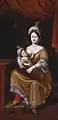 Posthumous portrait by an unknown painter, c. 17-18th century
- Portrait of Mahpeyker Kösem Sultan, c. 19th century
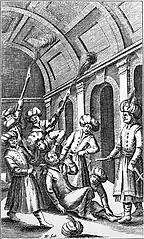
- Murder of Kösem Sultan by Paul Rycaut, 1694
- The strangulation of Kösem Sultan, 1812
- Execution of Kösem Sultan portrayed in Histoire de l'état présent de l'Empire Ottoman, 1670
- Büyük Valide Han, constructed by Kösem Sultan in 1651
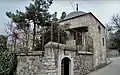 Çinili Çocuk Kütüphanesi (library), constructed by Kösem Sultan in 1640
 Çinili Hamamı (bathhouse), constructed by Kösem Sultan in 1640
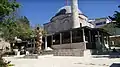 Çinili Camii Mosque, constructed by Kösem Sultan in 1640
See also
Bibliography
- Mansel, Philip (1995). Constantinople: City of the World's Desire, 1453–1924. New York: St. Martin's Press. ISBN 0719550769.
- Imber, Colin (2009), "The Ottoman Empire"; New York: Palgrave MacMillan.
- Peirce, Leslie P. (1993), The Imperial Harem: Women and Sovereignty in the Ottoman Empire, Oxford University Press, ISBN 0195086775
- Tezcan, Baki (2007). "The Debut of Kösem Sultan's Political Career". Turcica. Éditions Klincksieck. 39–40.
- Lucienne Thys-Senocak, Ottoman Women Builders (Aldershot: Ashgate 2006).
- Piterberg, Gabriel (2003). An Ottoman Tragedy: History and Historiography at Play. California: University of California Press. p. 271. ISBN 0-520-23836-2.
Notes
 |
Wikimedia Commons has media related to Kösem Sultan. |
- Baysun, M. Cavid, s.v. "Kösem Walide or Kösem Sultan" in The Encyclopaedia of Islam vol. V (1986), Brill, p. 272
- Peirce 1993, p. 252.
- Douglas Arthur Howard, The official History of Turkey, Greenwood Press, ISBN 0-313-30708-3, p. 195
- Peirce 1993, p. 105.
- Peirce 1993, p. 105: While Hurrem was the woman of the Ottoman dynasty best known in Europe, it is Kösem who is remembered by the Turks as the most powerful}}
- Necdet Sakaoğlu (2007). Famous Ottoman women. Avea. p. 129.
- Finkel, Caroline (2005). Osman's Dream: The Story of the Ottoman Empire, 1300-1923. New York: Basic Books. p. 197. ISBN 978-0-465-02396-7.
- A.H. de Groot (1993). s.v. Murad IV in The Encyclopaedia of Islam vol. VII. Brill. p. 597. ISBN 90-04-07026-5.
Kosem [qv] Mahpeyker, a woman of Greek origin (Anastasia, 1585–1651)
- Hogan, Christine (2006). The Veiled Lands: A Woman's Journey Into the Heart of the Islamic World. Macmillan Publishers Aus. p. 74. ISBN 9781405037013.
- Amila Buturović; İrvin Cemil Schick (2007). Women in the Ottoman Balkans: gender, culture and history. I.B.Tauris. p. 23. ISBN 978-1-84511-505-0.
Kösem, who was of Greek origin. Orphaned very young, she found herself at the age of fifteen in the harem of Sultan Ahmed I.
- Redhouse Turkish/Ottoman-English Dictionary (14th ed.). SEV Matbaacılık ve Yayıncılık A.Ş. 1997. p. 722. ISBN 978-975-8176-11-3.
- Davis, Fanny (1970). The Palace of Topkapi in Istanbul. Scribner. pp. 227–228. OCLC 636864790.
Kosem was said to have been the daughter of a Greek priest of one of the Aegean islands, probably captured during one of the Ottoman-Venetian maritime campaigns. Her name was Anastasia but was changed after her conversion, no doubt on her admission to the palace, to Mâh-Peyker (Moon-Shaped), and later by Sultan Ahmet to Kosem
- Redhouse Turkish/Ottoman-English Dictionary (14th ed.). SEV Matbaacılık ve Yayıncılık A.Ş. 1997. p. 722. ISBN 978-975-8176-11-3.
- Peirce 1993, p. 129.
- Peirce 1993, p. 233.
- Relazioni di ambascitori veneti al Senato..., op. cit., s. 22, 649.
- Piterberg 2003, p. 18.
- Peirce 1993, p. 106.
- Piterberg 2003, p. 14.
- Living in the Ottoman Realm: Empire and Identity, 13th to 20th Centuries, pp. 199-201
- Peirce 1993, p. 128.
- Freely, John 1998, p. 24.
- Tezcan 2007, p. 350.
- Mansel 1995, p. 200.
- Leslie P. Peirce, Kösem Sultan: İktidar Hırs ve Entrika. 2015.
- Peirce 1993, p. 235.
- History's 9 Most Insane Rulers, Scott Rank. 2016. p. 80
- Peirce 1993, p. 250.
- The Negotiations of Thomas Roe in his Embassy to the Ottoman Empire from the year 1621 to the year 1628
- Peirce 1993, p. 145.
- Peirce 1993, p. 243.
- Peirce 1993, p. 244-245.
- Peirce 1993, p. 245.
- Mansel 1995, pp. 200–201.
- Piterberg, 2003 & Murad’s succession, p. 26.
- Peirce 1993, p. 223.
- Peirce 1993, p. 241.
- Ibidem, s. 298.
- Peirce 1993, p. 193.
- Rycaut, Paul 1694, p. 493.
- Janda, Setareh (10 January 2020). "Facts About Ibrahim I, The Man Who Lived In A Cage". Ranker.
- Rycaut, Paul 1694, p. 492.
- Peirce 1993, p. 147.
- Peirce 1993, p. 215.
- Peirce 1993, p. 249.
- Börekçi, Günhan. "Ibrahim I." Encyclopedia of the Ottoman Empire. Ed. Gábor Ágoston and Bruce Masters. New York: Facts on File, 2009. p. 263
- Peirce 1993, p. 258.
- Şefika, Şule. “Women Leaders in Chaotic Environments”. 2016. P. 81
- Freely, John 1998, p. 26.
- Rank, Scott. History's 9 Most Insane Rulers p.76
- Peirce 1993, p. 263.
- Rycaut, Paul 1694, p. 495.
- Thys-Senocak, p. 26
- Quioted in Thys-Senocak, p. 26
- Shepard, Edward. History of the Ottoman Turks: from the beginning of their empire, p. 17
- Kohen, Eli. History of the Turkish Jews and Sephardim: Memories of a Past Golden Age. Lanham, Md.: University Press of America, 2007. Page 142.
- Mansel 1995, p. 201.
- Morgan, Robert (21 September 2016). History of the Coptic Orthodox People and the Church of Egypt. FriesenPress. ISBN 9781460280270.
- The Ottoman Empire, 1300-1650: The Structure of Power by Colin Imber, p. 69
- Osman's Dream: The History of the Ottoman Empire p.55-103
- Living in the Ottoman Realm: Empire and Identity, 13th to 20th Centuries P.21
- The Secret World Of The Islamic Empire's Harem | The Hidden World Of The Harem | Parable, 2003
- Peirce 1993, p. 143.
- Peirce 1993, p. 251.
- Kosem Sultan, Ottoman Sultana. Britannica. Adam Zeidan. 2016.
- Peirce 1993, p. 284.
- Peirce 1993, p. 251-252.
- Thys-Senocak, p. 17
- Honored by the Glory of Islam: Conversion and Conquest in Ottoman Europe, p. 35
- Rycaut, Paul. “The present state of the Ottoman Empire” p.18
- Hammer-Purgstall, Joseph von. “Histoire de l'Empire ottoman, depuis son origine jusqu'à nos jours. Tome 11 / par J.” 1835-1843. pp. 280
- Inside the Seraglio: Private Lives of the Sultans in Istanbul, John Freely. ch. 10
- Rycaut, Paul. “The Present State of the Ottoman Empire”, p.20
- Rycaut, Paul. “The present state of the Ottoman Empire” p.18
- Mansel 1995, p. 202.
- Thys-Senocak, p. 28
- Singh, Nagendra Kr (2000). International encyclopaedia of Islamic dynasties. Anmol Publications PVT. p. 425. ISBN 81-261-0403-1.
Kosem Walide…Her body was taken from Topkapi to the Eski Saray and then buried in the mausoleum of her husband Ahmad I.
- Osman's Dream: The History of the Ottoman Empire P.22
- Farah, Ceaser E. “Decision making and change in the Ottoman Empire” p=172
- Farah, Ceaser E. “Decision making and change in the Ottoman Empire” p=172-178
- Living in the Ottoman Realm: Empire and Identity, 13th to 20th Centuries P. 203
- Peirce 1993, p. 209.
- Şefika Şule Erçetin (28 November 2016). Women Leaders in Chaotic Environments:Examinations of Leadership Using Complexity Theory. Springer. p. 83. ISBN 978-3-319-44758-2.
- İbrahim Alaeddin Gövsa / Türk Meşhurları (1946), Ana Britanica Ansiklopedisi (13. cilt, 1986), Büyük Larousse Ansiklopedisi (12. cilt, s. 7064, 1986), M. Çağatay Uluçay / Padişahların Kadınları ve Kızları (1992), Mücteba İlgürel / Türkiye Diyanet Vakfı İslam Ansiklopedisi (26. cilt, s. 273-275, 2002), İhsan Işık / Ünlü Kadınlar (Türkiye Ünlüleri Ansiklopedisi, C. 6, 2013) - Encyclopedia of Turkey's Famous People. Missing or empty
|title=(help)CS1 maint: multiple names: authors list (link) - Madame de Gomez, Histoire de Osman Premier..., op. cit., wstęp.
- Michel Baudier, Histoire générale du Serail et de la cour du grand seigneur Empereur des Turcs, 1623, s. 56.
- Stern, Bernhard 1934, p. 125.
- Singh, Nagendra Kr (2000). International encyclopaedia of Islamic dynasties (reproduction of the article by M. Cavid Baysun "Kösem Walide or Kösem Sultan" in The Encyclopaedia of Islam vol V). Anmol Publications PVT. pp. 423–424. ISBN 81-261-0403-1.
Through her beauty and intelligence, Kösem Walide was especially attractive to Ahmed I, and drew ahead of more senior wives in the palace. She bore the sultan four sons – Murad, Süleyman, Ibrahim and Kasim – and three daughters – 'Ayşe, Fatma and Djawharkhan. These daughters she subsequently used to consolidate her political influence by strategic marriages to different viziers.
- Peirce 1993, p. 232.
- Peirce 1993, p. 365.
- Turkish screenwriter tells Ottoman history through one woman's life
- "Turkish star Beren Saat to play mother of Ottoman sultan in new drama – CINEMA-TV". Hürriyet Daily News | LEADING NEWS SOURCE FOR TURKEY AND THE REGION. Retrieved 20 October 2017.
- "Kösem Sultan – Nurgül Yeşilçay". www.fox.com.tr. Retrieved 20 October 2017.
.svg.png.webp)
