Krein–Milman theorem
In the mathematical theory of functional analysis, the Krein–Milman theorem is a proposition about compact convex sets in locally convex topological vector spaces (TVSs).
Krein–Milman theorem — A compact convex subset of a Hausdorff locally convex topological vector space is equal to the closed convex hull of its extreme points.
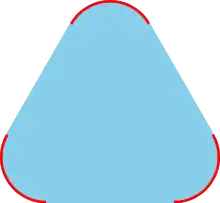


This theorem generalizes to infinite-dimensional spaces and to arbitrary compact convex sets the following basic observation: a convex (i.e. "filled") triangle, including its perimeter and the area "inside of it", is equal to the convex hull of its three vertices, where these vertices are exactly the extreme points of this shape. This observation also holds for any other convex polygon in the plane

Statement and definitions
Preliminaries and definitions
Throughout, will be a real or complex vector space.

For any elements and in a vector space, the set is called the closed line segment or closed interval between and The open line segment or open interval between and is when while it is when ;[1] it satisfies and The points and are called the endpoints of these interval. An interval is said to be non-degenerate or proper if its endpoints are distinct.









The intervals and always contain their endpoints while and never contain either of their endpoints. If and are points in the real line then the above definition of is the same as its usual definition as a closed interval.


For any the point is said to (strictly) lie between and if belongs to the open line segment [1]


If is a subset of and then is called an extreme point of if it does not lie between any two distinct points of That is, if there does not exist and such that and In this article, the set of all extreme points of will be denoted by [1]



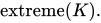
For example, the vertices of any convex polygon in the plane are the extreme points of that polygon. The extreme points of the closed unit disk in is the unit circle. Every open interval and degenerate closed interval in has no extreme points while the extreme points of a non-degenerate closed interval are and

A set is called convex if for any two points contains the line segment The smallest convex set containing is called the convex hull of and it is denoted by The closed convex hull of a set denoted by is the smallest closed and convex set containing It is also equal to the intersection of all closed convex subsets that contain and to the closure of the convex hull of ; that is,


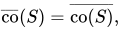
where the right hand side denotes the closure of while the left hand side is notation. For example, the convex hull of any set of three distinct points forms either a closed line segment (if they are collinear) or else a solid (that is, "filled") triangle, including its perimeter. And in the plane the unit circle is not convex but the closed unit disk is convex and furthermore, this disk is equal to the convex hull of the circle.


Statement
Krein–Milman theorem[1] — Suppose is a Hausdorff locally convex topological vector space (for example, a normed space) and is a compact and convex subset of Then is equal to the closed convex hull of its extreme points:


Moreover, if then is equal to the closed convex hull of if and only if where is closure of




The convex hull of the extreme points forms a subset of so the main burden of the proof is to show that there are enough extreme points so that their convex hull covers all of
A corollary to the above theorem, which is also some called "the Krein–Milman theorem", is that every non-empty compact convex subset of a Hausdorff locally convex TVS has extreme points; that is, the set of its extreme points is not empty.[1]
A particular case of this theorem, which can be easily visualized, states that given a convex polygon, the corners of the polygon are all that is needed to recover the polygon shape. The statement of the theorem is false if the polygon is not convex, as then there can be many ways of drawing a polygon having given points as corners.
More general settings
The assumption of local convexity for the ambient space is necessary, because James Roberts (1977) constructed a counter-example for the non-locally convex space where [2]


Linearity is also needed, because the statement fails for weakly compact convex sets in CAT(0) spaces, as proved by Nicolas Monod (2016).[3] However, Theo Buehler (2006) proved that the Krein–Milman theorem does hold for metrically compact CAT(0) spaces.[4]
Related results
Under the previous assumptions on if is a subset of and the closed convex hull of is all of then every extreme point of belongs to the closure of This result is known as Milman's (partial) converse to the Krein–Milman theorem.[5]


The Choquet–Bishop–de Leeuw theorem states that every point in is the barycenter of a probability measure supported on the set of extreme points of
Relation to the axiom of choice
The axiom of choice, or some weaker version of it, is needed to prove this theorem in Zermelo–Fraenkel set theory. Conversely, this theorem together with the Boolean prime ideal theorem can prove the axiom of choice.[6]
History
The original statement proved by Mark Krein and David Milman (1940) was somewhat less general than the form stated here.[7]
Earlier, Hermann Minkowski (1911) proved that if is 3-dimensional then equals the convex hull of the set of its extreme points.[8] This assertion was expanded to the case of any finite dimension by Ernst Steinitz (1916).[9] The Krein–Milman theorem generalizes this to arbitrary locally convex ; however, to generalize from finite to infinite dimensional spaces, it is necessary to use the closure.
See also
- Banach–Alaoglu theorem – The closed unit ball in the dual of a normed vector space is compact in the weak* topology
- Carathéodory's theorem (convex hull) – Point in the convex hull of a set P in Rd, is the convex combination of d+1 points in P
- Choquet theory
- Helly's theorem – Theorem about the intersections of d-dimensional convex sets
- Radon's theorem – Says d+2 points in d dimensions can be partitioned into two subsets whose convex hulls intersect
- Shapley–Folkman lemma – Result in convex geometry
- Topological vector space – Vector space with a notion of nearness
Citations
- Narici & Beckenstein 2011, pp. 275–339.
- Roberts, J. (1977), "A compact convex set with no extreme points", Studia Mathematica, 60: 255–266
- Monod, Nicolas (2016), "Extreme points in non-positive curvature", Studia Mathematica, 234: 265–270, arXiv:1602.06752
- Buehler, Theo (2006), The Krein–Mil'man theorem for metric spaces with a convex bicombing, arXiv:math/0604187
- Milman, D. (1947), Характеристика экстремальных точек регулярно-выпуклого множества [Characteristics of extremal points of regularly convex sets], Doklady Akademii Nauk SSSR (in Russian), 57: 119–122
- Bell, J.; Fremlin, David (1972). "A geometric form of the axiom of choice" (PDF). Fundamenta Mathematicae. 77 (2): 167–170. Retrieved 11 June 2018.
Theorem 1.2. BPI [the Boolean Prime Ideal Theorem] & KM [Krein-Milman] (*) [the unit ball of the dual of a normed vector space has an extreme point].... Theorem 2.1. (*) AC [the Axiom of Choice].
- Krein, Mark; Milman, David (1940), "On extreme points of regular convex sets", Studia Mathematica, 9: 133–138
- Minkowski, Hermann (1911), Gesammelte Abhandlungen, 2, Leipzig: Teubner, pp. 157–161
- Steinitz, Ernst (1916), "Bedingt konvergente Reihen und konvexe Systeme VI, VII", J. Reine Angew. Math., 146: 1–52; (see p. 16)

Bibliography
- Adasch, Norbert; Ernst, Bruno; Keim, Dieter (1978). Topological Vector Spaces: The Theory Without Convexity Conditions. Lecture Notes in Mathematics. 639. Berlin New York: Springer-Verlag. ISBN 978-3-540-08662-8. OCLC 297140003.
- Bourbaki, Nicolas (1987) [1981]. Sur certains espaces vectoriels topologiques [Topological Vector Spaces: Chapters 1–5]. Annales de l'Institut Fourier. Éléments de mathématique. 2. Translated by Eggleston, H.G.; Madan, S. Berlin New York: Springer-Verlag. ISBN 978-3-540-42338-6. OCLC 17499190.
- Paul E. Black, ed. (2004-12-17). "extreme point". Dictionary of algorithms and data structures. US National institute of standards and technology. Retrieved 2011-03-24.
- Borowski, Ephraim J.; Borwein, Jonathan M. (1989). "extreme point". Dictionary of mathematics. Collins dictionary. Harper Collins. ISBN 0-00-434347-6.
- Grothendieck, Alexander (1973). Topological Vector Spaces. Translated by Chaljub, Orlando. New York: Gordon and Breach Science Publishers. ISBN 978-0-677-30020-7. OCLC 886098.
- Jarchow, Hans (1981). Locally convex spaces. Stuttgart: B.G. Teubner. ISBN 978-3-519-02224-4. OCLC 8210342.
- Köthe, Gottfried (1983) [1969]. Topological Vector Spaces I. Grundlehren der mathematischen Wissenschaften. 159. Translated by Garling, D.J.H. New York: Springer Science & Business Media. ISBN 978-3-642-64988-2. MR 0248498. OCLC 840293704.
- Köthe, Gottfried (1979). Topological Vector Spaces II. Grundlehren der mathematischen Wissenschaften. 237. New York: Springer Science & Business Media. ISBN 978-0-387-90400-9. OCLC 180577972.
- Narici, Lawrence; Beckenstein, Edward (2011). Topological Vector Spaces. Pure and applied mathematics (Second ed.). Boca Raton, FL: CRC Press. ISBN 978-1584888666. OCLC 144216834.
- N. K. Nikol'skij (Ed.). Functional Analysis I. Springer-Verlag, 1992.
- Robertson, Alex P.; Robertson, Wendy J. (1980). Topological Vector Spaces. Cambridge Tracts in Mathematics. 53. Cambridge England: Cambridge University Press. ISBN 978-0-521-29882-7. OCLC 589250.
- H. L. Royden, Real Analysis. Prentice-Hall, Englewood Cliffs, New Jersey, 1988.
- Rudin, Walter (1991). Functional Analysis. International Series in Pure and Applied Mathematics. 8 (Second ed.). New York, NY: McGraw-Hill Science/Engineering/Math. ISBN 978-0-07-054236-5. OCLC 21163277.
- Schaefer, Helmut H.; Wolff, Manfred P. (1999). Topological Vector Spaces. GTM. 8 (Second ed.). New York, NY: Springer New York Imprint Springer. ISBN 978-1-4612-7155-0. OCLC 840278135.
- Schechter, Eric (1996). Handbook of Analysis and Its Foundations. San Diego, CA: Academic Press. ISBN 978-0-12-622760-4. OCLC 175294365.
- Trèves, François (2006) [1967]. Topological Vector Spaces, Distributions and Kernels. Mineola, N.Y.: Dover Publications. ISBN 978-0-486-45352-1. OCLC 853623322.
- Wilansky, Albert (2013). Modern Methods in Topological Vector Spaces. Mineola, New York: Dover Publications, Inc. ISBN 978-0-486-49353-4. OCLC 849801114.
This article incorporates material from Krein–Milman theorem on PlanetMath, which is licensed under the Creative Commons Attribution/Share-Alike License.