Kudumbi
| Kudumbi | |
|---|---|
| Classification | Farmers, cultivators |
| Religions | Hinduism |
| Languages | Konkani, Malayalam |
| Populated states | Kerala |
| Ethnicity | Kunbis of Goa |
The Kudumbi, also referred to as the Kunubis, the Kurumbi, or Kurmi, or the Kunbi, are traditionally a Konkani-speaking farming community residing in Kerala, India.[1][2] The majority of the group are farmers, laborers, and petty workers, settled across central and southern Kerala. Kudumbis are part of the larger Kunbi–Kurmi diaspora, a generic farming community spread out over India, with the probable exception of only Jammu and Kashmir.
Present Kudumbis
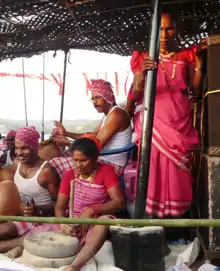
Kudumbis are innately hardworking, sincere, humble and god-fearing people. Many are expert in Pandal or tent erection work. Many temples use their service during the annual festivals. Kudumbis living around the Kerala backwaters are involved in large scale Shrimp farming,fishing and working in commercial aquaculture farms .Even though they are coming under Other backward /Eligible community in the Kerala, generally their social backwardness remains unnoticed.
In 1956 when the unified Kerala state was formed under the republic of India, the education fee concessions of Cochin kudumbis where also extended to Travancore and Malabar regions of the state.For the last two decades the community has progressed educationally and financially, thanks to educational concessions granted by the State Government. The community enjoys the job reservation coming under the Other Backward Classes OBC / SEBC. There are many Govt. servants, few of them holding high posts in various Departments. There are now many engineers,few doctors, leading Advocates and Ph.D. scholars from the community. Some of the young Kudumbi IT professionals are found working in USA, UK, Australia etc in reputed MNC. The community is socially in upfront, competing with other mainstream communities to improve their social and economic status. In fact there are few elected representatives in various Gram panchayats, Block panchayats and Municipal Corporations, especially in the localities where the community has a decisive voting majority.
History
Goan legacy
According to Goan historian Anant Ramakrishna Dhume, the Kunbi caste are modern descendants of ancient Mundari tribes. In his work, Dhume mentions several words of Mundari origin in the Konkani language and also elaborates on the deities worshipped by the ancient tribe, their customs, methods of farming, etc.[3] The Portuguese, who ruled over Goa for over 500 years, considered the Kunbi, Velip and Gowada communities as Tribu, which means tribes. The Central Government failed to extend the Constitution (Scheduled Tribes) Order 1950 to the Union Territory of Goa, Daman, and Diu immediately after the liberation of Goa in 1961 and that was perceived as an injustice by many.[4][5] Kunbis are included in ST list in Goa state in 2002. G. S. Ghurye says that "Kurmi, Kanbi and Kunbi perhaps signify the occupation of the group, viz., that of cultivation, though it is not improbable that the name may of tribal origin."[6]
In 1510, Goa was captured by the Portuguese general Alfonso Albuquerque from the Adil Shah dynasty of Bijapur, and Portuguese rule was established. In 1545 St. Francis Xavier, sent a letter to John III of Portugal, requesting an Inquisition to be installed in Goa. The inquisitor's first act was to forbid any open practice of the Hindu faith on pain of death. The Portuguese colonial administration enacted anti-Hindu laws to encourage conversions to Christianity. Prohibition was laid upon Hindu rituals as well. In all, over 42 Hindu practices were prohibited. All the people above 15 years of age were compelled to listen to Christian preaching or otherwise be punished. Several Hindu temples were destroyed as well. An order was issued for suppressing the Konkani language and making it compulsory to speak the Portuguese language. The law provided for dealing toughly with anyone using the local language. Following that law all the non-Christian cultural symbols and the books written in local languages were sought out to be destroyed. In the first hundred years, the Inquisition burned 57 alive at the stake and 64 in effigy. Others were sentenced to various punishments, totalling 4,046. The Kudumbi were forced to migrate from Goa following religious persecution by the Portuguese during the said infamous Goa Inquisition. The Kudumbis, along with Gouda Saraswat Brahmins (Malayalam: ഗൌഡ് സാരസ്വത്), Daivajnas and Vaishya Vanis who wanted to preserve their religious and cultural identity, migrated from Goa along the west coast of India, primarily through sea voyages.
Some of the groups that fled Goa landed in coastal districts of state of Karnataka, that is, the Uttara Kannada, Dakshina Kannada and Udupi districts, and some groups voyaged further to Kerala.[7][8]
The Census Report of India, 1961 – Volume VII, Kerala (page 210) refers to the Kudumbi community, and it is recorded that,
- "As to the fact that they were originally inhabitants of the area north Goa, there can be no doubt for the language, the ornament and the mode of dress of the woman show striking similarities with the present inhabitants of that area, proclaiming common origin. They are believed to have traveled by country crafts and landed at the sea port of towns Kerala which accounts for their concentration in places like Cranganore, Cochin, Parur, Kayamkulam, Alleppey, Purakkad and Quilon".[9] A small number of the Kudumbi are also found in cities like Bangalore, Mangalore, Mumbai, and Delhi, particularly those members of the group who migrated from Kerala in search of better prospects and livelihood.
Early Cochin Princely State
A group of Kudumbis may have migrated from Cochin to Travancore at the invitation of a Maharaja, Marthanda Varma and on arrival been given (free of tax) a coconut garden and land to grow rice. In return they were required to supply Avil to the palace and temple free of cost.[10]
Current status
K. R. Gowri Amma, a prominent figure in the communist movement in Kerala and former Minister, in her autobiography narrates the backwardness of Kudumbi Community as:
In the socio-political and in educational fields, the Kudumbis are backward. Very few of them are educated and officers are scarce. Kudumbi women do not wear a blouse but wrap the sari, sarong wise about them. In 1936, an association of young Kudumbis was established in Cochin and later in Travancore. In 1951, the two associations merged into one. Yet they have not achieved their rightful place in society. They have demanded that they be counted as scheduled castes. In reality their lot is worse than that of the scheduled castes..[11]
V. K. Valath says that the main agricultural labourers in the islands around Kochi have been from the Pulaya and Kudumbi castes. He adds that, whilst many people of the Pulaya and Mukkuvar castes converted to Christianity during the Portuguese period, the Kudumbis retained their traditional religious beliefs.[12]
The community is officially classified as being within the Socially and Economically Backward Communities (SEBC)[13] by the State Government. Many students have utilised the benefits of reservation legislation to improve their lives. A mass struggle and hunger strike were organized by the social organization Kudumbi Seva Sanghom (KSS) during 2006–2007, demanding a 1% reservation for Kudumbis seeking admission to various professional courses in Kerala. In 2008 the State Government finally acceded to the demand vide GO (MS)No.95/08/SC/ST dated 06.10.2008. Further, the Kudumbi community is totally exempted from the creamy layer.[14] Kudumbi Community is one among eight communities having hereditary occupations/calling, which had been excluded from the category of 'creamy layer' on account of its "Social Backwardness" as per GO (P) No.81/09/SCSTDD dated 26 September 2009.
Caste status
The KIRTADS[15] submitted a report stating that the Kudumbis should be included in the Scheduled Caste list.[16] After his election on 23 March 1987, and when challenged in court, K. Karunakaran, former chief minister of Kerala, supported inclusion of Kudumbis in the list.[17] United Democratic Front (UDF)had assured to use maximum pressure on the center for including the Kudumbies in the SC list.[18][19] However the legitimate claim of the Kudumbi Community stands in the ST list and not in SC List. On 10 March 2008, Veerendra Kumar, member of parliament (MP) of the 14th Lok Sabha, writer and chairman and managing director of Mathrubhumi press, made mention before the parliament under rule 377 concerning the classification of the Kudumbis. He pointed to the community's poverty, low level of literacy, and lack of ability to take any important government position.[20] On 4 May 2012, K. P. Dhanapalan MP, also made a special mention to the parliament about the classification of the Kudumbis.[21] In December 2011 in New Delhi, and on 30 May 2012 in Kochi a public protest was organised by supporters of the rights of the Kudumbi, including the Janathipathiya Samrakshana Samithy (Association for Defence of Democracy, J.S.S.) to demand inclusion of the community in the list of Scheduled Castes.
In her autobiography, political activist, K. R. Gowri Amma wrote,
- "In the socio-political and in educational fields, the Kudumbis are backward... They have demanded that they be counted as scheduled castes. In reality their lot is worse than that of the scheduled castes."[22]
The community is officially classified under SEBC (Socially and Economically Backward Communities) by the State Govt. Since then many students have used these benefits and come up in their life successfully. A mass struggle and hunger strike was organised by Kudumbi Seva Sanghom (KSS) during 2006-2007 demanding 1% reservation for seeking admissions in various Professional courses in Kerala. Finally in 2008 the State Govt accepted the above said demand and granted 1% reservation for the kudumbi community under SEBC (Socially and Economically Backward Communities) category for seeking admission in various Professional courses in Kerala. In a long run, this opportunity will partially help in removing the inherent social and educational backwardness of the community.
Kudubis of Karnataka (who were migrated from Goa and settled in the coastal districts of Kartaka) are non – scheduled tribes . They are also suffering from problems including non – recognition as a tribe in Karnataka (Caste Practices and influences Affecting Tribals – A Case study of Kudubis of Karnataka by Dr. Y Ravindranath Rao)[23][24] Kudubis of Karnataka has also urged state government to include them in the Scheduled Tribe list.[25][26]
Cultural diffusion and language convergence
For decades the Kudumbi led a socially secluded life. During the late 19th century in Kerala, when a socio-cultural revival took place in many backward communities, the Kudumbi opened themselves up to mainstream socio-cultural and economic developments. Unfortunately, newer socio-economic and cultural changes in the community spurred a slow reverse cultural diffusion.[10]
Language
The Kudumbis speak the Konkani language with their own dialect which closely resonates with the original Goan Konkani and popularly known as "Bhaash" (which means mother tongue). The older generation still prefer to speak in chaste kudumbi.But due to prolonged socio economic compulsions Konkani has suffered Language shift towards the Malayalam language and its prominent among kudumbis. Youngsters prefer to speak Malayalam over Konkani.But there are few scholars from the community who have contributed significantly to Konkani literature in Kerala. Kudumbi Seva Sanghom has been regularly participating in all India conferences,forums organised by Akhil Bharat Konkani Parishad,Goa and alike organisations.In order to develop Konkani among the konkani speaking communities,in 2009 Konkani teaching was initiated in three Govt. schools located around the Western Ernakulam district where there is a sizable kudumbi population.Many students participate in konkani poetry recitations during the cultural competitions organised by Kudumbi Seva Sanghom every year.Kudumbis living around Vypeen,Kodungallor , Paravoor ,Trichur district speak the purest form of Konkani compared to other localities in the southern district of Kerala.
Popular surnames
"Moopan" / "Moorthy" are the typical surnames prevalent in Central Kerala. These surnames are now rarely used because of neo socio-cultural values in the community and dissolution of self identity.
Kudumbi temples
Kudumbi Temples Traditionally many kudumbi localities have their own devili / temple owned by a trust/committee/family composing of local kudumbi members.Majority of them are dedicated to Devi and Lord Vishnu,with few of them to Lord Shiva .Historically after the exodus to Kerala, kudumbis could not maintain contacts with their Goan brethrens.So for decades kudumbis have imbibed local culture into their ethos. Unlike the other konkani peers, kudumbis do not have any traditional kuldevatas in their temples.All these temples are built on traditional Kerala temple architecture.Also the rituals,customes & traditions,festivals,poojas are based on Kerala traditions.The poojari/ priest in kudumbi temples are usually Gouda Saraswat Brahmins,Namboothiris and Ezhavas.Few temples even have kudumbi priests.Kudumbis workship Sri Kurumba Bhagavathi of Kodungallor as their kuladevi.The annual festival in kudumbi temples may last for three to ten days. The ladies offer a special Puja which is popularly known as "Suvasini" or the Suhasini Puja.
The reverberating rhythmic beats of Tonya-Melam or Tappu-melam (a tribal form of drum) can also be enjoyed during the festivals in many Kudumbi temples. The ceremony of Munnchuvu vajjavappo (carrying a decorated country boat) is accompanied by the Tappu-melam. This ceremony is held in few Kudumbi temples as a mark of remembrance of Goan exodus centuries back.
According to Kerala tradition, the ceremony of Talapoli, as a procession of ladies carrying oil lamps accompanied by chenda (percussion instruments) or tappu melam, can be seen during the festivals in these devi temples. The traditional haampu (multi-stacked portable brass lamp or a similar stone lamp) found in a number of Kudumbi temples is lit on special puja days. Votive items made from Aval (puffed rice) or beaten rice and jaggery are still offered as prasadam in many Kudumbi temples. Holi, the festival of colors, is celebrated in many Devi temples by the Kudumbi. During this festival, "Kamadeva" (Bodhan) the symbolic entity of "Kama" will be burnt to fire, purifying the life of all who participate in the festival. There will be a procession on the streets where all the participants will be applying colour each other, dancing with songs sung in Kudumbi language. Youngsters and children go in a group, pour yellow water from the pot kept in front of every house, and finally gather at their local devili temple.[27] In the night there will be a special group dance by women (fuguda) by gathering in a circle and clapping and doing brisk movements. After this there will be delicious dinner and food will be offered to souls. Even Kudumbis of Karnataka, who had migrated from Goa along with their brethren in Kerala and other places continue to celebrate their traditional festival 'holi' by preserving their own unique culture.[28][29]
Some of the well-known Kudumbi temples in Kerala (കേരളത്തിലെ കുഡുംബി ക്ഷേത്രങ്ങള്)-
Sreenivasa kovil-Thekkumbhagam,Tripunithura,Ernakulam—Main deity is Lord Sreenivasa / Venkateshwara തെക്കുംഭാഗം ശ്രീനിവാസ കോവില്, തൃപ്പൂണിത്തുറ, എറണാകുളം
Mallikarjuna Temple - Kaalamukku,Vypeen,Ernakulam—Main deity is Lord Shiva with his consort Parvathi Devi ശ്രീ മല്ലികാര്ജ്ജുന ക്ഷേത്രം, വൈപ്പിന്, എറണാകുളം
Vilanjoor Sree Bhagavathy Temple - A.N. Puram,Alapuzha -- Main deity is Bhagavathy or Devi വിളഞ്ഞൂര് ക്ഷേത്രം, ആലപ്പുഴ
Kochumullakal Devi Temple - Tiruvambady,Alapuzha-- Two Main Deities- Lord Vishnu and Bhagavathy or Devi കൊച്ചുമുല്ലക്കല് ക്ഷേത്രം, തിരുവമ്പാടി, ആലപ്പുഴ
Sri Gopalakrishna Temple - Thundi parambu, Cochin -- Main Deity is Lord Krishna
Sri Anandavishnu temple - Kattikunnu,Poothotha,Ernakulam - Main deity is Lord Vishnu in Ananthashayana form
Koshavarkunnu Sree Bhagavathy Temple - Mala, Kerala-Pallipuram , Trissur -- Main deity is Bhagavathy or Devi
Some Kudumbi temples of Kerala Some of the Kudumbi temples bear a unique local title "Moorthingal" prefixed with their actual title names sankaranarayana temple at Cherthala, Vettackal Alappuzha.
Social organizations
Kudumbi Seva Sanghom (KSS), Kerala Kudumbi Federation, Kudumbi Seva Samiti, Kudumbi Samajam, Kudumbi Karayogams, and Kudumbi Mahajana Sabha-Vypeen are the social organizations representing the community in Kerala. KSS is the predominant organization representing the majority of Kudumbis in Kerala, and it supports the social, educational and cultural uplifting of the community.
Educational and Socio-Cultural Institutions
Gandhi Krishnan Memorial Library- Tiruvambadi, Alapuzha -Runs a library in the name of Late social reformer Gandhi Krishnan.
TRACKS - Tripunithura, Ernakulam- A research center for Konkani studies
CS & RC (Center for Cultural Studies and Research Center) -North Paravoor, Ernakulam
Kattukaran Chandu Santhappan Memorial Trust at Poyya near Trichur-A rare Kathakali School run by a Kudumbi family
GKCS (Gandhi Krishnan Memorial Computer Studies) - Mattancherry,Kochi - A computer center run by KSS Br.31 ,Kochi
KEA - (Kudumbi Employees Association) - Cochin - Providing financial support for Kudumbis. Currently providing services in and around Mattancherry and Fort Cochin.
Konkani Bhasha Padana Gaveshana Kendram - A Konkani linguistic research body
KSSEC Trust - Kudumbi Seva Sangham Educational and Charitable Trust-Reg.No. 109/2009- Kudumbi Sevasangham Building Pullut - Kodungallur - Trissur.KSSEC Trust is a Govt. registered and recognized Trust with the supreme objective of doing Charitable activities and establishing & running of educational institutions. The foremost aim of this Trust is to provide Professional Quality Education to youngsters, preparing them for a global career. The Mananaging Trustees of KSSEC Trust are - Mr. NANAJI T.G., Mr. MANU A.B., Mr. NARAYANAN A.V, Mr. RAJAN T.M., Mr. AIJU M.M., Mr. PRAVEEN K.G., Mr. SANTHOSH K.L., Mr. DEVADAS,Mr. SHANMUGHAN,Mr. RAJENDRAN.
- S.N.G.S.U.P. School, Kakkathuruthy, Thrissur – owned and managed by the Kudumbi Education Trust (KET), under KSS
- Mahathma College and Saraswathy Vidhya Mandir, North Paravoor – owned and managed by the Kudumbi Education Society (KES), North Paravor
Social Reformers and Leaders
Gandhi Krishnan --(1910-1944) -- M.Krishnan popularly known as Gandhi Krishnan. He was born and bought up in Alapuzha but later shifted to Cochin.In 1937,Gandhi Krishnan took initiative to organise the youngesters and submitted a memorandum to Maharaja of Cochin seeking educational fee concessions for the Kudumbi students. The Maharaja understood the social and educational backwardness of community, ordered the inclusion of Kudumbis in Cochin state under the Depressed classes and granted educational fee concessions. He was the first Secretary of All Cochin Kudumbi Association formed in 1937-38. He served for few years in the Royal Air force. He followed the values of Mahatma Gandhi and also took part in the Indian Freedom Struggle. Even today Gandhi Krishnan is the most revered social reformer and stands as the iconic identity of Kudumbi community.
Santhalyan Master (Nominated Ex-MLC in erstwhile Cochin legislative assembly under Cochin Princely State) -(1908-1973)-Till the day , he is the only (Member of Legislative council) MLC from the kudumbi community in Kerala .He was a school master and an active politician in Cochin. He along with Gandhi Krishnan organised the community and guided them in fighting for their rights. He was the leader who united the kudumbis of both Cochin and Travancore state during the pre-unification era of Kerala state. He was first secretary of Dakshin Kerala Kudumbi Maha Sabha (DKKMS), an organisation of kudumbis in the unified Travancore-Cochin state. He is remembered for his leadership,courage and self-respect of his community.
R.V Nath (1921-2001)- A veteran soldier and a social leader from Kollam.He was also the first publisher of Margdeepam- which is now re-published by Kudumbi Seva Sanghom (KSS) the mouthpiece magazine of Kudumbi community.
Advocate S.R.Sivaraman M.A.B.L.,North Paravur 1937-1982
M.Chandu Master, Cherannallor, Ernakulam 1908-1992
Dr. BabuNath, Tripunithura,Ernakulam 1924-2001
T.C Krishnan, Vaikom and Cherthala 1934-1991
O.N.Sivaraman, Edathirinji ,Trichur 1944-2000
P.Raman Master, Kodungallur
P.M.AndiMaster, Kodungallur
Ramaian, Changanassery
K.G.Lakshmanan Vypeen, Ernakulam
Dr. M.B.Ashokan ,Kottayam 1952-1994
N.Gopalan Moopan, North Paravur, Ernakulam
P.C. Raman, Kadamakudi, Ernakulam
M.C. Raman, Koottala, Thrissur
K.R. Subramanian, Koottala, Thrissur
Prof. K.K. Vijayan, Kuzhupilli, Vypeen,Ernakulam (1944-2008)-Late President of Kudumbi Seva Sanghom
N.Velayudhan,Ernakulam- Co-Founders of Kerala Kudumbi Federation
K.N.Vasudevan, Ernakulam-Co-Founders of Kerala Kudumbi Federation
Shaji.P.Lekshmanan - Shaji Lekshmanan is a social reformer, activist, orator and an author. Launched the website (first of its kind) in 1999 to bring the Kudumbi community together and uplift the youth and revive the Kudumbi language. His monetary contributions towards Kudumbi Sevasanghom has been highly appreciated. He has offered free matrimonial services to the Kudumbi community through his website(by copying profile from keralamatrimony.com), which has benefitted the community to a large extent.
See also
References
- Loes Ch. Schenk-Sandbergen (1988). Poverty and survival: Kudumbi female domestic servants and their households in Alleppey, Kerala. Manohar Publications. p. 37.
- Georges Kristoffel Lieten; Olga Nieuwenhuys; Loes Ch. Schenk-Sandbergen; Werkgemeenschap Zuid-Azië (1989). Women, migrants, and tribals: survival strategies in Asia. Manohar Publications. p. 124.
- Dhume, Anant Ramkrishna (1986). The cultural history of Goa from 10000 B.C.-1352 A.D.(see pages 53, 94, 83, 95)
- Parliamentary Committee Observation /recommendation regarding inclusion of Gowada, Kunbi, Velip and Dhangar Communities of Goa in the list of Scheduled Tribes
- Parliamentary Committee Observation /recommendation regarding inclusion of Gowada, Kunbi, Velip and Dhangar Communities of Goa in the list of Scheduled Tribes
- Ghurye, G. S. (1969). Caste and Race in India. Popular Prakashan. p. 31. ISBN 9788171542055.
- Rao, Y.R. (2003). Tribal Tradition and Change: A Study of Kudubis of South India. Mangala Publications. ISBN 9788188685004.
- "IUAES AAS ASAANZ Conference 2011". anthropologywa.org. Retrieved 30 November 2014.
- The Census Report of India (1961). Vol. VII, Kerala, p. 210.
- Thampuran R. "Convergence and language shift: a case study of the Kudumbis of Kerala." Ciil-ebooks website.
- 'Atmakatha', by K R Gouri Amma
- V. V. K. Valath (1991). Keralathile Stala Charitrangal, Eranakulam Jilla. Second Edition, 2006, published by Kerala Sahitya Academy.
- SEBC list of Kerala State Govt
- GO(MS)No.95/08/SC/ST dated 6 October 2008
- "KIRTADS". kirtads.kerala.gov.in. Retrieved 30 November 2014.
- "Kudumbi." New Indian Express.
- "Scheduled Caste view." Rishabhdara website.
- Politics of Democracy and Decentralisation in India. A Case Study of Kerala by M R Biju
- Biju, R. (1997). Politics of Democracy and Decentralisation in India: A Case Study of Kerala. Atlantic Publishers and Distributors. p. 15. ISBN 9788171567058. Retrieved 30 November 2014.
- "Need To Include Kudumbi Tribe Of Kerala In The List Of Scheduled ... on 10 March, 2008". indiankanoon.org. Retrieved 6 May 2015.
- "Need To Include The Kudumbi Community Of Kerala In The List Of ... on 4 May, 2012". indiankanoon.org. Retrieved 6 May 2015.
- Nair J. R. and Nair H. "Archived copy". Archived from the original on 23 February 2014. Retrieved 10 November 2012.CS1 maint: archived copy as title (link) Samyukta website.
- Eradication of Caste and birth of new Humanity, edited by D M Ravi Prasad
- Prasad, D.M.R. (2004). Eradication of Caste and Birth of New Humanity. Deep & Deep Publications. p. 46. ISBN 9788176295130. Retrieved 30 November 2014.
- Hindu Newspaper Report
- "Kudubi Samajodh Sangha seeks ST status". The Hindu. 8 October 2011.
- "Holi, Kerala style". The Hindu. 7 March 2004. Archived from the original on 13 April 2004. Retrieved 6 May 2015.
- "Udupi Kudubis Preserve Traditional Flavour of Holi with Unique Customs". daijiworld.com. Retrieved 6 May 2015.
- "India News, Latest Sports, Bollywood, World, Business & Politics News". The Times of India. Archived from the original on 15 June 2013. Retrieved 6 May 2015.
Sources
- The Kurmis-Kunbis of India by Pratap Singh Velip Kankar. Published by Pritam Publishers PajiFord, Margoa, Goa Year −2006.
- 1956 An Introduction to the Study of Indian History (Popular Book Depot, Bombay) – D.D. Kosambi.
- Kudumbikalude Charithravum-Samskaravum - written by Dr. Vini M. Published by Sahithya Pravarthaka Cooperative Society, Kottayam, Kerala
 |
Wikimedia Commons has media related to Kudumbi people. |