Kuttam Pokuna
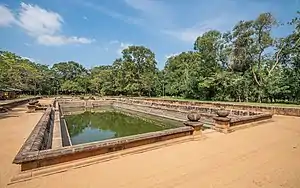
Kuttam Pokuna (twin ponds/pools) is one of the best preserved examples of bathing tanks or ponds in Sri Lanka. This pair of ponds were built by the Sinhalese in the ancient kingdom of Anuradhapura. They form part of the Abhayagiri vihāra complex and are considered one of the significant achievements in the field of hydrological engineering and outstanding architectural and artistic creations of the ancient Sinhalese.
Dimensions
The larger, southern pond is 132 feet (40 m) by 51 feet (16 m), while the smaller, northern pond is 91 feet (28 m) by 51 feet (16 m). The depths of the two ponds is 14 feet (4.3 m) and 18 feet (5.5 m) for the smaller pond and the larger pond respectively. The space between wall surrounding the compound and the two ponds is 18 feet (5.5 m).[1]
.jpg.webp) View of the ponds from the north
View of the ponds from the north.jpg.webp) The filter system
The filter system.jpg.webp)
 North pond from the south
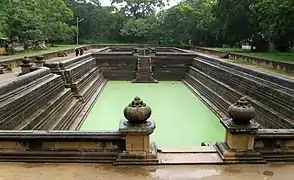 South pond from the south
Architecture
_7949853658.jpg.webp)
The two ponds are built in a 3 feet (0.91 m) deep, rectangular depression lined with a low wall. Five short stairs lead from the ground level into it. Next to one of these short stairs, in the northwest corner of the compound, a stone spout protrudes from the wall. According to older descriptions of the twin ponds the spout was supported by a small sculpture of a lion. However in recent photographs there is no sign of such a sculpture. The spout is the overflow of a small cistern, 4.5 feet (1.4 m) by 4.5 feet (1.4 m), on the other side of the wall.[3][4][5]
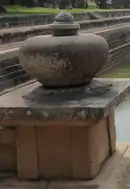
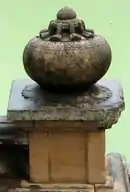
A low wall was built around each of the ponds. The faces of the ponds are cut granite slabs as are the bottom and the sides of the ponds. The ponds are made wider at the top than at the bottom, giving them a stepped slope, with steps too narrow to descend. Flights of stairs are seen on the northern and southern ends of the ponds. The southern pond has an additional flight of stairs on the western side. Unlike the other stairs, these do not protrude from the side of the pond. The stairs lead to the bottom of the pond and are decorated with punkalas, or pots of abundance, and scroll design. The northern pond is believed to be older than the southern pond.[6][1][7][2]
Although the ponds look very much alike at first glance, there are marked differences. The punkalas of the larger pond are more ornate, for example, and so are the banisters of the stairs. The sides of the large pond also have terraces on several levels, which are broad enough to walk or sit on and can be reached from the stairs.[3]
The northern side of the small pond is adorned with a sculpture of a five-hooded cobra (Nāga) under an arch of makaras. Another makara shape can still be recognised in the nearby stone spout.[6][2]
Water was transported from a rainwater reservoir over a distance for 3 kilometres to the ponds through underground ducts. Before the water entered the northern pond via a stone spout in the northern wall, it passed through a filter system. Through an underground duct the water passed from the north pond to the south pond. Eventually the water was drained from both ponds, to be used to water nearby rice fields. The ponds themselves were used by the Abhayagiri vihāra monks to bathe.[8][7][9] However, some sources speak of the baths being used by kings and queens.[10]
Restoration
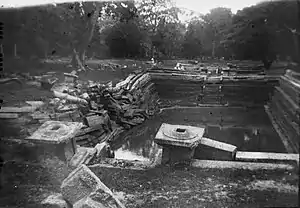
Between 1950 and 1955 the ponds were restored to their former appearance, including the surrounding, low wall, after having been left unattended for centuries. There had been one previous, less than successful attempt before that time. Most of the original punkalas turned out to be missing. They had either been stolen or destroyed. These punkalas were replaced by faithful, concrete copies of the ones that were found on the site.[3]
The underground drain was left unrestored.[3]
Dr. Senarath Paranavithana, Archaeological Commissioner of the Department of Archaeology of Sri Lanka from 1940 to 1956, was actively involved in the restoration of the ponds. During the restoration activities, a metal pot was found on the bottom of one of the ponds. In it were some small figurines, like a frog, a tortoise, a crab, several fish, a metal conch and a dancing woman.[2][8]
See also
References
- Anuradhapura by Dr. Rohan Hettiarachchi, Virtual Library Sri Lanka, retrieved 20 November 2021
- Kuttam Pokuna ( twin pond ) by Visit Anuradhapura, retrieved 22 November 2021
- Kuttam Pokuna (twin ponds) by Thilina Deepthi Karunachandra, 2018, retrieved 26 November 2021
- CEYLON 4. Architectural remains, Anuradhapura, Ceylon: measured, drawn and described by James G Smither, published by the Ceylon Government, 1872
- The Buried Cities of Ceylon: A Guide to Anuradhapura and Pollonarua by Stephen Montagu Burrows, A.M. & J. Ferguson, 1899, retrieved 3 December 2021
- Water Architecture in South Asia: A Study of Types Developments and Meanings by Julia A. B. Hegewald, Brill, Studies in Asian Art and Archaeology No. 24, Leiden, 2002, ISBN 9004123520
- Letters from Sri Lanka – Greywater Recycling at Kuttam Pokuna (the Twin Pools) by Craig Mackintosh, Permaculture Research institute, August 12, 2009, retrieved 22 November 2021
- Abhayagiri Vihara - The Northem Monastery (Uttararamaya) by Dr. Rohan Hettiarachchi, Virtual Library Sri Lanka, retrieved 20 November 2021
- Kuttam Pokuna by Lanka Travel Directory, retrieved 24 November 2021
- Summer in Ceylon by N. Maisondeau, Ceylon Observer, Colombo, 1909, retrieved 30 November 2021
External links
 |
Wikimedia Commons has media related to Kuttam Pokuna. |