Stinson L-5 Sentinel
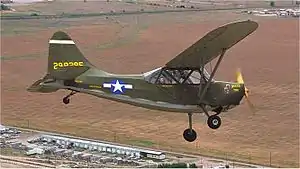
The Stinson L-5 Sentinel was a World War II era liaison aircraft used by most branches of the U.S. military and by the British Royal Air Force. It was produced by the Stinson Aircraft Company. Along with the Stinson L-1 Vigilant, the L-5 was the only other American liaison aircraft of World War II that was purpose-built for military use and had no civilian counterpart. All other military liaison airplanes adopted during World War II were lightly modified "off-the-shelf" civilian models. It is commonly mistaken that the L-5 was a military version of the Stinson 105 or Model 10 Voyager, or the YO-54 military flight-test variant of the Voyager. That is not true, but this misinformation persists on many prominent websites.
| L-5 Sentinel | |
|---|---|
 | |
| Role | Liaison / observation / light plane |
| Manufacturer | Stinson |
| First flight | June 28, 1941 |
| Produced | 1942–1945 |
| Number built | Over 3,896 |
| Developed from | Stinson YO-54 |
Design and development
The origins of the L-5, affectionately known as the "Flying Jeep", can be traced to the prewar civilian Stinson HW-75,a 75 horsepower civilian high-wing design built by the Stinson Aircraft Company at Wayne, Michigan and marketed as the Model 105. The L-5 is distantly related to that airplane was but not a militarized version of it. The prototype HW-75 first flew in February 1939 with a 50 hp engine but the production Model 105 airplanes were fitted with either the standard 75 hp engine, or an optional 80 hp powerplant. The Stinson 105 featured two side-by-side seats up front and a third "jumpseat" in the rear of the small cabin on which a child or small adult small could sit sideways. Featuring aerodynamic Handley-Page style slots on the outer third of the wings, the design was easy to fly, difficult to stall aerodynamically, and nearly impossible to spin.
In 1940, the Model 105 saw some minor improvements and was marketed as the "New 105". Four months later, in keeping with the automobile industry practice of introducing a new model in the spring each year, Stinson came out with the Model 10 Voyager that had a slightly wider cabin and some cosmetic changes but was essentially still a Model 105 with a new look. In early 1940, Stinson moved production from Michigan to a new factory built in Nashville, Tennessee where the Model 10's were built. Shortly after this move, the company became a subsidiary of the Vultee Aircraft Corporation. For the 1941 model year, more cosmetic changes and interior refinements were made and a 90 hp Franklin 4-cylinder engine was fitted. This version was sold as the Model 10A Voyager. In the postwar era, the fuselage of the 10A was enlarged to accommodate four seats, and the four-cylinder powerplant was replaced with a Franklin 125 hp six-cylinder engine, and eventually a 150hp and 165 hp "heavy case" version. This 4-seat conversion became the Stinson Model 108 Voyager and was the only civilian plane commercially produced by Stinson after WWII. The prototype first flew in December 1944.
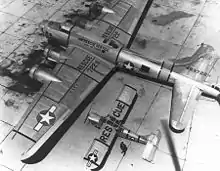
Six examples of the Model 10 Voyager equipped with 80 horsepower Continental A-80 engines, Lear radios and wind-driven electric generators were purchased by the military for testing under the experimental designation YO-54. Evaluated in September 1940 by the Air Corps for potential use as a low-cost off-the-shelf replacement for the complex, expensive and much larger O-49 Vigilant that Stinson had designed in 1939, the YO-54 failed to meet performance requirements and other military criteria. While the YO-54's were being evaluated, Stinson expected this rejection and on speculation they reconfigured the fuselage for tandem seating and added a Plexiglas "greenhouse", hoping the military would be more interested in this modified version. Known as the V-75B, and later as the V-75C with a more powerful engine, this lightly reworked version of the Voyager was also rejected by the Air Corps without undergoing formal trials. Stinson was advised that if they wished to obtain a contract for a low-cost replacement for the Vigilant that it had to be designed to Army-Navy engineering requirements as the O-49 had, not the lighter-duty CAA standard for civilian airplanes.
At that point, Stinson went back to the drawing board and designed a "clean sheet" tandem-seat airplane that met all of the military requirements. The only features that it shared with the civilian Model 10 / YO-54 were the airfoil, wing slots, and oleo-damped cantilevered main landing gear. Outwardly, it looked similar to the V-75C, but it was a completely different and much stronger airframe from the wheels up. It was also powered by a Lycoming six-cylinder O-435 engine of 175 horsepower that had been designed specifically for use on the new prototype V-76 (a designation in keeping with Stinson's new parent company Vultee). This aircraft, nicknamed the "Flying Jeep" by factory personnel, was now a very distant third cousin of the HW-75 / Model 105. Accepted in principle by the Wright Field Material Division after accelerated service trials were completed in September 1941, a purchase agreement was reached just days before the Japanese surprise attack on Pearl Harbor. The formal contract for 275 airplanes was signed in January 1942. In succeeding months and years, that contract would be greatly expanded to eventually number 3,590 planes delivered before the war's end. The RAF in India received 100 of them, and the U.S. Marine Corps 306.
Originally assigned the designation O-62 ('O' for observation) in 1941, by the time the first production examples were ready in November of 1942 the light observation category had been renamed "liaison" by the recently re-organized Army Air Forces. This occurred in March 1942 when all the light planes received the L-designation. Under the new system, the Taylorcraft O-57 became the L-2, the Aeronca O-58 became the L-3, and the Piper O-59 Cub became the L-4. The primary purpose of liaison category aircraft was courier and communication work and artillery spotting. In 1943 this was expanded to casualty evacuation. The fuselages of later models of the L-4 and L-5 were modified so that the aircraft could also be used for air ambulance or light cargo work. With a wider and deeper rear fuselage section and a large rear door that folded downward, the L-5B and subsequent variants could accommodate litter patient on all types of American and British "stretchers", or up to 250 pounds of cargo distributed between the fore and aft platforms.
The L-5 series was manufactured between November 1942 and September 1945, during which time 3,590 of the unarmed two-seaters were built for the United States armed forces, making it the second most numerous liaison aircraft of the war behind the Piper L-4 Cub.
Construction
The fuselage was constructed using chrome-moly steel tubing covered with doped cotton fabric. The wings and empennage were constructed of spruce and mahogany plywood box spars, plywood ribs and plywood skins. These components were also covered with fabric. The use of aluminum, which was in critically short supply and more urgently needed for other aircraft, was limited to the engine cowling, tail cone, framework for the ailerons, rudder and elevator, and the landing gear fairings. As mentioned previously, the L-5 was powered by a six-cylinder Lycoming O-435 engine of 185 horsepower (the prototype was 175) that was increased to 190 hp on the L-5G with improvements a better carburetor and changes in the induction system..
Operational history
Capable of operating from roads, meadows or short, hastily preparedairstrips, the L-5 "Sentinel" carried messages and VIP's, delivered troops, supplies, mail and ammunition to front line units. On return flights, wounded or critically ill personnel were often evacuated to rear area field hospitals for medical treatment, boosting the morale of combat troops fighting in remote areas. L-5s were also used for aerial photography, controlling vehicle convoys, para-dropping food, medical supplies and ammunition, laying communication wire, distributing propaganda leaflets, spraying pesticide, transporting prisoners, and directing fighter-bombers to ground targets. The L-5 was also popular with generals and other high-ranking officers for fast, efficient short-range transportation.
After tests on land, the "Brodie" system was first tested in September 1943 for shipboard use with an installation on the liberty ship City of Dalhart. Staff Sergeant R. A. Gregory made ten good takeoffs and hookups with a Stinson L-5 light plane.[1] During the Battle of Okinawa, L-5s operated from an LST using the Brodie landing system which allowed a light aircraft to take off and land without a flat surface by snagging a wire hung between two booms. One of the L-5s that used the Brodie system off Okinawa is now on display in the Boeing Aviation Hangar facility of the Smithsonian's NASM's Udvar-Hazy Center annex at Dulles Airport just west of Washington, DC.[2][3]
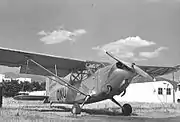
The USAAF, US Marines, and US Navy used this aircraft in the European, Pacific, and Far East theaters during World War II, and in Korea during the Korean War.
The Navy and Marine version of the L-5 through L-5E were designated OY-1, and all these aircraft had 12-volt electrical systems. The 24-volt L-5G became the OY-2. Neither the L-5G nor OY-2 saw combat during World War II because production did not begin until July 1945, just weeks before the war ended, but they were used extensively during the Korean War. The British Royal Air Force (RAF) procured 40 L-5s and 60 L-5Bs, and designated them Sentinel Is and Sentinel IIs respectively. These aircraft were used exclusively in the India-Burma theater of operations.
After World War II, the L-5 was widely used by the Civil Air Patrol for search and rescue work. Many other countries also received L-5s after the war, particularly India which received 200. A number of these went to Pakistan after the partition of India in 1948. From 1950 in India, L-5s were used by flying clubs to teach civilian pilots until about 1973 when a lack of spares forced their retirement.
Variants
_launches_OY-2_Sentinel_off_Korea_on_22_September_1950_(80-G-420239).jpg.webp)
Five versions of the Sentinel were produced for the U.S. Army Air Force (USAAF); the L-5, L-5B, L-5C, L-5E and L-5G. There was no official L-5A variant as is often reported because the designation was intended for a version of the aircraft that was never built. Nonetheless, many people in and out of the military still refer to the standard "observer" version of the L-5 as an L-5A. Like the L-5A, the L-5D was a planned version that was not adopted. A single L-5F was an L-5B equipped with an experimental low-noise "stealth" propeller and exhaust system for research purposes. The L-5B through L-5G models were modified to carry a litter patient or light cargo, or a rear seat passenger sitting in the normal position. An L-5H version was on the drawing boards at Stinson when the war ended, and it never reached the prototype stage.
- O-62
- Observation, artillery spotting and liaison aircraft, powered by a Lycoming 0-435-1 piston engine; 275 built.
- L-5
- Observation, artillery spotting and liaison aircraft; 1,538 built, 79 transferred to USN/USMC as OY-1.
- L-5A
- Cancelled conversions of L-5 with 24V electrical system and 200 hp (150 kW) ranger engine.
- L-5B
- 729 aircraft with rear fuselage hatch to permit loading of a stretcher or cargo; twin-float capability; 60 transferred to RAF as Sentinel Mk II, 40 transferred to USN/USMC as OY-1.
- L-5C
- 200 L5-B were equipped K-20 reconnaissance cameras.
- L-5D
- Not adopted. No prototype built.
- L-5E
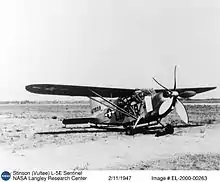
- 750 STOL variants with larger tires and brakes and manually drooping ailerons allowing shorter takeoff and landing; 152 transferred to USN/USMC as OY-1. An L-5E-1 variant included larger wheels and tires and heavy duty brakes. Thirty L-5E's were later converted to 24 volt electrical systems and re-designated OY-2.
- L-5G
- Similar to L-5E but with a 24 volt electrical system and powered by 190-hp (142-kW) Lycoming 0-435-11 piston engine with improved cylinders and carburetor and fitted with controllable pitch propellers. 115 were built by end of the war and the contract for 785 others was cancelled. Final production model redesignated U-19B in 1962.
- XL-5F
- One test and evaluation aircraft, powered by a Lycoming 0-435-2 piston engine.
- U-19A
- L-5 variants still in service redesignated U-19A by the USAF in 1962.
- U-19B
- L-5G redesignated U-19B in 1962. One used as a glider tug at the United States Air Force Academy.
- OY-1
- 306 L-5 and L-5Bs transferred to the United States Marine Corps and United States Navy.
- OY-2
- 152 transfers of L-5E to USN/USMC; 30 OY-1 conversions to 24V electrical system.
- Sentinel Mk I
- 40 L-5s supplied to the RAF under Lend-Lease.
- Sentinel Mk II
- 60 L-5Bs supplied to the RAF under Lend-Lease.
- L-5/235
- variant powered by Lycoming O-540-B, 235 hp (175 kW), used for glider towing.
Operators
.svg.png.webp)
- Royal Australian Air Force – operated one L-5 Sentinel from 1944 to 1946, loaned from the USAAF.
.svg.png.webp)

- Government of Indonesia – acquired a Sentinel during Indonesian National Revolution[5]

- Italian Air Force - operated 119 Stinson L-5 Sentinel from 1946 until 1961.[6]

- National Security Force
- Japan Ground Self-Defense Force

.svg.png.webp)
- Philippine Army Air Corps 1945 to 1947
- Philippine Air Force[7]

- Polish Air Force – The fuselage of the sole L-5 used in Poland after 1945 is displayed at the Polish Aviation Museum.





Surviving aircraft
_(29694988143).jpg.webp)
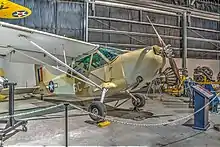
Today there are about 300 known examples left worldwide and less than half are in flying condition.[9] A group called the Sentinel Owners and Pilots Association is dedicated to the preservation and enjoyment of this aircraft type.[10]
Australia
- Airworthy
- OY-1
- 03995 – operated by Robert William Kemmis in Coolangatta, Queensland, Australia. This example was built for the USAAF but was delivered directly to the US Navy instead, serving until 1949.[11][12][9]
United States
- Airworthy
- OY-1
- 42-15060 – operated by the Commemorative Air Force FloriBama Wing in Pensacola, Florida.[13][14]
- OY-2
- 44-18143 – operated by the Commemorative Air Force Lake Superior Squadron in Superior, Wisconsin.[15][16]
- L-5
- c/n 76-272 – operated by the Commemorative Air Force Dallas Fort Worth Wing in Lancaster, Texas.[17][18]
- 42-98285 – operated by the Commemorative Air Force Dew Line Squadron in Amarillo, Texas.[15][19]
- 42-98667 – operated by the Commemorative Air Force Minnesota Wing in South St. Paul, Minnesota.[20][21]
- 42-98758 or 42-990444 – operated by the Commemorative Air Force Capital Wing in Brandy Station, Virginia.[22][23]
- 44-17543 - privately owned in White Hall, Maryland. It is an ETO Combat Veteran with Army Ground Forces (AGF).[24][25]
- 44-17588 – operated by the Fighter Factory/Military Aviation Museum in Pungo, Virginia.[26][27]
- 44-17590 – operated by the Commemorative Air Force Central California Valley Squadron in Modesto, California.[28][29]
- 44-17944 - operated by George J. Marrett in Paso Robles, California at the Estrella Warbird Museum. FAA registry N45CV.
- On Display
- OY-1
- 03917 – Travis Air Force Base Heritage Center in Fairfield, California. It is painted as an L-5.[30][9]
- L-5
- 42-98184 - Museum of Aviation, Robins AFB.[31]
- 42-14798 – Steven F. Udvar-Hazy Center of the National Air and Space Museum in Chantilly, Virginia. This airframe is the first production L-5 built and was donated to the museum on 5 June 1960.[32]
- 42-14918 – Flying Leatherneck Aviation Museum in San Diego, California.[33][9]
- 42-15046 – March Field Air Museum in Riverside, California.[34][9]
- 42-98144 or 42-98453 – National Naval Aviation Museum in Pensacola, Florida.[35][36][9]
- 42-98225 – National Museum of the United States Air Force in Dayton, Ohio.[37][9]
- 44-17925 – Vintage Flying Museum in Fort Worth, Texas.[38][39]
- 44-18010 – EAA AirVenture Museum in Oshkosh, Wisconsin.[40][9]
- 45-35046 – South Dakota Air and Space Museum, Box Elder, South Dakota.[41]
- Under Restoration or in Storage
- 42-14934 – to airworthiness with the Commemorative Air Force Air Group One in El Cajon, California.[42][43][44]
Netherlands
- Airworthy
- L-5
- 44-17113 - VW registration PH-PBB airworthy with the Dutch Dakota Association.[45]
Specifications (L-5)
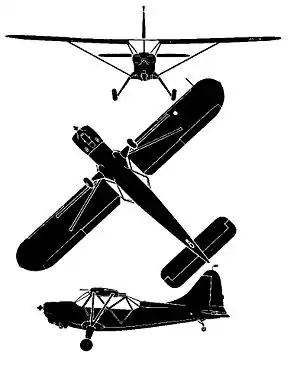
Data from Stinson L-5 Sentinel[46]
General characteristics
- Crew: 2 (pilot and observer)
- Length: 24 ft 1 in (7.34 m)
- Wingspan: 34 ft 0 in (10.36 m)
- Height: 7 ft 11 in (2.41 m)
- Wing area: 155 sq ft (14.4 m2)
- Airfoil: NACA 4412[47]
- Empty weight: 1,550 lb (703 kg)
- Max takeoff weight: 2,050 lb (930 kg)
- Powerplant: 1 × Lycoming O-435-1 6-cylinder air-cooled horizontally-opposed piston engine, 185 hp (138 kW)
- Propellers: 2-bladed fixed-pitch propeller
Performance
- Cruise speed: 130 mph (210 km/h, 110 kn) maximum
- 105 mph (91 kn; 169 km/h) normal
- Stall speed: 42 mph (68 km/h, 36 kn)
- Never exceed speed: 163 mph (262 km/h, 142 kn)
- Range: 375 mi (604 km, 326 nmi)
- Service ceiling: 15,800 ft (4,800 m)
- Rate of climb: 900 ft/min (4.6 m/s) at sea level
Armament
None (technically). Some aircraft had jury rigged anti-tank rocket launchers (mainly bazookas) installed and used with success against ground targets in WWII.
See also
Related development
Aircraft of comparable role, configuration, and era
Related lists
References
Notes
- "Bax Seat: Hanging Out With the Brodies". Flying Magazine. Los Angeles: CBS Magazines. 112 (12): 96. December 1985. Retrieved 2 September 2019.
- "NASM – Collections – Objects – Stinson L-5 Sentinel". National Air & Space Museum. Retrieved December 9, 2015.
The L-5 is one of the most important but overlooked aircraft of the Second World War. Versatile and durable, the L-5 flew a wide variety of missions: photo reconnaissance, resupply, evacuation of wounded, message courier, VIP transport, and artillery spotting.
- "L-5 Used in Pacific With Brodie System YouTube
- Bridgman 1951, p. 11a.
- "Indonesian aviation 1945-1950." Archived 14 December 2005 at the Wayback Machine adf-serials.com. Retrieved: 20 March 2021.
- aeroflight
- Bridgman 1951, p. 16a.
- Bridgman 1951, p. 20a.
- Gray, James (Summer 2014). "L-5 Newsletter" (PDF). Sentinel Owners & Pilots Association. Retrieved 6 December 2016.
- "[Home Page]". Sentinel Owners & Pilots Association. Retrieved 6 December 2016.
- Flypast Magazine, July 2007, Key Publishing Ltd.
- "Aircraft Register [VH-NOY]". Australian Government Civil Aviation Safety Authority. Retrieved 6 December 2016.
- "OY-1 Stinson/42-15060." Commemorative Air Force. Retrieved: 11 February 2020.
- "FAA Registry: N9315H." faa.gov Retrieved: 11 February 2020.
- "CAF Liaison/Observation". Commemorative Air Force. Retrieved 11 February 2020.
- "FAA REGISTRY [N5138B]". Federal Aviation Administration. U.S. Department of Transportation. Retrieved 18 May 2017.
- "Stinson L-5". DFW Wing. Retrieved 18 May 2017.
- "FAA REGISTRY [N57789]". Federal Aviation Administration. U.S. Department of Transportation. Retrieved 18 May 2017.
- "FAA REGISTRY [N63777]". Federal Aviation Administration. U.S. Department of Transportation. Retrieved 18 May 2017.
- "Stinson L-5 Sentinel". Commemorative Air Force Minnesota Wing. Retrieved 17 December 2016.
- "FAA REGISTRY [N68591]". Federal Aviation Administration. U.S. Department of Transportation. Retrieved 18 May 2017.
- "Our Stinson L-5 Sentinel". Capital Wing of the Commemorative Air Force. Retrieved 18 May 2017.
- "FAA REGISTRY [N1156V]". Federal Aviation Administration. U.S. Department of Transportation. Retrieved 18 May 2017.
- "Stinson L-5 Sentinel/44-17543." aerialvisuals.ca Retrieved: 13 February 2020.
- "FAA Registry: N3706C." faa.gov Retrieved: 13 February 2020.
- "Stinson L-5 Sentinel/44-17588." Military Aviation Museum. Retrieved: 13 February 2020.
- "FAA Registry: N57WT." faa.gov Retrieved: 13 February 2020.
- "Aircraft". Central California Valley Squadron. Retrieved 18 May 2017.
- "FAA REGISTRY [N5625V]". Federal Aviation Administration. U.S. Department of Transportation. Retrieved 18 May 2017.
- "Indoor Exhibits – Humanitarian Missions". Travis Air Force Base Heritage Center. Travis Heritage Center. Retrieved 13 February 2020.
- "Stinson L-5 Sentinel/42-98184." Museum of Aviation. Retrieved: 11 February 2020.
- "Stinson L-5 Sentinel". Smithsonian National Air and Space Museum. Retrieved 6 December 2016.
- "Aircraft Listing". Flying Leathernecks. Missing or empty
|url=(help) - "L-5 Sentinel". March Field Air Museum. March Field Air Museum. Retrieved 6 December 2016.
- "OY-1 SENTINEL". National Naval Aviation Museum. Naval Aviation Museum Foundation. Retrieved 6 December 2016.
- "Airframe Dossier – Stinson OY-1 Sentinel, s/n 60465 USMC, c/n 76-0385, c/r N57598". Aerial Visuals. AerialVisuals.ca. Retrieved 6 December 2016.
- "Stinson L-5 Sentinel". National Museum of the US Air Force. 17 April 2015. Retrieved 6 December 2016.
- "Our Collection". Vintage Flying Museum. Retrieved 6 December 2016.
- "Airframe Dossier – Stinson L-5E Sentinel, s/n 44-17925 USAAF, c/n 76-3199, c/r N1135V". Aerial Visuals. AerialVisuals.ca. Retrieved 6 December 2016.
- "1944 Stinson L-5B-1VW Sentinel – PH-PBB". EAA. EAA. Retrieved 6 December 2016.
- "South Dakota Air and Space Museum". www.sdairandspacemuseum.com. Retrieved 22 June 2019.
- "1943 Stinson L-5 Sentinel". Air Group One. Air Group One CAF. Retrieved 18 May 2017.
- "STINSON SENTINEL" (PDF). 27 June 2013. Retrieved 18 May 2017.
- "FAA REGISTRY [N59AF]". Federal Aviation Administration. U.S. Department of Transportation. Retrieved 18 May 2017.
- "1944 Stinson L-5B-VW Sentinel – N9658H". DDA. DDA. Retrieved 9 December 2017.
- "Stinson L-5 Sentinel". March Field Air Museum. Archived from the original on 15 September 2000. Retrieved 19 November 2020.
- Lednicer, David. "The Incomplete Guide to Airfoil Usage". m-selig.ae.illinois.edu. Retrieved 16 April 2019.
Bibliography
- Bavousett, Glenn B. World War II Aircraft in Combat. New York: Arco Pub. Co, 1976.
- Bridgeman, Leonard. Jane's All the World's Aircraft 1951–52. London: Samson Low, Marston & Company, Ltd., 1951.
- Elliot, Bryn (March–April 1997). "Bears in the Air: The US Air Police Perspective". Air Enthusiast. No. 68. pp. 46–51. ISSN 0143-5450.
- Love, Terry M. L-Birds: American Combat Liaison Aircraft of World War II. New Brighton, Minnesota: Flying Books International, 2001. ISBN 978-0-911139-31-0.
- Morgała, Andrzej. Ex-USAAF aircraft 1945: Piper L-4 Grasshopper, Douglas C-47 Skytrain/Dakota, Cessna UC-78 Bobcat, Stinson L-5 Sentinel, Taylorcraft L-2A Grasshopper. Sandomierz: STRATUS, 2011.
- "Pentagon Over the Islands: The Thirty-Year History of Indonesian Military Aviation". Air Enthusiast Quarterly (2): 154–162. n.d. ISSN 0143-5450.
- Young, Edward (Spring 1994). "Counter-Air: 2nd Air Commando Group in Burma & Thailand". Air Enthusiast. No. 53. pp. 10–19. ISSN 0143-5450.
External links
 |
Wikimedia Commons has media related to Stinson L-5 Sentinel. |
- Sentinel Owners and Pilots Association (SOPA), an organization dedicated to restoring, flying, maintaining and increasing public awareness of the Stinson L-5.
- "America Reports On Aid To Allies etc." Universal Newsreel, 1942
Authority control  |
|---|