Lake Svetloyar
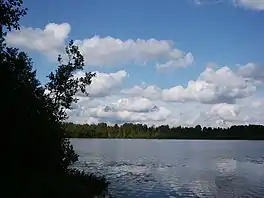
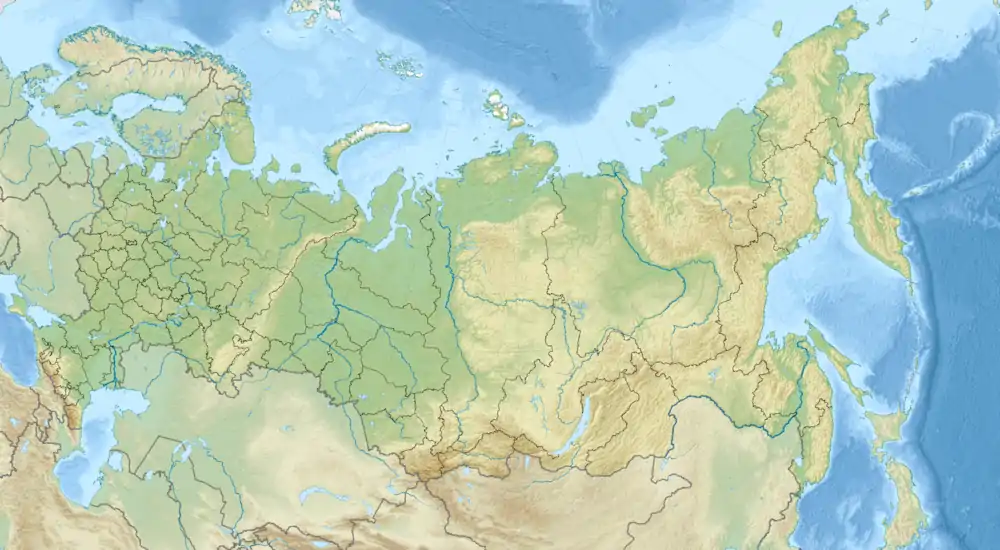
Lake Svetloyar (Russian: Озеро Светлоя́р, romanized: ozero svetloyar) is a lake in the Voskresensky District of the Nizhny Novgorod Oblast in central Russia. It is located within Voskresenskoe Povetluzhye Nature Park. In 2015, the lake was included in the Register of Cultural Heritage Objects as an object of cultural heritage of local significance.[1] It is closely associated with the Legend of Kitezh, a sunken city.
| Lake Svetloyar | |
|---|---|
 | |
  Lake Svetloyar | |
| Location | Nizhny Novgorod |
| Coordinates | 56°49′07″N 45°05′35″E |
| Type | unknown |
| Native name | Светлояр (Russian) |
| Max. length | 0.5 kilometres (0.31 mi) |
| Max. width | 0.35 kilometres (0.22 mi) |
| Surface area | 0.1483 square kilometres (0.0573 sq mi) |
| Max. depth | 33.4 metres (110 ft) |
| Surface elevation | 109 metres (358 ft) |

Description
The lake is located in between the Kerzhenets and Vetluga rivers, both tributaries of the Volga river.[lower-alpha 1] The area was declared a natural park in 2008. The lake has an oval shape (470 × 350 m) with the longer axis aligned north-south. It reaches a depth of 33.4 m.[2] Its deepest point is in the southern part of the lake, which rises to a shallow platform ranging in depth from 22 to 24 m. In the northern, relatively shallow part of the lake, the depth change is smoother comparatively.
The surface of the lake is 109 m above sea level. Its shores are somewhat elevated and the lake itself lays in a small basin. The hills that encircle it are most distinctly manifested from the south, where they form an arc. The height of the hills reaches 122–124 m above sea level (13–15 m above the lake's water level) and are separated by deep (7–8 m) ravines.[2]
The lake's water is transparent to a depth of more than 5 m. The lake is said to be relatively cold. The banks are weakly swamped.[2] To the north-east is the small, shallow Lunda River, from which the lake is connected by a stream. The runoff from the lake through the stream was disturbed during the construction of a road during the Soviet era. As a result, the lake began to swamp. Restoration of natural lake flow occurred in the 1990s.
In the 2000s, a number of studies confirmed the meteorite hypothesis of the origin of Svetloyar and some neighboring lakes.[3] In 2009, the results of field studies were published, confirming the hypothesis of the meteoric origin of the lake 3.0-3.2 thousand years ago.[4]
The volume of the lake basin (not the lake itself) is about 1.5 km3, and the area of the lake itself is 14.83 hectares. The thickness of the bottom sediments is about 8 m.[2]
Origin
Various researchers during different timeframes have hypothesized about the glacial, karstic, old, volcanic, neotectonic, salt-dome, and meteorite origin of the lake. The first explorer of the lake in the late 19th century was a Russian geologist, Vasily Dokuchaev, who suggested it was a meteorite crater. The volcanic origin of the lake was first suggested in the early 20th century by the writer Vladimir Korolenko. Amateur archaeologist A. P. Polivanov[5] conducted excavations on one of the Svetlogorsk hills and discovered the remains of ancient tools related to the Stone Age.
In 1969, under the leadership of Mark M. Barinov,[6] scuba divers using acoustical systems detailed the complex structure of the relief of the bottom of the lake. The central pit-hollow is fringed by a system of two underwater terraces, expanding in the northern and narrowing in the southern parts of the lake and having depths of 18-20 and 9–10 m, respectively. It was suggested that a multistage cyclic-periodic formation, very young in the scale of geological time, as a result of neotectonic processes. Based on this, it was concluded that the central basin was formed a little more than a millennium (about 1100–1200 years) ago in the form of a small lake with a depth of 15–17 m, and the immersion of the lower terrace occurred approximately 700–800 years ago.
Recently, a number of studies confirmed the meteorite hypothesis of the origin of Svetloyar and some neighboring lakes. In 2009, the results of field studies bolstered the hypothesis of the meteorite origin of the lake, around 3 thousand years ago. The correct form, depth, the geological structure of the surrounding hills, the stratigraphy of bottom sediments, numerous fragments of fused rocks, rounded teardrop formations of a black foamed vitreous mass, analogous to impactites, attest to the meteorite origin of the lake. The heavenly body that created Svetloyar could move from north to south along a low trajectory at an angle of 30-40 ° to the Earth's surface.
Media coverage
In 1993, the creative association "Ekran" (Russian: Экран, romanized: Ekran, lit. 'Screen') released the film "The Tale of the Great and Invisible City of Kitezh" (writer and director V. Kukushkin), about "the mythological roots and the search for the invisible" City of Kitezh under Lake Svetloyar.[lower-alpha 2] The film was shown on the first channel of Central Television in Easter on April 17, 1993, before the first television broadcast of the Easter service from the Epiphany Cathedral in Moscow.
In literature
In the 19th century novel by the ethnographer-fiction writer PI Melnikov-Pechersky "In the Forests",[7] Lake Svetloyar is described as an ancient place of departure of folk holidays with vivid remnants of paganism, which through the efforts of "zealots of ancient piety" from neighboring sketes, were gradually eradicated in the people's memory and replaced by the legend of the "city of Kitezh":
Skete elders and cell mothers were jealous ... “Why,” they said, “are these nightly splashing, why is the baptized people raging, playing tambourines and snuffling the devil, defiling the Lord's holidays with string hum, demonic songs, long splashing, Herodian dancing? .. Why do wives and virgins come to those satanic gatherings?… Why, in their shameless dances, do they nod, wiggle their ridges, jump and trample with their feet, a cry and bad songs are disliked with their lips? !… It is not befitting to do this! It is disgusting to God, damned by the holy fathers!…"
And they announced the Light Yar and the hills above it "holy places" ... Here, they said, there is an invisible city of God's saints, the city of Great Kitezh ... But we, sinners, cannot see its beauty, the place will be polluted by demonic deeds ...
And God-loving elders and honorable mothers began to come to Lake Svetloyar with books, crosses, icons on the shores of the lake ... They began to read the Psalter and sing canons on the shores of the lake, compiled the Kitezh "Chronicler" and began to read it to the people who came to celebrate Yarilin holidays. And on those cell gatherings, other lights glowed - on the night of Agrafena's day, the Bathers began to hang lamps from oak trees, sculpt wax candles, hang icons on branches ...
Notes and references
- [https://okn-mk.mkrf.ru/maps/show/id/3251384 О включении выявленного объекта культурного наследия - достопримечательного места "Культурно-ландшафтный комплекс "Озеро Светлояр и село Владимирское" в единый государственный реестр объектов культурного наследия (памятников истории и культуры) народов Российской Федерации как объекта культурного наследия муниципального значения и об утверждении границы территории данного объекта] On the inclusion of the identified object of cultural heritage - sightseeing place "Cultural and landscape complex" Lake Svetloyar and the village of Vladimirskoe "into a single state register of cultural heritage objects.
- Енгалычев С. Ю. Озеро Светлояр — голоценовый метеоритный кратер на востоке Нижегородской области Lake Svetloyar - Holocene meteorite crater in the east of the Nizhny Novgorod region // Regional geology and metallogeny. 2009 n°37 p.40—50.
- Kiselev A. K. (2006) The meteoritic nature of the calderas of the lakes Svetlojar and Nestiar (abstract). In: 40th Symposium ESLAB, First International Conference on Impact Cratering in the Solar System, 8-2 May 2006, P.113.
- "The legendary lake Svetloyar could have appeared when a meteorite fell". rian.ru (in Russian). 20 October 2009.
- "Поливанов А.П. Исследование Богородскаго городища".
- Barinov, M.M., 'The new worlds of underwater archaeology - diving into the past', UNESCO Courier, May 1972 'Underwater Archaeology' (special issue), pp.5-7 - http://unesdoc.unesco.org/images/0007/000782/078276fo.pdf
- Book II, Part IV, Chapter I
- the protection zone of the Nizhny Novgorod Povetluzhye, a nature park of regional significance
- description given by the site of the Radio and Television Fund of the Russian Federation