Laleh Seddigh
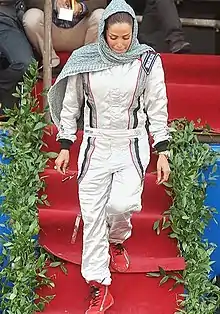
Laleh Seddigh (born 1977 in Tehran) is an Iranian racing driver.[1] She has been described as 'one of the most celebrated sportswomen in the Islamic Republic of Iran'.[2]
Biography
Early life
Seddigh started driving at the age of 13, taught by her father. She passed her driving test at 18.[3]
Career
Seddigh had to get special permission from a local ayatollah in order to compete against men. Permission was given since driving is not deemed a contact sport, and on the condition that Seddigh would confirm to dress-codes.[3]
Seddigh has said that she will not leave Iran as she is 'most effective' in promoting women's rights in Japan. Seddigh has trained other female racing drivers.[4]
Media
Seddigh's story is featured in a BBC TV documentary called Girl Racer, transmitted in 2008.[5]
References
- "LALEH BIOGRAPHY". lalehseddigh.com. Retrieved 2019-10-19.
- Tait, Robert (2007-03-04). "Iran's speed queen". the Guardian. Retrieved 2018-05-05.
- Girl Racer, BBC, 2008
- "How one woman overcame Iran's patriarchy to become its first female champion race car driver". Women in the World. 2015-11-20. Retrieved 2018-05-05.
- "Iranian Racing Authorities Stall Woman's Fast-Track Career". RadioFreeEurope/RadioLiberty. Retrieved 2019-10-19.
External links
In March 2005, 28-year-old Laleh Seddigh became the first woman to compete in Iran’s national saloon-car race. And – she won. Her participation challenged the traditions of her country and of her sport, both of which have got the reputation of being male-dominated. But challenging tradition is nothing new to Seddigh, who as a child preferred playing with boys instead of girls. At 13, five years before she reached the legal driving age, she learned to drive. Her instructor was her father, a successful businessman, who she says has always been her inspiration. “I have always liked to do those things that traditionally belonged to men, or which are supposed to be beyond the physical capacities of a woman,” she once told a reporter for an Australian newspaper.
Seddigh began racing shortly after getting her driving licence, but only against other women and mainly in cross- country races. At the same time, she studied industrial management and production engineering at Tehran University. Like car racing, these professions generally attract more men than women – and not only in Iran. By the time she asked Iran’s national auto racing federation for permission to compete against men, Seddigh had achieved years of racing experience and was studying for her PhD in industrial production and management. The day she won the race, she also became the first woman since the country’s 1979 revolution to compete against men in any sporting event. She followed the racing federation’s instructions to dress and behave “appropriately” on the winners’ platform by wearing a loose garment over her racing clothes and not speaking with the male drivers. But simply by standing there, Seddigh was proof of her conviction that, as she told a New York Times reporter, “Women have to believe in their inside power.”