SpaceX Starship
Starship is a fully reusable launch vehicle in development by American aerospace company SpaceX for the ultimate purpose of Mars exploration. The launch vehicle consists of a reusable stainless-steel Super Heavy booster and a Starship spacecraft, designed to hold liquid oxygen and liquid methane used by Raptor rocket engines. It is the tallest rocket ever built, taller than the Saturn V and the Space Launch System by 9 m (30 ft).
| Starship | |||||||||||||||||||||||||||||||||||
|---|---|---|---|---|---|---|---|---|---|---|---|---|---|---|---|---|---|---|---|---|---|---|---|---|---|---|---|---|---|---|---|---|---|---|---|
| super heavy-lift reusable launch vehicle built by SpaceX | |||||||||||||||||||||||||||||||||||
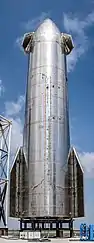
Starship spacecraft SN16 and Super Heavy booster BN4 | |||||||||||||||||||||||||||||||||||
| Has use | |||||||||||||||||||||||||||||||||||
| Manufacturer | |||||||||||||||||||||||||||||||||||
| Country of origin |
| ||||||||||||||||||||||||||||||||||
| Size | |||||||||||||||||||||||||||||||||||
| Height |
| ||||||||||||||||||||||||||||||||||
| Diameter |
| ||||||||||||||||||||||||||||||||||
| Stages |
| ||||||||||||||||||||||||||||||||||
| Launch history | |||||||||||||||||||||||||||||||||||
| Status |
| ||||||||||||||||||||||||||||||||||
| Launch sites | |||||||||||||||||||||||||||||||||||
| |||||||||||||||||||||||||||||||||||
| |||||||||||||||||||||||||||||||||||
.jpg.webp)

Starship's large mass and volume capacity to space and full reusability should make it both cost-competitive and able to serve many facets of spaceflight, including interplanetary spaceflight, space tourism, and fast point-to-point flights on Earth. With these capabilities, the rocket is incorporated into many space programs, such as the dearMoon project, NASA's Artemis program, and SpaceX's Mars program.
Starship was called the Mars Colonial Transporter, Interplanetary Transport System, and Big Falcon Rocket, each with substantially different designs. On 25 July 2019, Starhopper performed the first successful flight by any Starship prototype at the SpaceX South Texas launch site. The first complete Starship prototype was SN8, which crashed upon landing on 9 December 2020. On 5 May 2021, SN15 flew the same flight path as previous prototypes and soft-landed successfully. As of October 2021, Super Heavy BN4 and Starship SN20 are expected to become first prototypes to attempt reaching orbital velocity.
Background
| Part of a series on SpaceX's |
| Starship |
|---|
| Super Heavy & Starship |
 |
Although a large-scale, self-sufficient, and developed space economy is the industry's aim, the cost of accessing space has been a barrier to achieving it.[1] Little market competition emerged inside any national market, and within the United States high cost and preference to existing contractors made it difficult for commercial launch service providers to compete.[2] However, many measures of cost reduction had been implemented by various agencies and companies with varying success. One example is the development of small-lift launch vehicles, which the United States Air Force expected the launch cost to be less than ten million United States dollars.[3]
In the early 2010s, private spaceflight emerged and brought substantial competition into the existing market[1] with notable space vehicles for that sector including Falcon 9, Electron, and LauncherOne.[4] Also at that time, there have been numerous concepts and proposals for a human mission to Mars. However, none of them made it into technology development phase.[5]
Since at least 2009, SpaceX recovered the first stages of several early Falcon 9 flights to assist with the development of the reusable rocket stage. Initially, both stages were equipped with parachutes, but the mechanism failed to survive the extreme heat during atmospheric re-entry.[6] By late 2012, SpaceX abandoned parachute recovery, using the first stage's engines to propulsively land and abandoned reusing Falcon 9's second stage. The company then build Grasshopper, a technology demonstrator for first stage landing.[7] Technology developed for second stage reuse were instead transferred to Starship's development.[8]
Current design
The goal of Starship is to be a fully reusable orbital launch and reentry vehicle.[9] It is 120 m (390 ft) high and has a 9 m (30 ft) diameter,[10] taller than the Saturn V by 9 m (30 ft).[11] Starship consists of two stages: a Super Heavy booster and a Starship spacecraft;[12] both have a body made from SAE 304L stainless steel.[13] Starship and Super Heavy are also powered by Raptor and Raptor Vacuum engines, consuming liquid oxygen and methane.[14] Since SpaceX develops Starship via operational testing, meaning flying prototypes directly instead of testing each component, its design can change rapidly.[15]
A Starship launch can deliver more than 100 t (220,000 lb) of cargo and crew to low Earth orbit, and it can also send the same amount of payload to higher Earth, Moon, Mars, and other orbits after the spacecraft is refueled by tanker Starships.[16][17] The launch vehicle can be used to launch almost any space payload, instead of being specialized for only one facet of spaceflight.[18]
Raptor engine
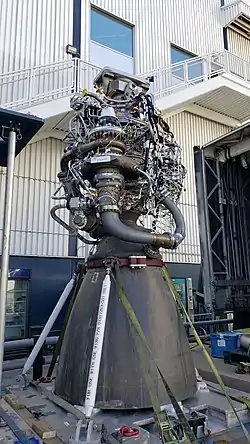
Both Starship's stages are equipped with Raptor engines, full-flow staged combustion cycle rocket engines consuming liquid methane and liquid oxygen.[14] Methane is chosen as Starship's propellant because it is cheaper, burns more cleanly, and can be produced on Mars via in-situ resource utilization.[19] In an interview with Tim Dodd, Elon Musk, SpaceX's CEO and chief engineer, stated that all Raptor engines would combust liquid oxygen and liquid methane in a ratio of 3.5 to 3.7, which is slightly less than the stoichiometric ratio. Matching the ratio between methane with oxygen molecules perfectly would generate extreme heat and melt the engines.[20] All Raptor engines should be able to fire many times, possibly up to a thousand each, late into manufacturing phase.[19]
For the Raptor Vacuum variant, it is equipped with a nozzle extension with a throat to exit area of 1 to 80 to increase Raptor's specific impulse in space to about 380 s (3.73 km/s). Later Starships might be equipped with an improved version of Raptor called Raptor 2, which feature increased thrust and slightly decreased specific impulse. In the same interview, Musk also mentioned that most of the Raptor 2 variant will be produced in a new SpaceX facility in McGregor, while SpaceX's factory at Hawthorne would be used to produce Raptor Vacuum and test new engine designs.[20]
The Raptor engine is the only operational full-flow staged combustion cycle engine: the Integrated Powerhead Demonstrator and RD-270 have the same power cycle, but never made into any operational vehicle.[19] A general full-flow staged combustion cycle engine has two preburners connected to their pair of turbopumps. Each is fed either with a mixture containing mostly liquid oxygen or a mixture containing mostly liquid methane. Unlike other engines, the engine combusts all propellant inside the preburner and provide engine turbines with more thrust and efficiency.[21]
Super Heavy booster
The Super Heavy booster measures 70 m (230 ft) tall[10] and may house up to thirty-three sea-level optimized Raptor engines.[22] Its tanks can hold about 3,600 t (7,900,000 lb) of propellant, consisting of about 2,800 t (6,200,000 lb) of liquid oxygen and 800 t (1,800,000 lb) of liquid methane. Without propellant, Super Heavy's mass ranges from 160 t (350,000 lb) to 200 t (440,000 lb).[20] Each booster can generate about twice the thrust of the S-IC, Saturn V's first stage.[22]
Four grid fins are installed above Super Heavy and controlled by electric motors via batteries. They are used to control Super Heavy's descent[20] and touchdown into a launch tower's pair of mechanical arms.[23] These grid fins are not spaced out evenly. Instead, they are positioned closer to make changing the booster's pitch easier. They will not retract during launch: Musk cited complexity, mass increase, and insignificant drag for the rationale. The booster would use evaporated gas from the tanks' ullage, empty volume, to control the booster's orientation and position, as well as exploit the Coriolis effect to separate from the spacecraft.[20]
Starship spacecraft
.jpg.webp)
The Starship spacecraft is attached to the top of the Super Heavy booster and is 50 m (160 ft) tall,[10] and the closest estimate of Starship's dry mass by Musk, is less than 100 t (220,000 lb).[20] The spacecraft is expected to hold 1,200 t (2,600,000 lb) of propellant[10] split into two main and two header tanks, each containing either liquid oxygen or liquid methane. The liquid methane header tank is placed in the middle of the two main tanks, while the liquid oxygen header tank is mounted at the nosecone. These header tanks are used to store propellant for landing the spacecraft using its engines with high accuracy.[24]
Six Raptor engines are mounted on its bottom. Three are optimized for operating in the atmosphere, and the other three optimized for vacuum operation called Raptor Vacuum.[25] It also has four body flaps to control the vehicle's falling velocity and orientation. Two are mounted at the nose cone and called aft flaps and the other two are mounted near the bottom and called forward flaps.[26] Starship's heat shield is made from many black tiles with some room to accommodate thermal expansion. They are mostly shaped into hexagons and mounted directly to the spacecraft. As well as being durable, they are able to enter the atmosphere multiple times. The spacecraft does not have a launch escape system as Starship should be reliable by the time it has humans on board.[20] Starship is expected to have 1,100 m3 (39,000 cu ft) of storage volume, far larger than any spacecraft ever built.[16]
SpaceX plans to build multiple Starship variants. For the cargo variant, a large door replaces conventional payload fairings, which can capture, store, and return payload and space debris to Earth. The payload door is closed during launch, opens to release payload once in orbit, then closes again during reentry. Another variant is called Starship tanker, which can fuel other Starships to increase the spacecraft's delta-v budget or range reaching Mars.[27] In 2019, SpaceX is partnering with NASA to further develop in-orbit cryogenic propellant fueling technologies.[28]
Starship HLS, another variant of Starship, will serve as a crewed lunar lander for NASA's Artemis program and be accompanied by Starship tankers and Starship propellant depot variants. By having Starship tankers transferring propellant to the Starship depot, the lunar lander only need one fueling session before heading toward the Moon.[29] Starship HLS will not have flaps and a heat shield and will not use the Raptor engines to directly land. Instead, a smaller set of landing thrusters will be equipped to the lunar lander. The vehicle will have significantly higher cargo capacity than other Artemis HLS alternatives, so an elevator will be used to transport cargo and astronauts to the lunar surface.[30]
Mission profile
Both stages would separate when they exploit the Coriolis effect.[20]
After atmospheric entry, Starship's body keeps facing windward and performs a belly flop maneuver. The maneuver manipulates the vehicle's wetted area by changing its flaps and body orientation, thereby changing amount of aerodynamic drag exerted and its terminal velocity.[31] A thesis analyzed that the belly flop maneuver can reduce the g-force exerted to astronauts and spent propellant.[24]
When the landing flip is performed, an pseudospectral optimal control tool predicted that Starship would overshoot the landing pad by about 100 m (300 ft). Therefore, the spacecraft intentionally tilts 20° further from the ground's normal line to guide itself back, as well as reducing its tilt to none upon touchdown. The result also predicted that the Raptor engines' throttle peaked to about ninety percent at five seconds after the flip and shortly before touchdown.[31] During landing, only Starship's header tanks is used, primarily because propellant at main tanks cannot be pumped while in the belly flop position. Even if that problem is addressed, having only the main tanks would still be impractical due to propellant slosh, pressurization and insulation.[24]
Operation
Ground infrastructure
.jpg.webp)
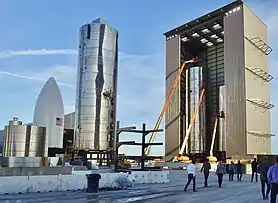
Starship may launch from Starbase, SpaceX's offshore platforms, and the Kennedy Space Center's Launch Complex 39A.[32] Starbase, in Boca Chica, Texas, is the primary development and launch site of the vehicle.[33] The offshore platforms—named Phobos and Deimos after the moons of Mars—were former oil drilling rigs owned by Valaris,[34] each 78 m (260 ft) long and 73 m (240 ft) wide.[35] Launch Complex 39A had supported many Saturn V and Space Shuttle launches,[36] and is now being used by SpaceX to launch Falcon 9 rockets. A separate Starship launch pad as of December 2021 is being constructed next to the old launch pad, permission for which was granted in 2019 by NASA.[37]
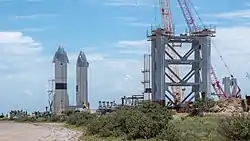
Starbase is divided into a build site and launch site.[38]
The tank farm at Starbase holds water and other liquids.[39] A Starship launch tower consists of steel truss sections and a lightning rod on top,[40] with a pair of mechanical arms catching Super Heavy. Eventually, this recovery system might enable these rocket stages to be prepared quickly and allow multiple launches in a day.[41]
These infrastructure are the subject of many spaceflight news correspondents and enthusiasts.[42] However, some residents of Boca Chica Village and Brownsville have criticized Starship development claiming that SpaceX had conducted unauthorized test flights along with infrastructure construction, the forced sale of houses, and noise pollution.[43][44] Environmental groups claim that the Starship development program threatens surrounding wildlife.[45]
Economics and missions
Starship launch cost estimates vary widely, ranging from Musk's $2 million per launch to a satellite market analyst's $10 million.[46] It is expected that with a larger volume and mass capacity as well as a substantially lower cost to orbit, Starship may allow larger and more advanced science payloads such as 8 m (26.2 ft) or 15.1 m (49.5 ft)-diameter mirror variants of the Large Ultraviolet Optical Infrared Surveyor space telescope.[47] Another example are Starlink satellites: although Falcon 9 launch can deliver sixty to low Earth orbit,[32] Starship would be able to put four hundred of them into orbit at the same time.[48] As the launch vehicle becomes more capable and less expensive to launch, it will replace all SpaceX's existing launch vehicles and spacecraft, including Falcon 9, Falcon Heavy, and Dragon 2.[49]
On 16 April 2021, NASA selected Starship HLS and awarded SpaceX a $2.89 billion contract over the Integrated Lander Vehicle and Dynetics HLS for the Artemis program.[50][51] Starship HLS will need to perform an uncrewed landing demonstration before it could do a crewed lunar landing on the Artemis 3 flight.[52] Responding to that announcement, on 26 April 2021 Blue Origin filed a protest to the Government Accountability Office.[53][54] On 4 November 2021, the Court of Federal Claims gave a memorandum opinion titled Blue Origin v. United States & Space Exploration Technologies Corp. rejecting Blue Origin's complaint.[55]
Starship is also expected to facilitate space tourism. A space mission named the dearMoon project has been planned by Japanese entrepreneur Yusaku Maezawa.[56] Originally using a Crew Dragon capsule,[57] the dearMoon project plans to perform a flight around the Moon with Starship. The mission's crew is expected to consist of Maezawa and eight others from the public.[58]
Another potential use for Starship is point-to-point flights, or termed Earth to Earth by SpaceX. The spacecraft would travel between spaceports on Earth, with flight times of some 40 minutes between New York City and Shanghai. SpaceX president and chief operating officer, Gwynne Shotwell, predicted that it could be cost-competitive with business class travel.[59] As of October 2020, the Rocket Cargo program is the only dedicated program that research this mode of transport, funded by the United States Transportation Command.[60][61] A space analyst highlighted risks involved in point-to-point spacecraft travel such as conflict escalation due to misunderstanding between allies.[62]
Space colonization

SpaceX has stated that its goal is to start the colonization and terraforming of Mars through its launch vehicles for humanity's long-term survival.[63] Musk had estimated that a Mars city containing a million people would be self-sustaining. Excluding population growth, at least ten thousand crewed Starships and a hundred thousand Starships delivering cargo would be needed.[64]
Starship might use the Sabatier reaction to create liquid methane and liquid oxygen on Mars[65] by exposing carbon dioxide and hydrogen to a catalyst and temperature conditions of 300–400 °C (600–800 °F) and pressure conditions of 3 MPa (400 psi).[66] Carbon dioxide and hydrogen gas can be obtained from Mars's atmosphere and underground ice.[67][68] The chemical reaction is an endothermic reaction with the chemical formula below:[66]
- CO2 (g) + 4 H2 (g) → CH4 (g) + 2 H2O (g) (ΔHr = −165.0 kJ/mol)
Development
Starship development has been described as iterative and incremental and often contrasted against Blue Origin's New Glenn[69] and the Space Launch System's development.[70] Because of this design methodology, SpaceX has built and launched many Starship prototypes to collect vast amounts of data and refine its design, similar to the Falcon 9's development.[20] The vehicle's design has also influenced other launch vehicles, such as the Terran R's and Project Jarvis' reusability and stainless-steel construction.[71][72]
SpaceX's development had led to many prototypes' explosion, disrupting the surrounding environment along with residential areas[45] and now being subjected to Federal Aviation Administration's (FAA) environmental assessment.[73] Musk specifically often announces over-optimistic development timelines and pressures his employees to achieve them.[74]
Early conceptual designs
-2018_version.png.webp)
In November 2005, SpaceX first referenced a launch vehicle concept with Starship's capabilities during a student conference where Musk briefly mentioned a theoretical heavy‑lift launch vehicle code named BFR. It was going to be powered by a larger version of the Merlin engine called the Merlin 2.[75] At least from 2012, SpaceX has thought about building another space vehicle called the Mars Colonial Transporter, but little information was given to the public.[76]
In September 2016 at the 67th International Astronautical Congress, Musk announced the Interplanetary Transport System,[77] as well as provided key information about it to the public.[78] The Interplanetary Transport System was to be 122 m (400 ft) tall, 12 m (39 ft) wide, and conceived to be a fully reusable launch vehicle that could launch humans to Mars and other destinations in the Solar System. Both stages were to be made from carbon composites. The first stage or booster was to be powered by 42 Raptor engines, and the second stage or spacecraft named Interplanetary Spaceship was to be powered by nine Raptor engines. These Raptor engines were to be used not only for launching it into orbit, but also to enable these rocket stages to propulsively land on the surface. The second stage was going to have a heat shield made of phenolic-impregnated carbon ablator to protect itself when reentering the atmosphere. In orbit, Starship could be fueled to reach further destinations in the Solar System.[78][79]
At the following International Astronautical Congress, Musk announced a replacement launch vehicle called the Big Falcon Rocket, informally called the Big Fucking Rocket. The Big Falcon Rocket was revised to be 106 m (348 ft) tall and 9 m (30 ft) wide, with three aft flaps and two forward flaps to control its descent.[80] In that conference, he talked about possible functions of the launch vehicle extensively.
In November 2018, the present names of the launch vehicle and stage were first published: Super Heavy for the booster, Starship for the spacecraft, and Starship for the whole vehicle.[12] In January 2019, Musk announced that Starship would be made from stainless steel and stated that this might be stronger than an equivalent carbon composite in a wide range of temperatures.[81] In the same month, SpaceX announced it would lay off ten percent of its workforce to finance Starship and Starlink projects.[82]
Prototypes development
| Note: The start dates are when prototypes were first spotted by the public, and the end dates are when prototypes are destroyed, decommissioned, or retired. |
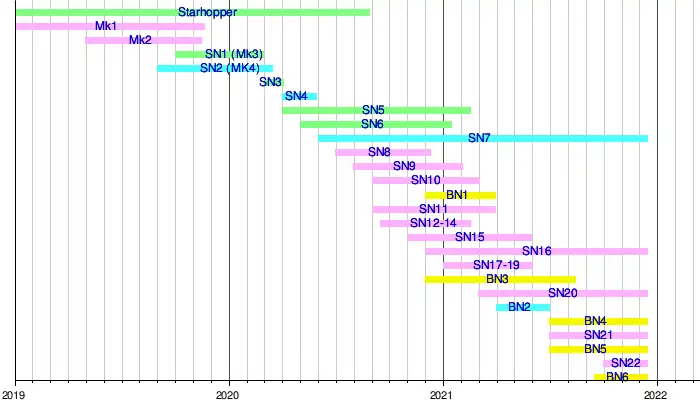 |
Simplified prototypes • Starship spacecraft • Super Heavy booster • Test tanks |
Starhopper–SN6: Hops
| Videos of Starship prototypes' tests | |
|---|---|
| From NASASpaceFlight.com, Tim Dodd and SpaceX | |
 Starhopper 20m hop Starhopper 20m hop | |
| Starhopper 150m hop | |
| Starship Mk1 cryogenic proof test | |
| Starship SN1 cryogenic proof test | |
| Starship SN3 cryogenic proof test | |
| Starship SN5 150m hop | |
| Starship SN6 150m hop |
Starhopper is the first prototypes to operate the Raptor engines, or any full-flow staged combustion in general.[83] The test article hopped to about 150 m (490 ft) and travelled to the landing pad on 27 August 2019 at 23:02 UTC.[84]
Starship Mk1 (Mark 1) was the first full‑scale Starship prototype built in September 2019[85] and Mk2 was constructed five months later in Florida. Both prototypes could not fly and were recycled years later.[86]
During a cryogenic proof or propellant fueling test on 28 February 2020, SN1 (Mk3) crumbled due to a fault in its bottom tank.[87]
On 3 April 2020, during SN3's cryogenic proof test, a valve leaked the liquid nitrogen inside its lower tank, causing the vessel to depressurize and collapse.[88]
On 29 May 2020, SN4 exploded after its fifth successful static fire or engine firing test.[89] A month later, Musk tweeted that new prototypes would be made from SAE 304L instead of SAE 301 stainless steel.[13]
On 4 August 2020, SN5 completed a 150 m (490 ft) hop using a single Raptor engine,[90] and SN6 replicated SN5's flight path successfully 20 days later.[91]
SN8–SN15: Flights
| Videos of Starship prototypes' tests | |
|---|---|
| From NASASpaceFlight.com and SpaceX | |
| Starship SN8 third static fire test | |
| Starship SN8 12.5km flight | |
| Starship SN9 10km flight | |
| Starship SN10 10km flight | |
| Starship SN11 10km flight | |
| Starship SN15 10km flight |
SN8 was the first complete Starship prototype and underwent four static fire tests between October and November 2020.[92] Notably, in the third static fire test, the engine melted the launch pad, and bits of molten concrete hit it back.[93] On 9 December 2020, SN8 performed the first flight by a Starship, reaching an altitude of 12.5 km (7.8 mi), and crashed on impact.[94] During the SN8 launch, SpaceX ignored the FAA warnings that the flight profile posed a risk of explosion, causing the FAA's Associate Administrator Wayne Monteith to condemn the company for not conducting thorough checks established by the agency.[95]
On 2 February 2021, SN9 flew 10 km (6.2 mi) high, then crashed at an angle.[96]
On 3 March 2021, SN10 repeated SN9's flight path, successfully hard landed, and exploded eight minutes later.[97]
On 30 March 2021, SN11 exploded in a dense fog while descending,[98] with the most possible explanation being a hard start on the engine's turbopump.[99]
After the launch, SpaceX skipped SN12, SN13, and SN14, incorporating their improvements to SN15 instead.[100] On 5 May 2021, SN15 flew the same flight path as previous prototypes and soft-landed successfully.[101][102]
SN20–present: Launches
Around August 2021, SpaceX used an alternate "Starship X" and "Booster X" naming scheme where X is the serial number. They are often abbreviated to "SN" and "BN", followed by the prototype's number. Sometimes, "Starship X" is abbreviated to "Ship X", "SN" to just "S", and "BN" to "B".[103]
As of October 2021, SN20 and BN4 are targeted for an orbital flight pending approval from the FAA.[104] BN4 is expected to separate about three minutes into the orbital flight and splashdown in the Gulf of Mexico, approximately 30 km (19 mi) from the shoreline. SN20 spacecraft's ground track will then traverse the middle of the Straits of Florida. Once over the Atlantic Ocean, SN20 is expected to accelerate close to orbital speed and splashdown around ninety minutes later, 100 km (60 mi) northwest of the island of Kauaʻi.[105][106] As of December 2021, the FAA is assessing the environmental impact statement draft with the public's comments.[107]
References
- Weinzierl, Matthew (2018). "Space, the Final Economic Frontier". The Journal of Economic Perspectives. American Economic Association. 32 (2): 174. doi:10.1257/jep.32.2.173. JSTOR 26409430. Archived from the original on 1 September 2021. Retrieved 24 November 2021 – via JSTOR.
- Worden, Simon P.; Sponable, Jess (22 September 2006). "Access to Space: A Strategy for the Twenty-First Century". Astropolitics. 4 (1): 69–83. Bibcode:2006AstPo...4...69W. doi:10.1080/14777620600762857. S2CID 145293511. Archived from the original on 13 October 2019. Retrieved 24 November 2021.
- Wagner, Breanne (June 2008). "Market Slowdown: Low-cost space launch vehicles await liftoff". National Defense. National Defense Industrial Association. 92 (655): 52–55. JSTOR 45370953. Archived from the original on 24 November 2021. Retrieved 24 November 2021 – via JSTOR.
- Zimmerman, Robert (1 February 2017). "CAPITALISM IN SPACE: Private Enterprise and Competition Reshape the Global Aerospace Launch Industry". Center for a New American Security: 21. JSTOR resrep06111. Archived from the original on 24 November 2021. Retrieved 26 November 2021.CS1 maint: date and year (link)
- Linck, Evan; W. Crane, Keith; L. Zuckerman, Brian; A. Corbin, Benjamin; M. Myers, Roger; R. Williams, Sharon; A. Carioscia, Sara; Garcia, Rodolfo; Lal, Bhavya (1 February 2019). Evaluation of a Human Mission to Mars by 2033 (Report). pp. 11–12. JSTOR resrep22892.5. Archived from the original on 27 July 2020. Retrieved 26 November 2021.
- Bergin, Chris (12 January 2009). "Musk ambition: SpaceX aim for fully reusable Falcon 9". NASASpaceFlight.com. Archived from the original on 5 July 2017. Retrieved 24 November 2021.
- Chang, Kenneth (15 August 2013). "Latest SpaceX Rocket Test Successfully Goes Sideways". The New York Times. ISSN 0362-4331. Archived from the original on 12 November 2020. Retrieved 13 December 2021.
- Hanry, Caleb (21 November 2017). "SpaceX aims to follow a banner year with an even faster 2018 launch cadence". SpaceNews. Archived from the original on 1 October 2021. Retrieved 15 January 2018.
- Inman, Jennifer Ann; Horvath, Thomas J.; Scott, Carey Fulton (24 August 2021). SCIFLI Starship Reentry Observation (SSRO) ACO (SpaceX Starship). NASA. p. 2. Archived from the original on 11 October 2021. Retrieved 12 October 2021.
- "Starship page". SpaceX. Archived from the original on 22 May 2020. Retrieved 24 September 2021.
- Technical information summary AS-501 Apollo Saturn V flight vehicle (PDF) (Report). Marshall Space Flight Center: NASA. 15 September 1967. p. 6. Archived (PDF) from the original on 23 April 2021. Retrieved 26 November 2021.
- "Elon Musk renames his BFR spacecraft Starship". BBC News. 20 November 2018. Archived from the original on 23 April 2021. Retrieved 22 November 2021.
- Howell, Elizabeth (21 August 2021). "Every SpaceX Starship explosion and what Elon Musk and team learned from them (video)". Space.com. Archived from the original on 3 September 2021. Retrieved 11 October 2021.
- Gruss, Mike (13 January 2016). "Orbital ATK, SpaceX Win Air Force Propulsion Contracts". SpaceNews. Archived from the original on 3 February 2016. Retrieved 15 January 2016.
- Davis, Malcolm (17 May 2021). "SpaceX's reusable rocket technology will have implications for Australia". The Strategist. Archived from the original on 11 September 2021. Retrieved 28 November 2021.
- Berger, Eric (31 March 2020). "SpaceX releases a Payload User's Guide for its Starship rocket". Ars Technica. Archived from the original on 20 April 2021. Retrieved 8 December 2021.
- Chaben, Jack B. (2020). "Extending Humanity's Reach: A Public-Private Framework for Space Exploration". Journal of Strategic Security. University of South Florida Board of Trustees. 13 (3): 90. doi:10.5038/1944-0472.13.3.1811. JSTOR 26936546. Archived from the original on 27 November 2021. Retrieved 26 November 2021.
- Sheetz, Michael (19 February 2021). "What's behind SpaceX's $74 billion valuation: Elon Musk's two 'Manhattan Projects'". CNBC. Archived from the original on 11 November 2021. Retrieved 28 November 2021.
- Nast, Condé (31 July 2019). "The wild physics of Elon Musk's methane-guzzling super-rocket". Wired UK. ISSN 1357-0978. Archived from the original on 22 February 2021. Retrieved 9 December 2021.
- Sesnic, Trevor (11 August 2021). "Starbase Tour and Interview with Elon Musk". The Everyday Astronaut (Interview). Archived from the original on 12 August 2021. Retrieved 12 October 2021.
- "New rocket engine combustion cycle technology testing reaches 100% power level". NASA. 18 July 2006. Archived from the original on 8 March 2016. Retrieved 29 November 2021.
 This article incorporates text from this source, which is in the public domain.
 - Berger, Eric (2 August 2021). "SpaceX installed 29 Raptor engines on a Super Heavy rocket last night". Ars Technica. Archived from the original on 4 August 2021. Retrieved 24 September 2021.
- Berger, Eric (4 January 2021). "SpaceX may try to catch a falling rocket with a launch tower". Ars Technica. Archived from the original on 5 July 2021. Retrieved 24 September 2021.
- Mabboux, Romain (7 September 2021). Optimization of the pressurization system of the Themis reusable rocket first stage demonstrator (PDF) (Master thesis). KTH Royal Institute of Technology. pp. 69–70. Archived (PDF) from the original on 7 December 2021. Retrieved 7 December 2021.
- Grush, Loren (9 December 2020). "SpaceX flies Starship prototype rocket to highest altitude yet — but doesn't stick the landing". The Verge. Archived from the original on 2 July 2021. Retrieved 24 September 2021.
- Kanayama, Lee; Beil, Adrian (28 August 2021). "SpaceX continues forward progress with Starship on Starhopper anniversary". NASASpaceFlight.com. Archived from the original on 31 August 2021. Retrieved 22 November 2021.
- Pearson, Ben (3 June 2019). "SpaceX beginning to tackle some of the big challenges for a Mars journey". Ars Technica. Archived from the original on 11 October 2021. Retrieved 28 November 2021.
- Berger, Eric (31 July 2019). "NASA agrees to work with SpaceX on orbital refueling technology". Ars Technica. Archived from the original on 24 September 2021. Retrieved 28 November 2021.
- "NASA's management of the Artemis missions" (PDF). NASA. 15 November 2021. p. 4. Archived (PDF) from the original on 15 November 2021. Retrieved 22 November 2021.
- Foust, Jeff (6 January 2021). "SpaceX, Blue Origin, and Dynetics Compete to Build the Next Moon Lander". IEEE Spectrum. Archived from the original on 29 November 2021. Retrieved 29 November 2021.
- Sagliano, Marco; Seelbinder, David; Theil, Stephan (25 June 2021). SPARTAN: Rapid Trajectory Analysis via Pseudospectral Methods (PDF). 8th International Conference on Astrodynamics Tools and Techniques. Bremen: German Aerospace Center. pp. 10–12. Archived (PDF) from the original on 7 December 2021. Retrieved 7 December 2021.
- Sheetz, Michael (1 September 2020). "Elon Musk says SpaceX's Starship rocket will launch "hundreds of missions" before flying people". CNBC. Archived from the original on 2 September 2020. Retrieved 2 September 2020.
- "How SpaceX's massive Starship rocket might unlock the solar system—and beyond". MIT Technology Review. Archived from the original on 8 December 2021. Retrieved 11 December 2021.
- Burghardt, Thomas (19 January 2021). "SpaceX acquires former oil rigs to serve as floating Starship spaceports". NASASpaceFlight.com. Archived from the original on 20 January 2021. Retrieved 20 January 2021.
- "ENSCO 8500 Series® Ultra-Deepwater Semisubmersibles" (PDF). Ensco plc. Archived (PDF) from the original on 21 January 2021. Retrieved 21 January 2021.
- published, Robert Z. Pearlman (17 February 2017). "The Milestone Space Missions Launched from NASA's Historic Pad 39A". Space.com. Archived from the original on 29 October 2021. Retrieved 11 December 2021.
- Sheetz, Michael (3 December 2021). "Elon Musk says SpaceX has started building a Starship launchpad on Florida's Space Coast". CNBC. Archived from the original on 7 December 2021. Retrieved 11 December 2021.
- Berger, Eric (2 July 2021). "Rocket Report: Super Heavy rolls to launch site, Funk will get to fly". Ars Technica. Archived from the original on 6 October 2021. Retrieved 12 December 2021.
- Weber, Ryan (31 October 2021). "Major elements of Starship Orbital Launch Pad in place as launch readiness draws nearer". NASASpaceFlight.com. Archived from the original on 5 December 2021. Retrieved 11 December 2021.
- "Form 7460-1 for ASN 2021-ASW-4185-OE". Obstruction Evaluation / Airport Airspace Analysis by Federal Aviation Administration. SpaceX. 16 March 2021. Archived from the original on 8 April 2021. Retrieved 6 September 2021.
- Cuthbertson, Anthony (30 August 2021). "SpaceX will use 'robot chopsticks' to catch massive rocket, Elon Musk says". The Independent. Archived from the original on 2 September 2021. Retrieved 23 September 2021.
- Wattles, Jack (9 April 2021). "$200,000 streaming rigs and millions of views: inside the cottage industry popping up around SpaceX". CNN. Archived from the original on 9 April 2021. Retrieved 27 November 2021.
- Sheetz, Michael (14 July 2021). "FAA warns SpaceX that massive Starship launch tower in Texas is unapproved". CNBC. Archived from the original on 4 September 2021. Retrieved 24 September 2021.
- Koren, Marina (11 February 2020). "Why SpaceX Wants a Tiny Texas Neighborhood So Badly". The Atlantic. Archived from the original on 15 August 2021. Retrieved 24 September 2021.
- "Disgruntled neighbors and dwindling shorebirds jeopardize SpaceX expansion". NBC News. Archived from the original on 11 December 2021. Retrieved 11 December 2021.
- Mann, Adam (20 May 2020). "SpaceX now dominates rocket flight, bringing big benefits—and risks—to NASA". Science (news). doi:10.1126/science.abc9093. Archived from the original on 7 November 2021. Retrieved 28 November 2021.
- Bender, Maddie (16 September 2021). "SpaceX's Starship Could Rocket-Boost Research in Space". Scientific American. Archived from the original on 26 October 2021. Retrieved 22 November 2021.
- C. Boley, Aaron; Byers, Michael (20 May 2021). "Satellite mega-constellations create risks in Low Earth Orbit, the atmosphere and on Earth". Scientific Reports. Nature Portfolio. doi:10.1038/s41598-021-89909-7. eISSN 2045-2322. Archived from the original on 21 November 2021. Retrieved 27 November 2021.
- Gebhardt, Chris (29 September 2017). "The Moon, Mars, and around the Earth – Musk updates BFR architecture, plans". NASASpaceFlight.com. Archived from the original on 1 October 2017. Retrieved 30 March 2019.
- Brown, Katherine (16 April 2021). "As Artemis Moves Forward, NASA Picks SpaceX to Land Next Americans on Moon" (Press release). NASA. Archived from the original on 16 April 2021. Retrieved 16 April 2021.
- Davenport, Christian (16 April 2021). "Elon Musk's SpaceX wins contract to develop spacecraft to land astronauts on the moon". The Washington Post. Archived from the original on 16 April 2021. Retrieved 16 April 2021.
- Berger, Eric (16 April 2021). "NASA selects SpaceX as its sole provider for a lunar lander". Ars Technica. Archived from the original on 17 April 2021. Retrieved 24 September 2021.
- "Protest of Blue Origin Federation, LLC against National Aeronautics and Space Administration award of Option A contract for Human Landing System under Broad Agency Announcement NNH19ZCQ001K_APPENDIX-H-HLS" (PDF). Archived (PDF) from the original on 22 September 2021. Retrieved 27 April 2021.
- E. Patton, Kenneth (2 August 2021). "Statement on Blue Origin-Dynetics Decision". Government Accountability Office. Archived from the original on 18 September 2021. Retrieved 14 October 2021.
- Blue Origin Federation LLC, v. United States, and Space Exploration Technologies Corp. United States Court of Federal Claims. 18 November 2021. Archived from the original on 18 November 2021. Retrieved 20 November 2021.
- Grush, Loren (14 September 2018). "SpaceX says it will send someone around the Moon on its future monster rocket". The Verge. Archived from the original on 14 September 2018. Retrieved 15 September 2018.
- Malik, Tariq (18 September 2018). "How SpaceX's 1st Passenger Flight Around the Moon with Yusaku Maezawa Will Work". Space.com. Archived from the original on 1 February 2020. Retrieved 26 November 2021.
- Sheetz, Michael (2 March 2021). "Japanese billionaire to fly eight members of the public on SpaceX moon flight". CNBC. Archived from the original on 3 March 2021. Retrieved 3 March 2021.
- Sheetz, Michael (18 March 2019). "Super fast travel using outer space could be US$20 billion market, disrupting airlines, UBS predicts". CNBC. Archived from the original on 29 October 2019. Retrieved 30 March 2019.
- Sheetz, Michael (4 June 2021). "The Pentagon wants to use private rockets like SpaceX's Starship to deliver cargo around the world". CNBC. Archived from the original on 1 September 2021. Retrieved 21 November 2021.
- Cameron, Doug (4 June 2021). "Pentagon Envisions Using Cargo Rockets". Wall Street Journal. ISSN 0099-9660. Archived from the original on 6 June 2021. Retrieved 21 November 2021.
- Adam, Smith (14 May 2021). "Elon Musk's SpaceX reveals Starship's first orbital test flight". The Independent. Archived from the original on 20 May 2021. Retrieved 24 September 2021.
- Sheetz, Michael (23 April 2021). "Elon Musk wants SpaceX to reach Mars so humanity is not a 'single-planet species'". CNBC. Archived from the original on 2 October 2021. Retrieved 2 October 2021.
- Andersen, Ross (30 September 2014). "Exodus". Aeon. Archived from the original on 12 June 2015. Retrieved 27 January 2016.
- Sommerlad, Joe (28 May 2021). "Elon Musk reveals Starship progress ahead of first orbital flight of Mars-bound craft". Independent. Archived from the original on 23 August 2021. Retrieved 4 December 2021.
- Rönsch, Stefan; Schneider, Jens; Matthischke, Steffi; Schlüter, Michael; Götz, Manuel; Lefebvre, Jonathan; Prabhakaran, Praseeth; Bajohr, Siegfried (15 February 2016). "Review on methanation – From fundamentals to current projects". Fuel. 166: 276–296. doi:10.1016/j.fuel.2015.10.111. Archived from the original on 9 September 2020. Retrieved 24 November 2021.
- Franz, Heather B.; Trainer, Melissa G.; Malespin, Charles A.; Mahaffy, Paul R.; Atreya, Sushil K.; Becker, Richard H.; Benna, Mehdi; Conrad, Pamela G.; Eigenbrode, Jennifer L. (1 April 2017). "Initial SAM calibration gas experiments on Mars: Quadrupole mass spectrometer results and implications" (PDF). Planetary and Space Science. 138: 44–54. Bibcode:2017P&SS..138...44F. ISSN 0032-0633. Archived (PDF) from the original on 26 November 2021. Retrieved 26 November 2021.
- Good, Andrew; Johnson, Alana (11 December 2019). "NASA's Treasure Map for Water Ice on Mars" (Press release). NASA. Archived from the original on 8 November 2021. Retrieved 26 November 2021.
- Berger, Eric (24 August 2021). "First images of Blue Origin's "Project Jarvis" test tank". Ars Technica. Archived from the original on 24 August 2021. Retrieved 8 December 2021.
- Chang, Kenneth (28 September 2019). "Elon Musk Sets Out SpaceX Starship's Ambitious Launch Timeline". The New York Times. ISSN 0362-4331. Archived from the original on 7 April 2020. Retrieved 8 December 2021.
- Berger, Eric (8 June 2021). "Relativity has a bold plan to take on SpaceX, and investors are buying it". Ars Technica. Archived from the original on 8 June 2021. Retrieved 14 October 2021.
- Berger, Eric (27 July 2021). "Blue Origin has a secret project named "Jarvis" to compete with SpaceX". Ars Technica. Archived from the original on 30 July 2021. Retrieved 27 November 2021.
- Shepardson, David (30 September 2021). "U.S. extends environmental review for SpaceX program in Texas". Reuters. Archived from the original on 1 October 2021. Retrieved 4 October 2021.
- Sheetz, Michael (30 November 2021). "Elon Musk tells SpaceX employees that Starship engine crisis is creating a 'risk of bankruptcy'". CNBC. Archived from the original on 6 December 2021. Retrieved 8 December 2021.
- Foust, Jeff (14 November 2005). "Big plans for SpaceX". The Space Review. Archived from the original on 24 November 2005. Retrieved 16 September 2018.
- Coppinger, Rob (23 November 2012). "Huge Mars Colony Eyed by SpaceX Founder Elon Musk". Space.com. Archived from the original on 27 February 2021. Retrieved 22 November 2021.
- Nast, Condé (19 September 2016). "Mars and beyond: Elon Musk teases his plans for interplanetary travel". Wired UK. ISSN 1357-0978. Archived from the original on 27 February 2021. Retrieved 22 November 2021.
- Bergin, Chris (27 September 2016). "SpaceX reveals ITS Mars game changer via colonization plan". NASASpaceFlight.com. Archived from the original on 28 September 2016. Retrieved 27 September 2016.
- Wall, Mike (27 September 2016). "SpaceX's Elon Musk Unveils Interplanetary Spaceship to Colonize Mars". Space.com. Archived from the original on 3 December 2021. Retrieved 8 December 2021.
- Malik, Tariq (14 September 2018). "SpaceX Has Apparently Tweaked Its Giant BFR Rocket Design. And It Looks Awesome!". Space.com. Archived from the original on 25 August 2021. Retrieved 24 September 2021.
- Wall, Mike (23 January 2019). "Why Elon Musk Turned to Stainless Steel for SpaceX's Starship Mars Rocket". Space.com. Archived from the original on 3 February 2019. Retrieved 22 November 2021.
- Patel, Neel (7 January 2021). "SpaceX now operates the world's biggest commercial satellite network". MIT Technology Review. Archived from the original on 22 August 2020. Retrieved 9 January 2020.
- Burghardt, Thomas (25 July 2019). "Starhopper successfully conducts debut Boca Chica Hop". NASASpaceFlight.com. Archived from the original on 26 July 2019. Retrieved 1 January 2021.
- Harwood, William (27 August 2019). "SpaceX launches "Starhopper" on dramatic test flight". CBS News. Retrieved 14 December 2021.
- Jee, Charlotte (30 September 2019). "SpaceX has unveiled the rocket it hopes will one day carry humans to Mars". MIT Technology Review. Archived from the original on 20 March 2021. Retrieved 27 November 2021.
- Bergeron, Julia (6 April 2021). "New permits shed light on activity at SpaceX's Cidco and Roberts Road facilities". NASASpaceFlight.com. Archived from the original on 7 April 2021. Retrieved 27 November 2021.
- Torbet, Georgina (27 April 2020). "SpaceX Starship Successfully Passes Pressure Testing". Digital Trends. Archived from the original on 1 March 2021. Retrieved 23 September 2021.
- Bartels, Meghan (3 April 2020). "SpaceX's Starship SN3 prototype collapses in pressure tank test". Space.com. Archived from the original on 18 September 2021. Retrieved 28 September 2021.
- Foust, Jeff (29 May 2020). "SpaceX Starship prototype destroyed after static-fire test". SpaceNews. Archived from the original on 18 September 2021. Retrieved 30 May 2020.
- Wall, Mike (5 August 2020). "SpaceX's Starship SN5 prototype soars on 1st test flight! 'Mars is looking real,' Elon Musk says". Space.com. Archived from the original on 23 November 2021. Retrieved 27 November 2021.
- Malik, Tariq (3 September 2020). "SpaceX launches Starship SN6 prototype test flight on heels of Starlink mission". Space.com. Archived from the original on 23 November 2021. Retrieved 27 November 2021.
- Wattles, Jackie (10 December 2020). "Space X's Mars prototype rocket exploded yesterday. Here's what happened on the flight". CNN. Archived from the original on 10 December 2020. Retrieved 10 December 2020.
- Wall, Mike (24 November 2020). "SpaceX's Starship SN8 prototype fires engines ahead of major test flight". Space.com. Archived from the original on 23 January 2021. Retrieved 5 October 2021.
- Wall, Mike (10 December 2020). "SpaceX's Starship SN8 Prototype Soars on Epic Test Launch, with Explosive Landing". Scientific American. Archived from the original on 26 November 2021. Retrieved 3 March 2021.
- Roulette, Joey (15 June 2021). "SpaceX ignored last-minute warnings from the FAA before December Starship launch". The Verge. Archived from the original on 6 October 2021. Retrieved 8 October 2021.
- Sheetz, Michael (2 February 2021). "SpaceX's Starship prototype again explodes on landing attempt after successful launch". CNBC. Archived from the original on 2 February 2021. Retrieved 20 September 2021.
- Chang, Kenneth (3 March 2021). "SpaceX Mars Rocket Prototype Explodes, but This Time It Lands First". The New York Times. ISSN 0362-4331. Archived from the original on 5 June 2021. Retrieved 18 September 2021.
- Griffin, Andrew (1 April 2021). "Elon Musk confirms SpaceX Starship exploded in 'crater'". The Independent. Archived from the original on 1 April 2021. Retrieved 18 September 2021.
- Wall, Mike (5 April 2021). "SpaceX identifies cause of Starship SN11 prototype's crash". Space.com. Archived from the original on 7 May 2021. Retrieved 18 September 2021.
- Wall, Mike (13 April 2021). "SpaceX's SN15 Starship prototype rolls out to launch pad". Space.com. Archived from the original on 24 April 2021. Retrieved 18 September 2021.
- Amos, Jonathan (5 May 2021). "SpaceX Starship prototype makes clean landing". BBC News. Archived from the original on 6 May 2021. Retrieved 18 September 2021.
- Gorman, Steve (6 May 2021). "Elon Musk's SpaceX Starship completes successful launch and landing after several fiery failures". Reuters. Archived from the original on 6 May 2021. Retrieved 29 September 2021.
- Sheetz, Michael (6 August 2021). "Musk: 'Dream come true' to see fully stacked SpaceX Starship rocket during prep for orbital launch". CNBC. Archived from the original on 19 August 2021. Retrieved 24 September 2021.
- "SpaceX could launch 1st Starship to orbit in January, Elon Musk says". space.com. 18 November 2021. Archived from the original on 25 November 2021. Retrieved 30 November 2021.
- Gohd, Chelsea (22 October 2021). "Elon Musk says SpaceX could launch Starship orbital flight test next month". Space. Space. Archived from the original on 11 November 2021. Retrieved 11 November 2021.
- "Starship Orbital – First Flight FCC Exhibit" (PDF). SpaceX. 13 May 2021. Archived from the original on 13 May 2021. Retrieved 10 September 2021.
- Shepardson, David (15 November 2021). "U.S. FAA aims to complete SpaceX Starship review by Dec 31". Reuters. Archived from the original on 29 November 2021. Retrieved 9 December 2021.
External links
 Media related to SpaceX Starship at Wikimedia Commons
 Quote related to SpaceX Starship at Wikiquote
 Book about SpaceX Starship at Wikibooks
 Data related to SpaceX Starship at Wikidata
- Official website – SpaceX's website about Starship
- Starship playlist – SpaceX's media playlist about Starship on Youtube
| Missions |
| .svg.png.webp) | |||||||
|---|---|---|---|---|---|---|---|---|---|
| Infrastructure |
| ||||||||
| |||||||||

| Active |  | |
|---|---|---|
| In development | ||
| Retired | ||
| Proposed | ||
| Cancelled | ||
| Launch vehicles |
|  | ||||||||
|---|---|---|---|---|---|---|---|---|---|---|
| Spacecraft |
| |||||||||
| Test vehicles |
| |||||||||
| Rocket engines |
| |||||||||
| Lists of missions | ||||||||||
| Launch facilities |
| |||||||||
| Landing sites |
| |||||||||
| Other facilities |
| |||||||||
| Support |
| |||||||||
| Contracts | ||||||||||
| R&D programs | ||||||||||
| Key people |
| |||||||||
| Related |
| |||||||||
* denotes unflown vehicles or engines, and future missions or sites. † denotes failed missions, destroyed vehicles, and abandoned sites.
| ||||||||||