Lawns in the United States
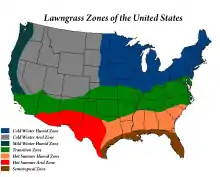
In a 2005 NASA-sponsored study, it was estimated that the area covered by lawns in the United States to be about 128,000 square kilometres (49,000 sq mi), making it the nation's largest irrigated crop by area.[1] Lawn care is thus a popular business in the United States; proper maintenance, construction and management of lawns of various kinds being the focus of much of the modern horticulture industry. Estimates of the amount spent on professional lawn care services vary, but a Harris Survey put the total at $28.9 billion in 2002 (approximately $1,200 per household using such services).
In her book The Lawn: A History of an American Obsession (1994) Virginia Scott Jenkins traces the historic desire to kill weeds. She notes that the current rage for a chemically dependent lawn emerged after World War II and argues that "American front lawns are a symbol of man's control of, or superiority over, his environment."
According to the EPA, "of the 26 billion gallons of water consumed daily in the United States, approximately 7.8 billion gallons, or 30 percent, is devoted to outdoor uses. The majority of this is used for irrigation."[2]
Along with trees, lawns are a vital element in the fight against urban heat islanding. Lawns provide:
- Oxygen conversion,
- Filtering of air particulates,
- Erosion control,
- Air and surface cooling to offset asphalt, cement, and rooftops,
- A place for recreation and enjoyment.
In comparison to bare dirt, a lawn may be 20 °F cooler on a hot day, and up to 40 °F cooler than cement surfaces.
“What if each American landowner made it a goal to convert half of his or her lawn to productive native plant communities? Even moderate success could collectively restore some semblance of ecosystem function to more than twenty million acres of what is now ecological wasteland. How big is twenty million acres? It’s bigger than the combined areas of the Everglades, Yellowstone, Yosemite, Grand Teton, Canyonlands, Mount Rainier, North Cascades, Badlands, Olympic, Sequoia, Grand Canyon, Denali, and the Great Smoky Mountains National Parks. If we restore the ecosystem function of these twenty million acres, we can create this country’s largest park system. It gives me the shivers just to write about it. Because so much of this park will be created at our homes, I suggest we call it Homegrown National Park.”
— Nature's Best Hope: A New Approach to Conservation That Starts in Your Yard by Douglas W. Tallamy
https://a.co/3M53dNu
Lawnmowers
Some companies and brands of lawn mowers in the US include:
- The Grasshopper Company
- Sensation Lawn Mowers, a commercial lawnmower brand
US lawn mower patents
- US patent Lawn mowers
- U.S. Patent 7,117,660, Filed April 12, 2000, Issued October 10, 2006. Self-propelled lawn mower [ed., self-propelled lawn mower comprising a microprocessor and at least one cutter]
- U.S. Patent 4,964,265, Filed September 11, 1989, Issued October 23, 1990. [ed., remote control lawn mower]
- U.S. Patent 1,050,799, Filied March 28, 1910, Issued January 21, 1913 [ed., Stephen Foster Briggs gas engine igniter]
- U.S. Patent 624,749, Lawn mower. Filed September 8, 1898, Issued May 9, 1899.[3] (ed., John Albert Burr, African-American inventor)
- U.S. Patent 210,654, Filed September 30, 1878, Issued December 10, 1878. [ed., leaf catcher]
- U.S. Patent 190,994, Issued May 22, 1877. [ed., leaf catcher]
- U.S. Patent 158,794, Filed November 28, 1874, Issued January 19, 1875.
- U.S. Patent 73,807 [ed., roller mower]
- U.S. Patent 69,409 [ed. Titled "lawn mower".]
- US patent Mowing machines
- U.S. Patent 38,381
- U.S. Patent 33,578
- U.S. Patent 32,244
- U.S. Patent 31,668, Issued March 12, 1861.
- Designs
- U.S. Patent D346809, Filed April 24, 1992, Issued May 10, 1994. [ed., remote control lawn mower design]
- Reissued US patent
- U.S. Patent RE3330, Issued March 16, 1869.
Pesticides
The idea of lawn landscaping is fairly new with the turfgrass species used in lawns coming to the Americas in the last century. The idea of using chemicals to control a lawn is even newer. Around the 1930s, the use of chemicals to maintain a lawn was advised against. The most common way to control a yard during this time was to either hand pull the weeds or keep chickens. Chemical use became popular in the post-WWII era and has grown significantly since then. In 1999 a study by the United States Geological Survey found that 99% of urban water streams contained pesticides. Surprisingly, pesticides are commonly used by people who understand the negative effects of the chemicals, but they continue to use them due to the immense pressure they feel to maintain their lawn for their neighborhood’s sake. People often view their lawns as a social responsibility that speaks to their character which is why they are willing to use chemicals on their lawns despite the negative effects they may have. Many local governments also do not help this scenario because they have enacted “weed laws” that restrict grass growth over a certain number of inches. According to Robbins and Sharp, these laws are not necessarily the reason many people use chemicals, but they can be a barrier to those who wish to use alternative means of maintaining their lawns.[4]
See also
- History of the lawn
- Lawn, a town in Taylor County, Texas
References
- "Looking for Lawns" - general interest article about the NASA study
- "Conserving Water" - EPA tips to conserve water
- Ben Ikenson (2004). Patents: Ingenious Inventions, How They Work and How They Came to Be. Black Dog & Leventhal Publishers. 288 pages. Page 213
- Robbins, Paul (2003). "The Lawn-Chemical Economy and Its Discontents". Antipode. 35: 955–979.
Further reading
- Virginia Scott Jenkins (1994) The Lawn: A History of an American Obsession
External links
- A motor lawn mower - Scientific American 13 November, 1897