Leading man
A leading man is a complimentary term for the actor who is the primary male protagonist in a film, television show, or play, usually the main character who can be an action hero or any sort of man, often including a love interest to the leading lady. A leading man is sometimes an all-rounder; capable of being comical and/or heroic, singing, dancing, and acting at a professional level.
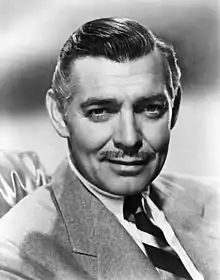
A leading man can also be an actor who is often seen in romantic roles. An example of this would be Bruce Cabot's role playing against Fay Wray in King Kong. Less frequently, the term has been applied to an actor who is often associated with one particular actress; for example, Spencer Tracy had a similar association with both Katharine Hepburn and Joan Bennett, and Gable made numerous major films with Joan Crawford, Myrna Loy, or Jean Harlow. The term is also used collectively, as in "Hollywood's leading men" to refer to a group of notable, famous, or popular actors.
Examples
1920s
Leading men of the silent era included Francis X Bushman, Douglas Fairbanks, Charlie Chaplin, Buster Keaton, Harold Lloyd, Ramon Novarro, John Barrymore, John Gilbert, Wallace Beery, Conrad Nagel, Conrad Veidt, Rudolph Valentino, Sessue Hayakawa and Henry B. Walthall.
1930s
Leading men of the 1930s included Clark Gable, Ronald Colman, Maurice Chevalier, Warren William, Robert Young, William Powell, Fredric March, Paul Muni, Gary Cooper, George Raft, Edward G. Robinson, Cary Grant, Spencer Tracy, Henry Fonda, Robert Montgomery, Bing Crosby, Fred MacMurray, James Cagney, Errol Flynn, John Wayne, Burgess Meredith, George Brent, Robert Taylor and Charles Boyer.
1940s
In the 1940s, leading men included James Stewart, Humphrey Bogart, George Sanders, Tyrone Power, Joel McCrea, Ray Milland, Ronald Reagan, Bing Crosby, Bob Hope, Dana Andrews, Joseph Cotten, Gregory Peck, William Holden, Burt Lancaster, Victor Mature, Laurence Olivier and Robert Mitchum.
1950s
The 1950s included Marlon Brando, Farley Granger, Charlton Heston, Robert Mitchum, Michael Rennie, Gene Kelly, Montgomery Clift, Rock Hudson, Tony Curtis, Norman Lloyd, Ricardo Montalbán, Jeff Chandler, Yul Brynner, James Dean, Elvis Presley, Frank Sinatra, Dean Martin, Jerry Lewis, Jack Lemmon and Paul Newman.
1960s
The 1960s included Steve McQueen, James Garner, Sidney Poitier, Clint Eastwood, Dustin Hoffman, Jon Voight, Rex Harrison, Robert Redford, Keir Dullea, Kirk Douglas, Lee Marvin, Jerry Lewis, Dick Van Dyke and Sean Connery.
1970s
The 1970s included Robert De Niro, Al Pacino, Jack Nicholson, James Caan, John Travolta, Gene Hackman, Gene Wilder, George Segal, Martin Sheen, Burt Reynolds, Woody Allen, Sylvester Stallone, Bruce Lee and Chuck Norris.
1980s
The 1980s included Harrison Ford, Kevin Costner, Arnold Schwarzenegger, Eddie Murphy, Tom Cruise, Tom Hanks, Mel Gibson, Michael J. Fox, Chevy Chase, Bill Murray, Richard Gere, and Michael Douglas.
1990s
The 1990s included Johnny Depp, Bruce Willis, Keanu Reeves, Nicolas Cage, George Clooney, Leonardo DiCaprio, Robert Downey, Jr., Robin Williams, Brad Pitt, Will Smith, Denzel Washington and Jim Carrey.
2000s
Some examples of new leading men at the beginning of the millennium include Ben Affleck, Matt Damon, Christian Bale, Russell Crowe, Will Ferrell, Ben Stiller, Mark Wahlberg, Matthew McConaughey, Daniel Craig, Hugh Jackman, Adam Sandler, Ryan Reynolds and Vince Vaughn
2010s and 2020s
Modern examples of the leading man include Bradley Cooper, Timothee Chalamet, Adam Driver, Ryan Gosling, Kevin Hart, Tom Holland, Michael B. Jordan, Dwayne Johnson, Chris Pratt, and Channing Tatum.
