Lechenaultia tubiflora
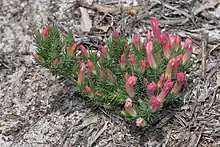
Lechenaultia tubiflora is a plant in the Goodeniaceae family,[2] endemic to the south-west and south of Western Australia.[1]
| Lechenaultia tubiflora | |
|---|---|
 | |
Scientific classification  | |
| Kingdom: | Plantae |
| Clade: | Tracheophytes |
| Clade: | Angiosperms |
| Clade: | Eudicots |
| Clade: | Asterids |
| Order: | Asterales |
| Family: | Goodeniaceae |
| Genus: | Lechenaultia |
| Species: | L. tubiflora |
| Binomial name | |
| Lechenaultia tubiflora | |
| Synonyms[1] | |
|
Ericopsis formosus C.A.Gardner | |
L. tubiflora was first described in 1810 by Robert Brown.[2][3]
Distribution
It is found in the IBRA regions: Avon Wheatbelt, Esperance Plains, Geraldton Sandplains, Jarrah Forest, Mallee, Swan Coastal Plain, and Warren.[4]
References
- "Leschenaultia tubiflora R.Br. | Plants of the World Online | Kew Science". Plants of the World Online. Retrieved 29 November 2021.
- "Lechenaultia tubiflora". Australian Plant Name Index, IBIS database. Centre for Plant Biodiversity Research, Australian Government.
- Brown, Robert (1810), Prodromus florae Novae Hollandiae et insulae Van-Diemen, exhibens characteres plantarum quas annis 1802–1805, London: R. Taylor et socii, p. 581, doi:10.5962/BHL.TITLE.3678, Wikidata Q7247677
- "Lechenaultia tubiflora". FloraBase. Western Australian Government Department of Parks and Wildlife.
External links
This article is issued from Wikipedia. The text is licensed under Creative Commons - Attribution - Sharealike. Additional terms may apply for the media files.