Leonel Gómez Vides
Leonel Eugenio Gómez Vides (December 31, 1940 – November 25, 2009[1]) was a Salvadoran coffee farmer and political activist. From a wealthy family, Gómez worked on land reform issues on behalf of the poor before being exiled to the United States following an assassination attempt in 1981. Developing close relationships with American political figures, Gómez returned to El Salvador in 1989 and helped broker the 1992 Chapultepec Peace Accords that ended the country's civil war. He died in 2009 of a heart attack.
Leonel Gómez Vides | |
|---|---|
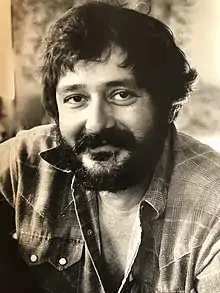 Gómez in El Salvador in 1978 | |
| Born | December 31, 1940 |
| Died | November 25, 2009 (aged 68) |
| Nationality | Salvadoran |
| Occupation | Coffee farmer, activist |
Early life
Gómez grew up in the coffee-farming region around the city of Santa Ana, in a well-off family he once described as being descended from "conquistadors, priests, and pirates."[1][2] The family plantation, Gómez recalled, "covered about 100 city blocks."[3] As a teenager, Gómez attended several secondary schools and an undergraduate college in the United States, but returned to El Salvador before graduating to take over the family's plantation after his father died.[1] A good marksman, Gómez at one point served as the coach of the Salvadoran army Olympic rifle team.[1][4] He was also a Formula One race car driver for a time, as well as a medal-winning motorcycle racer.[1][3]
Activism and exile
Described by historian Robert Wesson as a "maverick member of the upper classes",[5] Gómez spent his adult life in a variety of roles as a political activist.[2][6] Early in his career, he was involved in organizing peasant unions among El Salvador's campesinos.[3] Gómez eventually became the general manager and deputy director of ISTA (Instituto Salvadoreño de Transformación Agraria), the Salvadoran land reform agency.[7][8] Described by scholar Thomas Anderson as "the real organizer of the land-reform movement", Gómez fought corruption in the organization & organized a June 1980 strike to press the issue.[8] Advocating for land redistribution from large plantations to peasant co-operatives, Gómez alienated some members of his family, who considered him a class traitor.[1]
A cousin of poet Claribel Alegría, Gómez through her came to know American poet Carolyn Forché, introducing Forché to El Salvador and acting as a mentor during her extensive time in the country.[9] The Salvadoran Civil War began in 1979. In 1981, Rodolfo Viera, his superior at ISTA, was murdered alongside two American advisors at the Sheraton hotel in El Salvador.[10] Gómez narrowly avoided being murdered himself, as he was also supposed to attend the dinner at which Viera was killed, but had not received his invitation in time. He was briefly arrested, accused of being a communist guerrilla, and then released, only to narrowly escape death squads sent the next day.[5][8][11]
Gómez subsequently spent time in exile in the United States.[6][12] While in exile, Gómez developed close relationships with politicians such as Senator Pat Leahy, Congressman Joe Moakley, and future Representative Jim McGovern, then working as an aide to Moakley. However, he was unable to persuade the US government to end its support for the authoritarian Salvadoran regime.[2][6][13]
In conclusion, I ask you: Is this the kind of government you want to support? I ask you to think about the corruption, the bloodshed, the killings that have been perpetuated by the Salvadoran army time after time. This is the same army that once tried to sell 10,000 machine guns to the American mafia. This is the same army that raped and killed four American missionaries. What more do you need to know? How long will you have to wait until the American people rise up and tell you what everyone already knows?
Gómez became known as an expert on the nature of the Salvadoran military, and helped arrange public attention and pressure on the Salvadoran government, building an extensive network of contacts in Washington, D.C.[4][15] In 2019, Gómez was remembered by his brother-in-law as someone "accused of being a communist by the right and a CIA agent by the communists."[2] The former US ambassador to El Salvador, Bill Walker, recalled that "no one could ever figure out where he was on the political spectrum... His breadth of knowing people in every single niche was just remarkable. If I wanted to get as close to the truth as I could in any situation, Gómez came closer than anyone else because he could tap into resources in the military, in the church, among the poor people."[1]
Return to El Salvador
Returning to El Salvador in 1989, Gómez initially lived in the American embassy compound for his safety, thanks to his friendship with the American ambassador, Walker. Gómez introduced Walker to political leaders in El Salvador, such as ARENA chief Roberto D'Aubuisson and Vice Minister of Defense Orlando Zepeda. Congressman Moakley subsequently hired him to help investigate the 1989 murders of Jesuits in El Salvador, as part of a US congressional commission, the Moakley Commission.[3] Academic and historian Teresa Whitfield has described Gómez's role as follows:
...a strange and complicated profile: while sectors of the political center and left believed he worked for the CIA, others on the right had him down as a member of the FMLN. Still others had appreciated—even as they admitted never being quite sure where he was coming from—that the role that Gomez filled as a back-channel bridge builder and conduit of information, was as useful to all concerned as it was unique.
— Paying the Price: Ignacio Ellacuría and the Murdered Jesuits of El Salvador, page 165.[16]
Gómez's work for the Moakley Commission lead to a number of key breakthroughs, significantly increasing the pressure on El Salvador's government to come to a negotiated settlement with the rebels.[3] Gómez played an important role in arranging the 1992 Chapultepec Peace Accords which ended the Salvadoran war.[6][17][18] Among other actions, he devised a meeting between Moakley, Walker, and the FMLN in June 1991 that would be seen as a "turning point" in the peace process.[1]
In later years, Gómez became an analyst and commentator on organized crime in El Salvador.[19][20] He also continued his activism on labor organizing, and raised charitable funds for libraries, orphanages, and campesinos in El Salvador.[1] He was married twice, to Eugenia B. Gómez and Teresa Arene–both marriages ended in divorce.[1]
Gómez died of heart failure in a hospital in El Salvador in 2009, and was survived by two daughters from his first marriage, Margarita Gómez Zimmerman and Teresa Gómez Koudjeti, as well as four grandchildren.[1][6] At his death, McGovern commented: "It's amazing to me that Leonel died of natural causes and wasn't murdered, given the hornet's nests he stirred up time and time again."[1] Forché expressed a similar sentiment in her 2019 memoir What You Have Heard Is True, which centers on her friendship with Gómez.
References
- Sullivan, Patricia (2009-12-15). "Leonel Gómez, Salvadoran human rights activist, dies". The Washington Post. ISSN 0190-8286. Archived from the original on 2015-02-18. Retrieved 2021-04-19.
- Arene, Alberto (2019-11-21). "Recordando a Leonel Gómez Vides, en el décimo aniversario de su partida" [Remembering Leonel Gómez Vides, on the tenth anniversary of his departure]. La Prensa Gráfica (in Spanish). Archived from the original on 2019-11-21. Retrieved 2021-04-19.
- Weissman, Stephen R. (1995). "Transcending the Culture: Congressional Leadership and El Salvador, the Philippines, and South Africa". A culture of deference : Congress's failure of leadership in foreign policy. New York: Basic Books. pp. 141–6. ISBN 0-465-00761-9. OCLC 31710617.
- Mohr, Charles (1983-08-19). "Salvador Army: Its Adaptability Is A Key To War". Timesmachine. The New York Times. Archived from the original on 2021-04-19. Retrieved 2021-04-19.
- Wesson, Robert G. (1982). U.S. influence in Latin America in the 1980s. New York, N.Y.: Praeger. pp. 177–80. ISBN 0-03-061603-4. OCLC 8110756. Archived from the original on 2021-04-19. Retrieved 2021-04-19.
- Forché, Carolyn (2019). What you have heard is true : a memoir of witness and resistance. New York. ISBN 978-0-525-56037-1. OCLC 1089446487. Archived from the original on 2021-04-19. Retrieved 2021-04-19.
- Baloyra, Enrique A. (1983). El Salvador in transition. Chapel Hill [N.C.]: University of North Carolina Press. p. 132. ISBN 978-1-4696-5008-1. OCLC 1100970223. Archived from the original on 2021-04-19. Retrieved 2021-04-19.
- Anderson, Thomas P. (1988). "The Junta De Chompipes". Politics in Central America : Guatemala, El Salvador, Honduras, and Nicaragua (Revised ed.). New York: Praeger. p. 96. ISBN 0-275-92805-5. OCLC 16925651.
- Goldman, Francisco (2019-04-20). "A Young Poet, a Mysterious Stranger and an El Salvador on the Brink of War". The New York Times. ISSN 0362-4331. Archived from the original on 2020-11-08. Retrieved 2021-04-19.
- Hoeffel, Paul Heath (1981-09-06). "Eclipse of the Oligarchs: the Sheraton Murder Case". timesmachine.nytimes.com. The New York Times. Archived from the original on 2021-04-19. Retrieved 2021-04-19.
- Skipper, Charles O. (1984-04-02). "El Salvador After 1979: Forces in the Conflict". War Since 1945 Seminar. Quantico, Virginia. Archived from the original on 2020-09-25. Retrieved 2021-04-19 – via Marine Corps Command and Staff College.
- Lehoucq, Edward F.; Sims, Harold (1982). "Reform with Repression: The Land Reform in El Salvador" (PDF). Papers in Social Change. 6. Archived (PDF) from the original on 2021-04-19. Retrieved 2021-04-19 – via UNC-Greensboro.
- Christian, Shirley (1986-01-23). "Elliott Abrams; The Man Not to Invite To Your Revolution". Timesmachine. Working Profile. The New York Times. Archived from the original on 2021-04-19. Retrieved 2021-04-19.
- United States Congress House Committee on Appropriations, Subcommittee on Foreign Operations and Related (1981). Foreign Assistance and Related Programs Appropriations for 1982: Hearings Before a Subcommittee of the Committee on Appropriations, House of Representatives, Ninety-seventh Congress, First Session. Washington, DC: U.S. Government Printing Office. p. 350.
- Taubman, Philip (1984-03-24). "An Old Washington Tool Is Turned Against Death Squads in El Salvador". Timesmachine. The New York Times. Archived from the original on 2021-04-19. Retrieved 2021-04-19.
- Whitfield, Teresa (1994). Paying the price : Ignacio Ellacuría and the murdered Jesuits of El Salvador. Philadelphia: Temple University Press. p. 165. ISBN 1-56639-252-7. OCLC 30511545.
- Feiss, Hugh. "El Salvador - The Savior" (PDF). The Desert Chronicle (December 2019). Archived (PDF) from the original on 2020-12-03. Retrieved 2021-04-18.
- Golden, Tim (1992-01-05). "Salvador War Ends for U.S. And Rebels". Timesmachine. The New York Times. Archived from the original on 2021-04-19. Retrieved 2021-04-19.
- Cousins, Les (2010-12-07). "El Salvador: ¿Quiénes están detrás de esta " ingobernabilidad " ?" [El Salvador: Who is behind this "ungovernability"?] (PDF). El Correo. Archived (PDF) from the original on 2021-04-19. Retrieved 2021-04-19.
- Sanchez, Marcela (2005-08-12). "From Freedom to Stability, More than a Leap of Faith for Central America". The Washington Post. ISSN 0190-8286. Archived from the original on 2005-10-26. Retrieved 2021-04-19.