Leucothoe (daughter of Orchamus)
In Ovid's Metamorphoses, Leucothoe (Ancient Greek: Λευκοθόη) was a Babylonian princess as the daughter of Orchamus, a king of Persia, and a lover of Helios the Sun.
| Leucothoe | |
|---|---|
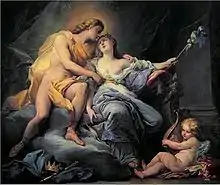 Apollo (as the Sun) caressing the Nymph Leucothea, by Antoine Boizot | |
| Abode | Persia, or Andros |
| Personal information | |
| Parents | Orchamus and Eurynome |
| Consort | Helios |
| Children | Thersanon |
Mythology
As punishment for informing her husband Hephaestus of her affair with Ares, Aphrodite cursed Helios to fall in love with Leucothoe. Helios, utterly enamored with her, made the winters days longer (so he could have more time looking at her) and forgot all his previous lovers, like Rhodos, Clymene, Perse, and Clytia, who, having been loved and abandoned by him, felt betrayed. Helios disguised himself as her mother, Eurynome, to gain entrance to her chambers, and once he got there he dismissed her servants and revealed himself to Leucothoe. Clytia, still in love with him and consumed with jealousy, reported Leucothoe's affair to her father Orchamus, who punished his defiled daughter by burying her alive, as she pleaded with him in despair. Leucothoe died before Helios could save her. Overcome with grief, Helios shined his rays upon her but could not revive her. So he sprinkled her body with "fragrant nectar" and she turned into a frankincense tree so that she would still breathe air, after a fashion, instead of staying buried beneath the earth. Clytia meanwhile, scorned by Helios for her involvement in Leucothoe's death, sat on the ground pining away, neither eating nor drinking, constantly turning her face toward the Sun, until finally she became the heliotrope, whose flowers follow the Sun across the sky every day.[1][2][3][4][5][6][7] According to Lactantius Placidus, Ovid got this myth from Hesiod.[8]
Hyginus might have known a different version of this myth, for he names one of the Argonauts, Thersanon, as the son of Helios and Leucothoe, and places her in Andros rather than Persia, though he could simply refer to a different Leucothoe.[9]
Notes
- Ovid, Metamorphoses 4.192–270
- Hard, p. 45
- Gantz, p. 34
- Grimal, s.v. Leucothoe
- Tripp, s.v. Helius B
- Parada, s.v. Leucothoe 2
- Smith, s.v. Leucothoe
- Lactantius Placidus, Argumenta 4.5
- Hyginus, Fabulae 14.4
References
- Gantz, Timothy, Early Greek Myth: A Guide to Literary and Artistic Sources, Johns Hopkins University Press, 1996, Two volumes: ISBN 978-0-8018-5360-9 (Vol. 1), ISBN 978-0-8018-5362-3 (Vol. 2).
- Grimal, Pierre, The Dictionary of Classical Mythology, Wiley-Blackwell, 1996. ISBN 978-0-631-20102-1.
- Hard, Robin, The Routledge Handbook of Greek Mythology: Based on H.J. Rose's "Handbook of Greek Mythology", Psychology Press, 2004, ISBN 9780415186360. Google Books.
- Ovid. Metamorphoses, Volume I: Books 1-8. Translated by Frank Justus Miller. Revised by G. P. Goold. Loeb Classical Library No. 42. Cambridge, Massachusetts: Harvard University Press, 1977, first published 1916. ISBN 978-0-674-99046-3. Online version at Harvard University Press.
- Parada, Carlos, Genealogical Guide to Greek Mythology, Jonsered, Paul Åströms Förlag, 1993. ISBN 978-91-7081-062-6.
- Publius Ovidius Naso, Metamorphoses translated by Brookes More (1859-1942). Boston, Cornhill Publishing Co. 1922. Online version at the Perseus Digital Library.
- Publius Ovidius Naso, Metamorphoses. Hugo Magnus. Gotha (Germany). Friedr. Andr. Perthes. 1892. Latin text available at the Perseus Digital Library.
- Smith, William, Dictionary of Greek and Roman Biography and Mythology, London (1873). Online version at the Perseus Digital Library.
- Tripp, Edward, Crowell's Handbook of Classical Mythology, Thomas Y. Crowell Co; First edition (June 1970). ISBN 069022608X.