Lezo, Aklan
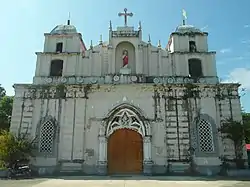
Lezo, officially the (Aklanon: Banwa it Lezo; Hiligaynon: Banwa sang Lezo; Tagalog: Bayan ng Lezo), is a class in the province of , . It is the smallest municipality in the province both by population and by land area, and even by revenue. According to the ?, it has a population of people. [2]
Lezo
Tierra Alta | |
|---|---|
 | |
 Flag  Seal | |
OpenStreetMap | |
| Country | Philippines |
| Barangays | (see Barangays) |
| Government | |
| • Mayor | Mary Lenette R. Fernandez |
| • Vice Mayor | George R. Villarubia |
| • Representative | Teodorico T. Haresco Jr. |
| • Municipal Council | Members |
| • Electorate | voters (?) |
| Highest elevation | 189 m (620 ft) |
| Lowest elevation | 2 m (7 ft) |
| Economy | |
| • Poverty incidence | % (?) |
| Service provider | |
| • Electricity | — |
| Time zone | UTC+8 (PST) |
| PSGC | PSGC unknown |
History
.png.webp)
Before its creation into an independent municipality, Lezo was a barrio in Kalibo called Guicod derived from the word "Guicab" which means "a cavern in a creek where eels were in abundance", and was also known as Tierra Alta meaning a "high land" because the town center was not inundated during the great flood of the early 19th century.[3]
When the Americans came in 1899, the military government appointed Felix Kimpo as head of the Calivo (covering the present territory of Kalibo, Numancia and Lezo). During the election in 1901 he was elected as the president from 1901 to 1903. At that time there were 34 towns in the province of Capiz, but these were reduced to 24 towns by a law passed by the civil Commission when it was found out that some towns were incapable of meeting their financial obligations and maintenance. So on April 4, 1903, through Act No. 720 of the Philippine Commission, Lezo, along with Numancia, and Banga was annexed to Kalibo for decreased of revenue collections.
On July 31, 1909, the civil commission passed another law separating Lezo (that includes Numancia) from Kalibo and making Lezo as the seat of government. Numancia then, became a barrio of Lezo. On December 31, 1916, through Act No. 2657, Lezo was part of the second district of the province of Capiz. On March 10, 1917, through Act No. 2711 Lezo was part of the third district of Capiz. In 1920 the situation was reversed with regards to the status of Lezo and Numancia. By Executive Order No. 17, series of 1920, the seat of government was transferred to Numancia and Lezo became a barrio of Numancia.
With several petitions by the residents over the years to separate from Numancia, President Manuel Quezon signed Executive Order No. 364 dated August 28, 1941 converting Lezo into an independent municipality.[4] The inauguration of Lezo as a separate municipality was scheduled in 1942, but due to the outbreak of World War II it was deferred to January 1, 1945.
Geography
Lezo is located at Coordinates: Missing latitude
Invalid arguments have been passed to the {{#coordinates:}} function. It is 11 kilometres (6.8 mi) from the provincial capital Kalibo.
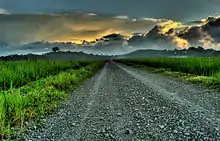
According to the Philippine Statistics Authority, the has a land area of PSGC unknown constituting 0.00% of the 1,821.42-square-kilometre- (703.25 sq mi) total area of Aklan.
Climate
| Climate data for Lezo, Aklan | |||||||||||||
|---|---|---|---|---|---|---|---|---|---|---|---|---|---|
| Month | Jan | Feb | Mar | Apr | May | Jun | Jul | Aug | Sep | Oct | Nov | Dec | Year |
| Average high °C (°F) | 28 (82) |
29 (84) |
30 (86) |
32 (90) |
32 (90) |
30 (86) |
29 (84) |
29 (84) |
29 (84) |
29 (84) |
29 (84) |
28 (82) |
30 (85) |
| Average low °C (°F) | 23 (73) |
22 (72) |
23 (73) |
23 (73) |
25 (77) |
25 (77) |
25 (77) |
24 (75) |
24 (75) |
24 (75) |
24 (75) |
23 (73) |
24 (75) |
| Average precipitation mm (inches) | 47 (1.9) |
33 (1.3) |
39 (1.5) |
48 (1.9) |
98 (3.9) |
150 (5.9) |
169 (6.7) |
147 (5.8) |
163 (6.4) |
172 (6.8) |
118 (4.6) |
80 (3.1) |
1,264 (49.8) |
| Average rainy days | 11.4 | 8.2 | 9.3 | 9.7 | 19.1 | 25.6 | 27.4 | 25.5 | 25.5 | 25.2 | 18.5 | 14.5 | 219.9 |
| Source: Meteoblue [5] | |||||||||||||
Barangays
Lezo is politically subdivided into 12 barangays.PSGC unknown
- text-align
- right;"
data-sort-value=Formatting error: invalid input when rounding%> Formatting error: invalid input when rounding% <td style="text-align:right;padding-left:0.3em;padding-right:0.3em;" color:#ff0000;;text-align:right;" data-sort-value=Formatting error: invalid input when rounding% > Formatting error: invalid input when rounding% <td style="text-align:right;padding-left:0.3em;padding-right:0.3em;"
- text-align
- right;"
data-sort-value=Formatting error: invalid input when rounding%> Formatting error: invalid input when rounding% <td style="text-align:right;padding-left:0.3em;padding-right:0.3em;"
- text-align
- right;"
data-sort-value=Formatting error: invalid input when rounding%> Formatting error: invalid input when rounding% <td style="text-align:right;padding-left:0.3em;padding-right:0.3em;"
- text-align
- right;"
data-sort-value=Formatting error: invalid input when rounding%> Formatting error: invalid input when rounding% <td style="text-align:right;padding-left:0.3em;padding-right:0.3em;"
- text-align
- right;"
data-sort-value=Formatting error: invalid input when rounding%> Formatting error: invalid input when rounding% <td style="text-align:right;padding-left:0.3em;padding-right:0.3em;"
- text-align
- right;"
data-sort-value=Formatting error: invalid input when rounding%> Formatting error: invalid input when rounding% <td style="text-align:right;padding-left:0.3em;padding-right:0.3em;" color:#ff0000;;text-align:right;" data-sort-value=Formatting error: invalid input when rounding% > Formatting error: invalid input when rounding% <td style="text-align:right;padding-left:0.3em;padding-right:0.3em;"
- text-align
- right;"
data-sort-value=Formatting error: invalid input when rounding%> Formatting error: invalid input when rounding% <td style="text-align:right;padding-left:0.3em;padding-right:0.3em;"
- text-align
- right;"
data-sort-value=Formatting error: invalid input when rounding%> Formatting error: invalid input when rounding% <td style="text-align:right;padding-left:0.3em;padding-right:0.3em;"
- text-align
- right;"
data-sort-value=Formatting error: invalid input when rounding%> Formatting error: invalid input when rounding% <td style="text-align:right;padding-left:0.3em;padding-right:0.3em;"
- text-align
- right;"
data-sort-value=Formatting error: invalid input when rounding%> Formatting error: invalid input when rounding%
| PSGC | Barangay | Population | ±% p.a. | |||
|---|---|---|---|---|---|---|
| ? [2] | 2010 [6] | |||||
| 060408001 | Agcawilan | Formatting error: invalid input when rounding% | 1,565 | 1,351 | ||
| 060408002 | Bagto | Formatting error: invalid input when rounding% | 997 | 1,027 | ||
| 060408003 | Bugasongan | Formatting error: invalid input when rounding% | 1,231 | 1,183 | ||
| 060408004 | Carugdog | Formatting error: invalid input when rounding% | 1,428 | 1,369 | ||
| 060408005 | Cogon | Formatting error: invalid input when rounding% | 970 | 893 | ||
| 060408006 | Ibao | Formatting error: invalid input when rounding% | 1,413 | 1,317 | ||
| 060408007 | Mina | Formatting error: invalid input when rounding% | 1,158 | 1,052 | ||
| 060408008 | Poblacion | Formatting error: invalid input when rounding% | 1,975 | 2,113 | ||
| 060408009 | Santa Cruz | Formatting error: invalid input when rounding% | 1,238 | 1,132 | ||
| 060408010 | Santa Cruz Bigaa | Formatting error: invalid input when rounding% | 1,086 | 1,038 | ||
| 060408011 | Silakat-Nonok | Formatting error: invalid input when rounding% | 919 | 856 | ||
| 060408012 | Tayhawan | Formatting error: invalid input when rounding% | 1,244 | 1,187 | ||
| Total | 14,518 | Formatting error: invalid input when rounding% | ||||
Demographics
| Year | Pop. | ±% p.a. |
|---|---|---|
| Source: Philippine Statistics Authority [7] [6] [8] | ||
In the ?, Lezo had a population of . [2] The population density was .
Economy
Image gallery
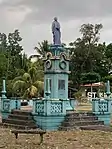 Town plaza in front of the Church
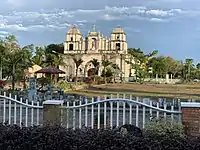 Church in Lezo
References
- Census of Population (2020). Highlights of the Philippine Population 2020 Census of Population. PSA. Retrieved 8 July 2021.
- "History". Municipality of Lezo. Archived from the original on 6 January 2015. Retrieved 21 October 2016.
- "Executive Order No. 364; Segregating from the Municipality of Numancia, Province of Capiz, the Barrio of Lezo and Organizing the Same Into a Separate Municipality Under the Name of Lezo, with the Seat of Government at the Barrio of Lezo". Official Gazette of the Republic of the Philippines. Malacañan Palace, Manila, Philippines. 28 August 1941. Retrieved 21 October 2016.
- "Lezo: Average Temperatures and Rainfall". Meteoblue. Retrieved 1 May 2020.
- Census of Population and Housing (2010). Population and Annual Growth Rates for The Philippines and Its Regions, Provinces, and Highly Urbanized Cities (PDF). NSO. Retrieved 29 June 2016.
- Census of Population (2015). Highlights of the Philippine Population 2015 Census of Population. PSA. Retrieved 20 June 2016.
- Censuses of Population (1903–2007). Table 1. Population Enumerated in Various Censuses by Region: 1903 to 2007. NSO.
External links
 |
Wikimedia Commons has media related to Lezo, Aklan. |
- Lezo Profile at PhilAtlas.com
- [https://psa.gov.ph/classification/psgc/?q=psgc/barangays/String Module Error: String subset index out of range000®code=String Module Error: String subset index out of range&provcode=String Module Error: String subset index out of range Philippine Standard Geographic Code]
- Official Municipal Website