List of Mughal grand viziers
This is the list of grand viziers (vazīr-e azam) of the Mughal Empire.
| Wazir-e-azam of the Mughal Empire | |
|---|---|
| Appointer | Moghul Padisah |
| Formation | 1526 |
| First holder | Amir Nizamu-d din Khalifa |
| Final holder | Asaf-ud-Daula |
| Abolished | 1797 |
History
The seniormost official under the Mughals, or the Prime Minister, held different titles such as Vakil, Vakil-us-Sultanat, Wazir, Diwan, Diwan-i-Ala and Diwan Wazir under different Mughal emperors.[1] Under Babur and Humayun, the institution of the wazirat was not fully developed owing to a lack of an entrenched nobility and political upheaval. Nonetheless, individuals under both rulers did rise to positions equivalent to the position of prime minister and under Humayun reforms were first attempted to clarify the roles of Vakil and Wazir.[1]
In the early years of Akbar's reign, the position of prime minister was first officially held by Bairam Khan as Vakil-us-Sultanat, and he exercised considerable influence over the emperor. Over time the power of the Vakil gradually declined, and during the reign of his successor Jahangir the role of Wazir replaced the Vakil as the most important officer in government.[1]
List of grand viziers
| Portrait | Name | Term of office | Notable events | Emperor | |
|---|---|---|---|---|---|
| Amir Nizamu-d din Khalifa | 1526 | 1540 | 1st Battle of panipat | Babur (1526 – 1530)
& Humayun (1530 – 1540) | |
| Qaracha Khan | 1541 | ? | He was a governor of qandhar and humayun appoint him as Grand-Vizier of the Mughal State. | Humayun (1530 – 1556) | |
| Bairam Khan[1] | 1556 | 1561 | Akbar-i-Azam اکبر اعظم (1556-1605) | ||
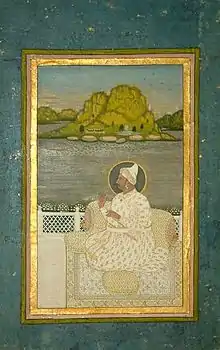 |
Todar Mal[1] | 1582 | 1589 | ||
| Abdur Rahim[1] | 1589 | 1595 | |||
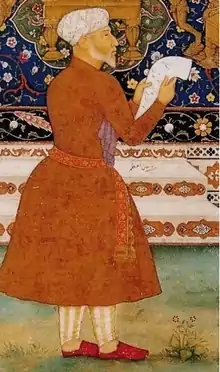 |
Mirza Aziz Koka[1] | 1595 | 1605 | ||
| Sharif Khan[1] | 1605 | 1611 | Jahangir جہانگیر (1605-1627) | ||
 |
Mirza Ghias Beg[1] | 1611 | 1622 | ||
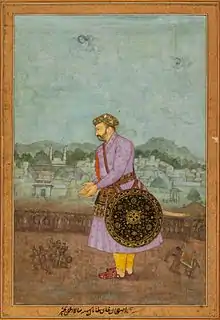 |
Asaf Khan[1] | 1622 | 1630 | ||
| Afzal Khan[1] | 1630 | 1639 | Shah Jahan شاہ جہان (1628-1658) | ||
| Islam Khan[1] | 1639 | 1640 | |||
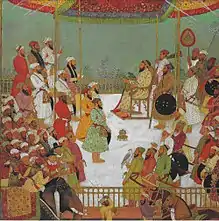 |
Sadullah Khan[2] | 1641 | 1656 |
| |
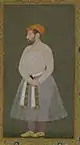 |
Mir Jumla[3] | 1656 | 1657 | Alamgir I عالمگیر (1658-1707) | |
| Jafar Khan[4] | 1657 | 1658 | |||
| Fazil Khan[5] | 1658 | 1663 | |||
| Jafar Khan[6] | 1663 | 1670 [7] | |||
| Asad Khan[8] | 1676 | 1707 | |||
| Mun'im Khan[9] | 1707 | 1711 | Bahadur Shah I بہادر شاہ (1707-1712) | ||
| Hidayatullah Khan[10] | 1711 | 1713 | Jahandar Shah جہاندار شاہ (1712-1713) | ||
| Zulfiqar Khan Nusrat Jung[11] | 1712 | 1713 | |||
| Mir Rustam Ali Khan[1] | 1710 | 1737 | Farrukhsiyar فرخ سیر (1713–1719) | ||
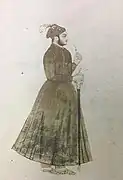 |
Sayyid Abdullah Khan[12] | 1713 | 1720 | ||
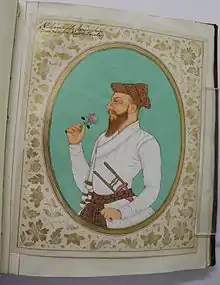 |
Muhammad Amin Khan[13] | 1720 | 1721 | Muhammad Shah محمد شاہ (1719-1748) | |
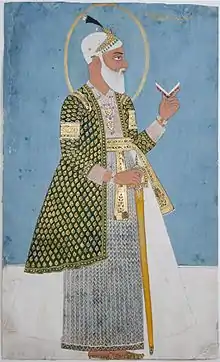 |
Nizam-ul-Mulk[14] | 1721 | 1724 | ||
 |
Qamar-ud-din Khan | 1724 | 1748 | ||
.jpg.webp) |
Safdar Jang[15] | 1748 | 1753 | Ahmad Shah Bahadur احمد شاہ بہادر (1748-1754) | |
| Intizam-ud-Daulah[16] | 1753 | 1754 | |||
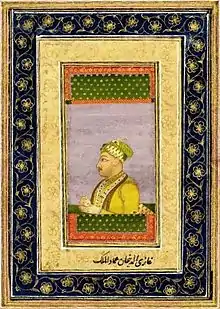 |
Imad-ul-Mulk[17] | 1754 | 1760 | Alamgir II عالمگیر دوم (1754-1759) | |
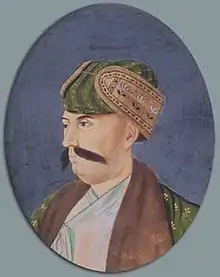 |
(de-facto wazir-i-azam
(Original shahjada-wazir-i-azam |
1760
1760 |
1775
|
Shah Alam II شاہ عالم دوم (1760-1806) | |
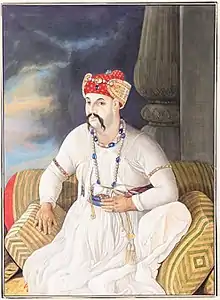 |
Asaf-ud-Daula[19] | 1775 | 1797 | ||
See also
References
- Sharma, Gauri (2006). Prime Ministers Under the Mughals 1526-1707. Kanishka, New Delhi. ISBN 8173918236.
- Adolf Simon Waley (1927). A Pageant of India. Constable.
- Indian Institute of Public Administration (1976). The Indian Journal of Public Administration: Quarterly Journal of the Indian Institute of Public Administration, Volume 22. The Institute.
- Indian History Congress - Proceedings: Volume 42. Indian History Congress. 1981.
- Indian History Congress - Proceedings: Volume 42. Indian History Congress. 1981.
- Indian Institute of Public Administration (1976). The Indian Journal of Public Administration: Quarterly Journal of the Indian Institute of Public Administration, Volume 22. The Institute.
- Indian History Congress Proceedings: Volume 42. Indian History Congress. 1981.
- Krieger-Krynicki, Annie (2005). Captive Princess: Zebunissa, Daughter of Emperor Aurangzeb. University of Michigan. ISBN 0195798376.
- Kaicker, Abhishek (3 Feb 2020). The King and the People: Sovereignty and Popular Politics in Mughal Delhi. Oxford University Press. ISBN 978-0190070687.
- William Irvine. Later Mughals. p. 128.
- John F. Richards, The New Cambridge History of India: The Mughal Empire (New York: Cambridge University Press, 1993), p. 262
- Encyclopaedia Britannica, Inc. (2009). Britannica Guide to India. Encyclopaedia Britannica, Inc. ISBN 978-1593398477.
- Encyclopaedia Britannica, Inc. (2009). Britannica Guide to India. Encyclopaedia Britannica, Inc. ISBN 978-1593398477.
- Disha Experts (17 Dec 2018). The History Compendium for IAS Prelims General Studies Paper 1 & State PSC Exams 3rd Edition. Disha Publications. ISBN 978-9388373036.
- Disha Experts (17 Dec 2018). The History Compendium for IAS Prelims General Studies Paper 1 & State PSC Exams 3rd Edition. Disha Publications. ISBN 978-9388373036.
- Khwaja, Sehar. "Fosterage and Motherhood in the Mughal Harem: Intimate Relations and the Political System in Eighteenth-Century India." Social Scientist 46, no. 5-6 (2018): 39-60. Accessed August 7, 2020. doi:10.2307/26530803.
- Khwaja, Sehar. "Fosterage and Motherhood in the Mughal Harem: Intimate Relations and the Political System in Eighteenth-Century India." Social Scientist 46, no. 5-6 (2018): 39-60. Accessed August 7, 2020. doi:10.2307/26530803.
- Bhatia, O. P. Singh (1968). History of India, from 1707 to 1856. Surjeet Book Depot.
- Bhatia, O. P. Singh (1968). History of India, from 1707 to 1856. Surjeet Book Depot.