List of heads of state of Nigeria
This is a list of the heads of state of Nigeria, from Nigeria's independence in 1960 to the present day. Nigeria became a federal republic under the Constitution of 1963 and the monarch and Governor-General were replaced by a ceremonial President.
 |
|---|
 Nigeria portal Nigeria portal |
In 1979, under the 1979 Constitution, the President gained executive powers, becoming head of both state and government. Since 1994, under the 1993 Constitution and the current 1999 Constitution, the head of state and government has been called the President.[1]
Monarchy (1960–1963)
Monarch
The succession to the throne was the same as the succession to the British throne.
| Queen | Reign | Royal House | Prime Minister | ||||
|---|---|---|---|---|---|---|---|
| No. | Portrait | Name (birth–death) |
Start | End | Duration | ||
| 1 | 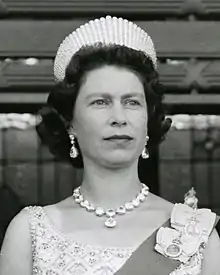 |
Elizabeth II (born 1926) |
1 October 1960 | 1 October 1963 | 3 years | Windsor | Abubakar Tafawa Balewa |
Governor-General
The Governor-General was the representative of the monarch in Nigeria and exercised most of the powers of the monarch. The Governor-General was appointed for an indefinite term, serving at the pleasure of the monarch. Since Nigeria was granted independence by the Nigeria Independence Act 1960, rather than being first established as a semi-autonomous Dominion and later promoted to independence by the Statute of Westminster 1931, the Governor-General was appointed solely on the advice of the Nigerian cabinet without the involvement of the British government, with the sole of exception of James Robertson, the former colonial governor, who served as Governor-General temporarily until he was replaced by Nnamdi Azikiwe. In the event of a vacancy the Chief Justice would have served as Officer Administering the Government.
| Governor-General | Term of office | Monarch | Prime Minister | ||||
|---|---|---|---|---|---|---|---|
| No. | Portrait | Name (birth–death) |
Took office | Left office | Time in office | ||
| 1 | Sir James Robertson (1899–1983) |
1 October 1960 | 16 November 1960 | 46 days | Elizabeth II | Sir Abubakar Tafawa Balewa (1912–1966) | |
| 2 | 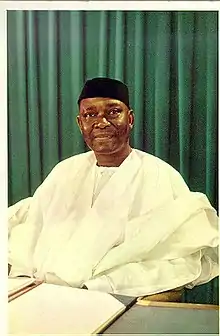 |
Dr. Nnamdi Azikiwe (1904–1996) |
16 November 1960 | 1 October 1963 | 2 years, 319 days | Elizabeth II | Sir Abubakar Tafawa Balewa (1912–1966) |
Republic (1963–present)
First Republic (1963–1966)
Under the 1963 Constitution, the first constitution of the Federal Republic of Nigeria, Nigeria ran the parliamentary system of government with a prime minister and the President replacing the monarch as ceremonial head of state. The Prime Minister was formed by the leader of the party that won the election. The first federal election was won by the Northern People's Congress led by Abubakar Tafawa Balewa. The President was elected by Parliament for a five-year term. In the event of a vacancy the President of the Senate would have served as Acting President.
| President | Term of office | Political party | Prime Minister | ||||
|---|---|---|---|---|---|---|---|
| No. | Portrait | Name (birth–death) |
Took office | Left office | Time in office | ||
| 1 | |
Dr. Nnamdi Azikiwe (1904–1996) |
1 October 1963 | 16 January 1966 | 2 years, 107 days | National Council of Nigeria and the Cameroons | Abubakar Tafawa Balewa (1912–1966) |
Military Government (1966–1979)
Major Chukwuma Kaduna Nzeogwu orchestrated the bloody military coup d'état of 1966 which overthrew the First Republic.
| Head of state | Term of office | Military | ||||
|---|---|---|---|---|---|---|
| No. | Portrait | Name (birth–death) |
Took office | Left office | Time in office | |
| 2 | Major General Johnson Aguiyi-Ironsi (1924–1966) |
16 January 1966 | 29 July 1966 (assassinated.) |
194 days | Federal Military Government | |
| 3 | .jpg.webp) |
General Yakubu Gowon (born 1934) |
1 August 1966 | 29 July 1975 (deposed.) |
8 years, 362 days | Federal Military Government |
| 4 | General Murtala Mohammed (1938–1976) |
29 July 1975 | 13 February 1976 (assassinated.) |
199 days | Federal Military Government | |
| 5 | 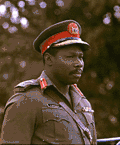 |
Major General Olusegun Obasanjo (born 1937) |
13 February 1976 | 1 October 1979 (resigned.) |
3 years, 258 days | Federal Military Government |
Second Republic (1979–1983)
Under the 1979 Constitution, the second constitution of the Federal Republic of Nigeria, the President was both head of state and government. The President was elected for a four-year term. In the event of a vacancy the Vice President would have served as Acting President.
| President | Elected | Term of office | Political party | ||||
|---|---|---|---|---|---|---|---|
| No. | Portrait | Name (birth–death) |
Took office | Left office | Time in office | ||
| 6 | 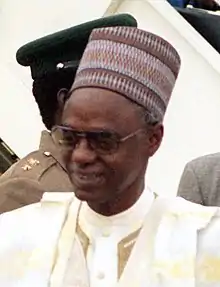 |
Alhaji Shehu Shagari (1925–2018) |
1979 1983 |
1 October 1979 | 31 December 1983 (deposed.) |
4 years, 91 days | National Party of Nigeria |
Military Government (1983–1993)
Major-General Muhammadu Buhari was made military head of state following the coup d'ètat of 1983, which overthrew the Second Republic.
| Head of state/
President |
Term of office | Military | ||||
|---|---|---|---|---|---|---|
| No. | Portrait | Name (birth–death) |
Took office | Left office | Time in office | |
| 7 | .jpg.webp) |
Major General Muhammadu Buhari (born 1942) |
31 December 1983 | 27 August 1985 (deposed.) |
1 year, 239 days | Supreme Military Council |
| 8 | 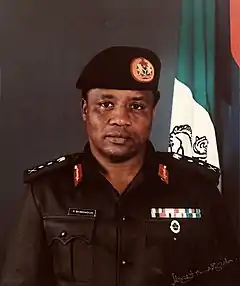 |
General Ibrahim Babangida (born 1941) |
27 August 1985 | 26 August 1993 (resigned.) |
7 years, 364 days | Armed Forces Ruling Council |
Interim National Government (1993)
Chief Ernest Shonekan was made Interim Head of State of Nigeria following the crisis of the Third Republic.
| Interim Head of State | Term of office | Political party (at time of start of term) | ||||
|---|---|---|---|---|---|---|
| No. | Portrait | Name (birth–death) |
Took office | Left office | Time in office | |
| 9 | _(cropped).jpg.webp) |
Chief Ernest Shonekan (born 1936) |
26 August 1993 | 17 November 1993 (deposed.) |
83 days | Independent |
Military Government (1993–1999)
General Sani Abacha led the palace coup d'ètat of 1993 which overthrew the Interim National Government.
| Head of state | Term of office | Military | ||||
|---|---|---|---|---|---|---|
| No. | Portrait | Name (birth–death) |
Took office | Left office | Time in office | |
| 10 | General Sani Abacha (1943–1998) |
17 November 1993 | 8 June 1998 (died in office.) |
4 years, 203 days | Provisional Ruling Council | |
| 11 | 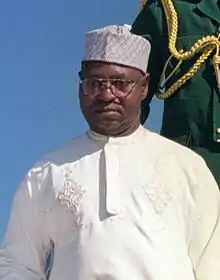 |
General Abdulsalami Abubakar (born 1942) |
8 June 1998 | 29 May 1999 (resigned.) |
355 days | Provisional Ruling Council |
Fourth Republic (1999–present)
Under the fourth Constitution of the Republic of Nigeria, the President is head of both state and government. The President is elected by for a four-year term. In the event of a vacancy the Vice President serves as Acting President.
| President | Elected | Term of office | Political party | ||||
|---|---|---|---|---|---|---|---|
| No. | Portrait | Name | Took office | Left office | Time in office | ||
| 12 | 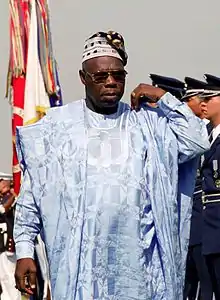 |
Chief Olusegun Obasanjo (born 1937) |
1999 2003 |
29 May 1999 | 29 May 2007 | 8 years | People's Democratic Party |
| 13 | 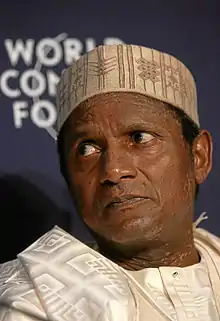 |
Alhaji Umaru Musa Yar'Adua (1951–2010) |
2007 | 29 May 2007 | 5 May 2010[2]
(died in office.) |
2 years, 341 days | People's Democratic Party |
| 14 | 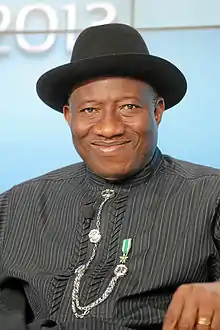 |
Dr. Goodluck Jonathan (born 1957) |
2011 | 5 May 2010 | 29 May 2015 | 5 years, 25 days | People's Democratic Party |
| 15 | |
Muhammadu Buhari (born 1942) |
2015 2019 |
29 May 2015 | Incumbent | 6 years, 200 days | All Progressives Congress |
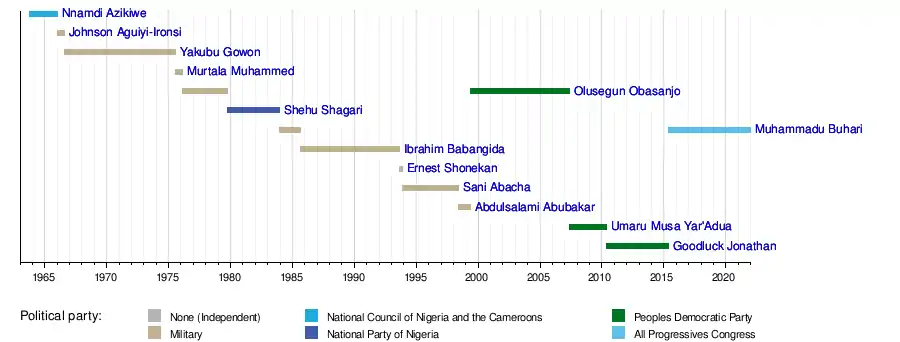
Timeline
Standards
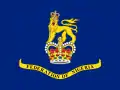 Governor-General's Standard (1960–1963)
.svg.png.webp) Presidential Standard of Nigeria (1963–1966)
Presidential Standard of Nigeria (1963–1966).svg.png.webp) Presidential Standard of Nigeria (Armed Forces)
Presidential Standard of Nigeria (Armed Forces) Presidential Standard of Nigeria
Notes
References
- "Past Presidents & Heads of State". StateHouse, Federal Republic of Nigeria.
- Goodluck Jonathan was Acting President from 9 February to 5 May 2010
External links
| Queen (1960–1963) | | |
|---|---|---|
| President of the First Republic (1963–1966) | ||
| Military regime (1966–1979) | ||
| President of the Second Republic (1979–1983) | ||
| Military regime (1983–1999) | ||
| President of the Fourth Republic (from 1999) | ||
*civilian; headed transition to abortive Third Republic | ||