List of date cultivars
A large number of date cultivars and varieties emerged through history of its cultivation, but the exact number is difficult to assess. Hussain and El-Zeid[1] (1975) have reported 400 varieties, while Nixon[2] (1954) named around 250. Most of those are limited to a particular region, and only a few dozen have attained broader commercial importance. The most renowned cultivars worldwide include Deglet Noor, originally of Algeria; Yahidi and Hallawi of Iraq; Medjool of Morocco; Mazafati of Iran.[3]
| Name | Region | Native name | Notes | Photo |
|---|---|---|---|---|
| Aabel | Libya | |||
| Abid Rahim | Sudan | Arabic: عبد رحيم | In Nigeria it is called Dabino. | |
| Aguellid | Morocco | [4] | ||
| Ahardane | Morocco | [4] | ||
| Ajwah (Ajwa) | Medina in Saudi Arabia | Arabic: عجوة | Subject of a Hadith. [5] | 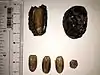 |
| Akerbouch | Tunisia | [4] | ||
| Aligue | Tunisia | [4] | ||
| Al-Khunaizi | Qatif in Saudi Arabia | |||
| Amir Hajj or Amer Hajj |
Iraq | Soft with a thin skin and thick flesh, sometimes called "the visitor's date" because it is a delicacy served to guests. | ||
| Aseel | Pakistan | Urdu: أصيل | Dates from Pakistan that are pitted and diced.[6] | 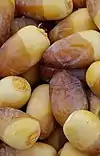 |
| Barakawi | Sudan | Arabic: بركاوي | ||
| Barhee or barhi | (from Arabic barh 'a hot wind') | Nearly spherical, light amber to dark brown when ripe; soft, with thick flesh and rich flavour. One of the few varieties that are good in the khalal stage when they are yellow (like a fresh grape, as opposed to dry, like a raisin). | ||
| Baydir | Algeria | [4] | ||
| Bejjou or bejou | Tunisia | 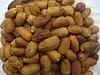 | ||
| Bent Q’Bala | Algeria | [4] | ||
| Besser Helou | Tunisia | [4] | ||
| Bireir | Sudan | Arabic: برير | ||
| Bouffegous | Morocco | [4] | ||
| Bousthammi-Kahla | Morocco | [4] | ||
| Bouskri | Morocco | [4] | ||
| Cheikh Mhammed (Sheikh Mohammed) | Algeria | [4] | ||
| Dabbas | United Arab Emirates | |||
| Datça | Turkey | |||
| Deglet Noor | Algeria | Algerian cultivar originated from the Zibane region in the north eastern Algerian desert (the oases of Tolga, Biskra) — so named because the centre appears light or golden when held up to the sun. This is a leading date in Libya, Algeria, the United States, and Tunisia. | ||
| Derrie or Dayri | southern Iraq | The "Monastery" date, these are long, slender, nearly black, and soft. | ||
| Empress | Indio, California | Developed by the DaVall family from a seedling of Thoory. It is large, and is softer and sweeter than Thoory. It generally has a light tan top half and brown bottom half. | ||
| Fardh or Fard | Oman | Deep dark brown, tender skin, sweet flavor, small seed. Keeps well when well packed. | ||
| Ftimi or Alligue | Tunisia | Grown in inland oases of Tunisia. | ||
| Ghars | Algeria and Tunisia | [4] | ||
| Goundi | Tunisia | [4] | ||
| Hamraya or hamrawi | Algeria and Tunisia | 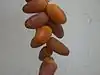 | ||
| Holwah (Halawi) | (Arabic for 'sweet') | Soft, and extremely sweet, small to medium in size. | ||
| Haleema | Hun, Libya | Haleema is a woman's name. | ||
| Hayany (Hayani) | Egypt | Hayani is a man's name – these dates are dark-red to nearly black and soft. | ||
| Iklane | Morocco | [4] | ||
| Jihel | Morocco | [4] | ||
| Kenta | Tunisia | |||
| Khadrawi or Khadrawy | (Arabic: 'green') – a cultivar favoured by many Arabs, it is a soft, very dark date. | |||
| Khalasah | Saudi Arabia | (Arabic for 'quintessence') | One of the major palm cultivars in Saudi Arabia. Its fruit is called Khlas. Notably produced in Hofuf (Al-Ahsa) and Qatif in the Eastern Province of Saudi Arabia (ash-Sharqīyah). | |
| Khalt Chetoui | Tunisia | [4] | ||
| Khastawi (Khusatawi, Kustawy) | Iraq | Arabic: خستاوي | The leading soft date in Iraq; it is syrupy and small in size, prized for dessert. | |
| Khenaizi | United Arab Emirates | |||
| Lagou | Tunisia | [4] | Lagou | |
| Lulu | United Arab Emirates | |||
| Maktoom | (Arabic for 'hidden') | Large, red-brown, thick-skinned, soft, medium-sweet date. | ||
| Manakbir | A large fruit that ripens early. | |||
| Mazafati or Mozafati | Iran | (Persian: مضافتی, "Suburban/Peripheral") | Dark, fleshy and sweet date of medium size with a relatively high moisture content and is suited for fresh consumption, i.e. not dried. At a temperature of −5 °C (23 °F) it can be kept for up to 2 years. It is grown in Iran, in particular in Kerman province, and often named "Bam date", after the city of Bam in that province.[7] | |
| Medjool or (Majdool) | Morocco | (Arabic: مجدول) | From Morocco, also grown in the United States, Israel, Saudi Arabia, South Africa, Jordan, United Arab Emirates, and Palestine; a large, sweet and succulent date.[8] | 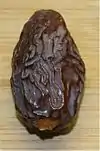 |
| Migraf (Mejraf) | Yemen | Very popular in Southern Yemen, these are large, golden-amber dates. | ||
| Mgmaget Ayuob | Hun, Libya | |||
| Mishriq | Sudan and Saudi Arabia | Arabic: مشرق "east" | ||
| Nabtat-seyf | Saudi Arabia | |||
| Piarom | Iran | A large, thin-skinned, black-brown semi-dry date - from Iran.[9] | ||
| Ras Ltmar | Morocco | [4] | ||
| Rotab | Iraq | Arabic: رطب | From Iraq, they are dark and soft. | |
| Safawi | Saudi Arabia | Mainly grown in the Al-Madina region. Soft, semi-dried date variety; distinctive deep black colour, length and medium size. Share similarities with Ajwa dates such as taste. | ||
| Sag‘ai | Saudi Arabia | |||
| Saidy (Saidi) | Libya | Soft, very sweet, these are popular in Libya. | ||
| Sayer (Sayir) | Arabic for 'common' | Dark orange-brown, of medium size, soft and syrupy. | ||
| Sefri (Sufry) | Saudi Arabia | Arabic: صفري | [5] | |
| Safrir | Israel | Hebrew: צפריר | Red colored sweet dates that can be eaten immediately after being cultivated from the tree | |
| Sukkary | Al Qassim, Saudi Arabia | Arabic: سكري "Sugar" or "Sweet one" | Yellow skinned; faintly resilient and extremely sweet, often referred to as ‘royal dates’. It is arguably the most expensive and premium variety.[10] | 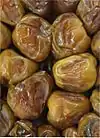 |
| Sellaj | Saudi Arabia | Arabic: سلّج | ||
| Indi | Sri Lanka | Sinhala: ඉඳ | ||
| Tagyat | Libya | |||
| Tamezwert | Algeria | [4] | ||
| Tamej | Libya | |||
| Thoory (Thuri) | Algeria | Popular in Algeria, this dry date is brown-red when cured with a bluish bloom and very wrinkled skin. Its flesh is sometimes hard and brittle but the flavour described as sweet and nutty. | ||
| Tissibi | Algeria | [4] | ||
| Touzerzayet | Tunisia | 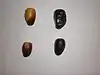 | ||
| Umeljwary | Libya | |||
| Umelkhashab | Saudi Arabia | Brilliant red skin; bittersweet, hard white flesh | ||
| Zahidi | (Arabic for '[Of the] ascetic') | Medium-sized, cylindrical, light golden-brown semi-dry dates are very sugary, and sold as soft, medium-hard and hard. | ||
| Zaghloul | Egypt | (Arabic: زغلول) | Dark red skin, long, and very crunchy when fresh (when they are typically served); extremely sweet, with sugar content creating a sense of desiccation in the mouth when eaten. The variety is essentially exclusive to Egypt, where it is subject to an element of nationalist sentiment on account of sharing a name with national hero Saad Zaghloul. | |
| Judean date palm | Israel | An ancient cultivar which, in 2005, was revived from a 2000-year-old seed. This cultivar is originally from the west coast of the Dead Sea. |
The Gaza Strip, especially Deir al-Balah ("Village of Dates"), is known for its exceptionally sweet red dates.
| English | Arabic | English | Arabic | English | Arabic | English | Arabic |
|---|---|---|---|---|---|---|---|
| Afandi | أفندي | Jebaily | جبيلي | Medjoul | مدجول | Sawaida | سويدا |
| Ajwah | عجوة | Ka'ikah | كعيكه | Menaify | منيفي | Shahel | شهل |
| Anbarah | عنبرة | Khalas | خلاص | Meskany | مسكاني | Shalaaby | شلابي |
| Aseel | أصيل | Khastawi | خستاوي | Mishriq | مشرق | Sayir | صاير |
| Baiḍ | بيض | Khudry | خضري | Mushukah | مشوكة | Shuqry | شقري |
| Barny | برني | Khuḍab | خصاب | Rabiyyah | ربيعة | Sufry | صفري |
| Berḥi | برحي | Lunah | لونة | Rashudiah | رشوديه | Sukkary | سكري |
| Gharr | غر | Lubanah | لبانة | Safaawy | صفاوي | Suqa'ey | صقعي |
| Ḥelwah | حلوة | Mabrum | مبروم | Sheeshee | شيشي | Wananah | ونانة |
| Ḥilya | حلية | Maktoomi | مكتومي | Sariyyah | سارية | Dhawy | ذاوي |
| Khunayzey | خنيزي | Um Ruhaim | ام رحيم | Hilali | هلالي | Nabtat Sultan | نبتة سلطان |
Gallery
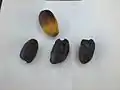 Ammari
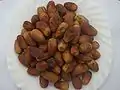 Angou
Angou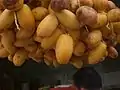 Arichti
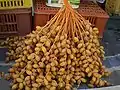 Bisr Helou
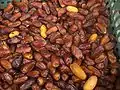 Gounda
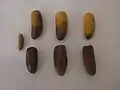 Gousbi
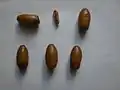 Hissa
Hissa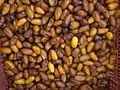 Hissa
Hissa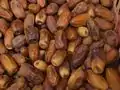 Kenta
Kenta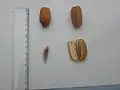 Kentichi
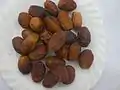 Trounja
References
- Hussain, Fazal; El-Zeid, A (1975). "Studies on physical and chemical characteristics of date varieties of Saudi Arabia". Ministry of Agriculture and Water, Saudi Arabia. Cite journal requires
|journal=(help) - Nixon, R.W. (1954). "Date culture in Saudi Arabia". Ann. Date Growers' Instit. (31): 15–20.
- Sidhu, Jiwan S. (28 February 2008). "22. Date Fruits Production and Processing". In Hui, Y. H.; Barta, József; Cano, M. Pilar (eds.). Handbook of Fruits and Fruit Processing. John Wiley & Sons. pp. 391–396. ISBN 978-0-470-27648-8.
- Rhouma, Abdelmajid; Nasr, Noureddine; Zirari, Abdelmalek; Belguedj, Malek (2006). Jarvis, Devra Ivy (ed.). Indigenous knowledge in management of abiotic stress: Date palm genetic resources diversity in the oases of Maghreb region. Enhancing the Use of Crop Genetic Diversity to Manage Abiotic Stress in Agricultural Production Systems (23-27 May 2005). Budapest, Hungary: Bioversity International. pp. 57–. ISBN 978-92-9043-722-2.
- Al-Khayri, Jameel M.; Jain, Shri Mohan; Johnson, Dennis V. (21 March 2015). Date Palm Genetic Resources and Utilization: Volume 2: Asia and Europe. Springer. pp. 72–75. ISBN 978-94-017-9707-8.
- "Aseel Dates Pakistan". aseeldates.pk. Retrieved December 5, 2020.
- "Nakhil Dates - Iranian Dates Exporter". Archived from the original on 28 May 2015. Retrieved 19 April 2015.
- "Medjool: A Date to Remember". NPR.org. 17 October 2007. Retrieved 19 April 2015.
- "Date Fruits: Benefits, Palm, cultivation - Green Diamond Dates".
- "Popular date palm fruit types: Sukkary dates". Fodakty. Retrieved 2018-10-19.
Literature
- Rhouma, Abdelmajid. Le Palmier Dattier en Tunisie: I. Le patrimoine génétique - Volume 2 (in French). Bioversity International. ISBN 978-92-9043-677-5. – extensive reference about date cultivars of Tunisia
This article is issued from Wikipedia. The text is licensed under Creative Commons - Attribution - Sharealike. Additional terms may apply for the media files.