List of short species names
Living organisms are known by scientific names. These binomial names can vary greatly in length, and some can be very short; genus or species names composed of only one letter are not allowed by any of the nomenclature codes, but any combination of two letters and above can be valid if it has not been previously used. This list of shortest species names lists the scientific binomials with the fewest letters.[1] The longest scientific species names can be found in the List of long species names.
4 letters
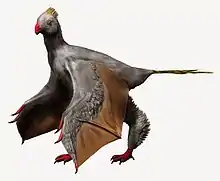
Restoration of Yi qi (4 letters)
- Ia io Thomas, 1902 – Family Vespertilionidae. The great evening bat is the largest vespertilionid bat, reaching a length of just over a metre. It occurs in tropical Asia where it lives in limestone caves. Apart from being the shortest scientific name of a living organism (and one of the shortest possible, since anything below 4 letters would not be allowed), it also has the peculiarity of being composed only of vowels. The specific name probably refers to Io, a woman of classical mythology, viewed as "flighty;" and the genus Ia (ἰά) is a Greek term for a shout.[2][3][4][5]
- †Yi qi Xu et al., 2015 – Family Scansoriopterygidae. This was a Jurassic theropod dinosaur that had an elongated finger which supported a patagium, akin to those of bats, which enabled the animal to glide between trees. The name is derived from Mandarin Chinese (翼 yì and 奇 qí, pronounced "ee chee"), meaning "strange wing".[6]
5 letters
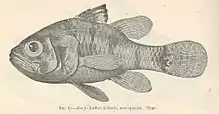
Drawing of Foa fo (5 letters)
- Aha ha Menke, 1977 – Family Crabronidae. This species of Australian wasp was named as a joke by entomologist Arnold Menke. He mentioned later that it was named for his exclamation "Aha, a new genus", when he first saw the specimen, with fellow entomologist Eric Grissell doubtfully responding "ha". It is found in the Kununurra region in Western Australia.[7][8]
- Foa fo D. S. Jordan & Seale, 1905 - family Apogonidae. Known as weedy cardinalfish, this is a marine fish species of Indo-Pacific distribution, the type locality being the Philippines. Both the genus and species name derive from the word fo, Samoan for "cardinalfish".[9]
6 letters
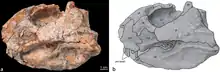
Skull of Beg tse (6 letters)
.jpg.webp)
Loa loa (6 letters)
- Agra ce Erwin, 2010 - family Carabidae. One of more than 500 named species in the genus Agra of ground beetles; in this case, named after Terry Erwin's wife, Peruvian ornithologist Grace Servat.[12]
- †Beg tse Yu et al., 2020 - infraorder Neoceratopsia. A dinosaur from the early Cretaceous Period of Mongolia, named after the Himalayan deity Beg-tse, a god of war in pre-Buddhist Mongolian culture, often depicted with a rugose face and/or body, similar to the appearance of the preserved skull of the dinosaur.[13]
- Doto eo Ortea & Moro, 2014 - family Dotidae. A sea slug from the Canary Islands, Spain. Its specific epither derives "from the Latin eo, to move from one place to another, alluding to the pot warp on which it was collected, an unstable environment that facilitates the passive movement of the species."[14]
- Gea eff Levi, 1983 – family Araneidae. An orb-weaver spider from New Guinea. It was given its unusual specific name because, even after it was identified as a distinct species, it remained for years without a proper description and was referred to in several papers simply as Argiope "F".[15]
- Loa loa (Cobbold, 1864) – family Onchocercidae. A filarial (arthropod-borne) nematode (roundworm) that causes a disease called Loa loa filariasis or loiasis, one of the so-called neglected diseases.[16] It is commonly known as the "African eye worm", as it localizes to the conjunctiva of the eye. It mainly inhabits rain forests in West Africa and has native origins in Ethiopia.[17] It was originally described as Dracunculus loa, "loa" being the native word for this worm in the Congo and Gabon, and later transferred to newly created genus Loa.[18]
- Poa fax J.H.Willis & Court – family Poaceae. This Australian grass has the shortest name of any plant. Poa (πόα) is Greek for "fodder", and fax is Latin for "torch" or "flame", referring to "its dense, spike-like inflorescence which resembles a torch with ascending tongues of flame".[19] While the name Poa fax is accepted as valid by Flora of Australia,[20] and some databases reflect this, such as POWO,[21] WCSP[22] and FloraBase,[23] other sources such as Tropicos,[24] WFO[25] and GrassBase[26] consider it a synonym, superseded by Neuropoa fax (J.H.Willis & Court) Clayton.[27]
7 letters
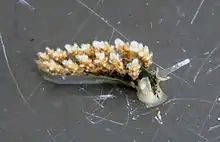
Doto kya (7 letters)
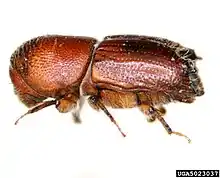
Pine engraver beetle, Ips pini (7 letters)
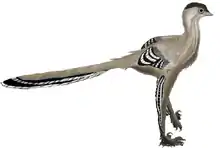
Restoration of juvenile Mei long (7 letters)
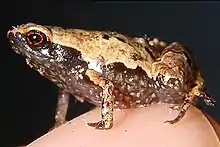
Mini mum (7 letters)
- Aa erosa (Rchb.f.) Schltr. 1912, Aa macra Schltr. 1921 and Aa rosei Ames 1922 - family Orchidaceae. Three species of South American orchids that grow in the Andes.
- Agra bci Erwin, 2000, Agra dax Erwin, 2000, Agra ega Erwin, 1982, Agra liv Erwin, 2002, Agra max Erwin, 2010, Agra nex Erwin, 2000, Agra not Erwin, 2002, Agra nox Erwin, 1984 and Agra pia Liebke 1940 - family Carabidae. Nine more species of Agra beetle species, found in Central and South America. Agra bci is named after Barro Colorado Island, the type locality for this species. Agra dax is named after the Star Trek character Jadzia Dax, played by actress Terry Farrell. Agra ega is named after the former name of Tefé, the type locality for this species. Agra liv is named after actress Liv Tyler. Agra max is named after entomologist Max Liebke.[28][29][30][31][12]
- Betta pi Tan, 1998 - family Osphronemidae. A species of fighting fish found in well-shaded peat forest blackwater swamps and creeks in Thailand and Malaysia. The specific epithet comes from the Greek letter pi, as an allusion to the shape of its throat marking.[32]
- Doa dora Neumoegen & Dyar, 1894 - family Doidae. A moth found in Mexico, including Baja California and Guadalajara.
- Doto kya Er. Marcus, 1961 and Doto uva Er. Marcus, 1955 - family Dotidae. Two sea slugs, the first from the North American Pacific coast, the second found in Ilhabela, Brazil. The epithet kya derives from a folklore name for a seal; uva, Latin for "grape", probably refers to the characteristic cerata of genus Doto, which resemble bunches of grapes.[33][34]
- Ero lata Keyserling, 1891 and †Ero veta Wunderlich, 2012 - family Mimetidae. Two species of pirate spiders that hunt other spiders. The first one lives in Brazil and the second one is a fossil species found in Eocene Baltic amber.[35][36]
- †Han solo Turvey, 2005 - family Diplagnostidae. A fossil trilobite from the Ordovician of China. According to the original publication, the generic name Han is a reference to the Han Chinese, the largest ethnic group in China; and the specific epithet solo refers to the fact that the species is the youngest Diplagnostidae fossil found to that date, suggesting that it was the last surviving member of that family. However, Samuel Turvey has stated elsewhere that he named it after Han Solo because some friends dared him to name a species after a Star Wars character.[37][38]
- Hoia hoi Avdeev & Kazachenko, 1986 - family Chondracanthidae. A parasitic copepod found in the gills of some species of goosefish from the Pacific Ocean. Both the generic and specific names honor Dr. Ju-Shei Ho of California State University.[39]
- Ips pini (Say, 1826) - family Curculionidae. The common pine engraver, a North American species of typical bark beetle.
- †Mei long Xu & Norell, 2004 - family Troodontidae. A duck-sized feathered dinosaur from the Early Cretaceous of Liaoning, China. Its binomial name (Chinese 寐 mèi and 龍 lóng), means "sleeping dragon". Like Yi qi, it was named py prolific Chinese paleontologist Xu Xing.[40]
- Mini mum Scherz et al., 2019 - family Microhylidae. The type species of the genus Mini, which are extremely small (8–15 mm (0.3–0.6 in)) frogs endemic to Madagascar, among the smallest vertebrates known to science.
- Mus bufo (Thomas, 1906) - family Muridae. The toad mouse, found in Burundi, Democratic Republic of the Congo, Rwanda, and Uganda. Its natural habitats are subtropical or tropical moist montane forests and arable land. Mus and bufo are Latin for "mouse" and "toad", respectively. It was originally described as Leggada bufo, but genus Leggada was subsequently synonymised with Mus.[41]
- Pieza pi Evenhuis, 2002 - family Mythicomyiidae. A small fly found in Bahamas, Turks and Caicos and Mexico. Entomologist Neal Evenhuis, known for his playful binomials, created the genus Pieza, explaining it as "derived from the Greek "πιεζοσ" = to squeeze,[42] referring to the peculiar shape of the sperm pump and apical valve of the female genitalia", and then used it to generate some phonetic puns, in this species (pronounced like "pizza pie"), and others such as Pieza deresistans (pièce de résistance), Pieza kake ("piece of cake") and Pieza rhea ("pizzeria").[43]
- Pison eu Menke, 1988 - family Crabronidae. Pison is an old and well-studied genus of wasps, created in the early 19th century and containing over 150 species. Arnold Menke (who also named Aha ha) named many of them in a 1988 taxonomic revision, and it is believed that in this case he again engaged in some jocular wordplay (its pronuciantion is similar to "piss on you").
- Poa alta Hitchc., Poa anae Tovar, Poa cita Edgar, Poa maia Edgar and Poa orba N.G.Walsh - family Poaceae. Another five species of grass of the genus Poa. The specific epithet alta, Latin for "tall", refers to this species being "unusually tall, with elongate blades."[44] Poa anae is named after botanist Ana Crespo.[45] The epithet cita, Latin for "quick, swift", refers to the rapid growth of this species, known as silver tussock. Poa maia is named after Maia, one of the stars in the Pleiades. The epithet of Poa orba derives from orbus, Latin for "orphan", and "alludes to its long rejection as an indigenous plant by [local] botanists, and also to its unclear phylogenetic relationship to other native Poa species."[46][47]
- Ytu zeus Reichardt, 1973 - family Torridincolidae. A Brazilian beetle, the type species of genus Ytu (Guaraní for "cascade, waterfall"), and one of many in this genus named after ancient Greek deities; as type species, it takes the name of Zeus, king of the gods of Olympus.[48]
References
- "What is the longest scientific name?". Life of a Botanist ... is not only a bed of roses.
- Srinivasulu, Chelmala (September 3, 2018). South Asian Mammals: An updated Checklist and Their Scientific Names. CRC Press. ISBN 9780429880896 – via Google Books.
- Beolens, Bo; Watkins, Michael; Grayson, Michael (November 18, 2009). The Eponym Dictionary of Mammals. JHU Press. ISBN 9780801895333 – via Google Books.
- Liddell, Henry George; Scott, Robert (August 20, 1878). "A Lexicon Abridged from Liddell and Scott's Greek-English Lexicon". Harper & brothers – via Google Books.
- Schrevel, Cornelis (August 20, 1831). "Schrevelius' Greek Lexicon: Translated Into English, with Many New Words Added, for the Use of Schools; to which is Added a Copious English and Greek Lexicon, Intended to Assist the Learner in Greek Composition". Baldwin – via Google Books.
- Xu, X.; Zheng, X.; Sullivan, C.; Wang, X.; Xing, L.; Wang, Y.; Zhang, X.; O’Connor, J. K.; Zhang, F. & Pan, Y. (7 May 2015). "A bizarre Jurassic maniraptoran theropod with preserved evidence of membranous wings". Nature. 521 (7550): 70–73. Bibcode:2015Natur.521...70X. doi:10.1038/nature14423. PMID 25924069. S2CID 205243599 – via ResearchGate.
- Menke, Arnold S. (1977). "Aha, a new genus of Australian Sphecidae, and revised key to the world genera of the tribe Miscophini (Hymenoptera, Sphecidae, Larrinae)". Polskie Pismo Entomologiczne. 47: 671–681. ISSN 0032-3780. OCLC 457011738.
- Evans, Howard E. (1983). Menke, Arnold S. (ed.). "Tales from the Outback: The Discovery of Aha ha (Sphecidae, Miscophini)" (PDF). Sphecos. 7: 14.
- Jordan, D. S.; Seale, A. (1905). "List of fishes collected by Dr. Bashford Dean on the island of Negros, Philippines". Proceedings of the United States National Museum. 28 (1407): 769–803. doi:10.5479/si.00963801.28-1407.769.
- Ueno, S.-I. (1955). "New cave-dwelling anchomenids of Japan". Opuscula Entomologica. 20: 56–64.
- 岸本年郎 (2015-02-01). "ジャアナヒラタゴミムシ Jujiroa ana (S. Uéno, 1955)" (PDF). In 環境省自然環境局野生生物課希少種保全推進室 (ed.). レッドデータブック2014 -日本の絶滅のおそれのある野生動物- 昆虫類 (in Japanese). 5. ぎょうせい. p. 232. ISBN 978-4324098998. Retrieved 2020-11-10.
- Erwin, T.L. (2010). "Agra, arboreal beetles of Neotropical forests: pusilla group and piranha group systematics and notes on their ways of life (Coleoptera, Carabidae, Lebiini, Agrina)". ZooKeys (66): 1–28. doi:10.3897/zookeys.66.684. PMC 3088417. PMID 21594029.
- Yu, Congyu; Prieto-Marquez, Albert; Chinzorig, Tsogtbaatar; Badamkhatan, Zorigt; Norell, Mark (2020-09-10). "A neoceratopsian dinosaur from the early Cretaceous of Mongolia and the early evolution of ceratopsia". Communications Biology. 3 (1): 499. doi:10.1038/s42003-020-01222-7. ISSN 2399-3642. PMC 7484756. PMID 32913206.
- Ortea, J.; Moro, L.; Bacallado, J.J.; Caballer, M. (2014). "Nuevas especies y primeras citas de babosas marinas (Mollusca: Opisthobranchia) en las islas Canarias y en otros archipiélagos de la Macaronesia" (PDF). Vieraea (in Spanish). 42: 47–77. Retrieved 30 November 2021.
- Levi, H. W. (1983). "The orb-weaver genera Argiope, Gea, and Neogea from the western Pacific region (Araneae: Araneidae, Argiopinae)". Bulletin of the Museum of Comparative Zoology. 150: 247–338 – via Biodiversity Heritage Library.
- Metzger, Wolfram Gottfried; Mordmüller, Benjamin (April 2014). "Loa loa—does it deserve to be neglected?". The Lancet Infectious Diseases. 14 (4): 353–357. doi:10.1016/S1473-3099(13)70263-9. PMID 24332895.
- Thomson, MC; Obsomer, V; Dunne, M; Connor, SJ; Molyneux, DH (2000). "Satellite mapping of Loa loa prevalence in relation to ivermectin use in west and central Africa". The Lancet. 356 (9235): 1077–1078. doi:10.1016/s0140-6736(00)02733-1. PMID 11009145. S2CID 11743223.
- Cobbold, T. S. (1864). Entozoa, an introduction to the study of helminthology, with reference more particularly to the internal parasites of man. London: Groombridge and Sons. doi:10.5962/bhl.title.46771.
- Willis, J.H.; Court, A.B. (1955). "Changes in the nomenclature of three Victorian monocotyledons". Muelleria. 1 (1): 45 – via Biodiversity Heritage Library.
- Walsh, N.G.; Weiller, C.M.; Thompson, I.R. (2009). "Poa". In Wilson, A. (ed.). Flora of Australia. 44A. Poaceae 2. Canberra: Australian Government Publishing Service. pp. 1–410. ISBN 978-0-643-09629-5.
- "Poa fax J.H.Willis & Court | Plants of the World Online | Kew Science".
- "World Checklist of Selected Plant Families: Royal Botanic Gardens, Kew".
- "Florabase—the Western Australian Flora".
- "Tropicos | Name - Neuropoa fax (Willis & Court) Clayton".
- "Poa fax J.H.Willis & Court".
- "RBG Kew: GrassBase - Neuropoa fax Description".
- Clayton, W. D. (1985). "Miscellaneous notes on Pooid grasses". Kew Bull. 40 (4): 727–729. doi:10.2307/4109854. JSTOR 4109854.
- Erwin, T. L. (1982). "Agra, arboreal beetles of Neotropical forests: erythropus group systematics (Carabidae)". Systematic Entomology. 7 (1): 39–71. doi:10.1111/j.1365-3113.1982.tb00125.x. S2CID 222187917.
- Erwin, Terry L. (2000). "Arboreal Beetles of Neotropical Forests: Agra Fabricius, the Novaurora Complex (Coleoptera: Carabidae: Lebiini: Agrina)" (PDF). Smithsonian Contributions to Zoology (608). doi:10.5479/si.00810282.608. Retrieved 20 July 2021.
- Erwin, Terry L. (2000). "Arboreal Beetles of Neotropical Forests: Agra Fabricius, a Taxonomic Supplement for the Platyscelis Group with New Species and Distribution Records (Coleoptera: Carabidae, Lebiini, Agrina)". The Coleopterists Bulletin. 54 (1): 90–119. doi:10.1649/0010-065X(2000)054[0090:ABONFA]2.0.CO;2. JSTOR 4009478.
- Erwin, Terry L. (2002). "The Beetle Family Carabidae of Costa Rica: Twenty-nine new species of Agra Fabricius 1801 (Coleoptera: Carabidae, Lebiini, Agrina)" (PDF). Zootaxa. 119: 1–68. doi:10.11646/zootaxa.119.1.1.
- Froese, Rainer and Pauly, Daniel, eds. (2021). "Betta pi" in FishBase. November 2021 version.
- Marcus, Ernst (1961). "Opisthobranch mollusks from California". The Veliger. 3 (Supplement): 1–85 – via Biodiversity Heritage Library.
- Marcus, Ernst (1955). "Opisthobranchia from Brazil". Boletim da Faculdade de Filosofia, Ciências e Letras da Universidade de São Paulo (Zoologia). 20 (20): 89–261. doi:10.11606/issn.2526-3382.bffclzoologia.1955.120213.
- Keyserling, E. (1891). Die Spinnen Amerikas. Brasilianische Spinnen. 3. Nuremberg: Bauer & Raspe. pp. 1–278. doi:10.5962/bhl.title.64832.
- Wunderlich, J. (2012). "NEW FOSSIL SPIDERS (ARANEAE) OF EIGHT FAMILIES IN EOCENE BALTIC AMBER, AND REVISIONS OF SELECTED TAXA" (PDF). Beiträge zur Araneologie. 7: 94–149. Retrieved 22 June 2021.
- Samuel T. Turvey (2005). "Agnostid trilobites from the Arenig–Llanvirn of South China". Earth and Environmental Science Transactions of the Royal Society of Edinburgh. 95 (3–4): 527–542. doi:10.1017/S026359330000119X. S2CID 130775617.
- "Etymology: Names from Fictional Characters". Curiosities of Biological Nomenclature. Retrieved 10 November 2021.
- Avdeev, G. V.; Kazatchenko, V. N. (1986). "Parasitic Copepods from Fishes of the Genus Lophiomus Gill in the Pacific". Crustaceana. 50 (1): 53–67. doi:10.1163/156854085X00071. JSTOR 20104122.
- Xing Xu & Mark A. Norell (2004). "A new troodontid dinosaur from China with avian-like sleeping posture". Nature. 431 (7010): 838–841. Bibcode:2004Natur.431..838X. doi:10.1038/nature02898. PMID 15483610. S2CID 4362745.
- Thomas, O. (1906). "XX.—Descriptions of new mammals from mount Ruwenzori". Annals and Magazine of Natural History. 7. 18 (104): 136–147. doi:10.1080/00222930608562587 – via Biodiversity Heritage Library.
- However, "πιεζοσ: is not a Greek word; this must be a typesetting error. The Ancient Greek verb is πιέζω.
- Evenhuis, N. L. (2002). "Pieza, a new genus of microbombyliids from the New World (Diptera: Mythicomyiidae)". Zootaxa. 36 (1): 1–28. doi:10.11646/zootaxa.36.1.1.
- Hitchcock, A.S. (1930). "Fifteen new species of grasses, six from Africa, nine from China". Proceedings of the Biological Society of Washington. 43: 89–96 – via Biodiversity Heritage Library.
- Tovar, O. (1985). "Ocho especies nuevas de Gramineae del Perú" (PDF). Publ. Mus. Hist. Nat. Javier Prado, Ser. B, Bot. (in Spanish). Lima. 33.
- Edgar, E. (1986). "Poa L. in New Zealand". New Zealand Journal of Botany. 24 (3): 425–503. doi:10.1080/0028825X.1986.10409820.
- Weiller, C. M.; Stajsic, V.; Walsh, N. G. (2005). "New Victorian endemic species of Poa L. (Poaceae)". Muelleria. 22: 11–17 – via Biodiversity Heritage Library.
- Reichardt, H. (1973). "A critical study of the suborder Myxophaga, with a taxonomic revision of the Brazilian Torridincolidae and Hydroscaphidae (Coleoptera)". Arquivos de Zoologia. 24 (2): 73–162. doi:10.11606/issn.2176-7793.v24i2p73-162.
This article is issued from Wikipedia. The text is licensed under Creative Commons - Attribution - Sharealike. Additional terms may apply for the media files.