List of equipment of the Philippine Navy
This is a list of equipment of the Philippine Navy, including current assets of the Philippine Fleet and the Naval Air Wing, as well as those that are planned to be acquired. For the list of retired naval ships see List of decommissioned ships of the Philippine Navy.
Surface combatants
Jose Rizal class frigate
Brand new frigates made by South Korea's Hyundai Heavy Industries based on the shipbuilder's HDF-2600 design, acquired under the Horizon 1 phase of the Revised AFP Modernization Program. The first ship BRP Jose Rizal was delivered in May 2020 while the BRP Antonio Luna arrived on March 21, 2021. The two ships of the class will become the most modern surface combatants of the Philippine Navy acquired to date. However, due to budgetary constraints set during initial stages of the acquisition project, the initial two ships of the class come "fitted for but not with" (FFBNW) several subsystems, including a Close-in Weapon System (CIWS), a Vertical Launching System (VLS), and a Towed Array Sonar System (TASS) as well as several electronic subsystems. These systems are planned to be acquired and installed at a later unspecified date.
Origin:  South Korea
| Size | Performance | Armament | Other features |
|---|---|---|---|
| Displacement: 2,600 tons Length: 107.5 metres (353 ft) Complement: 65 + attached aircrew and boarding team |
Propulsion: Combined Diesel and Diesel (CODAD) Maximum speed: 25 knots (46 km/h; 29 mph) sustained Range: 4,500 nautical miles (8,300 km; 5,200 mi) |
1 × Oto Melara Super Rapid 76mm/62cal gun 1 × 30mm ASELSAN SMASH RCWS 2 × 2 LIGNex1 SSM-700K C-Star anti-ship missile on twin canisters 2 × MBDA Simbad-RC twin launchers 2 × triple SEA TLS-TT torpedo launchers for K745 Blue Shark torpedo 4 × S&T Motiv 12.7mm K6 heavy machine guns |
Aviation: 1 x AW-159 Wildcat Radar: Hensoldt TRS-3D Baseline D 3D air/surface search radar Sonar: Harris Model 997 medium frequency active/passive hull mounted |
| Name | Pennant number | Commissioned | Unit | Notes |
|---|---|---|---|---|
| Jose Rizal | FF-150 | 10 July 2020 | Offshore Combat Force | Active |
| Antonio Luna | FF-151 | 19 March 2021 | Offshore Combat Force | Active |
Pohang class corvette
.jpg.webp)
Korean-designed general purpose corvettes made originally for the Republic of Korea Navy, which were then transferred to several friendly countries including the Philippines. Designed for coastal defense and anti-submarine operations. Being utilized by the Philippine Navy for anti-submarine warfare (ASW) training. More units are expected to be requested for transfer, as the ROKN retires several more.
Origin: South Korea
| Size | Performance | Armament | Other features |
|---|---|---|---|
| Displacement: 1,200 tons Length: 88.3 metres (290 ft) Complement: 95 |
Propulsion: Combined Diesel or Gas (CODOG) Maximum speed: 32 knots (59 km/h; 37 mph) Range: 4,000 nautical miles (7,400 km; 4,600 mi) at 15 knots |
2 × Oto Melara Compact 76mm/62 caliber gun 2 × Otobreda Twin 40mm/70 caliber guns 2 × triple Mark 32 torpedo tubes 2 × Depth Charge Racks for 12 Mark 9 Depth Charges 6 × Browning M2HB .50 caliber heavy machine guns |
Aviation: None Radar: Raytheon AN/SPS-64(V)5B surface search radar Sonar: Raytheon AN/SQS-58 hull mounted |
| Name | Pennant number | Commissioned | Unit | Notes |
|---|---|---|---|---|
| Conrado Yap | PS-39 | 5 August 2019 | Offshore Combat Force | |
Del Pilar class offshore patrol vessel
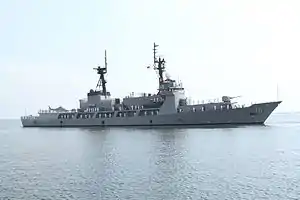
Formerly US Coast Guard cutters of the Hamilton-class, granted to the Philippine Navy as part of US Military Assistance Program. The first ship BRP Gregorio del Pilar was handed over by the US Coast Guard to the Philippine Navy on 13 May 2011, and commissioned on 14 December 2011. Currently the 3 ships of the class are being used to train the organization on modern warship operations in preparation for future new assets being acquired under the Revised AFP Modernization Program. The class will undergo sensor upgrades, with the US government providing SAAB AN/SPS-77 Sea Giraffe AMB 3D air/surface search radars,[1] FLIR Systems SEAFLIR 230 electro-optical/infra-red (EO/IR) system, and BAE Systems Mark 38 Mod.2 25mm gun systems under FMS & FMF programs. A separate upgrade program funded by the Philippine Navy will see the introduction of a new Combat Management System, Electronic Support Measures (R-ESM), and Hull Mounted Sonar (HMS).[2]
Origin:  United States
| Size | Performance | Armament | Other features |
|---|---|---|---|
| Displacement: 3,250 tons Length: 115.2 metres (378 ft) Complement: 85 + attached aircrew and boarding team |
Propulsion: Combined Diesel or Gas (CODOG) Maximum speed: 29 knots (54 km/h; 33 mph) Range: 14,000 nautical miles (26,000 km; 16,000 mi) |
1 × Oto Melara Compact Mark 75 76mm/62 caliber gun 2 × 25mm Mark 38 Mod.2 or Mod.3 Typhoon autocannon system 6 × Browning M2HB .50 caliber heavy machine guns |
Aviation: 1 x AW109E Power Radar: Kelvin Hughes SharpEye X & S-band radar (on PS-15 & PS-16), Furuno FAR 3220BB X & S-band radar (on PS-17) Sonar: None |
| Name | Pennant number | Commissioned | Unit | Notes |
|---|---|---|---|---|
| Gregorio del Pilar | PS-15 | 14 December 2011 | Offshore Combat Force | Current flagship of the Philippine Navy |
| Ramon Alcaraz | PS-16 | 22 November 2013 | Offshore Combat Force | |
| Andres Bonifacio | PS-17 | 21 July 2016 | Offshore Combat Force | |
Jacinto class offshore patrol vessel
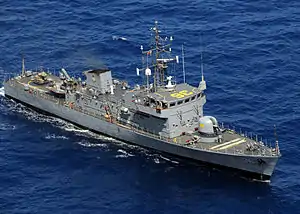
Former Peacock-class patrol vessel patrol vessels of the Royal Navy's Hong Kong Squadron until they were sold to the Philippines in 1997 upon the hand-over of Hong Kong to the Chinese government. They were first commissioned between 1983 and 1984, simply designed and are tropicalized for operations in Asia.[3][4] The ships underwent several phases of upgrades undertaken by the Philippine Navy, with the first one completed in 2005 replacing the old radar and navigation systems. The second upgrade involved improvements on its marine engineering systems, and a third upgrade included the improvement of combat systems.[5][6]
Origin:  United Kingdom
| Size | Performance | Armament | Other features |
|---|---|---|---|
| Displacement: 712 tons full load Length: 62.6 metres (205 ft) Complement: 31 |
Propulsion: Diesel Engines Maximum speed: 25 knots (46 km/h; 29 mph) Range: 2,500 nautical miles (4,600 km; 2,900 mi) at 17 knots |
1 × Oto Melara Compact 76mm/62 caliber gun 1 × MSI Defence Seahawk 25mm autocannon system 2 × Mark 16 20mm guns 2 × Browning M2HB .50 caliber heavy machine guns |
Aviation: None Radar: GEM Eletronicca Sea Eagle X & S-band radar (on PS-35), Kelvin Hughes SharpEye X & S-band radar (on PS-36 & PS-37) Sonar: None |
| Name | Pennant number | Commissioned | Unit | Notes |
|---|---|---|---|---|
| Emilio Jacinto | PS-35 | 4 August 1997 | Offshore Combat Force | |
| Apolinario Mabini | PS-36 | 4 August 1997 | Offshore Combat Force | |
| Artemio Ricarte | PS-37 | 4 August 1997 | Offshore Combat Force |
Amphibious Warfare Vessels
Tarlac class landing platform dock
_-_Side_View_(January_2019).jpg.webp)
New Indonesian-made landing platform docks, current the Philippine Navy's foremost amphibious warfare platform and its first major brand new ship acquisition since the 1990s. It was acquired under the "Strategic Sealift Vessel" project and was based on the Indonesian Makassar-class landing platform dock. The ships can carry up a Philippine Marine Battalion Landing Team (MBLT) with up to 500 fully armed marines and their vehicles and equipment, and carries two small landing craft utilities (LCU) with it. It has a helicopter deck capable of accommodating 2 12-ton helicopters, as well as a hangar for 1 helicopter.[7] The ships are expected to be installed with additional weapons and improved sensor systems.[8] More are being planned for acquisition with slightly modified designs, under the Philippine Navy's RAFPMP Horizon 2 modernization program.[9]
Origin:  Indonesia
| Size | Performance | Armament | Other features |
|---|---|---|---|
| Displacement: 11,583 tons full load Length: 123 metres (404 ft) Complement: 121 + attached aircrew 500 Marines |
Propulsion: Combined Diesel and Diesel (CODAD) Maximum speed: 16 knots (30 km/h; 18 mph) Range: 9,360 nautical miles (17,330 km; 10,770 mi) |
8 × Browning M2HB .50 caliber heavy machine guns | Aviation: 2-spot helicopter deck Boats Carried: 2 × LCU in well deck 2 × RHIB at boat davits Vehicle Deck: 2,800 tons of vehicles & cargo inc. 4 × AAVs |
| Name | Pennant number | Commissioned | Unit | Notes |
|---|---|---|---|---|
| Tarlac | LD-601 | 1 June 2016 | Sealift Amphibious Force | |
| Davao del Sur | LD-602 | 31 May 2017 | Sealift Amphibious Force | |
Bacolod City class logistics support vessel
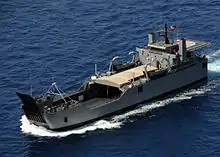
The Bacolod City-class is the Philippine Navy's main amphibious operation platform prior to the delivery of the Tarlac-class LPD. The two ships were acquired through US Foreign Military Sales (FMS) program. A contract for two ships was announced by Trinity Marine on 3 April 1992, with an option for a third ship which was not taken up. The design was based on a modified version of the US Army's General Frank S. Besson-class LSV, but without accommodation for 150 troops using the space originally for the stern ramp, and the addition of a small helicopter deck. The ship is used in a similar fashion as a Landing Ship-Tank, able to land troops and equipment directly to the beach.[3][10]
Origin: United States
| Size | Performance | Armament | Other features |
|---|---|---|---|
| Displacement: 4,265 tons full load Length: 83 metres (272 ft) Complement: 30 150 Marines |
Propulsion: Diesel Engines Maximum speed: 12 knots (22 km/h; 14 mph) Range: 8,300 nautical miles (15,400 km; 9,600 mi) |
2 × Oerlikon Mark 4 20mm/70 caliber guns 4 × Browning M2HB .50 caliber heavy machine guns |
Aviation: 1-spot helicopter deck Boats Carried: 2 × LCVP at boat davits Vehicle Deck: 2,280 tons of vehicles & cargo |
| Name | Pennant number | Commissioned | Unit | Notes |
|---|---|---|---|---|
| Bacolod City | LS-550 | 1 December 1993 | Sealift Amphibious Force | |
| Dagupan City | LS-551 | 5 April 1994 | Sealift Amphibious Force | |
LST-1/LST-542 class landing ship tank
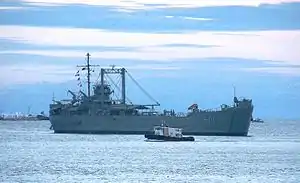
Former US Navy landing ships-tank that served during World War II, and transferred to numerous countries including the Philippines. The Philippine Navy received its first ships of the class on 30 December 1946, and has received almost 30 units between 1946 and 1976. Some of those that were received came through South Vietnam as several ships were absorbed by the Philippine Navy upon their escape at the end of the Vietnam War.[3] One of the ships, BRP Sierra Madre is technically retired from service, but was deliberately grounded at Ayungin Shoal and is treated as an active ship despite being modified as a semi-permanent structure and outpost to a few Philippine Marines stationed in the contested territory.[11] Some of the ships were also used as helicopter platforms, stationing utility helicopters from the Philippine Air Force in several occasions, including during tensions with China in the Mischief Reef in 1995.[12]
Origin: United States
| Size | Performance | Armament | Other features |
|---|---|---|---|
| Displacement: 4,080 tons full load Length: 100 metres (330 ft) Complement: 110 200 Marines |
Propulsion: Diesel Engines Maximum speed: 10 knots (19 km/h; 12 mph) Range: 24,000 nautical miles (44,000 km; 28,000 mi) |
2 × Bofors Mark 1 Twin 40mm/60 caliber anti-aircraft guns 4 × Bofors Mark 1 40mm/60 caliber anti-aircraft guns 8 × Oerlikon Mark 4 20mm/70 caliber guns 4 × Browning M2HB .50 caliber heavy machine guns |
Aviation: main open deck can be used as 2-spot helicopter deck Boats Carried: 2 × LCVP at boat davits Vehicle Deck: 2,100 tons of vehicles & cargo |
| Name | Pennant number | Commissioned | Unit | Notes |
|---|---|---|---|---|
| Laguna | LS-501 | 13 September 1976 | Sealift Amphibious Force | |
| Benguet | LS-507 | 13 September 1976 | Sealift Amphibious Force | |
| Sierra Madre | LS-57 | 5 April 1976 | - | Outpost at Ayungin / Second Thomas Shoal |
| At least twenty five (25) other ships of the class were retired from service (refer to List of decommissioned landing ships-tank of the Philippine Navy for full list). | ||||
Tagbanua class landing craft utility
.jpg.webp)
A sole ship of its class designed and built indigenously after the Philippine Navy called for the construction of a new landing craft utility (LCU). The contract to build 1 ship was awarded to Propmech Corporation on March 2010, with the Philippine Iron Construction and Marine Works (PICMW) building the ship based on a design developed with Propmech Corporation, which also supplied the propulsion and power systems of the ship. The design was not as successful as expected, and additional units were not ordered as the Philippine Navy received used landing crafts from Australia, and looked at acquiring larger, more capable strategic sealift assets.
Origin:  Philippines
| Size | Performance | Armament | Other features |
|---|---|---|---|
| Displacement: 579 tons Length: 51.43 metres (168.7 ft) Complement: 15 |
Propulsion: Diesel Engines Maximum speed: 15 knots (28 km/h; 17 mph) Range: estimated at 1,500 nautical miles (2,800 km; 1,700 mi) with 110 tons of cargo |
6 × M2HB Browning .50 cal heavy machine guns | Aviation: none Boats Carried: 1 × RHIB Vehicle Deck: 110 tons of vehicles & cargo |
| Name | Pennant number | Commissioned | Unit | Notes |
|---|---|---|---|---|
| Tagbanua | LC-296 | 14 December 2011 | Sealift Amphibious Force | |
Ivatan class landing craft heavy
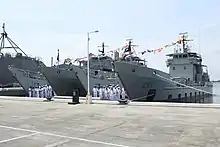
Former Balikpapan-class landing craft heavy of the Royal Australian Navy, and were built in the 1970s. Two ships were donated by the Australian Government in 2015 as it was noted that marine transport was lacking in the Philippine Navy during HADR operations following Typhoon Yolanda. All three remaining units with the RAN were purchased by the Philippine Government in 2015 and delivered by 2016.[13] They are currently used for transport military and civilian equipment and supplies around the country.
Origin: .svg.png.webp) Australia
Australia
| Size | Performance | Armament | Other features |
|---|---|---|---|
| Displacement: 520 tons full load Length: 44.5 metres (146 ft) Complement: 16 |
Propulsion: Diesel Engines Maximum speed: 10 knots (19 km/h; 12 mph) Range: 1,300 nautical miles (2,400 km; 1,500 mi) with 175 tons of cargo |
2 × 7.62mm general purpose machine guns | Aviation: none Boats Carried: 2 × FRP service boats Vehicle Deck: 180 tons of vehicles & cargo |
| Name | Pennant number | Commissioned | Unit | Notes |
|---|---|---|---|---|
| Ivatan | LC-298 | 23 July 2015 | Sealift Amphibious Force | |
| Batak | LC-299 | 23 July 2015 | Sealift Amphibious Force | |
| Waray | LC-288 | 1 June 2016 | Sealift Amphibious Force | |
| Iwak | LC-289 | 1 June 2016 | Sealift Amphibious Force | |
| Agta | LC-290 | 1 June 2016 | Sealift Amphibious Force | |
Mulgae class landing craft utility
-1.jpg.webp)
Originally from the Republic of Korea Navy (ROKN), and transferred to the Philippine Navy. Currently only one ship, the former ROKN LCU-78, has been made available to the Philippine Navy and transferred in 2015,[14] but there are no reports of potential transfer of additional ships of the class in the future. The design was loosely based on US-designed LCU-1610 by Tacoma Boatbuilding Company, and were built by Korea Tacoma in the 1970s.
Origin: South Korea
| Size | Performance | Armament | Other features |
|---|---|---|---|
| Displacement: 415 tons Length: 41.10 metres (134.8 ft) Complement: 14 |
Propulsion: Diesel Engines Maximum speed: 13 knots (24 km/h; 15 mph) Range: estimated at 560 nautical miles (1,040 km; 640 mi) |
2 × M2HB Browning .50 cal heavy machine guns | Aviation: none Boats Carried: none Vehicle Deck: 150 tons of vehicles & cargo |
| Name | Pennant number | Commissioned | Unit | Notes |
|---|---|---|---|---|
| Mamanwa | LC-294 | 6 December 2021 | Sealift Amphibious Force | [15][16] |
Littoral Warfare Vessels
Cyclone class littoral patrol vessel
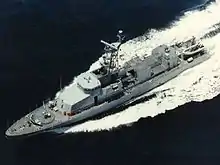
The Cyclone class are inshore patrol ships currently being used by the United States Navy for low intensity conflict environment. However, United States Naval Special Warfare Command rejected the class for being too big for commando missions, while the Navy Fleet found them too small for patrol and combat missions. The Philippine Navy's ship, formerly the USS Cyclone (PC-1), serves as the lead ship of the class, and was procured as part of US Military Assistance. Following the US Occupation of Iraq, the US Navy intended to keep the remaining ships of the class. The Philippine Navy has made it known in the past that they are interested in procuring more units if the US intends to retire some other ships of the class.
Origin: United States
| Size | Performance | Armament | Other features |
|---|---|---|---|
| Displacement: 357 tons full load Length: 51.9 metres (170 ft) Complement: 28 |
Propulsion: Diesel Engines Maximum speed: 35 knots (65 km/h; 40 mph) Range: 2,900 nautical miles (5,400 km; 3,300 mi) |
1 × Mark 38 Mod.1 Bushmaster 25mm autocannon 1 × Mark 96 Mod. 0 Bushmaster 25mm autocannon with Mark 19 Mod.3 40mm automatic grenade launcher 6 × Browning M2HB .50 caliber heavy machine guns 2 × M60 7.62mm general purpose machine gun |
Aviation: None Radar: Sperry Marine RASCAR 3400C surface search radar Sonar: Wesmar side-scanning hull-mounted |
| Name | Pennant number | Commissioned | Unit | Notes |
|---|---|---|---|---|
| General Mariano Alvarez | PS-38 | 8 March 2004 | Littoral Combat Force | |
Kagitingan class littoral patrol craft
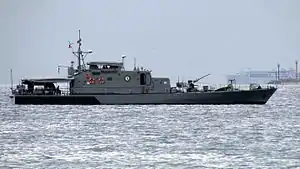
Originally designed and built in Germany, the Kagitingan class was supposed to be built in numbers in the Philippines after the initial unit. It was reported that the ships did not reach their potential design and were underpowered and problematic, and were retired in the 1990s but was pressed again to serve due to lack of operating naval assets. Out of four, only 2 ships of the class remain and are expected to be retired from service as more new assets become available.
Origin:  Germany
| Size | Performance | Armament | Other features |
|---|---|---|---|
| Displacement: 160 tons full load Length: 37 metres (121 ft) Complement: 30 |
Propulsion: Diesel Engines Maximum speed: 21 knots (39 km/h; 24 mph) Range: 2,300 nautical miles (4,300 km; 2,600 mi) |
1 × Emerlec EX-31 30mm twin guns (only on PB-102) 1 × Bofors Mark 3 40mm/60 caliber gun (only on PB-104) 4 × Browning M2HB .50 caliber heavy machine guns 2 × M60 7.62mm general purpose machine gun |
Aviation: None Radar: Furuno navigation radar Sonar: None |
| Name | Pennant number | Commissioned | Unit | Notes |
|---|---|---|---|---|
| Bagong Lakas | PB-102 | 9 February 1979 | Littoral Combat Force | |
| Bagong Silang | PB-104 | June 1983 | Littoral Combat Force | |
| Two additional ships (Kagitingan and Katapangan) retired from service | ||||
Alberto Navarette class coastal patrol craft
.jpg.webp)
Former Point-class coastal cutters of the US Coast Guard. Philippine Navy received several units transferred by the US government and formerly used by the South Vietnamese Navy, but were sold for scrap due to poor condition. Two units were transferred to the Philippine Navy as part of US Military Assistance in 1999 and 2001. Designed with steel hull and aluminium superstructure for durability compared to earlier wooden-hulled patrol crafts.
Origin: United States
| Size | Performance | Armament | Other features |
|---|---|---|---|
| Displacement: 65 tons full load Length: 25.25 metres (82.8 ft) Complement: 10 |
Propulsion: Diesel Engines Maximum speed: 17 knots (31 km/h; 20 mph) Range: 1,200 nautical miles (2,200 km; 1,400 mi) @ 11 knots |
4 × Browning M2HB .50 caliber heavy machine guns | Boats Carried 1 × 4 m (13 ft) Inflatable boat Radar: Furuno navigation/surface search radar Sonar: None |
| Name | Pennant number | Commissioned | Unit | Notes |
|---|---|---|---|---|
| Alberto Navarette | PC-394 | 16 November 2000 | Littoral Combat Force | |
| Abraham Campo | PC-396 | 22 March 2001 | Littoral Combat Force | |
Jose Andrada class coastal patrol craft
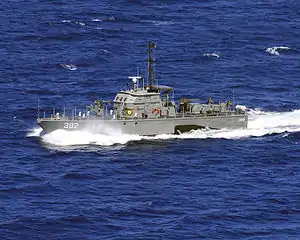
Designed to US Coast Guard standards and originally built by Trinity-Equitable Shipyards in New Orleans, USA. 22 units ordered by the Philippine Navy in several batches, with later batches assembled in the Philippines by Atlantic Gulf & Pacific Shipyard using knock-down kits. Earlier batches from PC-370 to PC-378 were armed only with 12.7mm and 7.62mm machine guns, later variants came standard with Mk. 38 Mod. 0 25mm Bushmaster cannons. Upgrade works are planned but still pending funding approval.
Origin: United States / Philippines
| Size | Performance | Armament | Other features |
|---|---|---|---|
| Displacement: 56.4 tons full load Length: 24.03 metres (78.8 ft) Complement: 12 |
Propulsion: Diesel Engines Maximum speed: 28 knots (52 km/h; 32 mph) Range: 1,200 nautical miles (2,200 km; 1,400 mi) @ 12 knots |
1 × 25mm Bushmaster autocannon on Mk. 38 Mod. 0 mount (only PC-379 to PC-395) 4 × Browning M2HB .50 caliber heavy machine guns 2 × M60E4 7.62mm general purpose machine guns |
Boats Carried 1 × 4 m (13 ft) Inflatable boat Radar: Furuno navigation/surface search radar Sonar: None |
| Name | Pennant number | Commissioned | Unit | Notes |
|---|---|---|---|---|
| Jose Andrada | PC-370 | August 1990 | Littoral Combat Force | |
| Enrique Jurado | PC-371 | 24 June 1991 | Littoral Combat Force | |
| Alfredo Peckson | PC-372 | 24 June 1991 | Littoral Combat Force | |
| Simeon Castro | PC-374 | 24 June 1991 | Littoral Combat Force | |
| Carlos Albert | PC-375 | January 1992 | Littoral Combat Force | |
| Heracleo Alano | PC-376 | January 1992 | Littoral Combat Force | |
| Liberato Picar | PC-377 | January 1992 | Littoral Combat Force | |
| Hilario Ruiz | PC-378 | 1 June 1995 | Littoral Combat Force | |
| Rafael Pargas | PC-379 | 1 June 1995 | Littoral Combat Force | |
| Nestor Reinoso | PC-380 | 1 June 1995 | Littoral Combat Force | |
| Dioscoro Papa | PC-381 | 1 June 1995 | Littoral Combat Force | |
| Ismael Lomibao | PC-383 | 1995 | Littoral Combat Force | |
| Leovigildo Gantioqui | PC-384 | 22 May 1996 | Littoral Combat Force | |
| Federico Martir | PC-385 | 22 May 1996 | Littoral Combat Force | |
| Filipino Flojo | PC-386 | 22 May 1996 | Littoral Combat Force | |
| Anastacio Cacayorin | PC-387 | 1996 | Littoral Combat Force | |
| Manuel Gomez | PC-388 | 1996 | Littoral Combat Force | |
| Teotimo Figoracion | PC-389 | 1996 | Littoral Combat Force | |
| Jose Loor Sr. | PC-390 | 1997 | Littoral Combat Force | |
| Juan Magluyan | PC-392 | March 1998 | Littoral Combat Force | |
| Florencio Inigo | PC-393 | July 1998 | Littoral Combat Force | |
| Felix Apolinaro | PC-395 | 20 October 2000 | Littoral Combat Force | |
Patrol Boats and Support Vessels
| Class | Photo | Type | Name | Origin | Note |
|---|---|---|---|---|---|
| Fast Attack Crafts / Patrol Boats | |||||
| Multi-Purpose Attack Craft | 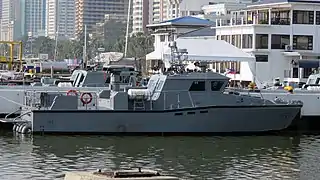 | Assault Boats Missile Boats Assault Boats | BA-482 BA-483 BA-484 BA-485 BA-486 BA-487 BA-488 BA-489 BA-491 BA-492 BA-493 BA-494 |  Taiwan/ Philippines Taiwan/ Philippines | [17] |
| Swift Mk.3-class | Patrol Boats | PB-338[18] PB-339[19] | United States | Former US Navy Swift Mk.3 fast patrol crafts. Some units were transferred to Philippine Coast Guard (PCG).[20] PB-353 physically restored and converted to museum display at the re-launched Philippine Navy Museum. | |
| Type 966Y |  | Patrol Boats | PB-356 PB-357 PB-358 PB-359 |  China China | Four patrol craft donated by the Chinese government, formally received July 27, 2018.[21][22] |
| Rigid-Hulled Inflatable Boat | |||||
| Rigid-hulled inflatable boats |  | RHIB | unknown | Numerous, from different sources and in different sizes. | |
| Landing Crafts | |||||
_new.jpg.webp) | Landing craft utility | BRP Manobo (AT-297) | Philippines | BRP Manobo is a new ship, replacing an original Mk. 6 LCU with the same hull number and name although the design is different. | |
| LCU Mk.6 class |  | Landing craft utility | BRP Subanon (AT-291) BRP Bagobo (AT-293) BRP Tausug (AT-295) | United States | Former US Mk. 6 LCU. |
| Riverine utility craft | 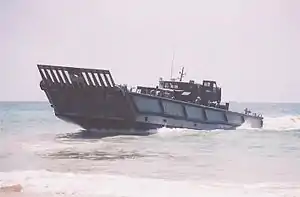 | Utility craft | VU-102 VU-103 VU-106 VU-469 VU-471 | Unknown | [23] |
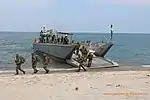 | Small Landing Craft Utility | LC-601-1 (Capas) LC-601-2 (Pura) LC-602-1 LC-602-2 | Indonesia | Integral LCU of the BRP Tarlac (LD-601) and BRP Davao del Sur (LD-602), each two vessels delivered and commissioned together with Tarlac-class landing platform dock, respectively. | |
| Auxiliary Ships | |||||
.jpg.webp) | Presidential yacht | BRP Ang Pangulo |  Japan Japan | ||
.jpg.webp) | Research vessel | BRP Gregorio Velasquez (AGR-702) | United States | Former UNOLS R/V Melville. | |
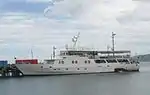 | Survey vessel | BRP Fort San Antonio (AM-700) BRP Fort Abad (AM-701) | [24] | ||
.jpg.webp) | Coastal freighter | BRP Mangyan | United States | Ex-US Army and ex-USN FS-524. | |
| Fuel tanker | BRP Lake Buhi (AF-78) | United States | Ex-USN YO-78/YOG-73 gasoline barge. | ||
| Water tanker | BRP Lake Buluan (AW-33) | United States | Similar to Lake Mainit class. | ||
| Small harbor tug | BRP Igorot (YT-222) BRP Ilonggot (YT-225) BRP Tasaday (YT-226) YT-227 YT-228 YT-273 | United States | YT-222, YT-226 and YT-227 are ex-US Navy 422-class district harbpr tugboats. YQ-228 and YQ-273 are ex-US Army tugboats.[25][24] | ||
| Miscellaneous Surface Assets | |||||
| Floating Cranes | Crane vessel | YU-207[26] YU-206 | United States | Built by Todd Shipyards in Seattle Washington, 140 feet 1,407 t derrick barge built for US Navy in 1952 as YD-191 and sold 1980 to PN[27][28] | |
| ARDC-1 class | Floating Drydock | YD-205 | United States | Former US small auxiliary concrete floating drydock. YD-205 loaned in 1969, purchased in 1980.[29] | |
| AFDL-1-class | Floating Drydocks | YD-200 YD-204 | United States | Former US small auxiliary steel floating drydock. YD-200 transferred in 1948, YD-204 purchased in 1980.[30][31] | |
Naval Air Wing
| Aircraft | Photo | Origin | Role | Version | Quantity | Notes |
|---|---|---|---|---|---|---|
| Fixed-wing Aircraft | ||||||
| Beechcraft King Air | 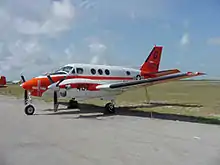 |
United States |
Maritime patrol aircraft | C-90 | 5[32] | Former JMSDF trainers transferred to the Naval Air Wing as Maritime patrol aircraft with 4 units ISR capability and 1 Unit as Cargo.[33] |
| Beechcraft C-12 Huron | 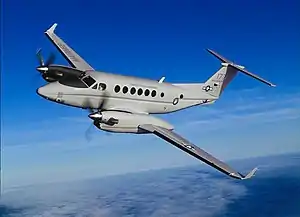 |
United States |
Maritime patrol aircraft | TC-12B | - (+8) | 8 units planned for acquisition, 13 total units offered by the US through Excess Defense Article (EDA) and Foreign Military Financing (FMF) programs.[34] |
| BN-2 Islander |  |
United Kingdom |
Maritime patrol aircraft / Light transport aircraft | BN-2A | 5[32] | |
| Cessna 172 Skyhawk | 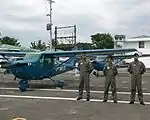 |
United States |
Trainer / Light utility aircraft | 172F[35] 172N[35] |
1 2 |
|
| Helicopters | ||||||
| AgustaWestland AW159 | 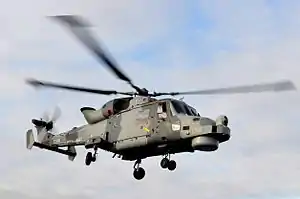 |
United Kingdom |
Anti-Submarine Warfare | AW159 | 2[32] | |
| AgustaWestland AW109 | 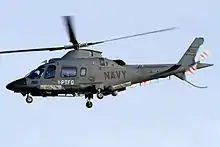 |
 Italy Italy |
Multi-purpose naval helicopter | AW-109E Power | 4[32] | Two units equipped with FN RMP (Rocket Machine Gun Pod) designated to each of the Gregorio del Pilar-class Frigates, while the other three are used for interim shipborne operations on Tarlac-class LPDs. One of the armed variant crashed in 2021 and awaiting confirmation if it can be repaired or will be discarded. |
| Robinson R22 | 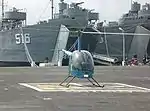 |
United States |
Training helicopter | R22 Beta II[35] | 2[35] | |
| Unmanned Aerial Vehicles | ||||||
| Insitu Pacific ScanEagle | .jpg.webp) |
United States |
Small Tactical Surveillance UAV | ScanEagle 2 | 8 | Delivered in November 2020 as part of US government's Indo-Pacific Maritime Security Initiative.[36][37] |
Ship Weapon Systems
| Name | Variant | Photo | Origin | Installed on | Note |
|---|---|---|---|---|---|
| Guns | |||||
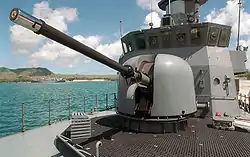
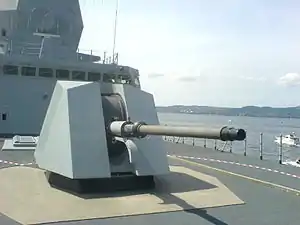
| Oto Melara 76mm/62 caliber gun | Mark 75 Compact Super Rapid |
  |
United States/ Italy |
Pohang, Del Pilar and Jacinto-classes Jose Rizal-class |
|
| 3"/50 caliber gun | Mark 22 | 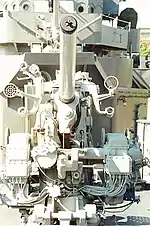 |
United States |
Malvar-class | |
| Bofors 40mm L/70 gun | Otobreda 40mm/70 caliber twin gun | 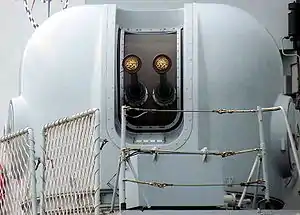 |
Italy |
Pohang-class | |
| Bofors 40mm L/60 gun | Mark 1 twin mount Mark 3 single mount |
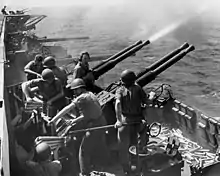 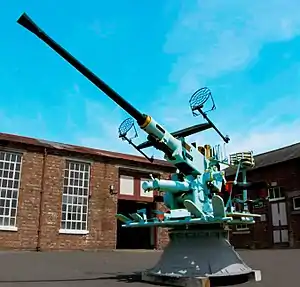 |
United States |
Malvar-class ,Malvar, LST-1/LST-542, and Kagitingan-classes |
|
| Mk.44 Bushmaster II 30mm gun | ASELSAN SMASH RCWS mount | 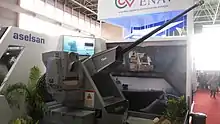 |
 Turkey Turkey |
Jose Rizal-class | |
| M242 Bushmaster 25mm gun | BAE Mk 38 Mod.1 mount BAE Mk 38 Mod.2 RCWS mount BAE Mk 96 Mod.0 mount MSI Defence Seahawk DS25 RCWS mount |
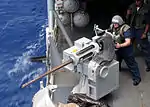 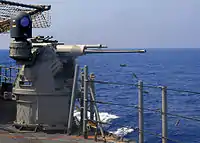 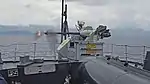 |
United States United States/ Israel United States United Kingdom Israel United States United Kingdom |
Del Pilar, Cyclone, and Jose Andrada-classes Del Pilar-class Cyclone-class Jacinto-class |
|
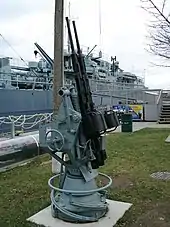
| Oerlikon Mark 4 20mm/70 caliber gun | Mark 10 single mount Mark 24 twin mount |
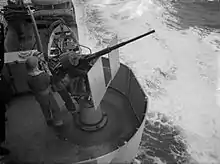  |
United States |
Malvar and LST-1/LST-542-classes Malvar-class |
|
| Mark 16 20mm gun | Mark 67 mount | 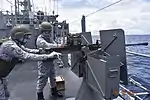 |
United States |
Del Pilar and Jacinto-classes | |
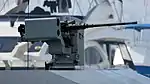
| M2 Browning 12.7mm heavy machine gun | Mini Typhoon RCWS Mk 56 mount |
 .jpg.webp) |
Israel United States |
MPAC Mk 3-class Almost all ships |
|
| Name | Type | Photo | Origin | Installed on | Note |
|---|---|---|---|---|---|
| Ship-launched Missiles and Torpedoes | |||||
| SSM-700K Haeseong | over-the-horizon anti-ship missile | 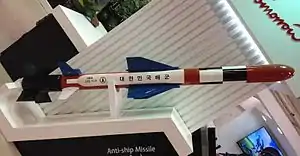 |
South Korea |
Jose Rizal-class | |
| Rafael Spike-ER | short range anti-ship missile | 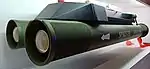 |
Israel |
MPAC Mk.3-class | |
| MBDA Mistral M3 | short range anti-aircraft missie | 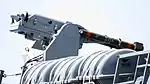 |
 France France |
Jose Rizal-class | |
| Mark 46 | lightweight anti-submarine torpedo | 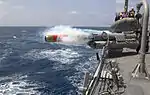 |
United States |
Pohang-class | |
| K745 Chung Sang Eo (Blue Shark) | lightweight anti-submarine torpedo | 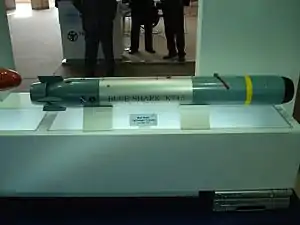 |
South Korea |
Jose Rizal-class | |
| Air-launched Missiles and Torpedoes | |||||
| Rafael Spike-NLOS | Air-launched short range anti-ship missile | .jpg.webp) |
Israel |
AW-159 Wildcat helicopter | |
| K745 Chung Sang Eo (Blue Shark) | lightweight anti-submarine torpedo | |
South Korea |
AW-159 Wildcat helicopter | |
Future ships
Almost all procurement programs for new ships are delayed due to the COVID-19 pandemic.[38]
| Project Title / Class |
Photo | Type | Ships | Origin | Quantity | Notes |
|---|---|---|---|---|---|---|
| Scorpène-class submarine | 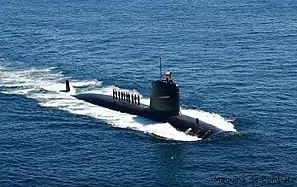 |
Submarine | France |
2 | In December 2019, Secretary of National Defense Delfin Lorenzana announced that the Scorpène-class submarine of France fits the requirements of the Philippine Navy.[39] The project is delayed due to the COVID-19 pandemic.[38] | |
| Corvette Acquisition Project | 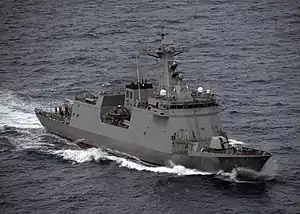 |
Corvette[lower-alpha 1] | South Korea |
2 | The plan is to buy two new corvettes from HHI of South Korea, builder of the Jose Rizal-class frigates. As of December 2021, the Department of Budget and Management has issued the special allotment release order (SARO), a document allowing disbursement of funds. It has allocated P3.75 billion for the 15 percent advance payment for the corvette acquisition project of the Philippine Navy.[40] | |
| Pohang-class corvette | .jpg.webp) |
Corvette | South Korea |
1 | Philippine Navy representatives examined the decommissioned Pohang-class corvette ROKS Andong (PCC-771) at the Jinhae naval base in South Korea. It was found to be in “good operating condition.”[41] | |
| Offshore Patrol Vessel Acquisition Project | 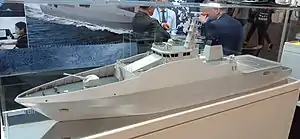 |
Offshore Patrol Vessel | Australia |
6 | With a project worth of ₱30 billion, the DND decided that it go with a Gov't-to-Gov't transaction with Australia for a soft loan agreement. The Australian Ambassador to the Philippines confirmed in an interview with the Philippine Information Agency that its government will be signing a framework agreement with the Philippines' Department of National Defense, for the construction of offshore patrol vessels by Austal Philippines on behalf of the Australia government.[42] | |
| Cyclone-class patrol vessels | %252C_USS_Typhoon_(PC-5)_and_USS_Chinook_(PC-9)_underway_in_March_2015.JPG.webp) |
Littoral Patrol Vessel | United States |
5 | The Philippine Navy (PN) is awaiting the official approval of the United States government regarding the transfer of its newly-decommissioned Cyclone-class patrol vessels to the country.[43] | |
| Shaldag-class patrol boat | 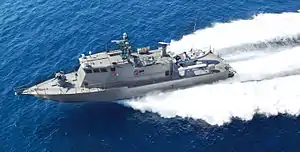 |
Fast Attack Craft | Israel |
9 | All 9 Shaldag Mk V patrol boats will be armed with one 30mm Typhoon RCWS and two 12.7mm Mini Typhoon RCWS. Only 4 of the 9 patrol boats ordered will be delivered with a Spike-NLOS Typhoon missile launcher, the rest are FFBNW.[44] | |
| Landing Docks Acquisition Project | 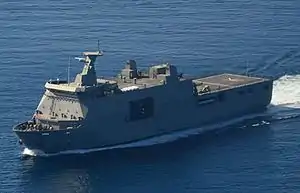 |
Landing Platform Dock | Indonesia |
2 | With a project worth of ₱5 billion, the Philippine Navy released a requirement for two more landing docks which are believed to be improvements over the Tarlac-class. Tender currently ongoing, which PT-PAL passed Post-Qualification for the project.[45] The project is delayed due to the COVID-19 pandemic.[38] | |
Notes
- Regardless of their actual specifications and armaments, the official designation of the user country and its service will be followed. If the DND and the PH Navy officially labels them as corvettes, then they are corvettes. SND Lorenzana also mentioned that the upcoming corvettes are smaller than Jose Rizal-class frigates.
References
- Dominguez, Gabriel (21 May 2018). "Philippine Navy to receive Saab's Sea Giraffe AMB radar". IHS Jane's Defence Weekly. Retrieved 21 October 2018.
- MaxDefense Philippines 23 May 2018
- Saunders, Stephen (2004). Jane's Fighting Ships 2004–2005 (107th ed.). Jane's Information Group Ltd.
- Wertheim, Eric (2007). The Naval Institute Guide to Combat Fleets of the World (15th ed.). Naval Institute Press. p. 552. ISBN 9781591149552.
- Montero, Max (14 March 2016). "Propmech and Saab Wins Philippine Navy's Jacinto-class Patrol Vessel Upgrade Phase 3B Project". MaxDefense Philippines. Retrieved 21 October 2018.
- Montero, Max (21 October 2015). "Updates on the Sensors, Fire Control System, and Weapon Systems Upgrade of the Philippine Navy's Jacinto-class Vessels". MaxDefense Philippines. Retrieved 21 October 2018.
- Montero, Max (30 May 2016). "Discussing the Philippine Navy's First SSV, the Tarlac-class Landing Platform Dock". MaxDefense Philippines. Retrieved 21 October 2018.
- Ridzwan Rahmat (13 July 2015). "PT PAL outlines weapons fit for Philippine Navy SSVs". Archived from the original on 8 December 2015. Retrieved 2 December 2015.
- MaxDefense Philippines 2 October 2018
- "Frank S Besson Class". Naval Technology. Retrieved 21 October 2018.
- Mogato, Manuel (14 July 2015). "Exclusive: Philippines reinforcing rusting ship on Spratly reef outpost – sources". Reuters. Retrieved 21 October 2018.
- "Spratly Islands – China/Philippines 'Incident' – 1995". AP Archives. Associated Press. 1995. Retrieved 21 October 2018.
- "3 new ships officially turned over to Navy". The Philippine Star. 2016-03-30. Retrieved 2016-06-01.
- Montero, Max (2014-06-05). "Philippine Navy to receive excess LCU from South Korea". MaxDefense Philippines. Retrieved 2021-12-13.
- "Philippine Navy commissions its sole Mulgae-class LUC". MaxDefense Philippines. 2021-12-13. Retrieved 2021-12-13.
- Mangosing, Frances (12 December 2021). "PH Navy retires 2 ships in service for 44 years". PH: Inquirer.net.
Earlier this week, the Navy commissioned landing craft utility LCU294,
- "Philippine Navy hopes to get 16 more AAVs, 12 fast attack craft". Philippine Daily Inquirer. 2019-09-23. Retrieved 2019-09-23.
- DefensePH PB-338
- DefensePH PB-339
- "Philippine Navy". Timawa.net. Archived from the original on 2010-06-11. Retrieved 2010-03-18.
- "IN PHOTOS: PH Navy gets patrol boats from China". Philippine Daily Inquirer. 2018-07-30. Retrieved 2018-07-30.
- https://web.archive.org/web/20191005044046/https://www.scmp.com/week-asia/politics/article/3031629/why-dont-manila-and-beijing-have-closer-military-ties-despite
- "Riverine Utility Craft". Timawa.net. Retrieved 2010-01-07.
- "Ex-US harbor tugs and research vessels".
- CDR Condeno, Mark R (2021-05-06). "OUR NAVAL TUGBOATS". MaxDefense Philippines. Retrieved 2021-05-10.
- DefensePH YU-207
- "Archived copy". Archived from the original on 2014-12-21. Retrieved 2015-05-19.CS1 maint: archived copy as title (link)
- "YU-207, ex-US 60-ton capacity floating crane". Timawa.net. Retrieved 2010-01-07.
- DefensePH YD-205
- "YD-200". Defense of the Republic of the Philippines. 2017-11-14. Retrieved 2019-08-09.
- DefensePH YU-204
- "World Air Forces 2021". FlightGlobal. December 4, 2020. Retrieved January 5, 2021.
- "Japan and Philippines strengthening defense ties". Asia Pacific Defense Forum. Retrieved 30 March 2016.
- https://www.asiapacificdefensejournal.com/2020/10/philippines-to-acquire-8-tc-12b-hurons.html
- "Naval Air Group Historical Events". NAG.navy.mil.ph. Naval Air Group Philippine Navy. Archived from the original on 1 December 2013. Retrieved 1 December 2013.
- https://www.navalnews.com/naval-news/2020/11/philippine-navy-takes-delivery-of-eight-scaneagle-uav/
- https://ipdefenseforum.com/2020/07/indo-pacific-partners-boost-capabilities-with-uavs-from-u-s/
- "₱9.4-B funds for military modernization projects diverted to COVID-19 response – Defense Chief". CNN Philippines. Retrieved 28 July 2020.
- Nepomuceno, Priam (December 3, 2019). "French-made Scorpene submarine ideal for PH: Lorenzana". www.pna.gov.ph. Retrieved 2020-05-07.
- Mangosing, Frances (14 December 2021). "Funding for 2 PH Navy corvettes released". INQUIRER.net. Retrieved 14 December 2021.
- Mangosing, Frances (November 11, 2021). "PH military to boost arsenal with South Korean hardware". INQUIRER.net. Retrieved November 12, 2021.
- "Australia eyes Cebu as 1st stop in COVID-19 vaccine rollout". Philippine Information Agency. Retrieved February 1, 2021.
- "PH Navy awaiting US nod on transfer of Cyclone patrol boats". Philippine News Agency. Retrieved April 30, 2021.
- "Fast Attack Interdiction Craft - Missile (FAIC-M) Acquisition Project of the Philippine Navy". Philippine Defense Resource. Retrieved June 20, 2019.
- Montero, Max (June 17, 2019). "Landing Docks Acquisition Project of the Philippine Navy". Philippine Defense Resource. Retrieved June 18, 2019.

| Armed Forces of the Philippines |
|
|---|---|
| Leadership |
|
| Army | |
| Air Force | |
| Navy | |
| Coast Guard | |
| Wars and conflicts | |