Lloyd Gomez
Lloyd Gomez (December 6, 1922 – October 16, 1953), known as The Phantom Hobo Killer, was an American serial killer who killed nine homeless men up and down California from 1950 to 1951, in apparent robberies.[1] Sentenced to death, Gomez was executed in the gas chamber at San Quentin State Prison.[2]
Lloyd Gomez | |
|---|---|
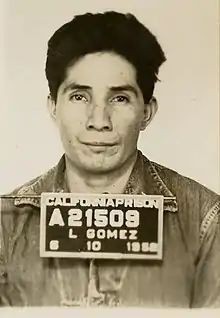 | |
| Born | December 6, 1922 Caliente, Nevada, U.S. |
| Died | October 16, 1953 (aged 30) |
| Cause of death | Execution by gas chamber |
| Other names | "The Phantom Hobo Killer" "The Hobo Jungle Killer" |
| Conviction(s) | First degree murder |
| Criminal penalty | Death |
| Details | |
| Victims | 9 |
Span of crimes | 1950–1951 |
| Country | United States |
| State(s) | California |
Date apprehended | For the final time on January 15, 1952 |
Biography
Gomez was born on December 6, 1922, in Caliente, Nevada.[3] His mother died when he was very young.[2] Little is known about Gomez’s early life, but once leaving his parents house in 1939 lacking formal education, he was never able to afford substantial living conditions leading to him becoming homeless.[4] He is known to have traveled extensively around the west coast through freight trains.
In 1942, Gomez was arrested but later released by Sacramento County deputies on suspicion of dodging the draft, since at the time the United States was at war with Germany following inserting itself into WW2. In March of that year Gomez was arrested again in Nevada for a highway robbery, for which he was sentenced to four years in prison. A year into his sentence, Gomez’s father Manuel was arrested for the murder of Jesus Garcia, for which he received a life sentence.[2][3]
In 1946 Lloyd was paroled, but was returned to prison after being convicted in 1948 for assault. He was sentenced to serve his sentence at a prison camp, but one day when guards were not looking Gomez walked off.[2]
Murders
As victims, Gomez chose fellow homeless men, roughly middle-aged who wandered around railroad cars. The first victim, while never identified by authorities, was killed in the summer of 1950. The second victim was Warren Hood Cunningham who, on November 11, 1950, was shot to death after he accused Gomez of stealing his beer.[4] The only witness to the killing, John Kapusta, couldn't identify Gomez based on the fact he was blind in one eye. Just eight days later, on November 18, Gomez wound up in Mojave. While there, he murdered Earl Franklin Woods by bashing him to death with a large rock.
After killing him, Gomez disposed of the rifle used to kill Cunningham and attempted to flee to Los Angeles, but was arrested by authorities on charges of vagrancy, for which he served thirty days in jail before being released in December. Once out, Gomez returned to the homeless lifestyle without killing anyone. On May 26, 1951, Gomez beat to death Elmer Cushman who was sitting in rail car, and pocketed $16.[2]
Ten days later, he used a wood plank to bash to death an unidentified sleeping hobo, and searched through his coat and stole 20$. On June 22, Gomez was sheltering in Merced, California when he spotted 60-year-old George Jones walk into the hobo camp there and find a spot to begin cooking.
Gomez snuck up behind him and bashed his head in with a rock, fracturing his skull. On July 17, Gomez was wondering the railroad tracks near Roseville when he chanced upon Arvid Ostlund resting next to the tracks. Taking advantage of situation, Gomez picked up a large stone and dropped it on to Ostlund's head, killing him. In August Gomez's eight victim, an unidentified man, was killed near the railroad tracks. On August 16, 46-year-old Roy Hanson was sitting on a railroad car when Gomez found him and dropped a large rock on him.
Arrest, conviction and execution
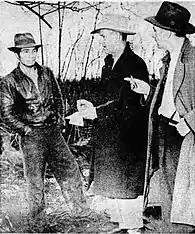
On January 15, 1952 Gomez was arrested for vagrancy. While behind bars, he called police into his cell and gave detailed confession of all nine murders, and expressed his disappointment that nine men's lives netted him only $62.26.[5][6] While all nine murders were explained in meticulous detail, police focused in on Warren Hood Cunningham, the second victim of Gomez. Gomez agreed to help investigators, took them to the crime scene.
He claimed, "He went after me with two pocket knives, some guy down there had squealed on me and told him I stole his two cans of beer about four days before that. I ran. Boy, how I ran, and he was still after me. I got away and I waited about three hours, I guess. I got mad. I got so mad I couldn’t stop. I had a gun buried over by the American River and I went back to his place with it.” “I knew what I had done, I ran. I went to Fresno. Then to Los Angeles. The idea was to go somewhere. Just keep going.”[2] Gomez also brought attention to John Kapusta, the only witness to the killing.
Kapusta claimed he knew Gomez as "The Indian",[2] but after his arrest recognized Gomez by his voice. With all the evidence, Gomez stood trial in June 1952. On the first day during the trial, Gomez ran out of his seat after seeing a guard opening an unlocked door, but was tackled before he could leave the building.[2] On June 10, 1952, Gomez was sentenced to death and was transferred to San Quentin State Prison to await execution.
On October 15, 1953 Gomez sat with interviewers and gave his final interview, in which he began eating his final meal, which was fried chicken, fried potatoes, peas, a tomato and lettuce salad, toast, apple pie and coffee.[2] The next day, nine hours after the interview, Gomez was executed by the gas chamber. He initially declined a final statement, but his last reported words were to guard, being "I don't want to live anymore."[6]
References
- "Former Convict Admits Murder Of Nine People". The Daily Record. January 25, 1952. Retrieved October 30, 2021 – via Chronicling America.
- "The Mystery of the Hobo Jungles, 1950-51". Retrieved October 30, 2021.
- "Former Nevadan Tells of Slayings". Reno Gazette-Journal. January 25, 1952. p. 14. Retrieved November 30, 2021 – via Newspapers.com.
- "People v. Gomez (stanford)". Stanford Law School. Retrieved October 30, 2021.
- "Nine Slayings In 2 1⁄2 Years Confessed by Jailed Vagrant". Evening Star. January 25, 1952. Retrieved October 30, 2021 – via Chronicling America.
- "Itinerant Farm Laborer Executed". Petaluma Argus-Courier. October 16, 1953. p. 4. Retrieved November 11, 2021 – via Newspapers.com.