Holocaust Museum LA
Holocaust Museum LA, formerly known as Los Angeles Museum of the Holocaust, is a museum located in Pan Pacific Park within the Fairfax district of Los Angeles, California.[1] Founded in 1961 by Holocaust survivors, Holocaust Museum LA is the oldest museum of its kind in the United States.
 | |
 | |
  Location of Holocaust Museum LA | |
Former name | Los Angeles Museum of the Holocaust |
|---|---|
| Established | 1961 |
| Location | Pan Pacific Park 100 S The Grove Dr Fairfax District, Los Angeles, CA 90036 |
| Coordinates | 34.074609°N 118.356230°W |
| Visitors | 253,000 |
| Director | Beth Kean |
| Website | www |
History
Holocaust Museum LA is the oldest museum founded by Holocaust survivors[2] in the United States. In 1961, a group of Holocaust survivors in an English as a second language class at Hollywood High School met and realized their deep connection and drive to steward the past.[2] They began meeting to discuss their personal experiences, the importance of commemorating their lost relatives and friends, and educating future generations. They each possessed primary sources, such as photographs, artifacts, documents, and memories, and decided that these objects needed a permanent home – a sanctuary for documentation, commemoration, preservation, and education.
Holocaust Museum LA opened its permanent subterranean building in Pan Pacific Park in October 2010, where it has since had over 250,000 visitors.
Architecture
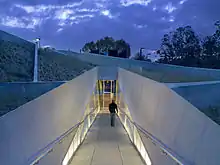
In 2010, led by the President of the Museum Board and the major donator for the construction,[3] Randy Schoenberg (whose story of litigating the return of the Klimt painting, Adele Bloch-Bauer I, from Austria was featured in the film Woman in Gold), the museum moved into its permanent home designed by renowned architect Hagy Belzberg.[3] The structure and implementation of the museum's exhibits were implemented by Randy Schoenberg, Dr. Vladimir Melamed and Joanna Chenn. 1961 – 1966: In the early 1960s, survivors of the Holocaust together with activists of the Los Angeles Jewish community initialized the establishment of a Memorial House to preserve and display the Holocaust era’s documents and artifacts in one place for commemoration and memorialization purposes. They perceived themselves as former prisoners of Nazi-German concentration camps and ghettos. An identifier “survivor” was not in official parlance then.
The first record in this regard is dated by April 11, 1961, and it relates to the Memorandum sent by the Planning Committee to the Jewish Federation Committee. An excerpt of this Memorandum reads, “On the initiative of the Jewish survivors of concentration camps, the Board of Supervisors of L.A. County on April 11, 1961 took a resolution commending the Jewish survivors of concentration camps from their leadership in establishing a national shrine… to the victims of the Holocaust. The Board of Supervisors pledges support and cooperation.”
Commonly utilized reference to a group of Jewish survivors attending the ESL classes, who allegedly initiated the establishment of a Memorial House does not find any recorded corroboration. Apparently this notion of a group taking a ESL class in an adult school appeared much later and since it has been widely propagated, gained official recognition. In all available factual materials, there is no evidence in regard to the activity of such group in the 1960s. Evidently, this notion became an oral tradition, eventually well-established. This version also became a convenient explanation and well-perceived story of how the museum was founded. In the beginning of 1960s, the active participants and promoters of memorialization and commemorations were the former prisoners of Nazi-German concentration camps and ghettos who did not attend ESL classes. If it was a group of survivors attending an adult school for ESL classes, then this occurrence should be relegated to the 1970s.
The first proposition of a site for a Memorial House is recorded in the meeting of the Memorial House Committee on February 4, 1964. The Memorial House was to be located at 590 N. Vermont Avenue in Los Angeles, CA 90004. (It was the residence for the Jewish Federation of Los Angeles).
1966 – 1976:
Two committees are established: one is composed of the former prisoners of Nazi-German concentration camps and ghettos and the other could be perceived as an executive arm for it largely comprised Jewish public officials, functionaries, activists; some of them were also the former prisoners of Nazi-German concentration camps and ghettos. A notion of a Memorial House is being actively discussed on the sessions of the United Los Angeles Memorial Committee. A Memorial House had been opened, although it did not have a permanent location. Founding tenets for the eventual memorial, - The purpose of the Memorial is to be educational; - The Memorial is to have a Commemorative nature; - The Memorial is to function in a historical sense (as archives, museum, exhibits, etc.) - It should be a memorial to all victims of Nazi atrocities with emphasis on six millions Jews.
Whether or not the Memorial House had been settled there, remains unclear, for on January 15, 1968, Dr. Otto Schirm, Chairman of the United Los Angeles Memorial Committee wrote, “Several of our members who represent us on the so-called Morton Silverman Committee of the Jewish Federation Council, are quite disturbed by the last two meeting of this group. It appears that rather than proceed along the lines suggested by our United Committee to achieve our objective the shortest possible time, the Federation-Council group would like to eliminate completely our United Committee, undermine the position of our Chairman and delay the selection of a site in order to accommodate the wishes of some people who would like to combine our Memorial House site with the site of a Jewish Community Center to be built in the distant future at a location not yet selected!! Apart from all other considerations of a practical nature, how can people think for a Memorial House for our martyrs right next to a Jewish Center where there dances, swimming, ball games and other recreational activities going at the same time?
It is believed that an interim Memorial House was eventually accommodated in the Jewish Community Library at 590 N. Vermont Avenue, Los Angeles, CA 90004.
1977 – 1978: The Memorial House gained official museum status and it is regarded as an agency or department of the Jewish Federation of the Greater Los Angeles. It is now housed in the specially designated quarters on the 12th floor of the Jewish Federation Building of Greater Los Angeles, 6505 Wilshire Blvd, Los Angeles, CA 90048.
1978 – 1994: In 1992, the Los Angeles Holocaust Monument opened in Pan Pacific Park on the Beverly Boulevard side. Designed by Architect Joseph Young, the Monument becomes a dominating landmark at the surrounding milieu and eventual joint platform for the new Los Angeles Museum of the Holocaust. In 1992, the Museum relocated to larger quarters on the first and second floor at the Jewish Federation Building, 6505 Wilshire Blvd., Los Angeles, CA 90048. Since 1992, a joint institution takes inception, namely the Martyrs Memorial and the Museum of the Holocaust.
1994 – 2004: After the Earthquake of 1994, the Museum was changing locations for several times until it moved to the Los Angeles O.R.T. Building, 6435 Wilshire Boulevard, Los Angeles, CA 90048.
2004 – 2008: Museum is located in the Los Angeles O.R.T. Building. The Museum’s Archive is completely restructured and reorganized. The preparatory process to obtain all necessary authorizations for the building of a permanent home for the Museum is in progress.
2008 – 2010: Construction of the new permanent Museum in Pan Pacific Park, Los Angeles under the management of the Belzberg Architect Group and under the supervision of the Museum Board is in progress. Exhibit-formation and fundraising for the new museum go hand-by-hand. The Museum site amalgamates the Holocaust Monument and a combined architectural structure is well merged in to the park terrain.
October 2010: The new Museum is open to public
Conclusion,
An assertion that the ESL class attendees to have been the actual founders of a Memorial House or of a prototype of thereof does not find any plausible corroboration in the museum records, correspondences and recollections.
This Chronology exemplifies a thorny and long path the Jewish activists endured to materialize the everlasting concept of commemoration, education and memorialization of the History of the Holocaust.
Since the oldest available to us record reflects the date of April 11, 1961, when one of the meetings of took place and a memorandum of memorialization and commemoration was issued, it is plausible enough to regard this date or rather April 1961 as a conceptual inception of a Memorial Hall eventually reified into the actual Museum.
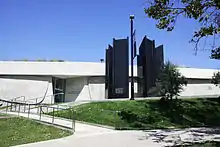
The Museum's architecture allows the physical building to be fully integrated into the surrounding park landscape. The architecture of the main Museum building is also designed to immerse the visitor in the horror and darkness of the Holocaust, as the ceilings are lower and the rooms darker in the galleries discussing the concentration camps. While the visitor is submerged in the history of the Holocaust, park-life continues outside of the Museum. In a similar way, there were people outside the ghettos and camps, either neighbors or those halfway across the world, who either did not know or chose to ignore the ways Jews and other targeted groups were victimized and murdered during the Holocaust. This juxtaposition is a key component in the architectural design of the building.[4]
The building design received the Los Angeles Cultural Affairs Commission Design Honor Award, the Green Building Design Award, and a Gold LEED rating – the national standard of sustainable architecture. The award-winning interior and exterior architecture reflect the poignant history covered in the Museum's galleries. As visitors move through the Museum, light and space change, mirroring the time in history. The galleries are organized chronologically and cover Jewish life before the Holocaust as well as key historical events between 1933 and 1945. The Museum features a rich collection of primary sources, and Holocaust Museum LA holds one of the largest collections in the United States of artifacts from the Holocaust period.
The Museum is divided into three spaces: the internal Museum space, the Goldrich Family Foundation Children's Memorial, and the outdoor Martyrs Memorial. The Children's Memorial is an outdoor reflective space where the approximately 1.5 million children who were murdered in the Holocaust are remembered. There are 1.2 million holes of various sizes in the walls of the Children's Memorial, and visitors can write messages to the children. A small Garden of the Righteous pays homage to non-Jews who risked their lives to save.
The Museum's design also incorporates the Martyr's Memorial monument, which was built in the early 1990s. This monument consists of six 18-foot-high (5.5 m) high, black, triangular, granite pillars, each one honoring the 6 million Jews who were murdered in the Holocaust. These pillars are also meant to symbolize the crematoria smokestacks.
Exhibitions
- Tree of Testimony: In collaboration with the USC Shoah Foundation, Holocaust Museum LA installed a 70-screen video sculpture that displays the 52,000 survivor testimonies from the USC Shoah database. Visitors can use their audio guides to listen to any of the 70 testimonies that are being highlighted. Since there are over 50,000 stories and only 70 screens, each Survivor is guaranteed to be shown at least once a year, ensuring that each visitor experiences a different testimony. At any given time, there are survivors speaking in as many as 32 different languages.[5][6][7]
- The Sobibor Model: Sobibor was one of the six main death camps established by the Nazis and was part of the Operation Reinhard plan to murder all the Jews of Poland. Survivor Thomas Blatt built a model of the Sobibor Extermination camp solely from memory,[2] and it is permanently displayed at Holocaust Museum LA. There is also a video screen above the model where Blatt talks about his experience in the camp. Blatt was a part of the 250 prisoners who carefully planned and executed their escape from Sobibor. Only about 50 survived, and Blatt was one of them.
- Symbols of Hate[8]
- Childhood Left at the Station[9]
- Children's Memorial[10]
See also
- History of the Jews in Los Angeles
- Jews and Judaism in Los Angeles topics
- Austrian Holocaust Memorial Service of Austrian Service Abroad — Holocaust Museum LA participates
- Museum of Tolerance
References
- Vankin, Deborah (28 August 2020). "Los Angeles Museum of the Holocaust changes its name, putting history first". Los Angeles Times. Retrieved 1 September 2020.
- Rothstein, Edward (23 March 2011). "Bearing Witness Beyond the Witnesses". The New York Times.
- Berrin, Danielle (19 September 2017). "Schoenberg parts With Holocaust Museum LA, citing problems with new management". The Jewish Journal of Greater Los Angeles. Tribe Media Corp. Retrieved 19 September 2017.
- Hawthorne, Christopher (28 October 2010). "Architecture review: Los Angeles Museum of the Holocaust". Los Angeles Times.
- Banks, Sandy (18 April 2020). "Coronavirus rules challenge Holocaust memorial tradition, but it survives". Los Angeles Times.
- Lewis, Amanda (23 April 2012). "L.A. Museum of the Holocaust's Tree of Testimony Tells Survivors' Stories Through Video Art". LA Weekly.
- Shenker, Noah (3 August 2015). Reframing Holocaust Testimony. Indiana University Press. p. 217. ISBN 978-0-253-01717-8.
- Fabrikant, Geraldine (9 March 2020). "From Swastika Selfies to Lessons on Nazism". The New York Times. ISSN 0362-4331. Retrieved 31 August 2020.
- KABC (5 December 2018). "LA Museum of the Holocaust features 'kindertransport' exhibit". ABC7 Los Angeles. Retrieved 31 August 2020.
- Fuller, Elizabeth (19 August 2019). "Los Angeles Museum of the Holocaust (LAMOTH) Shares Stories of Atrocities and Survival". Larchmont Buzz. Retrieved 31 August 2020.
- "Piecing together daily life in Terezin". The Jewish Journal of Greater Los Angeles. 2 February 2011. Retrieved 31 August 2020.
