Luis Garavito
Luis Alfredo Garavito Cubillos (born 25 January 1957), also known as La Bestia ("The Beast") or Tribilín (named after the Disney character "Goofy"), is a Colombian serial killer, pederast, rapist, child molester, and necrophile. In October 1999, he admitted to the rape, torture, mutilation and murder of 147 children,[8][9][10] predominantly boys and teenagers.[11] His victims, based on the locations of skeletons listed on maps that Garavito drew in prison, could possibly exceed 400; Garavito continues to confess to more murders. He has been described by local media as "the world's worst serial killer". The judicial body ruled that all Garavito's sentences total 1,853 years and 9 days in jail.[12] Currently, Garavito is confirmed to have murdered at least 189 people in total.[3][2]
Luis Garavito | |
|---|---|
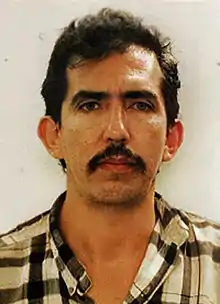 Mugshot taken on Apr. 23, 1999 by the Colombian National Police (Policía Nacional de Colombia) | |
| Born | Luis Alfredo Garavito Cubillos 25 January 1957 Génova, Quindío, Colombia |
| Other names | The Beast Goofy The Monster of Génova The Priest The Madman Alfredo Salazar Bonifacio Morera Lizcano |
| Height | 5 ft 5 in (1.65 m) |
| Criminal charge | Murder Rape Violent sexual act[1] |
| Penalty | 835 years' imprisonment (2000)[2][3] 1,853 years and 9 days' imprisonment (2001)[4] |
| Details | |
| Victims | 189+ (138 convicted)[3][2][5][6] |
Span of crimes | 2 October 1992–22 April 1999 |
| Country | Colombia Ecuador Venezuela |
| State(s) | Valle del Cauca, Boyacá, Meta Department, Quindío, Risaralda, Cundinamarca, Nariño, Huila, Caquetá, Antioquia and Caldas, Chone (Ecuador),[7] |
Date apprehended | 22 April 1999 |
| Imprisoned at | EPAMS Valledupar - La Tramacúa |
Childhood
Luis Alfredo Garavito was born in Génova, Colombia on January 25, 1957, to Manuel Antonio Garavito and Rosa Delia Cubillos. Manuel was described by Garavito as being a womanizer, a drunkard, and extremely physically and emotionally abusive to Garavito throughout his childhood. The eldest of seven siblings, he had three brothers and three sisters. Growing up, Luis was referred to as an imbecile, bastard, and other pejoratives by his father Manuel. He recalled his father Manuel sleeping with him, and not with his mother at a young age, and allegedly being fondled by Manuel. Attending Simón Bolívar school in Ceilán, Valle del Cauca, Colombia, he was said to be shy and reserved, and often a target for bullies in spite of his violent temper.[13] Teachers had found him enthusiastic to learn, but incredibly frustrated with his inability to understand subjects. Nicknamed "Squiggle" by his bullies, he was very insecure of his glasses and made few attempts to play with other children.[14] His teachers made no attempts to stop the bullying, which distressed Garavito.[15]
Though Garavito's mother is unknown, it had been speculated from the community of Génova that Garavito's mother had been a long-time prostitute. During the time of working as a prostitute, Garavito's mother had been brutally abused by Garavito's father, who was a heavy alcoholic and would also abuse Garavito's siblings. Around this time, Garavito's father would force Garavito to watch his mother conduct in sexual intercourse with her clients, letting his mother's clients sexually abuse and molest Garavito. Under the influence of drugs, Garavito's mother would not do anything due to the abuse and torture of Garavito's alcoholic father.[16] When Garavito was "six or seven," he even recalled being strapped to a tree and beaten by Manuel as Luis attempted to defend his mother Rosa.[14]
When Garavito was around 11 years old, his father forbade him to go to school in favor of making money to sustain the family. This crushed the young boy, who was also forbidden to have friends or a girlfriend by his father Manuel. He would then be subject to brutal sexual abuse by a local drug-store owner and neighbor, lasting from age 12 to 14. The man was a friend of Manuel's, and had burnt Garavito with a candle, bitten him violently, and cut him with a razor blade during the molestations.[17]
Adolescence
When Garavito was first abused, his dysfunction led him to kill and dissect two birds. Soon after this, Garavito would find himself sexually attracted to children and subsequently fondle his younger brothers and sisters on the family farm, often stripping them naked.[14] He would then be raped again by another neighbor, who beat him into the undergrowth, and showed him heterosexual pornography that apparently disgusted Garavito.[18] Because of his rebelliousness and inclinations, Garavito would be kicked out on a repeated basis throughout his teens, once by his mother for attempting to rape a boy, and again at 16 following an attempted assault on a 6-year-old boy in Bogotá. Garavito was not kicked out for the rape attempt however, but for general rebelliousness, as his father Manuel reasoned that "if there are no women" then Garavito was presumably in his right to assault a young boy. Despite this, they frequently argued about Garavito's homosexuality, which was the source of much tension between the two. He left the house for the last time, before telling a stranger that he would "take revenge on the world."[14]
As a young man in his late teens, Garavito started working as an assistant at a compensation fund and later in a chain of stores, and studying in marketing. Despite his new-found career, he began to have problems with his co-workers, clients, and bosses. Sometimes the conflicts were so extreme that they resulted in physical altercations.[19] After losing his job, he worked as a street vendor and migrant worker, developing various relationships with women despite never having been known to have had intercourse with them.[20] Many of these women had children, who Garavito was known to have treated kindly, in addition to being a loving boyfriend. A struggling alcoholic, Garavito was known by his friends to be kind, yet easily angered.[21]
Adulthood
Garavito would be plagued with symptoms of psychosis, paranoia, and depression as a result of the extreme abuses he had faced as a child and adolescent. For the majority of the 1970s and the 1980s, Garavito would sexually molest children of both sexes as he spiraled into mental illness; his attraction would soon turn pederast however. He would support himself as a migrant worker, and fall in love with a girl from Trujillo. Suffering from depression and suicidal tendencies, he expressed a desire to have children.[14]
Like his father Manuel, Garavito became an alcoholic and soon had to participate in Alcoholics Anonymous meetings in 1978. He began a relationship with a woman named Claudia, who he described as being the first woman he'd ever wanted to engage with physically, though his relationships with women were always short-lived as a result of his mental illness. Drifting from his family, he was only close to his sister Esther, who avoided him due to his alcoholism.[22] After losing his job at a bakery, Garavito would then attempt suicide and spend at least 5 years in and out of psychiatric facilities in Colombia, primarily for depression despite suffering from "malicious voices in his head."[13]
In late 1980, Garavito would escalate his habit of molesting children at least once a month, to torturing the children with methods used on himself as a child by his abuser. He would then write the name of the molested child in a blue notebook, and pray for them fervently while beating his chest. Despite this, Garavito developed an interest in esoteric study, tarot readings, and Satanism. He would visit palm readers and other occultic practitioners before deciding that they were just as clueless as he was.[14]
Discovering his biography in a red book, he would also become fond of Adolf Hitler. This fondness would turn into idolization, expressing admiration for Hitler and mass graves, and stating that he "liked the concentration camps."[14] Committing his first murder of a boy named Juan Carlos on Oct. 2, 1992, he began to wear various disguises in order to evade identification and arrest. In 1995, Garavito would suffer from a hard fall, breaking his leg which never healed properly, leaving him with a permanent limp that helped to provide investigators with evidence against him in his 1999 trial.[13] Frequently seen drunk by locals, he would drift from town to town as he outwore his welcome. His erratic behavior had left him unable to develop meaningful relationships, despite living with two different women in Pereira at the time of his arrest.[19]
Victims and Modus Operandi
A prolific child molester and pedophile, Garavito began to feel apathy with his crimes. On October 2, 1992, he had spotted 13-year-old boy Juan Carlos walking near a bazaar he had been drinking at.[13] According to Garavito, the moon had invoked a "strange force" within him that compelled him to kill that night. He began to follow the child, buying synthetic rope and a butcher knife on the way before offering him work for 500 or 1,000 pesos. The boy left the crowded area in Jamundí with Garavito to a remote area near the local railroad, where he was later found with his front teeth knocked out, severe cuts to his rectum and throat, and his genitals severed. Six days later, Garavito would make the trip to Trujillo to see his sister Esther, and murder 12 year-old Jhon Alexander Peñaranda on the way in Tulúa as he attempted to control his urges by drinking brandy. Soon after the first murder, Garavito would begin to compulsively murder youth, predominantly male and poverty-stricken.[14]
Garavito's victims were clearly identified by their age, sex, and social status. Garavito targeted children, mostly boys between the ages of 6 to 13 (with the single exception of a crippled 16-year-old boy) who were either homeless, peasants, or orphaned. Claiming to feel a force within that compelled him to kill, Garavito would look for children and lure them away by bribing them with small gifts such as money, candy or odd jobs.[23] Terrified of the dark, he would approach them in broad daylight in public places ranging from the rural countryside to the crowded city streets. He would also wait and drink brandy near school zones on evenings to wait for unknowing children.[7]
He had a preference for lighter skinned boys with light-coloured eyes. Born and raised in the heavily Spanish-descended Paisa region of Colombia, Luis knew where to find boys that fit his criteria.[22] He offered easy work for money and even disguised himself as different characters who could be seen as legitimately offering work to the child, such as a priest, a farmer, a homeless man, a street vendor, a drug dealer, a schoolteacher, an elderly man, and a gambler.[24] To prevent suspicions about his activities from developing, Garavito would change his disguise often.
Once he had the trust of a child, Garavito would walk to a secluded spot or mass grave site with the victim, encouraging them to talk about their personal life until they were tired and vulnerable, which then made them easy to handle. First, their hands were bound. Then, Garavito would remove all their clothes, and proceed to torture, rape, and sometimes decapitate them. According to Garavito, he made a "pact with the devil" and Satanic ritual was also incorporated into the murders of the children.[14] Usually, the boy would endure prolonged rape and torture by having the hands, feet, and buttocks stabbed with a screwdriver. Teeth were often knocked out, and sharpened objects inserted into the anus. The penis and testicles were also often severed and placed into the child's mouth while alive. They were burned with a lighter, stomped on, and often showed cuts in the back, belly, and throat. Sometimes, they were sexually abused as their intestines poured out.[14]
Garavito's climax would occur when he had decapitated the child alive or cut the throat as he finished.[25] Necrophilia with the victim's corpse was also sometimes involved in the crimes. The bodies of the children were all found completely naked, and all bore bite marks and signs of anal penetration; containers of lubricant were found near the bodies, along with empty bottles of the cheapest brandy in Colombia. Most corpses showed signs of prolonged torture. The victims were almost exclusively boys, though female children were also found.[17][26][27] In 2003, Garavito also confessed to 23 more murders, including that of 5 adults. One was a shoe-shiner, and all adult victims were thought to have been killed to rid Garavito of potential witnesses rather than to fulfill personal fantasy.[28]
Investigation
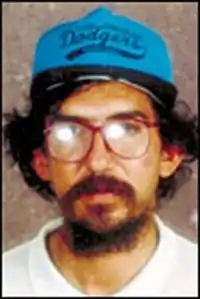
Beginning in October 1992, boys between the ages of 6 through 13 (with the exception of a 16-year-old disabled youth) began disappearing rapidly from the streets of Colombia. Due to the decades-long civil war, many children in Colombia were poor, homeless, or orphaned. For years, these murders had gone unnoticed because many of the victims had no police report filed on their disappearance. Clusters of bodies had begun popping up all over Colombia, yet authorities did not take much notice until 1997, when mass graves of as many as 41 children were uncovered in Pereira.[23][29]
This large number of missing children called for a widespread investigation, as these killings were not confined to a specific area. The brutality was so fierce to authorities that they initially hypothesized the killings were performed by a Satanic cult or an international child-trafficking ring. On February 6, 1999, outside the town of Palmira, Colombia, the bodies of two naked children were found lying next to each other on a hill near a sugar cane field. The next day, only meters away, they had discovered another child's body. All three bodies had their hands bound and bore signs of sexual abuse. The victims' necks were severely cut, and bruises were on their backs, genitals, legs, and buttocks. The murder weapon was found in the same area as the bodies. Garavito had passed out partially naked on top of a child's corpse[30] while drunk with a cigarette in his mouth,[19] causing the cane field to catch fire. He burned himself severely in the process, and left behind his burnt glasses, shoes, money, and underwear. Receipts and a note containing a woman's (Garavito's girlfriend) address was also found.[11]
From his glasses, the authorities were able to determine that the local serial killer was middle-aged and had an astigmatism in his left eye. His shoes also showed that he walked with a limp, and stood between 163 and 167 centimeters tall. They falsely arrested a local sex offender named Pedro Pablo Ramirez Garcia, who was 44 and had a limp in his right foot. As two boys disappeared in Pereira, a young boy had outed Garcia as the man who attempted to assault him. He was kept in jail until more children began to disappear in Bogota. Meanwhile, Aldemar Duran, the main detective had begun to suspect Luis Alfredo Garavito Cubillos as their wanted killer. Pedro was released after Duran was able to track down the girlfriend and sister of Garavito.[31]
His girlfriend was contacted, but told police that she had not seen Garavito in months. She did, however, give to the police a black cloth suitcase that he had left in her possession, which contained a number of Garavito's belongings. These items included pictures of young boys, detailed journals of his murders, tally marks of his victims, and bills. This new information led them to Garavito's residence, but the property was vacant. Detectives believed that Garavito was either traveling for work or away attempting to find his next victim. He was picked up by the local police just a few days later, on an unrelated charge of attempted rape against a 12-year-old boy. A homeless 16 year-old (whose original intent was to smoke marijuana) had been close enough to hear the struggle between Garavito and the child and began to curse and throw stones at Garavito. Garavito then made his way through the undergrowth to stab the teenager with a dagger; the boy and the teenager both fled to the Rosa Blanca farmhouse located on La Coralina road in Villavicencio, where Garavito tracked them down before fleeing.[32][9] A search was conducted after they phoned police there, and authorities found Garavito walking out of the woods as they urged angry locals not to get involved in the search. He gave them a false ID, and claimed to be Bonifacio Morera Lizcano, a local politician. Despite this, they suspected the man to be Garavito anyway.[33]
Garavito was also said to have operated in Venezuela during the summer of 1998, when he murdered 14-year-old Abel Gustavo Loor Velez on July 20, 1998 and 12-year-old Jimmy Leonardo Palacios Anchundia in Chone, Ecuador. He was also speculated to have committed two more murders in Santo Domingo, Ecuador as locals witnessed a Colombian man through both areas from July to August asking for money. Marked for his thick Colombian accent, he was spotted prowling around an all girls' school (UNE) before fleeing Ecuadorian authorities who had been setting up an operation to catch him.[7]
Arrest, confession, and sentencing
Garavito was arrested on 22 April 1999, on separate charges of attempted rape.[11] Garavito was questioned about the local killings and his attempted rape charges. Police speculated that Garavito had planned on killing the young boy if the bystander had not intervened. After several months of interrogation, detectives suspected Garavito of being "La Bestia," although Garavito had insisted on his innocence. The detailed description of his killings brought Garavito to tears.[24]
For Colombia's Justice Department, Garavito's confession was not enough. Garavito had an eye condition that was rare and only found in men in a particular age group. His glasses were specifically designed for his unique condition. These particular glasses were found at a crime scene. Garavito also left behind bottles of brandy, his underwear, and his shoes. DNA was found on the victims, along with the other items left behind. Police scheduled the entire jail where Garavito was being detained to get an eye exam; the outcome of his eye exam would help police pair the glasses to Garavito. By making it mandatory for all the prisoners, it reduced Garavito's suspicion and kept him from lying about his eyesight.[24] His height of 165 centimeters and limp was also crucial in connecting him to the investigators' findings.
While Garavito was out of his cell, detectives took DNA samples from his pillow and living area. The DNA found on the victims was a match to the DNA found in Garavito's cell. Garavito confessed to murdering about 140 children and was charged with killing 172 altogether throughout Colombia.[34] He was found guilty on 138 of the 172 accounts; the others are ongoing. Garavito was sentenced to 1,853 years and 9 days in prison, the lengthiest sentence in Colombian history.[35] However, Colombian law limits imprisonment to 40 years—and because Garavito helped police find the victims' bodies, his sentence was further reduced to 22 years.[36]
Garavito is currently serving his sentence in a maximum-security prison in Valledupar in the department of El Cesar in Colombia.[37] He is held separately from all other prisoners because it is feared that he would be killed immediately. He will become eligible for parole in 2023,[38] when he has served three quarters of his sentence.[38]
Today, Luis Alfredo Garavito is studying to become a politician and enter the ministry in the hopes that he'll be able to help abused children upon his release.[39] As of the present, Garavito suffers from severe eye cancer which leaves him weak and fatigued, requiring daily blood transfusions. He spends most of his time making handcuffs, earrings, and necklaces in the medical unit of Valledupar's prison.[17]
Public response
Many Colombians criticized the possibility of Garavito's early release. In recent years, Colombians have increasingly felt that Garavito's sentence was not sufficient punishment for his crimes. Some have argued he deserves either life in prison or the death penalty, neither of which exist in Colombia. Colombian law had no provision or method to impose a sentence longer than what Garavito received, which was seen as a deficiency in the law caused by the failure to address the possibility of a serial killer in Colombian society. The law has since increased the maximum penalty for such crimes to 60 years in prison.[40]
The TV host and journalist Guillermo Prieto La Rotta, popularly known as Pirry, interviewed Garavito for a show which aired on 11 June 2006. Pirry mentioned that, during the interview, Garavito tried to minimize his actions and expressed intent to start a political career in order to help abused children. Pirry also described Garavito's conditions in prison and commented that due to good behavior, he could probably apply for early release within three years.
References
Notes
- Ortega, Maria (24 May 2018). "Garavito o "La Bestia": el violador y asesino de casi 200 niños en Colombia que tendría la posibilidad de salir de prisión". Retrieved 2 December 2021.
- El País Staff (26 May 2000). "Condenado a 835 años de prisión el asesino de 189 niños en Colombia". elpais.com (in Spanish). Retrieved 14 October 2021.
- Clarín Staff (27 May 2000). "Un asesino condenado a 835 años de cárcel". clarin.com (in Spanish). Retrieved 14 October 2021.
- "Condenan a 1853 años de cárcel al mayor asesino en serie de Colombia". Caracol Radio (in Spanish). 3 November 2001. Archived from the original on 12 June 2018. Retrieved 5 February 2018.
- Benecke, Mark (2005). Murderous Methods: Using Forensic Science to Solve Lethal Crimes. Columbia University Press. ISBN 0-231-13118-6.
- Peter Vronsky (2004). Serial Killers: The Method and Madness of Monsters. Berkley Books. p. 35. ISBN 978-0-425-19640-3.
- "La Confesion". 12 December 1999. Retrieved 2 December 2021.
- Ruth Morris and Juanita Darling (30 October 1999). "Colombian Held in Deaths of 140 Children". Los Angeles Times. Retrieved 14 October 2021.
- Guardian Staff (31 October 1999). "Confession of 'worst murderer in history'". the Guardian. Retrieved 18 April 2021.
- "The Man Who Killed at Least 138 Kids Will be Out of Jail in 2021". 6 January 2018.
- M. Benecke; A. Mätzler; M. Rodriquez; A. Zabeck (September 2005). "Two Homosexual Pedophile Sadistic Serial Killers:Jürgen Bartsch (Germany, 1946-1976) and Luis Alfredo Garavito Cubillos (Colombia, 1957)" (PDF). 125 (3). Minerva Medicolegale: 153–169. Archived (PDF) from the original on 3 July 2015. Retrieved 20 June 2010. Cite journal requires
|journal=(help) - "Condenan a 1853 años de cárcel al mayor asesino en serie de Colombia". Caracol Radio (in Spanish). 3 November 2001. Archived from the original on 12 June 2018. Retrieved 5 February 2018.
- "Luis Garavito – Also Known as "The Beast" | True Crime Seven". 22 April 2020.
- "Estructura de la Personalidad de Luis Alfredo Garavito Irene Baron Chilito Jhon Cortes Caballero Helder Guiovanni Porras Elisa Maria Velasco Franco Psicologia Juridica y Forense".
- "La infancia, infamia y perfil criminal de Luis Alfredo Garavito, la "bestia" colombiana que se convirtió en el mayor asesino de niños de la historia". 2 November 2021. Retrieved 2 December 2021.
- "Infamous Colombian Man, Called 'The Beast', is the Worst Serial Killer in History Because of this Brutal Reason". 9 November 2017.
- "El prontuario de Garavito, 'La Bestia' que partió la historia de Colombia en dos con su sevicia".
- "The Beast — Luis Garavito". 31 May 2021.
- "SÍ, YO LOS MATÉ, PIDO PERDÓN". 31 October 1999.
- http://benecke.com/pdf/serial_killer_bartsch_mark_benecke.pdf
- "Infamous Colombian Man, Called 'The Beast', is the Worst Serial Killer in History Because of this Brutal Reason". 9 November 2017.
- "3 of the World's Deadliest Serial Killers Come from the Same Place: Why?".
- "World: Americas: Colombian child killer confesses". BBC News. BBC Online Network. 30 October 1999. Archived from the original on 25 January 2011. Retrieved 20 June 2010.
- "Serial Killer Documentary Luis Alfredo Garavito". Discovery Channel. Discovery Channel. 1 September 2016. Archived from the original on 10 April 2017. Retrieved 3 April 2017.
- "INTERVIEW WITH FORENSIC BIOLOGIST DR. MARK BENECKE ABOUT SERIAL KILLER LUIS ALFREDO GARAVITO CUBILLOS".
- "Garavito y los crímenes imperdonables: ¿un espejo en que no queremos mirarnos?". 12 November 2018.
- Benecke, pp. 161–162
- "Asesino en serie colombiano admite haber matado a otras 28 personas". Archived from the original on 2 April 2019.
- "Colombian Admits to Killing 140 Children over 5 Years". The New York Times. 30 October 1999.
- El País Staff (22 July 2003). "Sí, es el 'monstruo de los cañaduzales'". historico.elpais.com (in Spanish). Retrieved 14 October 2021.
- "The Beast". 31 May 2021.
- "ASÍ FUE CAPTURADO AUTOR DE 140 MUERTES". 3 November 1999. Retrieved 2 December 2021.
- "ASÍ FUE CAPTURADO AUTOR DE 140 MUERTES". 3 November 1999.
- Benecke, p. 162
- "Condenan a 1853 años de cárcel al mayor asesino en serie de Colombia". Caracol Radio (in Spanish). 3 November 2001. Archived from the original on 12 June 2018. Retrieved 5 February 2018.
- Benecke, p. 166
- https://www.elespectador.com/noticias/judicial/indagan-procesos-contra-luis-alfredo-garavito-para-evitar-que-salga-de-prision-articulo-819972
- Álvarez, Mónica G. (6 November 2020). "Garavito, la 'Bestia', y su agenda negra del horror: "Aquí enterré todos los cadáveres"". La Vanguardia (in Spanish). Retrieved 22 November 2020.
- "The Man Who Killed at Least 138 Kids Will be Out of Jail in 2021". 6 January 2018.
- "Rebajan la condena del asesino en serie Luis Alfredo Garavito" (in Spanish). Archived from the original on 4 June 2011. Retrieved 10 March 2010.
Bibliography
- "172 niños víctimas de Luis Alfredo Garavito" (in Spanish). Fiscalía General de la Nación. Archived from the original on 28 September 2007.
- "Man admits killing 140 children in Colombia". CNN. 30 October 1999. Archived from the original on 7 September 2005.
- "Pirry entrevista a Luis Alfredo Garavito". Universia (in Spanish). 7 June 2006. Archived from the original on 7 July 2011.