Lux Video Theatre
Lux Video Theatre is an American television anthology series that was produced from 1950 until 1957. The series presented both comedy and drama in original teleplays, as well as abridged adaptations of films and plays.
| Lux Video Theatre | |
|---|---|
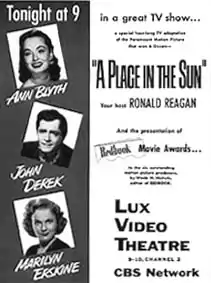 1954 production of A Place in the Sun on the series | |
| Genre | Anthology |
| Presented by | James Mason (1954–1955) Otto Kruger (1955–1956) Gordon MacRae (1956–1957) Ken Carpenter (1955–1957) |
| Country of origin | USA |
| Original language | English |
| No. of seasons | 7 |
| No. of episodes | 336 |
| Production | |
| Running time | 24–25 mins. (1950–1954) 47–50 mins. (1954–1957) |
| Release | |
| Original network | CBS (1950–1954) NBC (1954–1957) |
| Picture format | Black-and-white (1950–1956), Color (1956–1957) |
| Audio format | Monaural |
| Original release | October 2, 1950 – September 12, 1957 |
| Chronology | |
| Related shows | Lux Radio Theater Lux Playhouse |
Overview
The Lux Video Theatre was a spin-off from the successful Lux Radio Theater series broadcast on the NBC Blue Network (1934–1935) and CBS (1935–1955).
Lux Video Theatre began as a live 30-minute Monday evening CBS series on October 2, 1950, switching to Thursday nights during August, 1951.[1] In September 1953, the show relocated from New York to Hollywood.[2] On August 26, 1954, it debuted on NBC as an hour-long show on Thursday nights,[3] telecast until September 12, 1957. With the introduction of the one-hour format and the move to Hollywood, abridged versions of popular films were often used as the basis for shows.
To introduce each act and interview the stars at the conclusion, NBC added a series of regular hosts: James Mason[4] (1954–55), Otto Kruger (1955–56), Gordon MacRae (1956–57) and Ken Carpenter (1955–1957). Kruger recalled:
- All I do is come up and tell the people who I am and what we're up to. I don't have a single thing to do with producing, directing or casting the show. Yet I get letters every week complimenting me on my production, my directing, my casting, even my script adaptations.[5]
New episodes were broadcast during the summer as the Summer Video Theatre. In 1957–58, Lux shifted sponsorship to a half-hour musical variety show, The Lux Show Starring Rosemary Clooney.
For the 1958–59 season, the dramatic series was brought back with a new name, Lux Playhouse. The new series alternated weeks with Schlitz Playhouse. Those broadcasts began on October 3, 1958, and ended on September 18, 1959.[2]
The series finished in the Nielsen ratings at #30 in the 1950–51 season and #25 in 1955–56.[6]
Episodes
- November 20, 1950 – "Goodnight Please" – Franchot Tone[7]
- November 27, 1950 - "The Token" - Wanda Hendrix, Dean Harens, June Dayton[3]: 205
- December 25, 1950 - "A Child Is Born" - Thomas Mitchell, Fay Bainter[3]
- May 14, 1951 - "Local Storm" - Betty Field[3]: 215
- August 26, 1954 - "To Each His Own" - Dorothy McGuire and Mel Ferrer[3]
- September 24, 1951 - "A Matter of Life" - Edmond O'Brien[3]: 224
Notable guest stars
Among those cast in the productions were:
- Julie Adams
- Mary Astor
- Anne Bancroft
- William Bendix
- Joan Blondell
- Richard Boone
- Ernest Borgnine
- Eddie Bracken
- Scott Brady
- Walter Brennan
- Barbara Britton
- Charles Bronson
- Raymond Burr
- Hoagy Carmichael
- Art Carney
- Jack Carson
- Rosemary Clooney
- Lee J. Cobb
- Charles Coburn
- Nat 'King' Cole
- Jackie Cooper
- Broderick Crawford
- Bing Crosby
- Robert Cummings
- Arlene Dahl
- Laraine Day
- James Dean
- Melvyn Douglas
- Paul Douglas (actor)
- Joanne Dru
- Nelson Eddy
- Bill Erwin
- Barry Fitzgerald
- Nina Foch
- Janet Gaynor
- Coleen Gray
- Eileen Heckart
- Van Heflin
- Charlton Heston
- William Holden
- Celeste Holm
- Bob Hope
- Miriam Hopkins
- Dennis Hopper
- Rock Hudson
- Dean Jagger
- David Janssen
- Shirley Jones
- Boris Karloff
- Buster Keaton
- Grace Kelly
- Veronica Lake
- Burt Lancaster
- Angela Lansbury
- Cloris Leachman
- Jack Lemmon
- Gene Lockhart
- June Lockhart
- Jack Lord
- Peter Lorre
- Dayton Lummis
- Jeanette MacDonald
- Fred MacMurray
- Dorothy Malone
- Herbert Marshall
- Fredric March
- James Mason
- Raymond Massey
- Carole Mathews
- Walter Matthau
- Mercedes McCambridge
- Roddy McDowell
- Dorothy McGuire
- Butterfly McQueen
- Sal Mineo
- Vera Miles
- Thomas Mitchell (actor)
- Rita Moreno
- Dennis Morgan
- Audie Murphy
- Don Murray (actor)
- Kim Novak
- Margaret O'Brien
- Maureen O'Hara
- Maureen O'Sullivan
- Geraldine Page
- Lilli Palmer
- Dick Powell
- Robert Preston (actor)
- Vincent Price
- Luise Rainer
- Edward G. Robinson
- Basil Rathbone
- Ronald Reagan
- Thelma Ritter
- Lizabeth Scott
- Karen Sharpe
- Ann Sheridan
- Sylvia Sidney
- Alexis Smith
- Karen Steele
- Rod Steiger
- Jan Sterling
- Robert Sterling
- Rod Taylor
- Phyllis Thaxter
- Franchot Tone
- Claire Trevor
- Roland Young
- Beverly Washburn
- James Whitmore
- Esther Williams
- Natalie Wood
- Joanne Woodward
- Teresa Wright
References
- Lux Video Theatre (PDF). Radio-TV Mirror. October 1951. pp. 46–49. Retrieved 29 January 2012. (PDF)
- Brooks, Tim; Marsh, Earle F. (24 June 2009). The Complete Directory to Prime Time Network and Cable TV Shows, 1946-Present. Random House Publishing Group. p. 823. ISBN 978-0-307-48320-1. Retrieved November 4, 2021.
- Hawes, William (16 November 2015). Live Television Drama, 1946-1951. McFarland. p. 118. ISBN 978-1-4766-0849-5. Retrieved November 4, 2021.
- Becker, Christine (October 1, 2005). "Televising Film Stardom in the 1950s". Framework.
- Becker, Christine. It's the Pictures That Got Small: Hollywood Film Stars on 1950s Television. Wesleyan University Press, 2009.
- "ClassicTVHits.com: TV Ratings".
- "Television Highlights of the Week". The Boston Globe. November 19, 1950. p. 20-A. Retrieved May 4, 2021 – via Newspapers.com.