MCI D-Series
The MCI D-Series is a model of intercity bus produced by Motor Coach Industries (MCI). It is manufactured at the main plant in Pembina, North Dakota, United States.[1]
| MCI D-Series | |
|---|---|
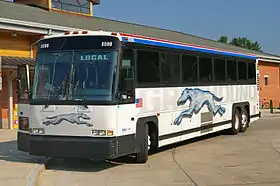 Greyhound Lines MCI 102-DL3 #6590 before remanufacturing | |
| Overview | |
| Manufacturer | Motor Coach Industries |
| Also called | Intercity Cruiser Commuter Cruiser Classic American Coach |
| Production | 1992-present |
| Assembly | Pembina, North Dakota, United States |
| Body and chassis | |
| Class | Tri-axle coach |
| Body style | Single-decker coach |
| Doors | 1 sedan door, some have 1 wheelchair lift door |
| Floor type | High-floor |
| Chassis | MCI special platform integral |
| Powertrain | |
| Engine | Detroit Diesel Series 60, Caterpillar C10, Caterpillar 3176B, Caterpillar C12, Caterpillar C13, Cummins M11, Cummins ISL, Cummins ISM, Cummins ISX, battery-electric bus |
| Capacity | 40-foot models: 38-53 45-foot models: 50-61 |
| Dimensions | |
| Length | 40 feet (12 m) 45 feet (14 m) |
| Width | 102 inches (2.6 m) |
| Height |
|
| Curb weight | 35,100 lbs, GVWR 44,400 lbs OR 48,000 lbs |
| Chronology | |
| Predecessor |
|
MCI introduced the D Series in 1992 to replace the B and C-Series models, which were equipped with obsolete two-stroke engines.
The coach uses MCI's special platform integral construction, which has come to dominate the US and Canada markets, allowing high durability and easy maintenance. It has a much longer service life than body-on-chassis coaches. All D-Series coaches are available with full-painted sides or stainless steel lower body.[2]
Development
The MCI 102-DL3 was developed from a 1988 Canadian government request to develop a wheelchair-accessible intercity bus. The prototype was apparently developed from the MCI 102-C3 with a 102-B3 nose and extended to 45 feet 5 inches (13.84 m). A large wheelchair-accessible lavatory was installed in the rear. The prototype was completed in 1990, but couldn't enter service in the US because it was too long, until the 45-foot length was approved in 1991.[3]
Changes were made for the production model. The engine was upgraded to the large new Detroit Diesel Series 60 and received a re-designed rear end cap with powerful radiator and intercooler. The large lavatory and wheelchair lift was removed from the production model, but could still be fitted by request. In the future a lift would be required for ADA regulations.[3]
The production model was named 102-DL3 and entered production in October 1992, followed by introduction into service in 1993. Early buyers included Peter Pan Lines, Fullington Trailways, and Horizon Coach Lines. The coach was immediately known for its surprisingly high speed, large size, and the durability of its integral construction. At the time, Greyhound Canada owned MCI, so they tested the model in 1992, but didn't order any until 1995.[3]
MCI developed the 102-D3 from earlier B and C-Series coaches, which had engine compartment too small to fit the new Detroit Diesel Series 60 engines. These four-stroke engines also powered the 45 foot models. MCI added an optional wheelchair lift. In the future a lift would be mandatory under ADA regulations.[4][5]
The 102-D3 entered production January 1994, followed by introduction into service with Royal Blue Tours, Chameleon Express, Lemi Tours, Gulf Transportation, and Indian Trails. Later the same year, it entered service with Peoria Charter Coach Company, Eyre Bus Service, Kerrville Bus Company, Greyhound's Texas, New Mexico, and Oklahoma Coaches division, and Trailways of New York. Like its larger sibling the 102-DL3, the 102-D3 was immediately known for its high speed and the durability of its integral construction, albeit at a smaller size than the 102-DL3. Greyhound Canada, which had owned MCI during the development process, introduced the 102-D3 in 1995.[4][5]
Variants
First Generation
The 102-D3 and 102-DL3, entered production in 1994 and 1992 respectively. The model number denoted the width (102 inches (2.6 m), exclusive of mirrors), "D" generation or basic model, the "L" in the model name designates longer length (45 feet (14 m), nominally), and 3-axle configuration. The models have large, block fender skirts and a rear-mounted radiator fan side-by-side with the intercooler fan. It has an air intake covered by a large grille, two piece engine door, small headlight/taillights, and a black roof cap. The models are also available with stainless steel front and/or sides. The 102-D3 and 102-DL3 were renamed D4000 and D4500 in 2001, and replaced by the second generation models in 2005. Commuter coach models were offered with a large destination sign above the front windows and bi-fold doors.[4] A prison transport coach version of the 40ft model was also offered, and continues to be offered as the D4000 ISTV.[6]
| Model | Photo | Introduced | Discontinued | Notes |
|---|---|---|---|---|
| 102-D3 | 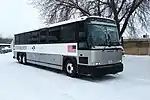 |
1994 | 2001 |
|
| D4000 | 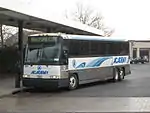 |
2001 | 2005 |
|
| 102-DL3 | _MCI_102DL3_70918.JPG.webp) |
1992 | 2001 |
|
| D4500 |  |
2001 | 2005 | |
Second Generation
The second generation D-Series models were introduced in 2005 as an updated versions of the first generation models. Updates a modified roof (with no visible rivets) and optional frameless passenger windows. The rear end cap design was updated in 2007 along with new engines to meet EPA 2007 regulations. The models are also available with stainless steel front and/or sides as well as a rubber front bumper.
| Model | Photo | Introduced | Discontinued | Notes |
|---|---|---|---|---|
| D4000CL | 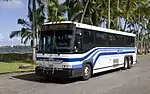 |
2005 | Present |
|
| D4000CT | 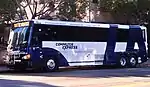 |
| ||
| D4005 |  |
| ||
| D4500CL |  |
2005 | Present |
|
| D4500CT |  |
| ||
| D4505 |  |
| ||
A prison coach model is also avalble, known as the D4000 ISTV, or Inmate Security Transportation Vehicle. It is designed for transporting up to 69 prison inmates and is available with containment cells, sirens, a rear officer position, and bulletproof materials.[7][8]
Third Generation
The D45 CRT, D45 CRT LE and, D4520 coaches make up the next generation of D-Series coaches, which have a taller body based on the J-Series coach with cosmetic updates. The commuter coach models ditch MCI's traditional alphanumerical naming system and are instead named using a modified alphanumerical naming system. For example" "D" generation or basic model, "45" for the length, "CRT" for "commuter rapid transit" and "LE" for modes with the Low Entry door. The touring coach model, the D4520, retains MCI's traditional alphanumerical naming system, with "20", denoting the third generation D-Series.
| Model | Photo | Introduced | Discontinued | Notes |
|---|---|---|---|---|
| D45 CRT | |
2020 | Present |
|
| D45 CRT LE | .jpg.webp) |
2017 |
| |
| D4520 | |
2020 |
| |
See also
- MCI J-Series
 Buses portal
References
- "A New Day for Accessible Commuting". Metro Council. Motor Coach Industries. Retrieved April 26, 2019.
- "MCI History". Retrieved April 6, 2014.
- "MCI Models A-J" (PDF). Archived from the original (PDF) on October 6, 2014. Retrieved April 6, 2014.
- "National Bus Trader" (PDF). Archived from the original (PDF) on October 6, 2014. Retrieved March 2, 2019.
- "STURAA TEST MCI 102D3" (PDF). United States Department of Transportation Altoona Bus Test. Pennsylvania Transportation Institute. Retrieved March 7, 2019.
- "40ft MCI D4000 2001 Prison Bus". Transit Sales International. Transit Sales International. Retrieved April 26, 2019.
- "Prison on wheels serves the security minded". BUSRide. BUSRide Magazine. April 2010. Retrieved April 26, 2019.
- "MCI® ISTV™ — RAISE THE BAR ON PRISON TRANSPORT". Motor Coach Industries. Motor Coach Industries. Retrieved April 26, 2019.
External links
 Media related to MCI D-Series at Wikimedia Commons