MYRRHA
The MYRRHA (Multi-purpose hYbrid Research Reactor for High-tech Applications) is a "first of its kind" design project of a nuclear reactor coupled to a proton accelerator (a so-called Accelerator-driven system (ADS)). MYRRHA will be a lead-bismuth cooled fast reactor with two possible configurations: sub-critical or critical.[1]
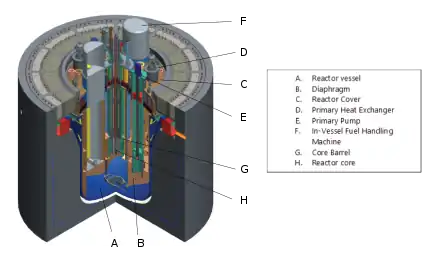
The project is managed by SCK CEN, the Belgian Centre for Nuclear Research. It will be built based on the experience gained from the first successful demonstration project: GUINEVERE.[2]
MYRRHA has an international recognition and has been listed in December 2010 by the European Commission as one of 50 projects to make Europe the leader in high-tech research in the next 20 years.[3]
MYRRHA is intended to be fully operational in 2036, with a first phase (100 MeV accelerator) ready in 2026.[4]
Components
MYRRHA is a research reactor aiming to demonstrate the feasibility of the ADS and the lead-cooled fast reactor concepts, with various applications from spent-fuel burning to material irradiation testing.[5] A linear accelerator will provide a beam of fast proton that hits a spallation target, producing neutrons. These neutrons will keep the subcritical nuclear reactor running.
Accelerator
The accelerator will accelerate protons to an energy of 600 MeV with a beam current of up to 4 mA. If the accelerator stops the reactor power drops immediately. To avoid thermal cycles the accelerator needs to be extremely reliable. MYRRHA aims at no more than 10 outages longer than three seconds per 100 days.[6] A first stage of the accelerator started operation in 2020.[7]
ISOL@MYRRHA
The high reliability and beam current makes the accelerator interesting for online isotope separation. Phase I of the project includes ISOL@MYRRHA to study exotic isotopes for fundamental and applied research.[8]
Spallation target
The protons collide with a liquid lead-bismuth mixture. The high atomic number of the target leads to a large number of free neutrons via spallation.[9]
Reactor
The pool type reactor will be cooled by a lead-bismuth mixture. Separated into a fast neutron zone and a thermal neutron zone, the reactor is planned to use a mixture of uranium and plutonium.[10]
The reactor is planned to run with a criticality under 0.95: On average a fission reaction will induce less than one additional fission reaction, the reactor does not have enough fissile material to sustain a chain reaction on its own and relies on the neutrons from the spallation target. As additional safety feature the reactor can be passively cooled when the accelerator is switched off.[9]
See also
References
- Mueller, Alex C. (2013). "Transmutation of Nuclear Waste and the future MYRRHA Demonstrator". Journal of Physics: Conference Series. 420 (1): 012059. arXiv:1210.4297. Bibcode:2013JPhCS.420a2059M. doi:10.1088/1742-6596/420/1/012059.
- "Reactor-Accelerator Hybrid Achieves Successful Test Run". 12 January 2012.
- "Viser les déchets nucléaires avec un faisceau de protons – Result in Brief – CORDIS – European Commission".
- , planning
- "IAEA website, " MYRRHA, An innovative and unique irradiation research facility"" (PDF).
- "Final Report Summary - MAX (MYRRHA Accelerator eXperiment, research and development programme)".
- "Myrrha protons accelerated for first time". 20 July 2020. Retrieved 14 June 2021.
- "ISOL@MYRRHA: Fundamental physics at MYRRHA". Retrieved 14 June 2021.
- "MYRRHA Reactor". Retrieved 14 June 2021.
- "MYRRHA: A multipurpose accelerator driven system for research & development" (PDF). Retrieved 14 June 2021.