Maghrawid Dynasty
Maghrawa Dynasty | |||||||||
|---|---|---|---|---|---|---|---|---|---|
| 970–1068/1069 | |||||||||
 | |||||||||
| Status | Dynasty | ||||||||
| Capital | Oujda | ||||||||
| Common languages | Berber, Arabic | ||||||||
| Religion | Islam | ||||||||
| Government | Emirate, tribal confederacy | ||||||||
| History | |||||||||
• Established | 970 | ||||||||
• Disestablished | 1068/1069 | ||||||||
| |||||||||
| Today part of | Algeria Morocco | ||||||||

The Maghrawa Dynasty was a Muslim dynasty founded by Zanata Berbers who originated in Algeria.[1]
Origins
The Ouarsenis is home to the Maghrawa[2] and Algiers, Cherchel, Ténès, the Chélif, Milianah and Médéah have been the territory of the Maghrawa since the Numidian times.[3]
History
They defected from Sunni Islam and became Kharijites Muslims from the 8th century forming an alliance with the Shia Muslim Idrisids then from the 10th century, with the Andalusian Umayyads of Córdoba. Consequently, they were involved in the Umayyad-Fatimid conflict in Morocco and Algeria. Although they were victorious over the Fatimids allies in 924, they soon became allied with them themselves. When they switched their alliance back to the side of Córdoba, the Zirids briefly took control over most of Morocco. [4]
In 976/977 the Maghrawa conquered Sijilmasa from the Banu Midrar. [5] The Maghrawa reached its peak under Ziri ibn Atiyya who expanded their territory at the expense of the Ifranid Dynasty. Ziri ibn Atiyya set out conquering as much as he could of what is now northern Morocco and he was able to achieve supremacy in Fez by 987.[6] In 989 he defeated his enemy, Abu al-Bahār, which resulted in Ziri ruling from Zab to Sous Al-Aqsa in 991 achieving supremacy in the Maghreb region.[7][8]
As a result of his victory he was invited to Córdoba by Almanzor and he went bearing many lavish gifts.[9] The Ifranids took advantage of his absence and under Yaddū, managed to capture Fes.[10] After a bloody struggle, Ziri reconquered Fes in 993 and displayed Yaddū's severed head on its walls. There followed a period of peace during which time Ziri founded the city of Oujda in 994 and made it his capital.[11][12]
Word reached Almanzor that Ziri was ignoring his wishes which caused Almanzor to withdraw his support in 996. Ziri responded by acknowledging Hisham II as Caliph. Almanzor then sent an invasion force to Morocco. After three unsuccessful months, Almanzors army were forced to retreat to the safety of Tangiers. Almanzor then sent a powerful reinforcement under his son Abd al-Malik and the armies clashed near Tangiers. During the battle, Ziri was stabbed by an African soldier who reported to Abd al-Malik that he had seriously wounded the Zenata leader. Abd al-Malik pressed home the advantage, and the wounded Ziri fled the field hotly pursued by the Caliph's army. The inhabitants of Fes would not let him enter the city, but opened the gates to Abd al-Malik on October 13, 998. Ziri fled to the Sahara, where he rallied the Zenata tribes and overthrew the unpopular remnants of the Idrisid dynasty at Tiaret. He was able to expand his territory to include Tlemcen and other parts of western Algeria, this time under Fatimid protection. Ziri died in 1001 of the eventual effects of the stab wounds. He was succeeded by his son Al-Mu'izz, who made his peace with Al-Mansur, who restored him to possession of all his father's former territories.
A revolt against the Andalusian Umayyads was put down by Al-Mansur (Abi Amir), although the Maghrawa were able to regain power in Fez. Under the succeeding rulers al-Muizz (1001-1026), Hamman (1026-1039) and Dunas (1039) they consolidated their rule in northern and central Morocco.
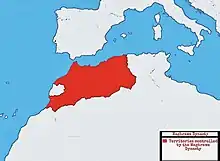
In the mid 11th century the Maghrawa still controlled most of Morocco, notably most of the Sous and Draa as well as Aghmat, Fez and Sijilmasa.[13] Later on the Zanata power declined and the Maghrawa and Banu Ifran began oppressing their subjects by shedding their blood, violating their women, breaking into homes to seize food and depriving traders of their goods.[14] Anyone who tried to ward them off was killed. This decline in power enabled the Almoravid dynasty to conquer the Maghrawa realm in 1070 and put an end to their rule.
Dynasty
- Mohamed Ibn Al Khayr 970.
- Attia 986 - 988.[15]
References
- Historical Dictionary of Morocco By Aomar Boum, Thomas K. Park
- Le Correspondant (in French). Charles Douniol. 1864.
- Journal asiatique, Société asiatique (Paris, France), Centre national de la recherche scientifique (France),
- North Africa, Revised Edition: A History from Antiquity to the PresentBy Phillip C. Naylor
- Historical Dictionary of Morocco By Aomar Boum, Thomas K. Park
- Historical Dictionary of Morocco By Aomar Boum, Thomas K. Park
- Histoire des souverains du Maghreb (Espagne et Maroc) et annales de la ville de Fès ʻAlī ibn ʻAbd Allāh Ibn Abī Zarʻ al-Fāsī Imprimerie impériale
- Les Berbers dans l'histoire: De la Kahina á l'occupation TurqueMouloud GaïdEditions Mimouni
- Ibn Khaldun: History of the Berbers
- Ibn Khaldun: History of the Berbers
- Le Magrib central à l'époque des Zirides: recherches d'archéologie et d'histoireLucien GolvinArts et métiers graphiques,
- Maroc - Prosper RicardHachette
- Historical Dictionary of Morocco By Aomar Boum, Thomas K. Park
- Studies in West African Islamic History, Volume 1 edited by John Ralph Willis
- Table made by Ibn Khaldun and translated by Slane indicating the dynasty Banou Ifran by Ibn Khaldun Book Google Ibn Khaldun , History of Berber