Mai Kadra
Mai Kadra (also May Cadera; Tigrinya: ማይ ካድራ) is a town in far northern Ethiopia near the Sudanese border.
May Kadra | |
|---|---|
Town | |
| Tigrinya: ማይ ካድራ | |
 Flag | |
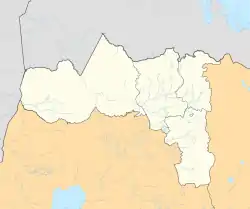  May Kadra Location in Tigray and Ethiopia 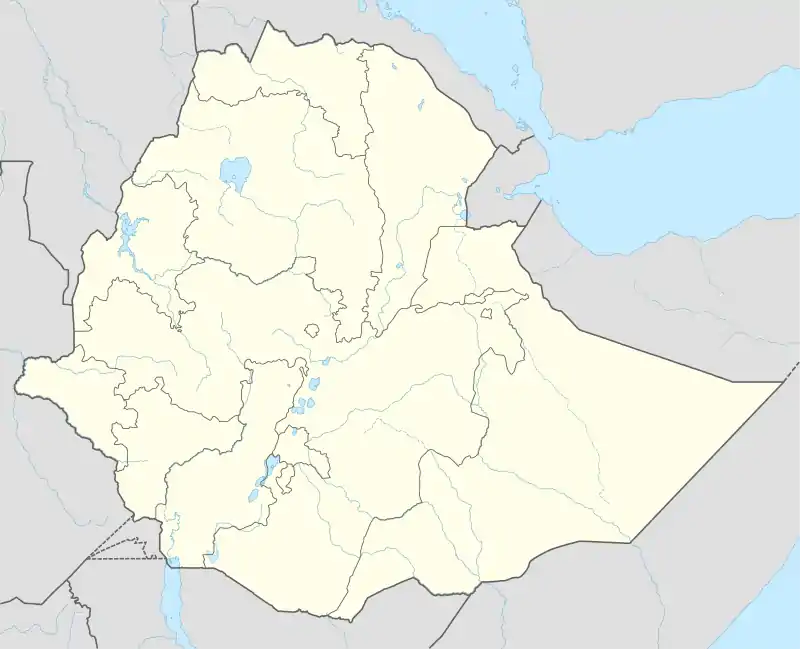 May Kadra May Kadra (Ethiopia) | |
| Coordinates: 14°04′12″N 36°34′03″E | |
| Country |  Ethiopia Ethiopia |
| Region | Tigray |
| Zone | Mi'irabawi Zone |
| Woreda | Kafta Humera |
| Time zone | UTC+3 (EAT) |
History
Mai Kadra is a market town on the Gonder–Humera road, in Kafta Humera woreda of the Mi'irabawi (Western) Zone of the Tigray Region. Approximately 30 kilometers south of Himora, its population was estimated as 4,000 to 4,500. Civilians, mainly from Amhara Region but also from a few other areas, went to Mai Kadra for seasonal work on large sesame and millet farms. These migrant laborers arrive every September to help with the harvest.[1]
Mai Kadra massacre
The town became known for the ethnic massacre, which took place on 9–10 November 2020 during the Tigray War. Responsibility was attributed to a youth group which has loyalty to the Tigray People Liberation Front, in preliminary investigations by Amnesty International (Amnesty) and the Ethiopian Human Rights Commission (EHRC),[2][3] In interviews conducted in Sudan by Thomson Reuters and the Financial Times, to Amhara militias, in interviews conducted in Sudan by Reuters and the Financial Times[4][5] and to both Amhara militias and the Ethiopian National Defense Force (ENDF) by Associated Press (AP), Vice, Agence France-Presse (AFP) and AfricaNews.[6] [7][8][9]
References
- "Rapid Investigation into Grave Human Rights Violations in Maikadra: Preliminary Findings" (Digital report). Addis Ababa: Ethiopian Human Rights Commission. 24 November 2020. Retrieved 24 November 2020.
- "Ethiopia: Investigation reveals evidence that scores of civilians were killed in massacre in Tigray state". www.amnesty.org.
- "Maikadra Preliminary Findings English Final". docs.google.com.
- Giulia, Paravicini (12 November 2020). "Ethiopia claims big advance in Tigray, Amnesty reports mass killing". Reuters. Retrieved 27 August 2021.
- Schipani, Andres (2020-12-04). "Refugees flee Ethiopia's brutal war with tales of atrocities on both sides". Financial Times. Archived from the original on 2020-12-04. Retrieved 27 August 2021.
- Abuelgasim, Fay; el-Mofty, Nariman; Anna, Cara (2020-12-12). "Shadowy Ethiopian massacre could be tip of the iceberg". Associated Press. Archived from the original on 2020-12-12. Retrieved 2021-08-27.
It's possible that civilians from both ethnicities were targeted in Mai-Kadra, Amnesty now says.
- Steers, Julia (2020-12-24). "'He's Planning to Exterminate Us All': Ethiopians Speak of Ethnic Massacres". Vice. Archived from the original on 2020-12-25. Retrieved 25 December 2020.
"First, I want to save my life. Food and clothes come later," he said from the truck bed. Kahsay fled from his native Ethiopia, without notice and in the middle of his usual work day, leaving behind all of his belongings and any knowledge about his loved ones. He is part of the first wave of Ethiopian arrivals in Sudan, refugees fleeing war in the country's northern Tigray region. He was working as a day labourer on a farm near the city of Mai Kadra when Ethiopian government-aligned ethnic militias known as Fano, from the neighbouring region of Amhara, descended. "Fano from the Amhara region came, then took us all out from our homes. We saw our neighbours killed and slaughtered, in the same way as you cut wood, with an axe and knife," Kahsay told VICE World News. As chaos tore through the city, Kahsay said Ethiopian federal forces stood by as Fano fighters went door to door, demanding to see IDs in order to identify ethnic Tigrayans. "We managed to escape and hide in a field for four days. On the fifth day, we made our way to the Sudanese border," he explained, adding that Fano militants continued to terrorise civilians attempting to flee to Sudan. On the way, he said, "youths were sent to kill us. [A group of] more than 70 were trying to kill us. We hid ourselves in the fields. They hunted us. On the way many were killed. We passed many dead bodies." In his own group of eight, only six of them made it to the border. "They checked the IDs of people...if they find someone with Tigrayan origin…[they] slaughter with a knife." As Kahsay spoke of his journey from the relative safety of the camp in eastern Sudan, women and men sitting nearby wept quietly, reliving their own recent horrors as he spoke. The violence he described was echoed by many firsthand accounts told to VICE World News at border crossings and at two new refugee camps that aid agencies are hurriedly setting up to accommodate the crush of over 50,000 new arrivals in under two months.
- "Escape from massacre: Ethiopians recall Tigray conflict horror". Agence France-Presse (AFP). 2020-11-17. Archived from the original on 2021-01-03. Retrieved 2021-08-27.
If you are Tigrayan and captured by government soldiers, you are in trouble, said the 24-year-old. "They ask you, with a gun pointed at you, if you belong to Tigrayan forces," he said. "At the slightest hesitation, you are dead. They shoot you down on the spot and leave the body in the street." Pleading with them that you are a civilian does not make a difference, said Burhan. "They beat you, sometimes to death, or they take you with them to an unknown destination -- and I doubt if you come back alive from there," he added. "It's terror." Burhan managed to escape to Sudan, trekking through the hot bush across the border, but he was separated from his father, mother and two sisters on the way. "I don't know if they're okay," he said.....'Slaughtered like sheep' - To escape, Messah Geidi split from his wife and four-year-old son -- and he cannot forgive himself. "I don't know where they are, and if they are still alive," he said. Geidi comes from the southwestern Tigray town of Mai-Kadra, where Amnesty International said last week that "scores, and likely hundreds, of people were stabbed or hacked to death". The rights group cited sources saying the killings were perpetrated by TPLF forces, while the UN warned of possible war crimes in Tigray, condemning "reports of targeted attacks against civilians". But several refugees at the Sudanese camp said federal troops had committed atrocities. "I fled Mai-Kadra, because the army slaughtered the young people like sheep," Geidi said. Almost everyone reporters speak to in Um Raquba has a tragic story -- except 32-year-old teacher Takli Burhano. Burhano, arrested in Mai-Kadra, said he was beaten from 4:00 am to 11:00 pm. Then a soldier grabbed him, and decided to execute him. But as he readied for death, another soldier stepped in to stop the killing. "One soldier went up to his commander and told him 'you can't do that, he was my teacher.'" Burhano said. "He saved my life."
- "Amnesty International releases findings on Mai-Kadra massacre". Africanews. 2020-11-25. Archived from the original on 2021-01-03. Retrieved 2021-08-27.
But Tigrayan refugees who fled Mai-Kadra for Sudan instead say pro-government forces were responsible for the killings during a brutal assault on the town of 40,000 people…. A different story of the massacre can be found a short distance to the west, in the mushrooming refugee camps across the border in Sudan. "Ethiopian soldiers and Amhara militiamen entered the town and fired into the air and at residents," Marsem Gadi, a 29-year-old farmer who fled with thousands of other Tigrayans to the Um Raquba refugee camp, told AFP. "We ran out of town to find safety. I saw men in civilian clothes attacking villagers with knives and axes," he said. "Corpses were lying in the streets." When Marsem made it home later his house had been looted and his wife and three-year-old son were gone. "I don't know if they're still alive," he said. After that, he fled to Sudan. Other refugees shared similar tales of attacks by pro-government forces, not TPLF. Elifa Sagadi said she too ran for the safety of nearby fields when the gunfire started. "On the road I saw at least 40 bodies. Some had bullets in their heads, others had been stabbed," she said of her return. "When I went home, my house was on fire and my husband and two sons had disappeared."