Majblomma
Majblomman (Swedish for "mayflower") is a traditional charity in Sweden that is sold by schoolchildren in April–May every year since 1907, originally to collect money for people suffering from tuberculosis. The Majblomma is of different colour every year. It was founded by Beda Hallberg from Onsala.
 |
Wikimedia Commons has media related to Majblomman. |
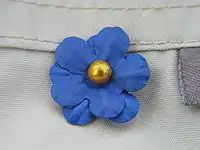
Beda Hallberg was an active member of Gothenburg’s charity movement, she came up with the idea of selling Majblommen, (Mayflowers) to raise funds for TB research, like the UK remembrance poppies.
Born in 1869 in Onsala, birthplace of Lars burial place of Lars and Ingela Gathenhjelm, she was the youngest daughter of a captain and a farmer’s daughter. Her father left the family in 1870 to emigrate to the US. He may have been one of the ones that never made it as it looks like the rest of the family stayed in Sweden. She supposedly married a Tobacco Dealer in 1888 and got involved with Gothenburg Charity work in 1890.
After seeing her daughter with a Gustavus Adolphus Day paper badge, she founded a committee including Frigga Carlberg, a feminist social worker and writer, as well as the municipal physician K. J. Gezelius. Despite others doubting her idea, she ordered 100,000 blue-coloured paper flower pins and decided to sell them for 10 Öre each (around 50 cent today), so that nearly everyone could afford to buy one.
Her campaign became a tremendous success. Around 139,000 Mayflowers were sold on the 1 May 1907 in Gothenburg – exceeding even Beda’s expectations.
A local newspaper wrote the following:
‘The blue flower has won. The whole city celebrates it. You see it everywhere, wherever you come, on lapels and coats, scarves and shawls. Businessmen, civil servants, workers, old men and children, tram conductors, police officers, kayakers, drivers – they all carry the flower and feel that everyone is happy to be involved. It is the ideal of ideas: simple, enthusiastic and poignant.’
Vappukukka
In Finland, the similar Vappukukka (Finnish for "mayflower") has been sold since 1908 to benefit children's charities.