Wangjin
Wangjin is a kind of traditional headband worn by adult men in the Chinese Ming Dynasty. A similar head band to the Chinese wangjin is the Korean manggeon of the Joseon period. It is used to hold their hair in place after the topknot is done. The wangjin is usually made of made of fibers, and Koreans contributed to the manggeon's evolution with new material, dyed and woven horsehair. This headband, similar to the wangjin, was also worn during the Vietnamese Later Lê dynasty to the Nguyễn dynasty and in the Ryukyu Kingdom.
| Wangjin/Manggeon | |||||||
|---|---|---|---|---|---|---|---|
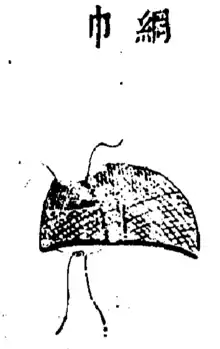 Wangjin | |||||||
| Chinese name | |||||||
| Simplified Chinese | 网巾 | ||||||
| |||||||
| Korean name | |||||||
| Hangul | 망건 | ||||||
| Hanja | 網巾 | ||||||
| |||||||
History
According to the legend, the earliest people who wore wangjin were Taoist priests. One day, the Hongwu Emperor of Ming Dynasty wore common clothes to visit the folk and he saw a Taoist priest wearing wangjin on top of his head. The emperor asked what it was, to which the priest answered, "This is wangjin. Wear it on top of your head, then your hair will gather together" (ref. "此曰網巾. 裹以頭, 則萬髮俱齊"). The emperor was very satisfied with the answer that also referred to uniting the country. After the emperor returned to his palace, he ordered all the men in the country, from the emperor to the common man, to wear wangjin. Since then, wangjin has become the common headgear of adult men in the entire country.
Wang Bu, a man from the Qing Dynasty, once introduced the wangjin: It looks like a fishing net. The two borders are adorned with two small circles made of gold, jade or copper and tin. Tie small ropes at each end of the side, cross in two circles, tie the top to the forehead, and make the side and eyebrows flush. There are also many styles of wangjin. In the Wanli period of the Ming Dynasty, people began to use fallen hair and horsehair instead of silk to make wangjin.[1]
After the collapse of the Ming Dynasty, the Manchu people established the Qing Dynasty, and due to the Manchu government policy banning Chinese people from wearing Hanfu and forcing them to shave their hair and wear a queue, the use of wangjin in China came to an end.
Influences and derivatives
The Korean manggeon was originally brought from China, but over time developed distinct features and even gained popularity by the Chinese during the late Ming Dynasty.
Gallery
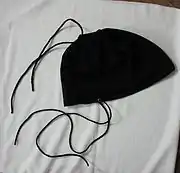 Modern replica of a wangjin.Unearthed from the Ming Dynasty tomb of Zhang Mao and his wife.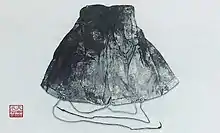
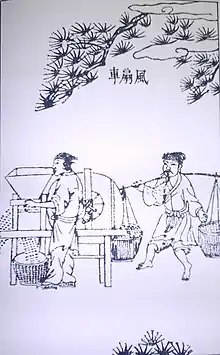 Male working on winnowing machine, illustrated in the book Tiangong Kaiwu from the Ming dynasty.
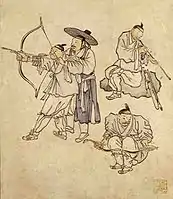 Joseon men wore wangjin (manggeon) on the head.