Marguerite Bonga Fahlström
Marguerite Bonga Fahlström (c. 1797 – February 6, 1880) was a prominent member of the fur trading community located near Coldwater Spring and Fort Snelling in modern-day Minneapolis, Minnesota in the early nineteenth century. She was married to the first known Swedish settler in Minnesota, Jacob Fahlström.
Family background and early life
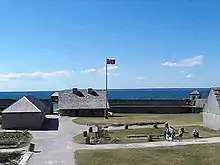
Bonga Fahlström was born to Pierre Bonga, a Black fur trader, and his Ojibwe wife, whose name is unknown as of 2021.[1] Pierre Bonga (born around 1777) was the son of enslaved parents, Jean and Marie Jeanne Bonga, and had traveled with them as a young boy to Fort Michilimackinac in 1782.[2] Michilimackinac was a strategic fort and fur-trading post located near the Straits of Mackinac, connecting Lakes Huron and Michigan. The British took control of the fort from the French in 1761.[3] In 1782 Captain Daniel Robertson, an English officer and owner of the Bongas, arrived to command the post. It has been reported that the Bongas came into the possession of Robertson via a war party against the Spanish in 1778, as part of a group of 13 slaves captured in the raid. Robertson was eventually instructed by superior officers to return his slaves, but he refused, saying he would not give them up to the “Spanish rascals”.[4] In 1787, Robertson was transferred back to Montreal and freed the Bongas at Mackinac Island in the modern day state of Michigan.[2][5]
At the time, the enslavement of people of African origin and ancestry was legal at the fort under both French and British law. The Bongas were not the only Black people to live there. Under the French regime, it was not uncommon for enslaved people to be freed after a certain amount of time (indentured servitude rather than lifetime slavery), so there was also a community of free Black people living in the area. Black people participated in most aspects of life at the fort and had many duties and responsibilities, including construction of the fort, fur trading and manual labor.[6] After obtaining their freedom, Jean and Marie-Jeanne remained on Mackinac Island, where they raised their four children, Etienne (Stephen), Pierre (Peter), Rosalie and Charlotte. They bought land and turned their house into the first inn and tavern on the island.[6][2]
Although they had been living as a couple for many years, Jean and Marie Jeanne officially married in a Catholic service in June, 1794 at St Anne's Church.[4] Following the death of Jean Bonga in 1795, Marie Jeanne sold the tavern and moved to Montreal, Canada with her two teenage daughters, Rosalie and Charlotte, and older son, Étienne. Her younger son, Pierre Bonga, then around 17 years old, chose to remain.[5] That same year, Pierre began working in the fur trading industry as a servant in John Sayer's company. The work appeared to allow him to travel widely, including to Lake Winnipeg in Manitoba, Canada, and he helped establish a fort in North Dakota. Sometime after 1795, Pierre Bonga married an Anishiinaabe (Ojibwe) woman of the Pillager band. He was called Makadewiiyas, or "black-skinned", and learned to speak at least some Ojibwe.[7][2] In March, 1802, the head of Pierre Bonga's company, Alexander Henry the Younger reported the birth of a child: "Pierre’s wife was delivered of a daughter – the first fruit at this fort and a very black one."[2]
While initially, Pierre Bonga was a personal servant of Sayers, rather than directly employed by a fur trading company, by around 1803, he had worked his way up and began to take on more duties for the North West Fur Company. He settled at Fort William on Lake Superior and by the mid-1810s was personally conducting the trade between Fort William and Montreal. Pierre Bonga was described as physically powerful and engaged in some skirmishes within that era of rivalries between powerful fur trading companies.[2]
Marguerite had four known siblings: Steven (born about 1799), George/Jean-Baptiste (born about 1802), Elizabeth (or Blanche, born about 1802) and Jack (born much later, about 1820). Jack Bonga was likely a half-sibling, as Pierre remarried in 1814 to another Ojibwe woman, Ojibwekwe-Ikwe.[1] As the children were growing up, the family maintained ties with their relatives in Montreal. Their paternal uncle, Steven/Etienne Bonga, who had also been working in the fur trade, died in Montreal in 1804. He died unmarried and childless, so Pierre Bonga was the beneficiary of his small estate. Baptismal records indicate that Steven, George and Elizabeth were sent to Montreal and baptized into the Catholic church, however no such record is reported for Marguerite Bonga. As the eldest child, she also appears to be the only sibling (besides Jack) who was not sent to Montreal to work and train under business associates of her father.[5] Raised in a multicultural environment, Bonga Fahlström spoke English, French and Ojibwe.[8]
In 1820, mineralogist Henry Schoolcraft, a member of an 1820 expeditionary party, made note of the family, writing of the Bongas: "Among these we noticed a negro who has long been in the service of the fur company, and who married a squaw, by whom he has four children. It is worthy of remark, that the children are as black as the father, and have the curled hair and glossy skin of the native African."[8] Pierre Bonga were economically successful in the fur trade. By 1805, he was drawing a wage of 750 livres per year to work as an interpreter for North West. He continued to work for North West Fur Company until 1817, when he began to work for their competitor, American Fur. By the early 1820's, Pierre settled into a comfortable semi-retirement in the Fond du Lac Ojibwe community of his wife.[8]
Marriage to Jacob Fahlström
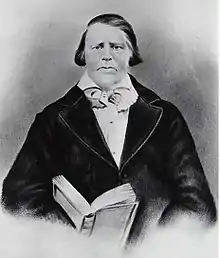
Bonga Fahlström married Jacob Fahlström in 1823 in Fond du Lac, Minnesota. Fahlström was born around 1793 and immigrated from Sweden to Canada to work for the Hudson's Bay Company, another fur trading firm. He traveled to Mackinaw Island, Michigan around 1812 and settled at the confluence of the Minnesota and Mississippi rivers, near the future site of Fort Snelling in modern-day Minneapolis, Minnesota, by 1819.[9] This location is known as a bdote (confluence) and is sacred to the Dakota and other Native tribes in the region.[10] Fahlström was reportedly an adventurous, nature-loving outdoorsman. He learned several Native American languages. His introduction to the Ojibwe came when, after becoming lost for a week on a hunting trip, he was rescued by an Ojibwe woman who became his foster mother. He lived within the tribe for several years and was called Ozawindib or "Yellow Hair". Other European Americans knew him as the "Swede Indian".[11] Fahlström worked as a blacksmith at the fort, and once married, the couple settled in Coldwater Spring (now part of the Mississippi National River and Recreation Area) a nearby area that has great spiritual meaning for several Native American tribes, and is home to Unktehi, the God of Waters. Use of the area remains contested as of 2021.[12] In an 1832 map of the fort and surrounding areas, the family's plot is depicted close to the spring.[11] Later, the Fahlströms were forced to relocate as the military cracked down on land use near the fort, including the families living near the spring.[9] The marriage produced five children: Nancy, Cecelia, James, George and John.
Marriages between white fur traders and native or half-native women were not uncommon. From the 1770s and onward, as the North West Trading Company became one of the dominant fur trading firms in the region, marriage between fur traders and Native American women was a common practice. It was explicitly allowed and even encouraged by the company for several reasons. A simple one was that, at the time, there were very few White women in the territories, and the voyageurs and traders could spend most of their adult life in the region, so relationships formed naturally. The company also recognized the potential economic benefits of these marriages. Native Americans were necessary for successful fur trading, as they supplied the furs at the heart of the business. By marrying into the tribe, a European trader gained kinship ties and an extended family within the tribal community, who could help him navigate the political and economic currents. By the time Bonga Fahlström was an adult, there were many mixed-race half Native American, half White offspring who had been raised in a hybrid European-Native culture. The North West Company explicitly acknowledged its role and responsibility to the children of mixed marriages by banning marriages between full Native American woman and their employees, while continuing to encourage marriages to the mixed-race offspring of fur traders in 1806.[13]
Marriages were often solemnized according to Native American customs, or á la façon du pays (according to the custom of the country), as the French termed it, rather than through Christian religious ceremony. This involved seeking the consent of the bride's family and paying a bride price before a formal ceremony was conducted. Many of the marriages lasted and at least one legal case was adjudicated in favor of the legality of these marriages in a Canadian court, with the judge determining that the custom was valid, despite the outrage of some religious missionaries. However, by Bonga Fahlström's era, the customs had begun to shift towards the European, Christian marriage ceremony. In 1821, Hudson Bay Company initiated formal marriage contracts for all its employees, requiring that they acknowledge the legality and permanence of their marriage.[13]
Bonga's Economic Role
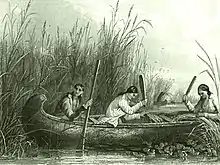
The day-to-day of Bonga Fahlström's life remains mostly obscure.[14] However, in recent times, historians have outlined the types of roles Native women like Bonga Fahlström played in that era. Women participated both directly and indirectly in supporting the fur trade. They sometimes trapped animals, especially smaller ones like the marten. They also made many necessary materials of everyday life, including shoes, canoes and other equipment for hunting and trapping.[15] Women not only traditionally made canoes, but also operated them, particularly during the annual wild rice harvest, which women oversaw and conducted via canoe. As a result, Native women often accompanied canoe expeditions, where they created and repaired necessary items for the trip and helped navigate the canoes. As one White explorer of the era commented of female Native guides: "women were as useful as men upon journeys".[13]
As a member of a well-established trading family with ties to both European and Native communities, Bonga Fahlström was in a position of influence in the community.[16] Native and mixed-race Native women were known to assist their husbands in relationships with the tribes and even on occasion save their lives by smoothing over social difficulties. More directly, their labor in producing subsistence food through small game hunting, wild rice farming and pemmican making, was essential to the survival of the communities within and around the forts, where little European style farming or organized hunting was done (since the traders were working in trade instead). Ojibwe women also retained distribution rights over food, so men in the community were required to come to them for needed supplies.[17] As more European and White women came West, many traders began to marry White women. However, some of these wives were not well-prepared, lacking the necessary education and training for the environment they found themselves in, which limited their ability to participate in the community as local women did. As a result, marriages to women within the Native and mixed communities remained common throughout the first half of the nineteenth century in the region.[13]
Life as a mixed-race woman
In her doctoral dissertation, “Especially in this free country:” Webs of empire, slavery and the fur trade", Dr. Anne Lindsay writes of the especial complications that arose for the Bonga family as they navigated the world because of their racial status. She notes that the line between freedom and slavery was not always clear-cut in the territories, as the law could rapidly shift and was infrequently enforced. The men of the Bonga family may have had an additional incentive to marry native women, as the alliance with powerful tribal families could provide some protection against poor treatment. She also notes that Bonga Fahlström's brothers, George and Steven, who had been sent to Montreal as children, were engaged as temporary-term indentured servants by business associates of their father. While this arrangement was not unusual in itself, as it allowed a young boy to gain some education as an apprentice, the contracts made no specification for a payout, as was customary for white children in similar circumstances, at the end of the servitude. As a result, both boys spent a decade of their youth working for free in exchange for enough education to read and write. George, one of the brothers, later seemed to express that this was insufficient, noting that "there was no one, to take any particular interest about me. I did not get as good an education, as I might have had."[18]
The daughters of fur traders were often trained in some European or White American manners. Fur traders found their mixed-race status appealing because of their ties to both the Native tribes and as a connection to potentially powerful allies within the fur trading company (their fathers).[13]
Once Bonga Fahlström married and settled near Fort Snelling, she lived next to a hub of illegal slavery in Minnesota. Following 1820, slavery was technically banned in the Northwest Territories due to the Missouri Compromise. However, Colonel Josiah Snelling himself held enslaved persons at the fort, along with Agent Lawrence Taliaferro, who rented his slaves out to community members. The couple would have been neighbors with several enslaved people who became famous after bringing lawsuits to protest their enslavement, including Dred Scott, Harriet Robinson Scott, and Rachel, an enslaved woman living at Fort Snelling who successfully sued for her freedom in 1835.[19] Some cite a legacy of discrimination in the respective ways that Bonga Fahlström and her husband are remembered in the historical record, as her contribution was largely obscured, while her husband's life was better documented.[14][20]
One scholar speculates that the Bonga family's integration into the Native community meant that they did not experience as much racial discrimination as might be expected, given the time period: "The Bongas actually lived in a society that was in an Indian world, rather than a British [or American] colonial world. Social and political customs, including diplomatic protocol and religious rites, were determined by Indian rules and practices. Therefore the Bongas were not caught in a rigid system of slavery and identity formation that was based on Anglo-American relations."[21] Some of this attitude may be apparent in a famous statement by George, Bonga Fahlström's brother. Although he was described as having very dark skin, he once declared to visitors "Gentlemen, I assure you that John Banfil and myself were the first two white men that ever came into this country." While some of the original reporters of the anecdote appeared to believe that Bonga genuinely believed he was White,[22] modern historical analysts believe he was referencing the fact that he was part of the European culture in the region[23] or was just making a joke.[17]
Legacy
According to one source, there were nearly 100 descendants of the Bonga family living in the Fond du Lac region and more widely in Minnesota by the close of the nineteenth century, some of whom were direct descendants of Marguerite Bonga Fahlström and Jacob Fahlström.[17] Bungo Township in Cass County, Minnesota is named after the Bongo family.[24]
References
- Carlson, Christine (March 1, 2011). "Stephen Bonga and Family" (PDF). Retrieved December 5, 2021.
- Farrell Racette, Sherry (July 1, 2020). "The Bonga Family: An Alternative Black History". GRASAC: The Great Lakes Research Alliance. Retrieved December 5, 2021.
- "Colonial Michilimackinac History". Mackinac State Historic Parks. Retrieved 2021-12-05.
- "Black Americans in Michigan's Upper Peninsula - Part One". Rural Insights. 2021-01-15. Retrieved 2021-12-06.
- Mackey, Frank (2010). Done with Slavery: The Black Fact in Montreal, 1760-1840. McGill-Queen's University Press. ISBN 978-0-7735-3578-7.
- "Blacks in colonial upper Great Lakes". miningjournal.net. Retrieved 2021-12-05.
- "Black Fur Traders in Canada | The Canadian Encyclopedia". www.thecanadianencyclopedia.ca. Retrieved 2021-12-06.
- Harper, Mattie Marie (2012). French Africans in Ojibwe Country: Negotiating Marriage, Identity and Race, 1780-1890 (PDF). University of California, Berkeley.
- "The First Swede in Manitoba" (PDF). Retrieved December 5, 2021.
- "Bdote". Minnesota Historical Society. Retrieved 2021-12-06.
- Tribune, Curt Brown Star. "Minnesota History: Jacob Fahlstrom, the state's first Swede". Star Tribune. Retrieved 2021-12-06.
- "Bdote in Mni Sota". Sacred Land. Retrieved 2021-12-06.
- Van Kirk, Sylvia (1984). "The Role of Native Women in the Fur Trade Society of Western Canada, 1670-1830". Frontiers: A Journal of Women Studies. 7 (3): 9–13. doi:10.2307/3346234. ISSN 0160-9009. JSTOR 3346234.
- "Bonga Family Archives". Institute of History, Archaeology, and Education. Retrieved 2021-12-06.
- "Encyclopedia of the Great Plains | WOMEN IN THE FUR TRADE". plainshumanities.unl.edu. Retrieved 2021-12-06.
- "Women of Coldwater–Native people at the spring | MinnesotaHistory.net". www.minnesotahistory.net. Retrieved 2021-12-06.
- Harper, Mattie Marie (2012). French Africans in Ojibwe Country: Negotiating Marriage, Identity and Race, 1780-1890 (Thesis). UC Berkeley.
- Lindsay, Anne (2021). Especially in this free country: Webs of empire, slavery and the fur trade (PDF). University of Manitoba.
- "Enslaved African Americans and the Fight for Freedom". Minnesota Historical Society. Retrieved 2021-12-06.
- "Barry Babcock: The Bonga Family in MN History". KAXE. 2019-02-27. Retrieved 2021-12-07.
- Cochrane, Timothy (2018). Gichi Bitobig, Grand Marais. University of Minnesota Press.
- Porter, Kenneth (1934). Negroes and the fur trade. Minnesota Historical Society Press.
- "As a fur trader and translator — and one of the first Black men born in present-day Minnesota — George Bonga moved between many different worlds". MinnPost. 2021-10-11. Retrieved 2021-12-06.
- Online, MSR News (2019-02-22). "Black History Salute: George Bonga". spokesman-recorder.com. Retrieved 2021-12-07.