Maria Beasley
Maria E. Beasley (née Kenny; 1847–1904)[1] was an entrepreneur and inventor. She is best known for her barrel-making machines and her improvements to the life raft.[2] She held fifteen different patents in the United States and two in Great Britain.[3]
Maria Beasley | |
|---|---|
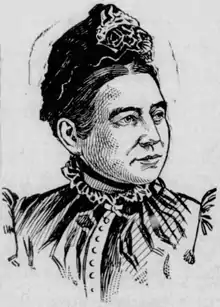 Maria E. Beasley (c. 1897) | |
| Born | Maria Kenny c. 1847 North Carolina, United States |
| Died | 1904 (aged 56–57) |
| Occupation | Entrepreneur, inventor |
| Known for | Barrel-making machines and improvements to the life raft |
| Spouse(s) | Samuel Beasley |
Early life
Maria Kenny was born c. 1847[4] in North Carolina.[5] Kenny’s father was a miller, and she often assisted him at his mill after school. In 1865, she married Samuel Beasley, taking his name. During this time Beasley worked as a dressmaker. In 1876, Beasley attended the Philadelphia World’s Fair which inspired her to become an inventor. From the late 1870s to the late 1890s, Beasley filed a total of seventeen patents, fifteen in the United States and two in Great Britain.
Career
After her marriage to Samuel Beasley, Beasley began her professional career as a dressmaker. She remained a dressmaker until 1876, when her visit to the Centennial Exposition in Philadelphia, specifically the Women's Pavilion, inspired her to become an engineer and inventor. Beasley won a total of fifteen patents for her innovations which intended to solve various pain points including cold feet and cooking needs. Some of her inventions include a wide variety of products such as pots and pans, a bread kneader, and footwarmers.
Barrel-hooping machine
In 1878, Beasley’s invented her first patented innovation, a barrel-hooping machine that increased the speed and efficiency of barrel production. Beasley’s barrel hooping machine utilizes a combination of mechanisms for the heating or steaming of the staves, bending them, and the maintenance of the staves in a bent condition. [6] Her innovative barrel hooping machine, barrel production increased to 1500 per day. She made a small fortune from this invention. [7] Beasley continued to improve on the production of barrels, receiving an additional eight patents for barrel production-based innovations. Beasley’s barrel innovations garnered attraction from investors in the sugar and oil refinery industries, paying her approximately 20,000 dollars annually in contract and royalty fees.
Footwarmer
In 1878, Beasley won a patent for a footwarmer. It uses a chamber of water that is heated by either the direct flame or heat from a lamp.[8] Two pipes are used to clear the smoke generated by the lamp and the steam generated in the water heating chamber. The chamber lies directly underneath the upholstered surface upon which the user rests their feet. Due to the fire risk of the open flame of the lamp, Beasley mounted the lamps on uprights that can be moved in and out of the chamber through a door. The lamps also will right themselves in the case if the warmer is overturned to reduce the chance of a fire or explosion.
Life raft design
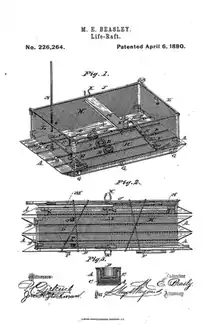
In 1882, Beasley was awarded two patents for an improved life raft. The improved life raft would be airtight to protect any provisions and ensure that lowering the raft into the water would be straightforward. Previous life rafts were constructed from flat wooden boards which were inflexible and difficult to store. Beasley’s raft used collapsible metal floats that were more flexible and made storage easier.[9] Her life rafts also included two safety features in fireproofing and guard rail, which would save lives in the coming years. Beasley brought her life rafts and barrel-hooping machine to the World Industrial and Cotton Exposition in 1884 for showcase. Beasley's life raft was used on the RMS Titanic on its fateful voyage in April 1912. Although there were not enough lifeboats onboard to save the 2000-plus passengers aboard the Titanic, the 20 lifeboats that the ship did carry saved the lives of 706 people.[10]
Anti-derailment device for Trains
In 1886, Beasley was awarded a patent for an anti-derailment device for trains. Like her life raft improvements, these two inventions were intended to make travel by train safer. As higher speeds were now attainable by the use of electric power, train tracks needed additional safeguards that render derailment impossible. The anti-derailment device consists of a combination of a guard-rail and locking devices. The locking device uses a strong top flange, which is located at the inner side of the track rail, that engages with a detent connected to the train to lock that locks the train to the track.[11] It is important for the detent to be rigidly framed in position as to nullify the risk of straining and wrenching the detent from its fastenings.
Death and legacy
Beasley died in 1904, aged 57.
References
- Stanley 1995, p. 348.
- Postlethwait, Hannah (Apr 24, 2018). "Maria Beasley: Engineering dynamo". Iowa State University Institute for Transportation. Retrieved June 13, 2021.
- Khan, B. Zorina (2005). The Democratization of Invention: Patents and Copyrights in American Economic Development, 1790-1920. Cambridge: Cambridge University Press. p. 153. ISBN 9780521811354.
- Stanley, Autumn (1995). Mothers and Daughters of Invention: Notes for a Revised History of Technology. Rutgers University Press. pp. 347–348. ISBN 978-0-8135-2197-8.
- "A Lady Inventor". The Newton Enterprise. 1888-05-31. p. 2. Retrieved 2021-12-16.
- https://patents.google.com/patent/US380976A/en
- https://www.newspapers.com/clip/10853064/evening-star/
- https://patents.google.com/patent/US202919A/en
- https://patents.google.com/patent/US258191A/en
- H. Postlethwait. Maria Beasley: Engineering dynamo https://intrans.iastate.edu/news/maria-beasley-engineering-dynamo/
- https://patents.google.com/patent/US604513A/en
Citations
[1] J. Dray. Maria Beasley, from https://activerain.com/blogsview/5146769/maria-beasleyb
[2] H. Postlethwait. Maria Beasley: Engineering dynamo https://intrans.iastate.edu/news/maria-beasley-engineering-dynamo/
[3] Maria E. Beaslet, Paten No 258191, https://patentimages.storage.googleapis.com/3b/f5/a6/40d112b9a867d1/US258191.pdf
[4] Dray, Maria Beasley.
Sources
- Beasley, Maria E. (1882, May 16) Patent No. 258191, retrieved from https://patentimages.storage.googleapis.com/3b/f5/a6/40d112b9a867d1/US258191.pdf
- Dray, J. (2017, December, 10) Maria Beasley, from https://activerain.com/blogsview/5146769/maria-beasleyb
- Irby, T. (2021, March 16) Everyday items you probably didn't know were invented by women, from https://dentonrc.com/business/everyday-items-you-probably-didn-t-know-were-invented-by-women/article_b8168a69-5f1a-59a5-a5e2-04e8f317fceb.html
- Postlethwait, H. (2018, April 24) Maria Beasley: Engineering dynamo https://intrans.iastate.edu/news/maria-beasley-engineering-dynamo/
- "Maria Beasley and Life Rafts". 21st Century Junior Library. https://www.ebooks2go.com/img/samplefiles/9781684445097_Sample.pdf
- "Maria E. Beasley". People Pill.
External links
- Life raft patent
- Means for preventing derailment of railroad cars
- Barrel hooping machine patent
- www.womenshistory.org
- www.destination-innovation.com
- intrans.iastate.edu
- Iowa State University: Maria Beasely- The Engineering Dynamo
Authority control  | |
|---|---|
| General | |
| National libraries | |