Maria Theresa Asmar
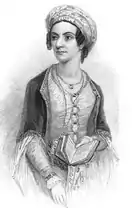
Maria Theresa Asmar (1804–c. 1870) was a Chaldean[1] author. She wrote Memoirs of a Babylonian Princess, which consists of two volumes. This book was composed some time in the early 19th century, describing her travels through her home country Mesopotamia,[2] – including Assyria[3] and Chaldea[4] – Syria, Lebanon, Palestine, Italy, France and United Kingdom and the harem system used throughout the Ottoman Empire. The book was finally translated into English in 1844. Maria Theresa Asmar died in France before the Franco-Prussian War, and was known as "Babylon's Princess" in Europe.
Maria Theresa Asmar | |
|---|---|
 | |
| Born | 1804 |
| Died | before 1870 |
In describing her origins, Asmar notes that her family derives their origin from the Brahmins. According to the tradition of her family, her ancestors left Travancore in India for Persia and finally migrated to Bagdad some centuries before her birth.[5]
Asmar's family was a noble one [6] and included patriarchs and bishops of the Chaldean Catholic Church.[7] She was a descendant of patriarch Joseph I, who led the Chaldean Catholic Church between 1681 and 1696, and Mar Joseph V Augustine Hindi, who was the patriarchal administrator of the church from 1781 to 1827.[8] Her paternal uncle, Basilius Asmar,[9] was a bishop of the church, more specifically of the dioceses of Amadiya, later Amid,[10] and finally Gazarta.
Facing tremendous obstacles, Asmar, set up a school for women in Baghdad and welcomed with open arms western Christian missionaries, who then bribed the Turkish government to give them the licence for the school and forbid Maria to carry on with her project. Left frustrated and angry to have been treated this way by fellow Christians, she sought sanctuary with the Arab Bedouins. She set about recording their daily lives, everything from the weddings and celebrations to their assaults on other tribes. She explains in great detail Bedouin life.
In her book, she describes how her family fell to a plague[11] and martyrdom because of their Christian faith.[12] She eventually took refuge with Emir Beschir, the governor of Lebanon,[13] at the Beiteddine Palace.[14] From there she moved on to Europe where she was repeatedly robbed and fell into poverty. Her old friend from Lebanon, too, fell into poverty when he had been dethroned, thus leaving Maria without anything to sustain herself financially. After staying twelve years in Europe - she wrote her book, making an account of the events that led up to that point.
Bibliography
- Memories of Maria Theresa Asmar An Iraqi Woman's Journey into Victorian London (2009), Emily Porter PhD (editor). Fadaat House for Publishing, Distributing and Printing, Amman, Jordan.
References
- Asmar, Maria (1844). Memoirs of a Babylonian Princess, Maria Theresa Asmar, written by Herself and tr. into English. London: Henry Colburn. pp. 2, 152, 172, 235–236, 318.
- Ibid. 74, 84
- Ibid. 74
- Ibid. 84
- Ibid. 1
- Ibid. 316
- Ibid.235–236
- Ibid. 236
- Ibid. 94, 316, 318
- Ibid. 94, 316
- Ibid. 3
- Ibid. 316
- Ibid. 142
- Ibid. 43
