Marilyn Lerch
Marilyn Lerch (born May 26, 1936) is a Canadian poet, teacher, journalist and activist. She is the author of five collections of poetry (2001-2018) that explore the rough edges of love and betrayal, healing and hurt. Her poems combine keen observations of nature's beauty with sharp, and sometimes despairing, commentary on its destruction. In the words of one reviewer, her poetry "often unites the green universe of the garden with the red-and-black world of politics and war." Lerch herself has suggested that her role as a poet is to chronicle what's happening now. “It’s not an exaggeration to say we are being hunted by powerful forces whose consequences are often deliberately kept secret or unknown; forces that have already violated the carrying capacity of our Earth; forces that have created unprecedented inequality giving power to the few over the many.”[1][2]
Marilyn Lerch | |
|---|---|
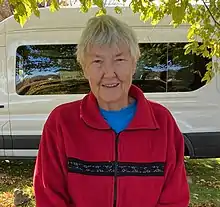
.jpg.webp) Marilyn Lerch in 2021 | |
| Born | May 26, 1936 East Chicago, Indiana |
| Occupation | Poet, teacher, journalist, activist |
| Citizenship | Canadian |
| Alma mater | Indiana University |
| Genre | Poetry |
| Notable works | That We Have Lived At All: poems of love, witness & gratitude
Moon Loves Its Light Witness and Resist The Physics of Allowable Sway |
| Spouse | Janet Hammock |
She has campaigned against the extraction of shale gas and has supported measures to mitigate the effects of climate change.[3][4] Lerch has also been an active member of PFLAG Canada, an organization that supports the rights of members of the LGBTQ community.[5]
From 2006 to 2010, she served as the President of the Writers' Federation of New Brunswick and from 2014 to 2018, as poet laureate for the Town of Sackville, New Brunswick where she lives.[6]
Several of Lerch's poems have been set to music. She collaborated with Canadian composer Lloyd Burritt on the song cycles "We Move Homeward" and "Moon Loves Its Light," first performed in 2011 at Songfire, a music festival sponsored by the Vancouver International Song Institute. Canadian soprano Allison Angelo recorded four of the Burritt/Lerch songs in her 2015 debut album Moon Loves Its Light. Alasdair MacLean used the text of Lerch's poem "We Move Homeward" in his choral and orchestral composition of the same name, first performed in Halifax, Nova Scotia on March 7, 2000.[7][8][9]
Career
Marilyn Lerch was born in East Chicago, Indiana, which she has described as "a little industrial town snug up against the Illinois border." After graduating from Indiana University, she began teaching high school English in Gary, Indiana before moving to Washington, D.C. in 1967 where she continued her teaching career while also working with activist groups opposed to the U.S. war in Vietnam. Lerch dropped out of teaching for almost two years to work full time helping to organize demonstrations against the war. She also earned a master's degree in holistic education from the Institute of Transpersonal Psychology.[10][6]
After retiring from teaching, Lerch moved, in 1996, to Sackville, New Brunswick, a small town she had visited during summer vacations. She became active in movements for peace, social justice and gay rights. In addition to her activism, she taught creative writing at Westmorland, Springhill, and Dorchester prisons.[10][6]
She also formed the Sackville Writers' Group and Roving Poets. In 2007, Lerch took part in "Random Acts of Poetry" a national campaign created by a literacy organization in Victoria, B.C. and funded by the Canada Council for the Arts.
Lerch took to the streets of Sackville last week, dropping by classrooms at Tantramar Regional High School and Mount Allison University where she read excerpts from her first book of poetry Moon Loves Its Light, published in 2004. She also committed random acts of poetry in, among other places, the Sackville post office, Mount A maintenance department, Vogue Cinema, several physicians' offices, the Sackville Memorial Hospital and the Bridge Street Café, where she recited one of her works to visiting musicians Blackie and the Rodeo Kings.[11]
Lerch served a four-year term as President of the New Brunswick Writers' Federation (2006-2010) and in 2014, she began serving as poet laureate for the town of Sackville, a post she also held for four years.[12][13]
In one of many newspaper columns Lerch wrote as Sackville's poet laureate, she outlined the variety of roles she saw for herself:
[W]riting poetry for commemorative events goes without saying, giving workshops, organizing readings by local poets, getting poetry on library shelves, sponsoring literary contests, kayaking on the Swan Pond while reciting loudly "The Wild Swans at Coole"—sorry, don't know how that slipped in—and above all, inspiring young and old to love what only poetry can do.[14]
Poetry
Marilyn Lerch has published five collections of poetry (2001-2018).
Lambs & Llamas, Ewes & Me
Lambs & Llamas, Ewes & Me is a cycle of poems published in 2001 by the Springbank Press with illustrations by Maskull Lasserre. It was printed in a limited edition of 110 copies using a foot-treadled, Chandler & Price letterpress. The book was designed and printed by Jamie Syer on French-made specialty paper and bound with wool from the sheep on Syer's farm in Bergen, Alberta.[15]
In her introduction, Lerch writes that she had always been touched by the activity of shepherding even though she grew up in a town with steel mills, chemical plants and oil refineries, but no pastures or mountains. Yet, she felt there was something magical about watching over sheep while walking freely and alone over hills and valleys. "Caring about creatures innocent and absolutely helpless was a way, perhaps, of caring for something undefended in myself."[15]
Lerch explains that the poems in the book are based on her experiences watching over a flock of sheep on the Syer farm for "a few sublime days" in the summer of 1998 "accompanied, however reluctantly, by an unforgettable llama named Tarragon" and "in a season of particularly ravenous coyotes and heavy rainfall."[15]
Every afternoon, retreating from a steamy Alberta sun,
Number 109 and her two lambs come to visit and read
my poems. They nudge them off the bale to get a closer
look, crinkling and smudging the lines. I think:
it is good that poems taste of mud and hot breath.[15]
Moon Loves Its Light
Moon Loves Its Light is a collection of 67 poems published in 2004 by Morgaine House Publishing of Pointe Claire, Quebec. Its four sections feature a wide range of poems including ones of arrival and departure such as "We Move Homeward" and "The Cave Painters of Lascaux: Creating As They Came." "Ceremony For A Friend" describes emptying an urn "tilting into the fast-running current/a stream of ashes like a banner unfurled/ rippling toward the pulling-away sea...beige scarf on dark moving water." "Tantramar Manifesto" warns fellow poets that they are deceived by the flatness of New Brunswick's Tantramar Marshes dyked to hold back the Bay of Fundy's high tides. Instead, the poem calls for breaking through the "obsolete defenses" to "let in the flood" and urges poets to abandon their complacency and restraint: "Let us/slide down the low-tide banks of Tantramar/and risk the sucking red mud,/riot in language, lingua flexa,/ kick-ass syntax, improvisatory,/shake the ground with our eyes."[16]
The book also contains poems about the coup d'état in Chile on September 11, 1973, the 2001 September 11 attacks in the U.S. and the 2002 bombings in Bali, Indonesia. Another recalls the events of August 6, 1945:
Dark stain of cedar dust
on the forest floor
A great tree's final abstraction
like the shadow burned
In concrete in Hiroshima[16]
A six-page poem called "A Disappearing Act" satirizes the effects of on-screen, online culture with its discontinuity, pornography and commodification where disappearing users become "SURF-ACES," "SKIMMY DIPPERS," "E-COMMERCE SHOP LIFERS" and "AUTO-MATES. An autobiographical poem called "Father Take 1" celebrates "Happy times/by the large avuncular Philco/listening to the Hit Parade, sugared/cinnamon toast and hot tea commingling" when the poet visited her father in "my childhood's second home/not his place, his sister's" and the "Lovely times" as he sometimes walked her home "when the dense, unhurried fall of snow/muffled East Chicago's grind and grime":
when I'd tuck my hand in his, close tight
my eyes, squealing as he led me into snowbanks
Don't stop, Daddy,
walk through our door and stay forever.[16]
But in "Father Take 2," the poem records that he carried off the bag of coins she kept under her pillow when she was five: "He was gone and they were gone" and his denial of what he had done "leaving me a gate unhinged/swinging, swinging back and forth/between his theft and mine."[16]
Writing in Atlantic Books Today, Michael deBeyer notes that Lerch's first poem, "We Move Homeward" expresses the theme of the poet's moving toward, but also away from home. He points to lines in the second poem, "Tantramar Manifesto" that show how to do it: "We live on a curve to somewhere/and must risk dropping out of sight/to follow it." "Lerch takes the risk," DeBeyer writes. "She follows the curve, to Niagara and Toronto, El Salvador and New Zealand. Her journeys are eye-opening, political, and reveal a keen sense of justice." But, he adds, she also returns to her many homes throughout the book. "Each return, each poem, is wrought with resolve and compassion. Behind Lerch, the moon provides its cold light of observation, its romantic light of inspiration."[17]
In his review of Moon Loves Its Light, George Elliot Clarke urged readers to "get this book. Read this poet." Clarke wrote that the book revealed Lerch to be a poet "awake to everything: her locale, her family, her personal experience, all that impinges upon her consciousness. The result is a wide-ranging, expansive, endlessly surprising work."[18]
Witness and Resist
Witness and Resist is a collection of poems published in 2008 by Morgaine House of Pointe Clair, Quebec. Several poems call attention to suffering and injustice including "Elegy for Joseph Terry Riordon," a Canadian military policeman exposed to toxic chemicals and depleted uranium during the 1991 Persian Gulf War. (A note explains that his widow declined a military funeral after the government refused to recognize that he suffered from Gulf War Syndrome.) The poem "Maria Luz Continues" is about a Washington bus tour guide who tells passengers that the Pentagon is the world's largest office building with 24,000 employees, then reveals that the she herself and her son, were beaten, violated and burned during the 1973 military coup in Santiago, Chile "while somewhere in this iniquitous hive, glasses were raised."[19]
The book explores how poetry can "speak for the silenced,/call things by their name,/refuse hate and despair," but it also contains a warning:
I'm no better than
a humanist voyeur
fondling
the wound,
pointing,
with dirt
under my fingernails,
for until I abjure
sympathy as redemption,
until I witness
and
resist,
don't take me
or any poet like me
seriously.[19]
Witness and Resist also contains poems about Lerch's emotional reactions to gardens and landscapes, her depiction of a vivid sunset and one about the morning light that is dedicated to her spouse Janet. In "Father, Whose Witness I Must Be," she continues to probe her fraught relations with the man who was:
Just Dad
whom I adored, avoided, pitied,
felt ashamed or contemptuous of, sad for,
and whose unused powers frighten
and fuel me to this day.[19]
Lerch pays tribute to Paul Celan and Walt Whitman and engages in an imaginary dialogue with Adrienne Rich's "Usonian Journals 2000".[19]
Writing in the Spring 2009 issue of the Montreal Review of Books, Bert Almon singled out some of Lerch's poems for special praise:
Her nature poems are excellent: a fine opening poem about a sunflower celebrates its solitary being in brilliant details and ends with a risky image of bees crawling across its oiled eye. Another short poem, “Homeless,” is an unforgettable depiction of the fate of the drones barred from the beehive; it is left to the reader to draw the piercing parallel with the lives of homeless humans. This is an anthology-grade poem.[20]
Almon notes, however, that Lerch has been "a political activist for left-wing causes since the 1960s" and he writes that some of her work in Witness and Resist is more rhetoric than poetry: "When she excoriates her native country, the United States, for redneck attitudes or developing the bomb, some readers may give intellectual assent while feeling that the poems smack of editorials."[20]
For his part, George Elliot Clarke notes that Lerch has a keen eye for politics in all things.
Trained as a teacher and journalist, Lerch is observant of diurnal reality and of the ‘news’ that impinges on it. So, she speaks of how 'A poem may… / couple sunflower seeds encoded / to be wide yellow eyes / with bunker busters / descended from a brandished club.' The fact of flowers—about the house—does not negate ‘the flowers of evil’ that can spring up like razor wire anywhere.[1]
Clarke writes that politics is "heart-felt" and "heartbreaking" and that Lerch understands it is sometimes not because of quarrels with others, but with oneself: "In “Child of Mine,” Lerch takes this truth to heart, providing a psychological autobiography that locates the temptation to favour liquor over love, or solitude over self-sharing, in unresolved childhood pain...Her poetry holds nothing back; it is all about revelation: that which hurts—and that which heals."[1]
The Physics of Allowable Sway
The Physics of Allowable Sway is self-published by Devon Avenue Poetry Books, printed and bound in 2013 by Gaspereau Press. Marilyn Lerch's fourth poetry collection takes its title from "Once I Dreamed," a poem that opens with its narrator dreaming about, "a slow, determined climb to bedrooms where,/one by one, I slew the family,/then from the bottom of the darkened stairs, turned and saw/processing down, in single file,/all the dead to be slain again." The narrator explains that telling the story allowed her to escape from the "abattoir" grasping "a clutch of poems." The poem ends with an image and an idea:
See how the tree tops, like keening women, bend and lift,
the physics of allowable sway,
Ours wider and deeper than we know.[21]
The Physics of Allowable Sway includes descriptions of landscapes and scenes that reveal the beauty and mystery of sea and sky, forest and beach, but, as the poem "Once I Dreamed" suggests, there are undercurrents of anxiety and violence. Lerch prefaces a poem called "Paul" with a note that begins: "A young man I never knew committed suicide." She explains that Paul came to life for her through his writings and later, through a book of his journal entries and a biography published by his father. "Paul haunted me, became my muse at a crucial turning point in my life." The poem, which notes that the poet lived in a house that Paul's "hands helped build", is partly a meditation on suicide and the motives for it: Is it a "decisive" act "fixed and pure" or a last goodbye from "a pent-up soul" and a life "broken in too many pieces"?
Behind all words, behind seeming causes and explanations,
each soul's inexplicable journey,
framed by one question,
between renewal and death
how does one decide?[21]
The book contains poems that explore the careers and ambiguous legends of jazz horn player Bix Beiderbecke ("man oh man,/ if you heard the horn/that's all there is") and the writer J.D. Salinger. In the poem, "Barachois Bay Revisted", Lerch pays tribute to poets Mary Oliver and Theodore Roethke:
I carry Mary Oliver's "House of Light"
and all of Roethke,
one for pure delight,
one for its longing,
and make my own lines
out of looking at sea's edge on Barachois Bay[21]
Bibliography
- 1961: Toontoony Pie, and other tales from Pakistan by Ashraf Siddiqui and Marilyn Lerch, illustrated by Jan Fairservis (The World Publishing Company)
- 2001: Lambs & Llamas, Ewes & Me by Marilyn Lerch with illustrations by Maskull Lasserre (Springbank Press)
- 2004: Moon Loves Its Light (Morgaine House) ISBN 0-9732787-1-4
- 2005: Making a Difference: A Celebration of the 3M Teaching Fellowship, edited by Marilyn Lerch (Council of 3M Teaching Fellows, Society for Teaching and Learning in Higher Education) ISBN 0-9738227-0-8
- 2008: Witness and Resist (Morgaine House) ISBN 0-9732787-6-5
- 2009: Breaking the Word Barrier: Stories of Adults Learning to Read, co-edited with Angela Ranson (Goose Lane) ISBN 0-86492-547-6
- 2013: The Physics of Allowable Sway (Devon Avenue Poetry Books) ISBN 978-0-9919152-0-0
- 2018: That We Have Lived At All: poems of love, witness & gratitude (Chapel Street Editions) ISBN 978-1-988299-19-8
References
- George Elliot Clarke. "Poetry Reviews". Maple Tree Literary Supplement. Retrieved 2021-11-08.
- "Marilyn Lerch launches fifth book of poems aiming to 'tell the tale of our time'". The New Wark Times. Retrieved 2021-11-01.
- Lerch, Marilyn. "News, views from the Tantramar Alliance Against Hydro-fracking," Sackville Tribune-Post, April 10, 2013, p.A7.
- Tower, Katie. "Solutions proposed at Sackville climate change forum: Adaptation efforts will require mobilization, resiliency, political will," Sackville Tribune-Post, February 5, 2020, p.A5.
- Hammock, Janet. "Third annual pride week planned in Sackville," Sackville Tribune-Post, September 24, 2014, p.18.
- "Marilyn Lerch". Sappyfest. Retrieved 2021-11-01.
- "Art Attack," Telegraph-Journal, June 25, 2011, p.F2.
- Allison Angelo. "Recordings". Retrieved 2021-11-05.
- We Move Homeward for chorus and orchestra by Alasdair Maclean, Chronosphere Music, February 2000.
- "Marilyn Lerch lives life with a purpose," Times & Transcript, April 9, 2012, p.A8.
- LeBlanc, Joan. "Random Acts of Poetry take place in town", Sackville Tribune-Post, October 10, 2007, p. A2.
- "Writers' Federation of New Brunswick". WFNB. Retrieved 2021-11-04.
- "Town of Sackville appoints Lerch as new poet laureate," Sackville Tribune-Post, December 11, 2013, p.A3.
- Lerch, Marilyn. "What exactly does a poet laureate do?" Sackville Tribune-Post, June 11, 2014, p.9.
- Lambs & Llamas, Ewes & Me by Marilyn Lerch, Springbank Press, 2001
- Moon Loves Its Light by Marilyn Lerch, Morgaine House, Pointe Clair, Quebec, 2004.
- DeBeyer, Michael. "Poetry is where the home is," Atlantic Books Today, Number 45, Fall 2004.
- Clarke, George Elliot. "Poetry of politics," Sunday Herald, The Nova Scotian, July 16, 2006, p.15
- Witness and Resist by Marilyn Lerch, Morgaine House, Point Claire, Quebec, 2008.
- Bert Almon. "Witness and Resist". Montreal Review of Books. Retrieved 2021-11-08.
- The Physics of Allowable Sway by Marilyn Lerch, Devon Avenue Poetry Books, Sackville, New Brunswick, 2013.
External links
- Video of Marilyn Lerch reading "The Great Toronto Garbage Strike of 2002" at the First International Festival of Poetry of Resistance on YouTube
- Writers' Federation of New Brunswick Biography
Authority control  |
|---|