Martin Agronsky
Martin Zama Agronsky (/əˈɡrɒn.skɪ/ ə-GRON-skih;[lower-alpha 1] January 12, 1915 – July 25, 1999), also known as Martin Agronski,[3] was an American journalist, political analyst,[4] and television host. He began his career in 1936 working under his uncle, Gershon Agron, at the Palestine Post in Jerusalem before deciding to work freelance in Europe a year later. At the outbreak of World War II he became a war correspondent for NBC, working across three continents before returning to the United States and covering the last few years of the war from Washington, D.C., with ABC.
Martin Agronsky | |
|---|---|
.jpg.webp) Agronsky in 1962 | |
| Born | Martin Zama Agrons January 12, 1915 Philadelphia, Pennsylvania, U.S. |
| Died | July 25, 1999 (aged 84) |
| Nationality | American |
| Occupation | Journalist |
| Years active | 1936–1988 |
| Spouse(s) |
|
| Children | 5, including Jonathan Agronsky |
| Relatives | Agron family |
| Signature | |
 | |
After the war, Agronsky covered McCarthyism for ABC; fearless against McCarthy, he won a Peabody Award in 1952. When broadcast journalism moved away from radio, Agronsky returned to NBC, covering the news as well as interviewing prominent figures, particularly Martin Luther King, Jr. as a young man. He returned to Jerusalem for a time and won the Alfred I. duPont Award in 1961 for his coverage of the Eichmann trial there. At the end of 1962 he recorded a documentary aboard the submarine USS George Washington, which received an award at the Venice Film Festival. A prominent news reporter, and associate of John F. Kennedy, he extensively covered the 1963 assassination of John F. Kennedy. The next year, he joined CBS, becoming reportedly the only journalist to work for all three commercial networks. With them, he moderated Face the Nation and won an Emmy for his interviews with Hugo Black, the first television interview with a sitting Supreme Court Justice.
He left major companies in 1968, joining a local network to helm his own show, Agronsky & Co.; a success, the show pioneered the "talking heads" news format. He added the Evening Edition, an interview format, to his show, which became prominent for its coverage of the Watergate scandal. Agronsky then joined PBS, swapping the Evening Edition for a longer interview show, Agronsky at Large. In his later career, he also acted as variations on himself in film and television. He continued hosting Agronsky & Co. until 1988, when he retired from his over 50-year journalism career.
Early years
Martin Zama Agronsky[5] was born Martin Zama Agrons[6] in Philadelphia, Pennsylvania, on January 12, 1915 to Isador and Marcia (née Dvorin), Russian Jewish immigrants from Minsk in present-day Belarus.[7] Isador Agrons changed the family name from Agronsky to Agrons some time before Martin's birth, but Martin chose to use the original name when he began his journalism career.[6] Members of the family variously used the names Agronsky, Agrons, and Agron. In his career, Agronsky had a friendship with Harry Golden, who befriended and became a confidant to Isador.[8]
Agronsky's family moved to Atlantic City, New Jersey, when he was a young child, and he graduated from Atlantic City High School in 1932. He studied at Rutgers University in New Brunswick, New Jersey, graduating in 1936.[9] At Rutgers, Agronsky (still Agrons) was a member of Jewish fraternity Sigma Alpha Mu and represented them on the Interfraternity Council.[10][11][12]
Career
Early career and World War II
In 1936, upon his graduation, Agronsky was offered a job as a reporter for the English-language Palestine Post, precursor to today's Jerusalem Post, which was owned by his uncle, Gershon Agron, and moved to Jerusalem. He left the newspaper in 1937 to become a freelance journalist covering the Spanish Civil War.[7] During his time in Europe, he also freelanced for various American, British, and other newspapers and various wire services around the world, including a freelance piece he wrote for Foreign Affairs magazine on the rise of anti-Semitism in Mussolini's Italy that argued Benito Mussolini was hostile to the small Italian Jewish population because he believed they prevented other nations from giving him loans.[13][14]
He was still in Europe at the outbreak of World War II, and despite having no broadcast journalism training, was hired by the National Broadcasting Company (NBC) as a radio war correspondent when the company expanded their coverage in 1940.[7] Max Jordan, the NBC bureau chief for all of Europe, wanted to put together an NBC presence throughout Europe to cover the British conflict with Germany in the Balkans and tapped Agronsky to be the bureau chief there. Agronsky covered the war from all over the Balkans and much of Eastern Europe before opening a permanent NBC bureau in Ankara, the capital of neutral Turkey. Although based in Ankara, Agronsky spent most of his time in Istanbul. He then became a foreign correspondent in Europe and North Africa, transferring to Cairo and being accredited to cover the British Eighth Army in North Africa. Though NBC's European war coverage was not particularly celebrated, Agronsky "was a bright spot [...] distinguishing himself under fire in the Balkans, North Africa, and the Middle East."[7]
When Pearl Harbor was bombed by Japan on December 7, 1941, Agronsky, now considered a seasoned war correspondent, was drafted to cover the Pacific theater and sent to Australia.[7] His journey to Australia to cover Douglas MacArthur's arrival in Melbourne took several months and took him through several countries; Agronsky was in Singapore as the Japanese began attacking, managing to catch the last plane out before the city was captured. He was attached to MacArthur's troops and primarily covered the Allied retreat in Asia.[7]
NBC was ordered to divest its radio network through the Red and Blue Networks in 1943, and Agronsky's contract was among those assigned to the "Blue" network, which NBC chose to divest. The associated assets became the American Broadcasting Company (ABC); smaller and less-renowned than the already-established networks, ABC did not have a television bureau. While other prominent war journalists found themselves able to take senior positions on television, Agronsky was instead assigned to Washington, D.C.,[7] where he did The Daily War Journal until the end of World War II. In 1948 he helped to pioneer television coverage of American political conventions.
McCarthy coverage
Agronsky maintained his prominence as a radio journalist; he won the Peabody Award in 1952 for his coverage and criticism of Senator Joseph McCarthy's excessive accusations.[7] He also reported on the Hollywood 10 and House Un-American Activities Committee. While many reporters gave milquetoast coverage of McCarthyism, said to be out of fear, Agronsky, like CBS's Edward R. Murrow after him, was openly critical of McCarthy and of the senators who enabled him. This bold stance saw Agronsky targeted with anti-Semitic hate mail and his show lose sponsors,[7][15][16] apparently pressured by McCarthy so that Agronsky's show would be taken off air;[15] ABC, however, "congratulated him and took him to lunch", and encouraged him to continue with the criticisms.[7][16] The conversation reportedly went:[15][17]
Robert Kintner: They suggested I should talk to you [Agronsky] about the way you're reporting McCarthy. Are you going to change?
Agronsky: (flatly) No.
Kintner: That's what I thought you'd say. Keep it up.
In 1953, Agronsky questioned president Dwight D. Eisenhower on investigating communism in churches and on book burning.[18]
ABC then became the only major network to broadcast the 1954 Army–McCarthy hearings on television, growing their prominence[19] and "sinking McCarthy" due to the public exposure to his excesses.[20]
He also did a one-on-one discussion show at ABC, At Issue, which aired on Sunday evenings in 1953.[21] The show was moved to Sunday afternoons as part of the public affairs block in 1954, and ended later that year when ABC faced technical and sponsorship issues, scrapping its Sunday afternoon programming. In 1954, Agronsky was replaced as chair of the Radio and Television Correspondents' Association by Richard Harkness, becoming an ex officio member of its executive committee.[22]
Look Here, Eichmann trial, and NBC News
In 1957, with television now the leading broadcast medium, Agronsky left ABC (whose program was still weak) and returned to NBC, as a news correspondent. From 1957 through 1964, starting with the Dave Garroway-hosted Today show, he did all the interviews out of Washington, D.C. During this period his reputation grew.[7] He also hosted the one-on-one interview show Look Here, where he interviewed, among others, John F. Kennedy as a senator, and a young Martin Luther King Jr.[23][24] Agronsky interviewed King on multiple occasions, with King notably outlining his nonviolence beliefs and faith in God on Look Here.[25][26][27]
He covered the Eichmann trial, of Nazi war criminal Adolf Eichmann, in Jerusalem in 1961 for nine months from start to finish, for which he won the Alfred I. duPont–Columbia University Award. Agronsky's reports were broadcast daily in a segment of the Huntley-Brinkley Report.[7] He interviewed Holocaust survivors as well as figures of interest in Israel and Germany.[28] While there, he spoke to friend Richard C. Blum, expressing his stress and his desire to leave. Blum said that Agronsky was the go-to reporter in D.C. for Israel affairs.[29] In the United States in 1961, Agronsky interviewed Freedom Riders as the group was formed.[30]
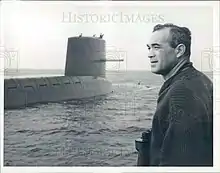
In December 1962, Agronsky and a film crew underwent Navy training and joined the submariners of the USS George Washington, part of the American Polaris program, undersea for almost three weeks during operational duty to film the documentary Polaris Submarine: Journal of an Undersea Voyage. It won a variety of awards, including the St Mark's Plaque – First Prize at the 1963 Venice Film Festival.[31]
Agronsky reported with Nancy Dickerson from the Washington Monument during the March on Washington in August 1963. This same month, NBC wrote that Agronsky's "incisive questioning of Cabinet members[,] Congressmen and other Washington [D.C.] officials, as well as visiting statesmen from abroad, often results in important newsbreaks in the next day's papers."[31] Later in 1963, Agronsky was given special permission to travel to Moscow to report on nuclear discussions, after NBC had been banned.[31] Upon his return, he gave audiences his opinions on US foreign policy based on what he had witnessed, saying in such a global political climate, no country could remain a bystander, encouraging the general population to not be apathetic.[32]
Assassination of John F. Kennedy
In the four-day aftermath of the assassination of president John F. Kennedy, Agronsky was one of the senior journalists to lead the large television news coverage.[33][34] The coverage invented the breaking format of modern television news.[35] Sociologists from Columbia University, led by Herbert Gans, interviewed a selection of the on-air journalists covering the assassination shortly afterwards to assess its affects; many were questioned about showing emotion. Agronsky's response, saying a journalist cannot show emotion as it would be imposing feelings on the viewer, was later said to typify the view of the issue at the time. When pressed further on the matter by Gans, Agronsky added: "I wanted to cry, but you don't".[33] He was reported to be smoking as he delivered reports from Washington, D.C., during the coverage, while hiding his cigarettes from the camera.[35]
| Agronsky interviewing Governor Connally at his hospital bedside, November 27, 1963 | |
|---|---|
 via Associated Press on YouTube | |
 https://www.youtube.com/watch?v=bzvGIsu6KGo https://www.youtube.com/watch?v=bzvGIsu6KGo |
Historian William Manchester wrote that shortly after the shooting, Agronsky telephoned Ted Kennedy to ask if he would be flying from D.C. to Dallas, one of limited communications Ted Kennedy received in the aftermath of his brother's assassination due to telephone lines overloading as people tried to call others to talk about the news.[36] Agronsky covered Kennedy's lying in state on the Today show. He noted that he had also covered the funeral of Franklin D. Roosevelt, describing the different mood by explaining that people mourning Kennedy seemed moved by his unfulfilled potential.[37] On November 27, 1963, five days after the assassination, Agronsky conducted an interview with Texas governor John Connally from his bedside in Parkland Memorial Hospital. Connally, to whom Agronsky was a good friend, had been riding in the seat ahead of Kennedy and was wounded.[38][39] As Connally recovered, the press were desperate to hear his story, but his aides deemed him too weak to face a conference. Instead, the combined press accepted the proposal to use a single reporter as a pool, with all networks carrying the interview live. Connally's office chose Agronsky to be their reporter; he was found in Arlington National Cemetery late the night before and took a midnight flight to Dallas.[40]
Agronsky had interviewed John F. Kennedy in life, with segments re-run on the 20th anniversary of the assassination in television documentary Thank You, Mr. President,[41] and co-authored and edited the 1961 book Let Us Begin: The First 100 Days of the Kennedy Administration.[42][43]
CBS
Agronsky moved to CBS in 1964. While there he held positions as the CBS bureau chief in Paris and moderator of Face the Nation. In 1968 he won an Emmy Award for his television documentary Justice Black and the Bill of Rights, in which he interviewed Hugo Black about his views on incorporation of the Bill of Rights.[7]
Agronsky & Company
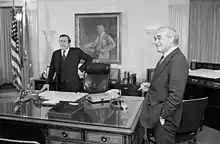
Agronsky became a news anchor for WTOP-TV in Washington, D.C., in 1969, and in the same year became host of the political discussion television program Agronsky & Company, produced by the same station. The format had Agronsky introduce a short segment on the news with political reporters. Shortly afterward, Agronsky left the local evening news and Agronsky & Company became a stand-alone weekly show produced and syndicated by Post-Newsweek stations (WTOP's then-owner). The show was syndicated nationally by Post-Newsweek to local stations and the PBS nationally, including WETA in D.C. He hosted the show until he retired in January 1988, and it proved to be one of the biggest successes of his career.[44]
The show generally is credited as having invented the preeminent roundtable discussion format for public affairs and political television shows that feature prominent journalists discussing current events and offering their opinions about them. Agronsky & Company did not have the spirited arguments and shouting that came to characterize many of its imitators, however. Its regular panelists included Hugh Sidey of Time magazine, Peter Lisagor of the Chicago Daily News, and columnists Carl Rowan, James J. Kilpatrick, Elizabeth Drew, and George Will. Although some of the liberal-versus-conservative argumentation now common on American public affairs shows began with pointed arguments between Agronsky & Company panelists, Agronsky himself always exerted a calming influence. The show was held in generally high regard; Ted Kennedy once said that "Everybody who is in public life watches Agronsky."[9]
For PBS, Agronsky and Paul Duke interviewed president Gerald Ford in 1975.[45]
After Agronsky's death, Agronsky & Co. commentator Hugh Sidey told the American Journalism Review of the show:[44]
I think the first thing is, it was first of its particular nature... So it had its own flavor... And Martin was its patriarch... He was a true shoe-leather reporter... I can remember many a program when we came straight from reporting the story... We came right out of the trenches. I'm not saying that doesn't happen now... but not with the same frequency... I would often come from being with the president... Show business had really not invaded our world back then... The idea was not to shout down anybody... I think another reason for its success was the nature of the times... We had real, real problems, explosive problems, security problems--and the discussions, I think, reflected that gravity... Compared to today... the kind of melding here between entertainment and journalism... The nature of those times was quite different, and I think that helped out the program a great deal as well as the people on it.
Evening Edition and Nixon presidency
In 1971, in addition to hosting Agronsky & Company once a week, Agronsky started a five-night-a-week half-hour interview show, Martin Agronsky's Evening Edition, produced by Eastern Educational Network,[46] which became a much-viewed program during the Watergate scandal. Evening Edition extensively covered the presidency of Richard Nixon, including the Cold War détente and Vietnam War.[46] It was broadcast from WETA's studio in Shirlington, Arlington, Virginia. Evening Edition aired nightly and was on before, during and after the Watergate break-in hearings broadcast on PBS that led, ultimately, to Nixon's resignation on August 9, 1974. Evening Edition went off the air in late 1975.
Agronsky At Large
Agronsky then did a one-hour interview show weekly on PBS during 1976 titled Agronsky at Large, where he interviewed such guests as Alfred Hitchcock and Anwar Sadat shortly before the Egyptian leader's assassination.[44]
Impact and legacy
During his 52-year journalism career (print from 1936 to 1940 and radio and television from 1940 to 1988) Agronsky worked for all three commercial networks in the United States.[7] He is believed to be the only broadcast journalist/commentator to have worked for all three, and is the only person to work for all three and PBS. He was the first television reporter to interview a sitting Supreme Court Justice.[47]
The moderator-led panel discussion format of news shows was, in 1984, described as "Martin Agronski style".[3] Agronsky & Company pioneered the "talking heads" news format.[47]
His papers, containing approximately 30,000 items, are held in a collection in the Library of Congress.[48][49]
Personal life
Agronsky married Helen Smathers, a United States Army nurse whom he met while covering MacArthur in Melbourne, Australia, in 1942. Agronsky returned to the U.S. in March 1943,[7] whereupon he expedited Smathers's return. They were married in Baltimore, Maryland, at City Hall, grabbing a stranger off the street to be their witness. They went on to have four children: Marcia, Jonathan, David, and Julie. After Helen's death in 1969, Agronsky then married Sharon Hines in 1971; the marriage produced one child, Rachel. Agronsky and Hines divorced after fifteen years.[7]
Death
Martin Agronsky died at his Rock Creek Park home in Washington, D.C., on July 25, 1999, of congestive heart failure. He was 84.[44]
Filmography
| Year | Title | Role | Notes | Refs. |
|---|---|---|---|---|
| 1953–1954 | At Issue | – | Host; television | |
| 1957 | Look Here | – | Host; television | |
| 1962 | Polaris Submarine: Journal of an Undersea Voyage | – | Narrator; television documentary First aired in 1962 in the US and 1963 in the UK (on BBC Television) |
[31][50] |
| 1960–1964 | Today | – | Reporter; television | |
| 1964 | After Ten Years: The Court and the Schools | – | Correspondent; television special | |
| 1962–1968 | The Huntley–Brinkley Report | – | Reporter; television | |
| 1964–1968 | CBS Reports | – | Reporter; television | |
| 1965–1968 | Face the Nation | – | Moderator; television | |
| 1971 | Vanished | Reporter | Television mini-series | |
| 1973 | What You Don't Know Can Kill You | – | Reporter; television | [51] |
| 1971–1976 | Martin Agronsky's Evening Edition | – | Host; television | |
| 1981 | First Monday in October | TV Commentator | Film | |
| 1983 | Thank You, Mr. President | – | Archive footage; television | [41] |
| 1969–1987 | Agronsky & Co. | – | Host; television | |
| 2018 | Hope & Fury: MLK, the Movement and the Media | – | Archive footage; television documentary |
Awards and honors
| Year | Association | Category | Work | Result | Refs. |
|---|---|---|---|---|---|
| 1948 | Newspaper Guild | Heywood Broun Award | Career | Won | [42] |
| 1949 | Society of Professional Journalists | Sigma Delta Chi Award | Career; Agronsky was also inducted into the Washington, D.C., chapter's Hall of Fame | Won | [48][52] |
| 1952 | Peabody Awards | Area of Excellence: News | Coverage of the excesses of Senator Joseph McCarthy; ABC radio | Won | [5] |
| 1953 | Alfred I. duPont Award | Excellence in broadcast journalism | ABC | Special commendation | [22] |
| 1961 | Alfred I. duPont Award | Excellence in broadcast journalism | Eichmann trial coverage; NBC | Won | [5] |
| 1962 | Press Club of Atlantic City | National Headliner Award | Career | Won | [42] |
| 1962 | Overseas Press Club | Best Movie Photography from Abroad | Polaris Submarine: Journal of an Undersea Voyage; NBC (with Scott Berner) | Won | [53][31] |
| 1963 | CINE | Golden Eagle Award | Polaris Submarine: Journal of an Undersea Voyage | Won | [31] |
| 1963 | Venice Film Festival | St. Mark's Plaque | Polaris Submarine: Journal of an Undersea Voyage | Won | [42][31] |
| 1968 | Emmy Awards | Outstanding Program Achievement in the Field of News Commentary or Public Affairs | CBS Reports: "Justice Black and the Bill of Rights" | Won | [7] |
| 1995 | Rutgers University | Hall of Distinguished Alumni | Career | Honored | [47] |
| Location | Date | School | Degree |
|---|---|---|---|
 New Hampshire New Hampshire |
1977 | Southern New Hampshire University | Doctor of Laws (LL.D)[54] |
In 1987, Agronsky gave the commencement address at San Diego State University.[55]
Notes
- IPA and respelling per Peabody Awards introduction.[1] During Agronsky's life, there was debate on how his name should be pronounced.
References
Citations
- The Peabody Awards 1952.
- Campbell-Thrane 1984.
- Roberts Forde & Ross 2011.
- Cox 2013.
- Museum of the Jewish People 2020.
- Carnes 2002.
- Marlowe Hartnett 2015.
- AP 1999.
- Greek101 2003.
- Rutgers University 1934.
- Rutgers University 1935.
- Zander 2016.
- Agronsky 1939.
- Bayley 1981.
- Bliss 2010.
- Shogan 2009.
- Eisenhower 1953.
- Bender, Brown & Rosenzweig 2012.
- Shafer 2005.
- New York Times 1953.
- Codel 1954.
- Agronsky & King 1957.
- Agronsky 2016.
- Joseph 2020.
- Chappell 2013.
- Shan Johnson 2006.
- W.B. 1995.
- Geraci, Lage & Rubens 2014.
- Holt et al. 2011.
- NBC 1963.
- Martin 1963.
- Bodroghkozy 2013.
- Dickerson 2013.
- Rosenberg 1988.
- Manchester 1996.
- Downs & Agronsky 1963.
- Agronsky 1963.
- Connally & Agronsky 1963.
- Read 2014.
- Shales 1983.
- Taft 2016.
- Agronsky et al. 1961.
- Robertson 1999.
- Duke & Agronsky 1975.
- Agronsky 2018.
- Rutgers University 1995.
- Ellis 2010.
- Agronsky 2010.
- BBC Television 1963.
- AP 1973.
- Society of Professional Journalists 2021.
- Overseas Press Club 1962.
- Southern New Hampshire University 2010.
- Day 1987.
Sources
- Audio-visual media
- Agronsky, Martin; King, Martin Luther, Jr. (1957). "Martin Luther King, Jr., on Nonviolence - The Civil Rights Act of 1964: A Long Struggle for Freedom | Exhibitions - Library of Congress". Library of Congress. Archived from the original on 2021-11-02. Retrieved 2021-12-11.
- Downs, Hugh; Agronsky, Martin (November 25, 1963). "Lee Harvey Oswald Shot On Camera". Today, NBC. Archived from the original on 2021-05-23. Retrieved 2021-12-11 – via YouTube.
- The Peabody Awards (1952). "Personal Award: Martin Agronsky for Outstanding Radio News Coverage". Archived from the original on 2021-09-03. Retrieved 2021-09-03.
- Read, Julian (January 6, 2014). "JFK's Final Hours In Texas". Sixth Floor Museum at Dealey Plaza. Archived from the original on 2021-12-11. Retrieved 2021-12-11 – via YouTube.
- Bibliography
- Agronsky, Martin (1939). "Racism in Italy". Foreign Affairs. 17 (2): 391. doi:10.2307/20028925. ISSN 0015-7120. Archived from the original on 2021-09-04. Retrieved 2021-09-04.
- Agronsky, Martin; Goldman, Eric Frederick; Hyman, Sidney; Ward, Barbara; Westfeldt, Wallace; Wolfert, Ira (1961). Agronsky, Martin; Grossman, Richard (eds.). Let Us Begin: The First 100 Days of the Kennedy Administration. Cornell Capa, Henri Cartier-Bresson, Elliott Erwitt, Burt Glinn, Constantine Manos, Inge Morath, Marc Riboud, Dennis Stock, Nicolas Tikhomiroff (photographers). Simon & Schuster. ASIN B000EAC928. OCLC 519702.
- Agronsky, Martin (1963-11-28). "Transcript of Interview With Gov. Connally on Assassination; Asked About Thoughts Told About Death Close to President Rough Exterior". The New York Times. ISSN 0362-4331. Archived from the original on 2021-09-03. Retrieved 2021-09-03.
- Collections
- Agronsky, Martin (2010). Martin Agronsky papers. Library of Congress. Archived from the original on 2021-09-04. Retrieved 2021-12-11.
- Agronsky, Martin (2016-01-04). "Interview by Martin Agronsky for "Look Here"". The Martin Luther King, Jr., Research and Education Institute, Stanford University. Archived from the original on 2021-09-30. Retrieved 2021-12-11.
- Agronsky, Martin (2018). "Richard Nixon Presidential Library and Museum White House Communications Agency Videotape Collection" (PDF). Richard Nixon Presidential Library and Museum. Archived (PDF) from the original on 2021-04-19. Retrieved 2021-12-10. Cite journal requires
|journal=(help) - Bender, Pennee; Brown, Joshua; Rosenzweig, Roy (2012). ""Have You No Sense of Decency": The Army-McCarthy Hearings". History Matters. Center for History and New Media Research, George Mason University. Archived from the original on 2021-09-12. Retrieved 2021-12-10.
- Connally, John; Agronsky, Martin (November 27, 1963). "Connally Interview with Martin Agronsky, November 27, 1963". Office of the Governor of Texas. Archived from the original on 2021-09-03. Retrieved 2021-09-03.
- Day, Thomas B. (1987). "San Diego State University Eighty-eighth Commencement": 8. Cite journal requires
|journal=(help) - Duke, Paul; Agronsky, Martin (August 7, 1975). "President's Media Interviews | Paul Duke and Martin Agronsky, Public Broadcasting System". Ford Presidential Library. Archived from the original on 2021-03-19. Retrieved 2021-12-10.
- Eisenhower, Dwight D. (1953). "Dwight D. Eisenhower: 1953: containing the public messages, speeches, and statements of the president, January 20 to December 31, 1953". Office of the Federal Register: 111, 429–430. Cite journal requires
|journal=(help) - Ellis, Donna (2010). "Martin Agronsky Papers" (PDF). Dan Oleksiw (assistance of). Library of Congress. Archived (PDF) from the original on 2021-09-03. Retrieved 2021-09-03. Cite journal requires
|journal=(help) - Geraci, Victor; Lage, Ann; Rubens, Lisa (2014). "Conversations with Richard C. Blum: Businessman, Philanthropist, President Emeritus Board of Regents University of California" (PDF). Richard C. Blum. University of California, Berkeley: 270–271. Archived (PDF) from the original on 2021-12-11. Retrieved 2021-12-10. Cite journal requires
|journal=(help) - Holt, Lester; McGee, Frank; Lewis, John; King, Martin Luther, Jr.; Nash, Diane; Seigenthaler, John; Kaplow, Herbert; Agronsky, Martin; Patterson, John; Kennedy, Robert; Ryan, Bill (2011-04-05). "The Freedom Riders Video Transcript". Learning for Justice. Archived from the original on 2021-02-09. Retrieved 2021-12-11.
- Museum of the Jewish People (2020). "Martin Agronsky family tree". Archived from the original on September 24, 2020. Retrieved September 11, 2020.
- Rutgers University (1934). Scarlet Letter (Yearbook). p. 103. Archived from the original on 2021-09-03. Retrieved 2021-09-03.
- Rutgers University (1935). Scarlet Letter (Yearbook). p. 179. Archived from the original on 2021-09-03. Retrieved 2021-09-03.
- Southern New Hampshire University (July 12, 2010). "Southern New Hampshire University Undergraduate Catalog 2010-2011": 187. Archived from the original on September 4, 2021. Retrieved September 4, 2021 – via Issuu. Cite journal requires
|journal=(help) - United States House Committee on Naval Affairs (1942). "Hearings Before the Committee on Naval Affairs of the House of Representatives on Sundry Legislation Affecting the Naval Establishment, 1941-[1942], Seventy-seventh Congress, First-[second] Session, Volume 22, Issues 171-305": 2425–2426. Archived from the original on 2021-09-03. Retrieved 2021-09-03.
Mr. SHANNON. Do you know the correct pronunciation of the name of this gentleman that sent this message to all the world? What is his name?
Cite journal requires
Admiral BLANDY. As I pronounce it, it is Martin Agronsky.
Mr. SHANNON. What is his nationality?
Admiral BLANDY. That I do not know, sir.
Mr. SHANNON. [...] I have not found anybody that can pronounce his name, and I have not found anybody that knows anything about him. Maybe the chair-man knows how to pronounce it.
The CHAIRMAN. No, I cannot pronounce it. The only things I can pronounce are plain English names. These odd names are too hard for me.|journal=(help) - W.B., ed. (1995). National Jewish Archive of Broadcasting: Catalog of Holdings (PDF) (Second ed.). The Jewish Museum. p. 135. Archived (PDF) from the original on 2021-12-11. Retrieved 2021-12-10.
- Features
- Dickerson, John (November 23, 2013). "Inside LBJ's home the night after JFK died". CBS News. Archived from the original on 2021-09-03. Retrieved 2021-09-03.
- Robertson, Lori (1999). "One of the Originals | Agronsky & Company for the five Post Newsweek stations". American Journalism Review (September 1999). Archived from the original on 2010-06-13. Retrieved 2009-10-23.
- Rosenberg, Howard (1988-11-22). "Death of Kennedy & Birth of TV News". Los Angeles Times. Archived from the original on 2021-09-03. Retrieved 2021-09-03.
- Shafer, Jack (2005-10-05). "Good Night, and Good Luck and bad history". Slate Magazine. Archived from the original on 2021-05-06. Retrieved 2021-12-10.
- Shales, Tom (1983-11-13). "Camelot Recaptured". Washington Post. ISSN 0190-8286. Archived from the original on 2017-11-15. Retrieved 2021-09-03.
- Literature
- Bayley, Edwin R. (1981). Joe McCarthy and the Press. Madison, Wis.: University of Wisconsin Press. pp. 193–195. ISBN 978-0-299-08623-7. OCLC 606186040. Archived from the original on 2021-12-11. Retrieved 2021-12-10.
- Bliss, Edward Jr. (2010). Now the News: The Story of Broadcast Journalism. Columbia University Press. p. 243. ISBN 9780231521932.
- Bodroghkozy, Aniko (2013-11-01). "Black Weekend: A Reception History of Network Television News and the Assassination of John F. Kennedy". Television & New Media. 14 (6): 560–578. doi:10.1177/1527476412452801. ISSN 1527-4764.
- Campbell-Thrane, Lucille (1984). Correspondence Education Moves to the Year 2000: Proceedings of the First National Invitational Forum on Correspondence Education. National Center for Research in Vocational Education, Ohio State University. pp. 79–86, 112. ISBN 978-0-318-17783-0. Archived from the original on 2021-09-03. Retrieved 2021-12-11.
- Carnes, Mark Christopher (2002). American National Biography: Supplement. Oxford University Press. ISBN 978-0-19-522202-9. Archived from the original on 2021-06-16. Retrieved 2021-12-11.
- Chappell, Paul K. (2013). The Art of Waging Peace: a Strategic Approach to Improving our Lives and the World (First ed.). Westport, CT. ISBN 978-1-935212-68-3. OCLC 850200112.
- Codel, Martin (1954). "Television digest with electronics reports". Cite journal requires
|journal=(help) - Cox, Jim (2013). Radio journalism in America: Telling the News in the Golden Age and Beyond. Jefferson, N.C.: McFarland & Company. ISBN 978-1-4766-0119-9. OCLC 839682810.
- Joseph, Peniel E. (2020). The Sword and the Shield: the Revolutionary Lives of Malcolm X and Martin Luther King Jr (First ed.). New York. ISBN 978-1-5416-1786-5. OCLC 1109808084.
- Manchester, William (1996). The Death of a President, November 20-November 25, 1963 (1st ed.). New York: Galahad Books. pp. 198, 205. ISBN 0-88365-956-5. OCLC 36213931.
- Marlowe Hartnett, Kimberly (2015). Carolina Israelite: How Harry Golden Made Us Care about Jews, the South, and Civil Rights (First ed.). Chapel Hill, North Carolina: University of North Carolina Press. p. 238. ISBN 978-1-4696-2321-4. OCLC 905949528.
- NBC (1963). N.B.C trade releases.
- Roberts Forde, Kathy; Ross, Matthew W. (2011). John C. Hartsock (ed.). "Radio and Civic Courage in the Communications Circuit of John Hersey's "Hiroshima"" (PDF). Literary Journalism Studies. 3 (2): 42. ISSN 1944-8988. Archived (PDF) from the original on 2021-12-11. Retrieved 2021-12-10.
- Shan Johnson, Andrea (2006). Mixed up in the Making: Martin Luther King Jr., Cesar Chavez, and the images of their movements (PDF) (Thesis). University of Missouri-Columbia. Archived (PDF) from the original on 2021-12-11. Retrieved 2021-12-10.
- Shogan, Robert (2009). No Sense Of Decency: the Army-McCarthy Hearings: A Demagogue Falls and Television Takes Charge of American Politics. Lanham: Ivan R. Dee. pp. 88–89. ISBN 978-1-61578-000-6. OCLC 854520723.
- Taft, William H. (2016). Encyclopedia of Twentieth-Century Journalists. Milton Park, Abingdon, Oxon. p. 5. ISBN 978-1-317-40325-8. OCLC 913955667.
- Zander, Patrick G. (2016). The Rise of Fascism: History, Documents, and Key Questions. Santa Barbara, California. p. 190. ISBN 978-1-61069-799-6. OCLC 932109927.
- News
- AP (April 14, 1973). "Monday Special of the Week". North Hills News Record. North Hills, Pennsylvania. p. 29. Archived from the original on September 3, 2021. Retrieved September 3, 2021.
- AP (June 26, 1999). "Martin Agronsky, TV Commentator, Dies". The Seattle Times. AP, The Washington Post. Archived from the original on May 19, 2011. Retrieved January 16, 2015.
- Martin, Mary (October 22, 1963). "Agronsky Claims U.S. No Innocent Bystander" (PDF). The Skiff. Archived (PDF) from the original on 2021-12-11. Retrieved 2021-12-11.
- New York Times (1953-08-05). "Television in Review; ' At Issue,' New Discussion Program, Seems Designed to Make Viewers Think". The New York Times. ISSN 0362-4331. Archived from the original on 2021-12-11. Retrieved 2021-12-10.
- Web
- BBC Television (1963). "Schedule - BBC Programme Index - January 22, 1963". BBC Genome. Archived from the original on 2021-09-03. Retrieved 2021-09-03.
- Greek101 (2003). "Famous Greeks". University of Nevada. Archived from the original on January 11, 2010. Retrieved 2021-09-03.
- Overseas Press Club (1962). "Awards Recipients Archive". Archived from the original on 2021-06-28. Retrieved 2021-12-10.
- Rutgers University (1995). "Martin Agronsky". Rutgers University Alumni Association. Archived from the original on 2021-09-03. Retrieved 2021-09-03.
- Society of Professional Journalists (2021). "Society of Professional Journalists Washington, D.C., Hall of Fame". Washington, D.C., Pro SPJ Chapter. Archived from the original on 2021-11-06. Retrieved 2021-12-10.
External links
Authority control  | |
|---|---|
| General | |
| National libraries | |
| Other | |