Mary Rosse
The Rt Hon. Mary Parsons, Countess of Rosse (née Mary Field; 1813–1885), was a British Irish amateur astronomer, architect, furniture designer, and pioneering photographer. Often known simply as Mary Rosse, she was one of the early practitioners of making photographs from waxed-paper negatives.[1]
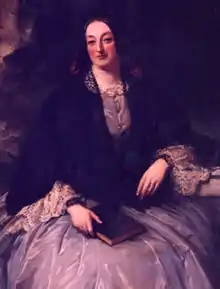
Early life
Mary Parsons was born Mary Field was born on 14 April 1813,[2] at Heaton Hall, Heaton, Yorkshire,[3] the daughter of John Wilmer Field, a wealthy estate owner.
Through her family she met William Parsons, 3rd Earl of Rosse, then Lord Oxmantown (1800–1867), an Anglo-Irish astronomer and naturalist, and they were married on 14 April 1836. In February 1841, Lord Oxmantown succeeded his father in the family peerage to become The 3rd Earl of Rosse. Mary, Baroness Oxmantown, thus now became The Countess of Rosse.[2]
Astronomy
In the early 1840s the couple became interested in astronomy, and Rosse helped her husband, Lord Rosse, build a number of giant telescopes, including the so-called Leviathan Telescope, that was considered a technical marvel in its time.[4] The author, Henrietta Heald, contends that Rosse was not only a financial support to the building of the telescope, but that she also was involved in a practical and intellectual capacity.[3]
She was an accomplished blacksmith – which was very unusual for higher class women of this time – and some of the iron work that supported the telescope may have been constructed by her. Other metal cast items around the castle grounds were designed by her, including bronze gates.[3]
During the Great Famine of 1845–47 in Ireland she was responsible for keeping over five hundred men employed in work in and around Birr Castle, where she and her husband lived.[3]
Photography
In 1842, Lord Rosse began experimenting in daguerreotype photography, possibly learning some of the art from his acquaintance William Henry Fox Talbot. In 1854, Lord Rosse wrote to Fox Talbot saying that Lady Rosse too had just commenced photography, and sent some examples of her work. Fox Talbot replied that some of her photographs of the telescope "are all that can be desired".
Lady Rosse became a member of the Dublin Photographic Society, and in 1859 she received a silver medal for "best paper negative" from the Photographic Society of Ireland. Many examples of her photography are in the Birr Castle Archives.[5] Much of the topography of Birr Castle that she portrayed has changed very little, and it is possible to compare many of her photographs with the actual places.
Children
The Countess of Rosse gave birth to eleven children, but only four survived until adulthood:
- Lawrence Parsons, 4th Earl of Rosse (17 November 1840 – 30 August 1908)
- Reverend Randal Parsons (26 April 1848 – 15 November 1936)
- Hon. Richard Clere Parsons (21 February 1851 – 26 January 1923), apparently made a name for himself building railways in South America.
- Sir Charles Algernon Parsons (13 June 1854 – 11 February 1931),[2] known for his commercial development of the steam turbine. His wife, Lady Katharine Parsons[6] and their daughter Rachel Parsons were founders of the Women's Engineering Society and its first and second presidents.[7]
Notes
- For more on waxed-paper negatives, see John Towler, "Negatives on Paper", chap. 29 of The Silver Sunbeam (New York: Joseph H. Ladd, 1864).
- Scaife, W. Garrett (2009). "Parsons, William". Dictionary of Irish Biography. Retrieved 8 November 2021.
- Heald, Henrietta (11 November 2020). "Mary Parsons, Countess of Rosse: Astronomer, Engineer and Photographer (1813–84)". Electrifying Women. Retrieved 8 November 2021.
- "Birr Castle Desme – History of the Telescopes". Archived from the original on 24 December 2008. Retrieved 5 January 2009.
- "Birr Castle Desme – Mary Rosse and Photography". Archived from the original on 26 December 2008. Retrieved 5 January 2009.
- "Obituary The Hon. Lady Parsons | Women's Engineering Society". www.wes.org.uk. Retrieved 4 July 2019.
- "Presidents Past & Present | Women's Engineering Society". www.wes.org.uk. Retrieved 4 July 2019.
Further reading
Taylor, Roger. Impressed by Light: British Photographs from Paper Negatives, 1840–1860. New York: Metropolitan Museum of Art, 2007. ISBN 978-0-300-12405-7.
External links
 |
Wikimedia Commons has media related to Mary Rosse. |
Authority control  | |
|---|---|
| General | |
| National libraries | |
| Art research institutes | |
| Other | |