Masked villain
A masked villain, also seen as masked mystery villain,[1][2] is a stock character in genre fiction. It was frequently used in the adventure stories of pulp magazines and movie serials in the early twentieth century,[3][4] as well as postmodern horror films[5] where the character "hides in order to claim unsuspecting victims".[6] They can also appear in crime fiction to add to the atmosphere of suspense and suspicion. It is used to engage the readers or viewers by keeping them guessing just as the characters are,[3] and suspension by drawing on the fear of the unknown.[7]: 135 The "Mask" need not be literal (although it often is), referring more to the subterfuge involved.
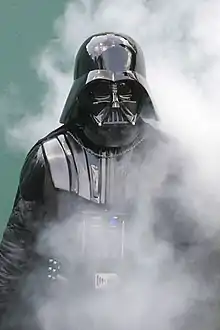
He or she is the often main antagonist of the story, often acting behind the scenes with henchmen confronting the protagonists directly.[3] Usually, the protagonists must discover the villain's true identity before they can be defeated.[8] Often, the villain will turn out to be either one of the protagonists themselves, or a significant supporting character. The author may give the viewer or reader clues, with many red herrings, as to the villain's identity - sometime as the characters find them and sometimes for the audience alone. However, the identity is not usually revealed to the audience before it is revealed to the characters of the story.[8]
Examples
Serials
- "The Tiger Shark" from The Fighting Marines.[7]: 133
- "The Ghost" from Dick Tracy vs. Crime, Inc. - "One of the most memorable of all the masked villains of serials" according to William C. Cline.[7]: 133, 135
- "The Dragon" from Ace Drummond.[9]: 99 [7]: 133
- "The Lightning" from The Fighting Devil Dogs.
- "Don Del Oro" from Zorro's Fighting Legion
- "The Wasp" from Mandrake the Magician.[7]: 133
- "The Scorpion" from Adventures of Captain Marvel.[2][7]: 129
- "The Octopus" from The Spider's Web
- "The Gargoyle" from The Spider Returns.[7]: 133
- "The Crimson Ghost" from The Crimson Ghost
- "Captain Mephisto" from Manhunt of Mystery Island.[7]: 129
- "The Rattler" from Mystery Mountain[7]: 129
- "The Wizard" from Batman and Robin.[7]: 133
The following villains were not actually "masked" but remained hidden from view:
- "The Black Ace" from The Mystery Squadron.
- "The Lame One" from Dick Tracy.
- "The Black Tiger" from The Shadow.
- "The Master Key" from The Master Key.
- "Mr. M" from The Mysterious Mr. M.
- "Dr. Vulcan" from King of the Rocket Men.[9]: 129
Television
Films
References
- Van Hise, James (1990). Serial Adventures. Pioneer Books. p. 46. ISBN 9781556982361.
- Lupoff, Richard A.; Thompson, Don, eds. (1970). All in color for a dime. Arlington House. p. 92. ISBN 9780870000621.
- Brasch, Ilka (October 12, 2018). "4. Detectives, Traces, and Repetition in The Exploits of Elaine". Amsterdam University Press. doi:10.1515/9789048537808-005/html – via www.degruyter.com.
- Brasch, I., & Mayer, R. (2016). Modernity management: 1920s cinema, mass culture and the film serial. Screen, 57(3), 302-315.
- Heller-Nicholas, Alexandra (2019). Masks in Horror Cinema: Eyes Without Faces. University of Wales Press. pp. 52, 68, ?. ISBN 978-1-78683-496-6.
- Jess-Cooke, Carolyn (2009). Film Sequels: Theory and Practice from Hollywood to Bollywood. Edingburgh: Edinburgh University Press. p. 56. ISBN 978-0-7486-2603-8.
- Cline, William C. (2000). Serials-ly Speaking: Essays on Cliffhangers. McFarland. ISBN 9780786409181.
- Bah, Aisha (2018). "Cultural Transgression and Subversion: The Abject Slasher Subgenre". The Mall. 2 (1): 72–83. Retrieved 2021-04-19.
- Benson, Michael (2000). Vintage Science Fiction Films, 1896-1949. McFarland. ISBN 9780786409365.
- Milligan, Cindy Ann (2015). Sonic Vocality: A Theory on the Use of Voice in Character Portrayal (PhD). Georgia State University. p. 5. Retrieved May 10, 2021.
- Rutherford, Paul (1994). "The Cannes Lions, Etc. (1984-92)". The New Icons? - The Art of Television Advertising. University of Toronto Press. p. 142. ISBN 0-8020-2928-0.