Australia women's national soccer team
 | |||
| Nickname(s) | Matildas | ||
|---|---|---|---|
| Association | Football Australia | ||
| Confederation | AFC (Asia) | ||
| Sub-confederation | AFF (Southeast Asia) | ||
| Head coach | Tony Gustavsson | ||
| Captain | Sam Kerr | ||
| Most caps | Cheryl Salisbury (151) | ||
| Top scorer | Sam Kerr (49) | ||
| FIFA code | AUS | ||
| |||
| FIFA ranking | |||
| Current | 11  (10 December 2021)[1] (10 December 2021)[1] | ||
| Highest | 4 (December 2017) | ||
| Lowest | 16 (October 2006) | ||
| First international | |||
.svg.png.webp) Australia 2–2 New Zealand Australia 2–2 New Zealand  (Sutherland, Australia; 6 October 1979) | |||
| Biggest win | |||
Australia 21–0 American Samoa  (Auckland, New Zealand; 9 October 1998) | |||
| Biggest defeat | |||
 United States 9–1 Australia United States 9–1 Australia (Ambler, United States; 5 June 1997) | |||
| World Cup | |||
| Appearances | 8 (first in 1995) | ||
| Best result | Quarter-finals (2007, 2011, 2015) | ||
| Olympic Games | |||
| Appearances | 4 (first in 2000) | ||
| Best result | Fourth Place (2020) | ||
| Asian Cup | |||
| Appearances | 5 (first in 2006) | ||
| Best result | Winners (2010) | ||
| OFC Nations Cup | |||
| Appearances | 7 (first in 1983) | ||
| Best result | Winners (1994, 1998, 2003) | ||












The Australia women's national soccer team is overseen by the governing body for soccer in Australia, Football Australia, which is currently a member of the Asian Football Confederation (AFC) and the regional ASEAN Football Federation (AFF) since leaving the Oceania Football Confederation (OFC) in 2006. The team's official nickname is "the Matildas" (from the Australian folk song Waltzing Matilda), having been known as the "Female Socceroos" before 1995.[2]
Australia is a three-time OFC champion, one-time AFC champion and one-time AFF champion, and became the first ever national team to win in two different confederations (before the men's team did the same in 2015 AFC Asian Cup). The team has represented Australia at the FIFA Women's World Cup on seven occasions and at the Olympic Games on four, although it has won neither tournament. Immediately following the 2020 Tokyo Olympics, Australia was ranked eleventh in the world by FIFA.[3]
Australia will co-host the 2023 FIFA Women's World Cup along with New Zealand, so the Matildas automatically qualify for this event as co-hosts.[4]
History
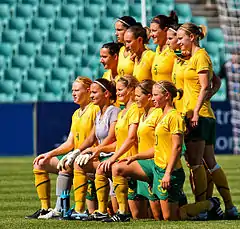
Foundation
The Australian Women's Soccer Association (AWSA) was founded in 1974[5] and a representative Australian team competed at the following year's Asian Women's Championship.[6] A national team made up primarily of players from New South Wales and Western Australia was sent to the 1978 inaugural World Women's Invitational Tournament, in Taipei, Taiwan.[7] Australia played against club teams at the tournament and none of the players' appearances counted as official caps.[8] Coached by Jim Selby, the selected players were: Sandra Brentnall (WA), Connie Byrnes (captain, NSW), Julie Clayton (WA), Kim Coates (NSW), Julie Dolan (NSW), Cindy Heydon (NSW), Barbara Kozak (WA), Sharon Loveless (WA), Toni McMahon (NSW), Sue Monteath (QLD), Sharon Pearson (NSW), Judy Pettitt (WA), Anna Senjuschenko (WA), Teresa Varadi (WA), Leigh Wardell (NSW) and Monika Werner (VIC).[9]
Australia's first official international match was against New Zealand at Seymour Shaw Park, Miranda, New South Wales, Australia on Saturday 6 October 1979, as it was billed as the "1st Australian Women's International Soccer Test". The Australian team listed in the match programme was Sue Monteath (Qld), Shona Bass (Vic), Kim Coates (Vic), Dianna Hall (SA), Carla Grims (SA), Fiana McKenzie (SA), Sandra Brentnall (WA), Judith Pettit (WA), Sharon Mateljan (WA), Julie Clayton (WA), Cindy Heydon (NSW), Julie Dolan (NSW), Toni McMahon (NSW), Jamie Rosman (NSW), Rosie van Bruinessen (NSW) and Leigh Wardell (NSW). Jim Selby remained as coach and the managers were Noelene Stanley and Elaine Watson. A lack of resources meant Australia's first eight official matches were all against New Zealand.[10]
The 1980s: Development in Oceania
Australia played in the first Oceania Cup in 1983 at New Caledonia, losing the final to New Zealand in extra time. It was the first time the Australians faced a team other than the "Football Ferns" of New Zealand. A team would not be assembled again until the next edition of the tournament in 1986 tournament in New Zealand, which featured Australia, New Zealand and Taiwan, as well as New Zealand's B team. Australia lost in the final again, beaten 4–1 by Taiwan.[11][12]
The late 80s had Australia encountering the American and European teams for the first time in the 1987 Women's World Invitational Tournament in Taiwan, and the 1988 FIFA Women's Invitation Tournament in China. For the latter tournament, the players had to sew themselves the own Australian crests onto the team tracksuits.[13] Hosting the 1989 Oceania Cup in Brisbane, the Australians finished third (A team) and fourth (B team).[14] The 1991 tournament doubled as qualifiers for the 1991 FIFA Women's World Cup, and the winner was determined by the best results from a group. Australia finished level on points with New Zealand, but had scored fewer goals, which resulted in New Zealand progressed to the World Cup as OFC representative.[15]
The 1990s: Continued growth
Between 1991 and 1994, the Matildas played internationally during a tour of Russia in 1994. The Oceania tournament in 1994 again doubled as World Cup qualifiers in the same round-robin format. Again, Australia finished even with New Zealand on points but this time had a superior goal difference, and qualified for their first FIFA Women's World Cup.[12]
Before 1995, the nickname for the women's team was just "Female Socceroos", derivative of the male squad. Thus in 1995 the Australian Women's Soccer Association joined with Special Broadcasting Service to broadcast a naming competition for the female team. Out of five names, the popular vote chose "Matildas", from the song "Waltzing Matilda". The players themselves did not approve of the name, and took years to use the moniker to describe the team.[16]
At the 1995 FIFA Women's World Cup in Sweden, Australia were grouped with the United States, China and Denmark. During their opening match against Denmark, they lost 5–0.[17] During the team's second match, a 4–2 loss to China, Angela Iannotta scored Australia's first goal at a World Cup.[18] In the final group match against cup holders the United States, Australia scored first but went on to lose 4–1.[19]
The Matildas would assert their Continental strength at the 1998 Oceania Cup, which doubled as a World Cup qualifying tournament. Australia thrashed their Pacific island opposition in their group games and semi-final, before defeating hosts New Zealand in the final 3–1 (the only goal conceded for the tournament), and qualifying for the 1999 FIFA Women's World Cup in USA. At the tournament, Australia was grouped with Sweden, China and Ghana. In their opening match, they secured their first non-loss in a World Cup match with a 1–1 draw against the Ghanaians. Their following group matches were both 3–1 losses, finishing third in the group, but showing improvement on previous tournaments.
Australia still did not have much attention and respect, with the Matildas forced to train with second-hand equipment from the Socceroos, not getting paid and with few games to play.[12] To promote themselves and raise funds for the team, in 1999 the Matildas posed nude for a calendar, which sold over 40,000 units.[16]
2000–2004: First Olympics appearances
The profile built for the sport carried into 2000, where the Matildas had a guaranteed spot for the 2000 Olympics in Sydney. While in January a friendly match against the Czech Republic in Melbourne's Bob Jane Stadium attracted only 1,500 spectators, a crowd of 10,000 came to the Matildas' game against China at the Sydney Football Stadium in June.[16] Much anticipation surrounded the team's Olympic performance on home soil, but a 3–0 loss to Germany in their opening game brought those hopes down. A draw with Sweden and a final loss to Brazil ended their tournament in the first round. While the on-field performance was disappointing, attendances at matches were high for women's soccer in Australia, raising the profile of the game.
The team were the host nation for an annual invitational tournament called the Australia Cup, from 1999 to 2004 inclusive, winning it twice.
Following the Olympics, many problems halted the Matildas' schedules. As Ernie Merrick backed out on his intentions to coach the team, Adrian Santrac only took over as manager in November, and Australia played no games in 2001. The following year the team argued over the calendar proceeds with the promoter, and AWSA went defunct, being absorbed by Soccer Australia (current Football Federation Australia). In-between, many players opted to retire from the national team.[20]
In 2003, they won the Oceania Cup and qualified for the 2003 FIFA Women's World Cup, where they finished in the first round.
The team won the 2004 OFC Women's Olympic Qualifying Tournament in Fiji to return to Olympic tournament in Athens 2004.[21] The Matildas won their first Olympic game ever against Greece, and managed to qualify for the quarterfinals,[22] losing to Sweden 2–1.[23]
2005-2009: Move to Asia
In 2006, Australia moved from the Oceania Football Confederation to the Asian Football Confederation, and the country was given hosting rights to the AFC Women's Asian Cup that same year. The opening game for the Matildas was against South Korea. An early own goal by South Korea put the Matilda's up, finishing with 3 goals in the second half to give them a 4–0 win. The second match against Myanmar was also a win to the Matildas, who finished with 2 goals, with Sally Shipard and Lisa De Vanna scoring one a piece. The Matildas went on to reach the final, being defeated 4–2 on penalties by China after having a two-goal half time lead.
2007 World Cup
Australia qualified for the 2007 FIFA Women's World Cup and drawn into Group C. They defeated Ghana 4–1 on 12 September in Hangzhou,[24] followed by a 1–1 draw against Norway at the same venue on 15 September. Thanks to a late goal from Cheryl Salisbury, they drew against Canada 2–2 on 20 September in Chengdu to advance to the knockout round for the first time in team history. Australia came up against Brazil in their elimination match, losing to Brazil 3–2 to end their 2007 World Cup run at the quarter-final stage.
2008 tournaments
The Matildas failed to get through qualifiers for the 2008 Olympics held in 2007, where they lost to Korea DPR both home and away in the final round.
In 2008, the Matildas competed in the 2008 AFC Women's Asian Cup. They were drawn in Group B, placing second in the group with relative ease behind Japan, who they would eventually face in the third place playoff. With the Matildas progressing from the group stage to the semi-finals, they were paired up against Korea DPR. Korea DPR won the match 3–0 and went on to win the tournament. This led them on to the third place playoff, facing Japan for a second time in the tournament and again losing, leaving the Matildas in fourth place.
2010–2013
| External video | |
|---|---|
 Aussies Abroad: The Matildas (ESPN) Aussies Abroad: The Matildas (ESPN) |
In 2010 the Matildas qualified for the 2010 AFC Women's Asian Cup in China. They beat Vietnam (2–0) and South Korea (3–1) before losing to China 1–0 which made them advance in second place and advance to the Semi-finals where they beat Japan 1–0. The final which was played in wet conditions was history making itself with it being the first senior soccer team (men or women) to make a final in the AFC. They created more history by being the first ever Australian soccer team to win in Asia after beating the team of Korea DPR in penalties during the final, 5–4, after a regular time score of 1–1 (Australia's lone and equalising goal being scored by Sam Kerr). The title gave the Matildas a berth at the 2011 FIFA Women's World Cup in Germany.[25]
2011 World Cup
The following year the team contested the World Cup, being sorted into Group D. Despite losing 1–0 to Brazil in the opening game, victories of 3–2 and 2–1 over Equatorial Guinea and Norway respectively qualified the Matildas to the quarterfinals.[26] At the knockout stage, the team lost 3–1 to Sweden. Caitlin Foord was awarded Best Young Player of the tournament, and defender Elise Kellond-Knight was chosen for the All-Star Team.
2014–2019: Stajcic Era
After operating as interim head coach of the Matildas in late April and May 2014 for the Matildas’ Asian Cup campaign. In 2014, Alen Stajcic was appointed permanent head coach of the squad in late 2014.[27]
2015 World Cup
During the 2015 FIFA Women's World Cup, they became the first Australian team, men's or women's, to win a knockout stage match at a World Cup when they defeated Brazil by a score of 1–0. The goal was scored by Kyah Simon after a shot by Lisa de Vanna was blocked and redirected by goalkeeper Luciana. In the quarterfinals, the Matildas lost to defending champions Japan in a late goal by Mana Iwabuchi.[28]
2016 Olympic Games
The following year, they contested in qualifiers for the 2016 Summer Olympics where they finished on top of the group after defeating all of the opponents bar China,[29] to get to the Olympic Games. Drawn in Group F, Australia lost to Canada, conceded a draw to Germany, and defeated Zimbabwe in a blowout to finish as the best third placed team. The adversary in the quarterfinals were hosts Brazil,[30] who avenged the defeat one year prior in the penalty shootouts as goalkeeper Bárbara saved Alanna Kennedy's kick.[31]
At the 2017 Tournament of Nations event, the Matildas recorded their first ever win over the United States after 27 attempts, defeating them 1–0 in Seattle.[32] The Matildas went on to defeat Japan 4–2 and Brazil 6–1 to finish as the inaugural tournament champions.[33] Following the Tournament of Nations, the Matildas scheduled a series of two friendlies hosting Brazil, with the first match at Penrith Stadium being sold-out,[34] and an even larger crowd of nearly 17,000 attending the next match 3 days later in Newcastle.[35]
In December 2017, Matildas were awarded the Public Choice Team of the Year at the Australian Institute of Sport Awards.[36]
At the 2018 AFC Asian Cup, Australia reached the final after defeating Thailand in the semi-final on penalty kicks. They would lose 1–0 to Japan in the final, but nonetheless secured a spot at the 2019 FIFA Women's World Cup.[37] Later that year at the 2018 Tournament of Nations Australia once again went undefeated, finishing the tournament with two wins and one draw. They were tied with the United States with 7 points, but the US had a superior goal differential and were crowned tournament champions.[38]
.jpg.webp)
2019–2020: Milicic Era
Despite entering 2019 on the back of good form and with their highest ever placement on the FIFA ranking list (4th), the Matildas coach Alen Stajcic was sacked from the role in January 2019 by Football Federation Australia (FFA), whose chief executive David Gallop said the decision was based on confidential surveys and conversations with players and staff.[39] The decision proved to be very controversial, as the FFA refused to discuss any further specifics as to the reasoning for the decision and was made only months out from a World Cup appearance. Some players, such as Sam Kerr, Lydia Williams and Elise Kellond-Knight spoke in support of Stajcic and voiced their surprise at his sacking.[40] Former men's national team assistant Ante Milicic was later appointed coach.[41]
2019 World Cup
For the 2019 FIFA Women's World Cup, Australia was in Group C with Italy, Brazil, and Jamaica. A 2–1 injury time loss to Italy was followed by a 3–2 win against Brazil. This victory was notable for 3 reasons – Australia came back from a 2–0 deficit, these were the first goals conceded by Brazil in the group stage in 16 years and it was their first group stage loss for 24 years.[42] The final group game was a 4–1 win over Jamaica with Sam Kerr scoring all four goals, becoming the first Australian player — male or female — to score a hat trick at a World Cup tournament.[43] The result saw Australia finish second in the group and proceed to play Norway in the round of sixteen. The game finished one-all after both regulation time and extra time with Norway winning the penalty shoot-out 4–1.[44]
2020–present: Gustavsson Era
Australia will co-host the 2023 FIFA Women's World Cup along with New Zealand, after the bidding decision was announced on 25 June 2020.[45] In September 2020, Football Federation Australia named Swede and former United States Women's National Soccer Team assistant coach Tony Gustavsson as the Matildas' new head coach, signing him on a deal running through 2024, including the delayed 2020 Olympics in Tokyo, the 2022 AFC Women's Asian Cup in India, the 2023 FIFA Women's World Cup in Australia and New Zealand, and the 2024 Olympics in Paris.[46]
2020 Olympic Games
In 2020, the Matildas qualified for the delayed 2020 Summer Olympics where they finished top of all competing nations during the 2020 Asian Football Confederation's Qualifying Tournament.[47] They were placed in Group G with countries Sweden, the United States, and New Zealand, nicknamed the 'Group of Death.'[48] After beating New Zealand, losing to Sweden, and drawing with the United States, they were ranked third in their group and progressed to the quarter finals against Great Britain.[49] The match saw Australia open the scoring with a 1-goal advantage, before Great Britain surpassed them with a 1-goal advantage in the second half. An 89th-minute goal by captain Sam Kerr saw Australia equalise before advancing to extra time. During the extra 30 minutes of play, Mary Fowler and Kerr scored an additional two goals to bring the score to 4–2, before Ellen White completed her hat trick. The game ended with a 4–3 scoreline, resulting in Australia's first entry into an Olympic semi-final, playing against Sweden for the second time in the tournament.[50] Despite a strong performance and a disallowed goal by Kerr, they lost 1–0, relegating them to a bronze medal match playoff against the United States.[51] The semi-final match against Sweden broke women's sport TV viewing records in Australia, with 2.32 million viewers tuning in.[52] In the bronze medal match, they lost 4–3 to the United States, resulting in the Matilda's 7th loss of the year.[53] Finishing fourth, the 2020 Olympics were the Matildas' most successful performance at the Olympics, having previously never progressed beyond the quarter-finals since its inception in 1996.[54]
Post Olympics
After their Olympics bronze medal defeat, Australia played their first ever match against the Republic of Ireland on 21 September 2021, with it being Sam Kerr's 100th cap.[55] In October, they played a series of home friendlies against Brazil, their first matches on home soil since 2019, recording a win and a draw.[56] In November, in their final matches of the 2021 calendar year, they played another series of home friendlies against World Number 1 side the United States, recording a defeat and a draw.[57] These two matches broke attendance records in Australia – the first match played on the 27 November in Stadium Australia, Sydney, broke the all-time standalone Matildas home attendance record set in 2000, with 36,109 spectators.[58] The second game broke the attendance record of any Matildas game played at Newcastle, with 20,495 spectators.[58] 2021 also saw a record number of Matildas' debutants, with 13 players making their first senior international caps, and a record number of players reaching the 100th cap milestones, including Emily Van Egmond, Kyah Simon, Sam Kerr, Alanna Kennedy and Tameka Yallop.
Team image
Regarded as Australia's most beloved national sporting team in 2019, the Matildas have grown its fanbase over recent years, due to increased exposure, successful tournaments and skilled players coming on to play both internationally and at club level, including captain Sam Kerr, widely regarded as one of the world's best female football players.[59]
Nicknames
The team's official nickname is "the Matildas" (from the Australian folk song Waltzing Matilda), having been known as the "Female Socceroos" before 1995.[2]
Naming Rights
Under a naming rights deal with Scentre Group and its predecessor, Westfield Group, the team was branded as "Westfield Matildas" from 2008 to 2021.[60] The team is currently branded as "Commonwealth Bank Matildas", based on a multi-year financial investment in the team by the Commonwealth Bank.[61]
Media coverage
Australian matches are broadcast by Paramount+ and on free-to-air by Network 10.[62]
FIFA world rankings
- As of 10 December 2021
Best Ranking Best Mover Worst Ranking Worst Mover
| Australia's FIFA world rankings | |||||||||||
|---|---|---|---|---|---|---|---|---|---|---|---|
| Rank | Year | Games Played |
Won | Drawn | Lost | Best | Worst | ||||
| Rank | Move | Rank | Move | ||||||||
| 11 | 2021 | 16 | 3 | 4 | 9 | 9 | | 11 |  2 2 | ||
| 7 | 2020 | 5 | 4 | 1 | 0 | 7 | | 7 | | ||
| 7 | 2019 | 11 | 7 | 1 | 3 | 6 |  1 1 | 8 | 2 | ||
| 6 | 2018 | 17 | 7 | 6 | 4 | 6 | 2 | 8 | 2 | ||
| 4 | 2017 | 11 | 9 | 1 | 1 | 4 | 2 | 8 | 2 | ||
| 6 | 2016 | 12 | 6 | 4 | 2 | 5 | 1 | 7 | | ||
| 9 | 2015 | 18 | 10 | 3 | 5 | 9 | 1 | 10 | | ||
| 10 | 2014 | 11 | 5 | 2 | 4 | 9 | 2 | 11 | 2 | ||
| 9 | 2013 | 7 | 4 | 1 | 2 | 8 | 2 | 10 | 1 | ||
| 9 | 2012 | 9 | 4 | 1 | 4 | 9 | 1 | 10 | | ||
| 10 | 2011 | 13 | 9 | 0 | 4 | 9 | 2 | 11 | 1 | ||
| 12 | 2010 | 13 | 8 | 2 | 3 | 11 | 3 | 14 | 1 | ||
| 14 | 2009 | 2 | 0 | 1 | 1 | 14 | | 14 | | ||
| 14 | 2008 | 22 | 14 | 0 | 8 | 12 | 2 | 14 | | ||
| 12 | 2007 | 17 | 12 | 2 | 3 | 12 | 3 | 15 | 1 | ||
| 15 | 2006 | 15 | 8 | 2 | 5 | 15 | | 15 | | ||
| 15 | 2005 | 14 | 5 | 4 | 5 | 15 | 1 | 16 | 1 | ||
| 15 | 2004 | 14 | 6 | 4 | 4 | 15 | 1 | 16 | | ||
| 16 | 2003 | 17 | 7 | 3 | 7 | 15 | | 16 | 1 | ||
Results and fixtures
Historical results
| Years | Article |
|---|---|
| 1975 to 1999 | Australia women's national soccer team results (1975–99) |
| 2000 to 2009 | Australia women's national soccer team results (2000–09) |
| 2010 to 2019 | Australia women's national soccer team results (2010–19) |
| 2020 to 2029 | Australia women's national soccer team results (2020–29) |
The following is a list of match results in the last 12 months, as well as any future matches that have been scheduled.
- Legend
Win Draw Loss Fixture
2021
| 10 April 2021 Friendly | Germany  | 5–2 | Australia | Wiesbaden, Germany |
| 16:10 | Report (FA) Report (FA) Report (SW) |
Gielnik  82', 90+2' 82', 90+2' |
Stadium: Brita-Arena Referee: Marta Frías Acedo (Spain) |
| 13 April 2021 Friendly | Netherlands  | 5–0 | Australia | Nijmegen, Netherlands |
| 18:30 CEST |
|
Report (FA) Report (FA) Report (SW) |
Stadium: Stadion de Goffert Referee: Esther Staubli (Switzerland) |
| 10 June 2021 Friendly | Denmark  | 3–2 | Australia | Horsens, Denmark |
| 18:00 CEST | Report (FA) Report (FA) Report (SW) |
|
Stadium: CASA Arena Referee: Lina Lehtovaara (Finland) |
| 15 June 2021 Friendly | Sweden  | 0–0 | Australia | Kalmar, Sweden |
| 18:45 CEST | Report (FA) Report (FA) Report (SW) |
Stadium: Guldfågeln Arena Referee: Ivana Martinčić (Croatia) |
| 14 July 2021 MS&AD CUP | Japan  | 1–0 | Australia | Kameoka, Japan |
| 19:20 UTC+9 | Report | Stadium: Sanga Stadium Referee: Azusa Sugino (Japan) |
| 21 July 2021 Olympics GS | Australia | 2–1 | New Zealand | Tokyo, Japan |
| 20:30 | Report |
|
Stadium: Tokyo Stadium Attendance: 0 Referee: Lucila Venegas (Mexico) |
| 24 July 2021 Olympics GS | Sweden | 4–2 | Australia | Saitama, Japan |
| 17:30 |
|
Report |
|
Stadium: Saitama Stadium 2002 Attendance: 0 Referee: Edina Alves Batista (Brazil) |
| 27 July 2021 Olympics GS | United States | 0–0 | Australia | Kashima, Japan |
| 17:00 | Report | Stadium: Kashima Soccer Stadium Attendance: 0 Referee: Anastasia Pustovoitova (Russia) |
| 30 July 2021 Olympics QF | Great Britain  | 3–4 | Australia | Kashima, Japan |
| 18:00 |
|
Report | Stadium: Kashima Soccer Stadium Attendance: 0 Referee: Salima Mukansanga (Rwanda) |
| 2 August 2021 Olympics SF | Australia | 0–1 | Sweden | Yokohama, Japan |
| 20:00 |
|
Report |
|
Stadium: International Stadium Yokohama Attendance: 0 Referee: Melissa Borjas (Honduras) |

| 5 August 2021 Olympics BM | Australia | 3–4 | United States | Kashima, Japan |
| 17:00 | Report | Stadium: Kashima Stadium Attendance: 0 Referee: Laura Fortunato (Argentina) |
| 21 September 2021 Friendly | Republic of Ireland  | 3–2 | Australia | Dublin, Ireland |
| 19:00 |
|
Report |
|
Stadium: Tallaght Stadium Referee: Paula Brady (Republic of Ireland) |
| 23 October 2021 Friendly | Australia | 3–1 |  Brazil Brazil | Sydney, Australia |
| 19:45 |
|
Report |
|
Stadium: CommBank Stadium Attendance: 15,270 Referee: Esther Staubli (Switzerland) |
| 26 October 2021 Friendly | Australia | 2–2 | Brazil | Sydney, Australia |
| 20:00 |
|
Report | Stadium: CommBank Stadium Attendance: 12,087 Referee: Désirée Grundbacher (Switzerland) |
| 27 November 2021 Friendly | Australia | 0–3 | United States | Sydney, Australia |
| 15:00 | Report | Stadium: ANZ Stadium Attendance: 36,109 Referee: Hyeon Jeong Oh (South Korea) |
| 30 November 2021 Friendly | Australia | 1–1 | United States | Newcastle, Australia |
| 20:05 |
|
Report |
|
Stadium: McDonald Jones Stadium Attendance: 20,495 Referee: Park Sejin (South Korea) |
2022
| 21 January 2022 2022 AFC Women's Asian Cup GS | Australia | v |  Indonesia Indonesia | Mumbai, India |
| 15:30 UTC+5:30 | Report | Stadium: Mumbai Football Arena |
| 24 January 2022 2022 AFC Women's Asian Cup GS | Philippines  | v | Australia | Mumbai, India |
| 15:30 UTC+5:30 | Report | Stadium: Mumbai Football Arena |
| 27 January 2022 2022 AFC Women's Asian Cup GS | Australia | v |  Thailand Thailand | Mumbai, India |
| 19:30 UTC+5:30 | Report | Stadium: Mumbai Football Arena |
All-time record
Australia has consistently played matches against international opponents since 1978.[63] To date, they have played 52 different nations and governing bodies, across FIFA World Cups, invitational tournaments, the OFC Women's Nations Cup (until 2004), the AFC Women's Asian Cup (from 2006) and international friendlies.
Coaching staff
Current coaching staff
| Position | Name |
|---|---|
| Head coach | Tony Gustavsson |
| Assistant coach | Melissa Andreatta |
| Goalkeeping coach | John Gorza |
Manager history
- As of 30 November 2021 after the match against United States.
| # | Name | Period | Matches | Wins | Draws | Losses | Winning % | Ref. |
|---|---|---|---|---|---|---|---|---|
| 1 | Jim Selby |
1979–1980 | 6 | 2 | 3 | 1 | 33.33% | [64][65][66] |
| 2 | Trixie Tagg |
1981 | 1 | 1 | 0 | 0 | 100% | [67][68] |
| 3 | Jim Selby |
1983–1984 | 8 | 3 | 3 | 2 | 37.5% | [64][66] |
| 4 | Fred Robins |
1986–1987 | 9 | 3 | 1 | 5 | 33.33% | [69] |
| 5 | John Doyle |
1988–1989 | 7 | 3 | 0 | 4 | 42.86% | [70][71] |
| 6 |  Steve Darby Steve Darby |
1989–1991 | 6 | 3 | 2 | 1 | 50.0% | [72] |
| 7 | John Reid |
1994 | 5 | 0 | 2 | 3 | 0.0% | [66] |
| 8 |  Tom Sermanni Tom Sermanni |
1994–1997 | 31 | 13 | 2 | 16 | 41.94% | [73] |
| 9 | Greg Brown |
1997–1999 | 37 | 14 | 8 | 15 | 37.84% | [74] |
| 10 | Chris Tanzey |
1999–2000 | 17 | 3 | 3 | 11 | 17.65% | [74][75] |
| 11 | Adrian Santrac |
2001–2004 | 43 | 19 | 9 | 15 | 44.19% | [76] |
| 12 | Tom Sermanni |
2005–2012 | 105 | 60 | 12 | 33 | 57.14% | [73][77] |
| 13 | Hesterine de Reus |
2013–2014 | 13 | 6 | 2 | 5 | 46.15% | [78][79] |
| 14 | Alen Stajcic |
2014–2019 | 63 | 35 | 15 | 13 | 55.56% | [80][81][82] |
| 15 | Ante Milicic |
2019–2020 | 16 | 11 | 2 | 3 | 68.75% | [83][84] |
| 16 | Tony Gustavsson |
2020–present | 16 | 3 | 4 | 9 | 18.75% | [85] |
Players
Current squad
The following 25 players were named to the squad for the friendly matches against United States on 27 and 30 November 2021.[86]
Caps and goals are current as of 30 November 2021 after the match against United States.
| No. | Pos. | Player | Date of birth (age) | Caps | Goals | Club |
|---|---|---|---|---|---|---|
| 1 | GK | Lydia Williams | 13 May 1988 | 95 | 0 | Arsenal |
| 12 | GK | Teagan Micah | 20 October 1997 | 8 | 0 | FC Rosengård |
| 18 | GK | Mackenzie Arnold | 25 February 1994 | 27 | 0 | West Ham United |
| 2 | DF | Angela Beard | 16 August 1997 | 3 | 0 | Fortuna Hjørring |
| 3 | DF | Courtney Nevin | 12 February 2002 | 7 | 0 | Melbourne Victory |
| 4 | DF | Clare Polkinghorne | 1 February 1989 | 138 | 13 | Vittsjö GIK |
| 5 | DF | Karly Roestbakken | 17 January 2001 | 7 | 0 | Canberra United |
| 7 | DF | Steph Catley | 26 January 1994 | 96 | 3 | Arsenal |
| 8 | DF | Charlotte Grant | 20 September 2001 | 3 | 0 | FC Rosengård |
| 14 | DF | Alanna Kennedy | 21 January 1995 | 102 | 8 | Manchester City |
| 21 | DF | Ellie Carpenter | 28 April 2000 | 54 | 1 |  Lyon Lyon |
| 24 | DF | Jessika Nash | 5 October 2004 | 1 | 0 | Sydney FC |
| 6 | MF | Clare Wheeler | 14 January 1998 | 5 | 0 | Fortuna Hjørring |
| 10 | MF | Emily van Egmond | 12 July 1993 | 112 | 24 | Newcastle Jets |
| 13 | MF | Tameka Yallop | 16 June 1991 | 101 | 11 | West Ham United |
| 19 | MF | Kyra Cooney-Cross | 15 February 2002 | 14 | 0 | Melbourne Victory |
| 9 | FW | Caitlin Foord | 11 November 1994 | 95 | 21 | Arsenal |
| 11 | FW | Mary Fowler | 14 February 2003 | 20 | 5 | Montpellier |
| 15 | FW | Emily Gielnik | 13 May 1992 | 50 | 11 | Aston Villa |
| 16 | FW | Hayley Raso | 5 September 1994 | 58 | 6 | Manchester City |
| 17 | FW | Kyah Simon | 25 June 1991 | 105 | 27 | Tottenham Hotspur |
| 20 | FW | Sam Kerr (captain) | 10 September 1993 | 104 | 49 | Chelsea |
| 22 | FW | Bryleeh Henry | 5 May 2003 | 2 | 0 | Western Sydney Wanderers |
| 23 | FW | Remy Siemsen | 26 February 1999 | 2 | 0 | Sydney FC |
| 25 | FW | Charlize Rule | 16 February 2003 | 0 | 0 | Sydney FC |
Recent call-ups
The following players have been called up to the squad within the last 12 months.
| Pos. | Player | Date of birth (age) | Caps | Goals | Club | Latest call-up |
|---|---|---|---|---|---|---|
| GK | Jada Mathyssen-Whyman | 24 October 1999 | 0 | 0 | Sydney FC |
v. Brazil, 26 October 2021 |
| GK | Sally James | 18 October 2002 | 0 | 0 | Melbourne City |
Transition Camp, 21–30 June 2021 |
| GK | Sarah Willacy | 29 June 1995 | 0 | 0 | Western Sydney Wanderers |
Women’s Talent ID Camp, 4–7 May 2021 |
| DF | Emma Checker | 11 March 1996 | 8 | 0 | Melbourne City |
v. Brazil, 26 October 2021 |
| DF | Jamilla Rankin | 9 May 2003 | 0 | 0 | Brisbane Roar |
v. Brazil, 26 October 2021 |
| DF | Jenna McCormick | 7 September 1994 | 4 | 0 | AGF Fodbold |
v. Republic of Ireland, 21 September 2021 |
| DF | Winonah Heatley | 18 June 2001 | 0 | 0 | Växjö DFF |
v. Republic of Ireland, 21 September 2021 |
| DF | Laura Brock | 28 November 1989 | 65 | 2 | EA de Guingamp |
2020 Summer Olympics RET |
| DF | Caitlin Cooper | 12 February 1988 | 10 | 2 | Western Sydney Wanderers |
Transition Camp, 21–30 June 2021 |
| DF | Beattie Goad | 31 May 1997 | 3 | 0 |  UDG Tenerife UDG Tenerife |
Transition Camp, 21–30 June 2021 |
| DF | Matilda McNamara | 18 December 1998 | 0 | 0 | Adelaide United |
Women’s Talent ID Camp, 4–7 May 2021 |
| DF | Alexandra Huynh | 25 July 1994 | 1 | 0 | Fortuna Hjørring |
v. Netherlands, 13 April 2021 |
| MF | Elise Kellond-Knight | 10 August 1990 | 113 | 2 | Hammarby IF |
v. United States, 30 September 2021 TOP |
| MF | Chloe Logarzo | 22 December 1994 | 54 | 8 | Kansas City |
v. Republic of Ireland, 21 September 2021 |
| MF | Amy Harrison | 21 April 1996 | 13 | 0 | PSV |
v. Republic of Ireland, 21 September 2021 |
| MF | Aivi Luik | 18 March 1985 | 33 | 0 |  Pomigliano Pomigliano |
2020 Summer Olympics RET |
| MF | Alex Chidiac | 15 January 1999 | 17 | 1 | JEF United Chiba |
Transition Camp, 21–30 June 2021 |
| MF | MelindaJ Barbieri | 16 May 2000 | 0 | 0 | Melbourne Victory |
Women’s Talent ID Camp, 4–7 May 2021 |
| MF | Emily Condon | 1 September 1998 | 1 | 0 | Adelaide United |
Women’s Talent ID Camp, 4–7 May 2021 |
| MF | Isobel Dalton | 9 September 1997 | 0 | 0 | Lewes |
Women’s Talent ID Camp, 4–7 May 2021 |
| MF | Polly Doran | 5 November 2001 | 0 | 0 | Melbourne Victory |
Women’s Talent ID Camp, 4–7 May 2021 |
| MF | Laura Hughes | 6 June 2001 | 0 | 0 | Canberra United |
Women’s Talent ID Camp, 4–7 May 2021 |
| MF | Rachel Lowe | 19 November 2000 | 1 | 0 | Sydney FC |
Women’s Talent ID Camp, 4–7 May 2021 |
| MF | Dylan Holmes | 22 March 1997 | 1 | 0 | BK Häcken |
v. Netherlands, 13 April 2021 |
| MF | Ella Mastrantonio | 22 January 1992 | 7 | 1 | Lazio |
v. Netherlands, 13 April 2021 |
| MF | Amy Sayer | 30 November 2001 | 4 | 0 | Stanford Cardinal |
v. Netherlands, 13 April 2021 |
| FW | Indiah-Paige Riley | 20 December 2001 | 1 | 0 | Fortuna Hjørring |
v. Republic of Ireland, 21 September 2021 |
| FW | Tara Andrews | 13 March 1994 | 2 | 0 | Newcastle Jets |
Women’s Talent ID Camp, 4–7 May 2021 |
| FW | Melina Ayres | 13 April 1999 | 0 | 0 | Melbourne Victory |
Women’s Talent ID Camp, 4–7 May 2021 |
| FW | Lisa De Vanna | 14 November 1984 | 150 | 47 | Perth Glory |
Women’s Talent ID Camp, 4–7 May 2021RET |
| FW | Nickoletta Flannery | 10 November 1999 | 0 | 0 | Canberra United |
Women’s Talent ID Camp, 4–7 May 2021 |
| FW | Georgia Yeoman-Dale | 24 February 1994 | 5 | 0 | Western Sydney Wanderers |
Women’s Talent ID Camp, 4–7 May 2021 |
Notes:
- RET Retired from national team.
- TOP Train-on player.
Captains
| Player | Span | Ref. |
|---|---|---|
| Julie Dolan | 1979–1984 | [87] |
| Sue Monteath | 1984–1987 | [88][89] |
| Julie Murray | 1995–1999 | [90] |
| Alison Forman | 2000 | [91] |
| Cheryl Salisbury | 2003–2009 | [92][93] |
| Melissa Barbieri | 2010–2013 | [94] |
| Clare Polkinghorne & Kate Gill | 2013–2014 | [95] |
| Clare Polkinghorne & Lisa De Vanna | 2015–2019 | [96][97] |
| Sam Kerr | 2019–present | [98] |
Records
- As of 30 November 2021
- Players in bold are still active, at least at club level.
Most caps
| # | Player | Span | Caps | Goals |
|---|---|---|---|---|
| 1 | Cheryl Salisbury | 1994–2009 | 151 | 38 |
| 2 | Lisa De Vanna | 2004–2019 | 150 | 47 |
| 3 | Clare Polkinghorne | 2006–present | 138 | 13 |
| 4 | Heather Garriock | 1999–2011 | 130 | 20 |
| 5 | Elise Kellond-Knight | 2007–present | 113 | 2 |
| 6 | Emily van Egmond | 2010–present | 112 | 24 |
| 7 | Joanne Peters | 1996–2009 | 110 | 28 |
| 8 | Kyah Simon | 2007–present | 105 | 27 |
| 9 | Sam Kerr | 2009–present | 104 | 49 |
| 10 | Anissa Tann | 1988–2002 | 102 | 8 |
| Alanna Kennedy | 2012–present | |||
| 11 | Tameka Yallop | 2007-present | 101 | 11 |
Most goals
| # | Player | Span | Goals | Caps | Ratio |
|---|---|---|---|---|---|
| 1 | Sam Kerr | 2009–present | 49 | 104 | 0.47 |
| 2 | Lisa De Vanna | 2004–2019 | 47 | 150 | 0.31 |
| 3 | Kate Gill | 2004–2015 | 41 | 86 | 0.48 |
| 4 | Cheryl Salisbury | 1994–2009 | 38 | 151 | 0.25 |
| 5 | Sarah Walsh | 2004–2012 | 32 | 70 | 0.46 |
| 6 | Joanne Peters | 1996–2009 | 28 | 110 | 0.25 |
| 7 | Kyah Simon | 2007–present | 27 | 105 | 0.26 |
| 8 | Emily Van Egmond | 2010–present | 24 | 112 | 0.21 |
| Sunni Hughes | 1989–2000 | 63 | 0.38 | ||
| 10 | Caitlin Foord | 2011–present | 21 | 95 | 0.22 |
Most clean sheets
| # | Player | Span | Clean
Sheets |
Caps | Ratio |
|---|---|---|---|---|---|
| 1 | Melissa Barbieri | 2002–2015 | 34 | 86 | 0.40 |
| 2 | Lydia Williams | 2005–present | 33 | 95 | 0.35 |
| 3 | Tracey Wheeler | 1989–2000 | 11 | 49 | 0.22 |
| 4 | Mackenzie Arnold | 2012–present | 10 | 27 | 0.37 |
| 5 | Claire Nichols | 1994–2003 | 9 | 19 | 0.47 |
| Belinda Kitching | 1996–1999 | 32 | 0.28 | ||
| 7 | Cassandra Kell | 2002–2004 | 7 | 24 | 0.29 |
| 8 | Brianna Davey | 2012–2015 | 5 | 18 | 0.28 |
| 9 | Teagan Micah | 2021–present | 2 | 8 | 0.25 |
Honours
Major tournaments
- Winners: 2008
Minor tournaments
- Winners: Australia Cup – 1999, 2001, 2002[99]
- Winners: 2017 Tournament of Nations
- Winners: 2019 Cup of Nations
Competitive record
Champions Runners-up Third place
FIFA Women's World Cup
| FIFA Women's World Cup record | ||||||||
|---|---|---|---|---|---|---|---|---|
| Year | Result | Position | Pld | W | D | L | GF | GA |
 1991 1991 |
Did not qualify | |||||||
| 1995 | Group stage | 12th | 3 | 0 | 0 | 3 | 3 | 13 |
| 1999 | Group stage | 11th | 3 | 0 | 1 | 2 | 3 | 7 |
| 2003 | Group stage | 13th | 3 | 0 | 1 | 2 | 3 | 5 |
| 2007 | Quarter-finals | 6th | 4 | 1 | 2 | 1 | 9 | 7 |
| 2011 | Quarter-finals | 8th | 4 | 2 | 0 | 2 | 6 | 7 |
.svg.png.webp) 2015 2015 | Quarter-finals | 7th | 5 | 2 | 1 | 2 | 5 | 5 |
| 2019 | Round of 16 | 9th | 4 | 2 | 1 | 1 | 9 | 6 |
| 2023 | Qualified as Co-Hosts | |||||||
| Total | 8/9 | 0 titles | 26 | 7 | 6 | 13 | 38 | 50 |
Olympic Games
| Summer Olympics record | ||||||||
|---|---|---|---|---|---|---|---|---|
| Year | Result | Position | Pld | W | D | L | GF | GA |
| 1996 |
Did not qualify | |||||||
| 2000 | Group stage | 7th | 3 | 0 | 1 | 2 | 2 | 6 |
 2004 2004 | Quarter-finals | 5th | 4 | 1 | 1 | 2 | 3 | 4 |
| 2008 |
Did not qualify | |||||||
| 2012 | ||||||||
| 2016 | Quarter-finals | 7th | 4 | 1 | 2 | 1 | 8 | 5 |
| 2020 | Fourth place | 4th | 6 | 2 | 1 | 3 | 11 | 13 |
| Total | 4/7 | 0 titles | 17 | 4 | 5 | 8 | 24 | 28 |
OFC Women's Nations Cup
| OFC Women's Nations Cup record | ||||||||
|---|---|---|---|---|---|---|---|---|
| Year | Result | Position | Pld | W | D | L | GF | GA |
.svg.png.webp) 1983 1983 | Runners-up | 2nd | 4 | 2 | 1 | 1 | 20 | 3 |
| 1986 | Runners-up | 2nd | 4 | 2 | 0 | 2 | 4 | 6 |
| 1989 | Third place | 3rd | 4 | 1 | 1 | 2 | 7 | 6 |
| 1991 | Runners-up | 2nd | 4 | 3 | 0 | 1 | 21 | 1 |
 1994 1994 | Champions | 1st | 4 | 3 | 0 | 1 | 13 | 2 |
| 1998 | Champions | 1st | 4 | 4 | 0 | 0 | 49 | 1 |
| 2003 | Champions | 1st | 4 | 4 | 0 | 0 | 45 | 0 |
| Total | 7/7 | 3 titles | 28 | 19 | 2 | 7 | 159 | 19 |
AFC Women's Asian Cup
| AFC Women's Asian Cup record | ||||||||
|---|---|---|---|---|---|---|---|---|
| Year | Result | Position | Pld | W | D | L | GF | GA |
| 2006 | Runners-up | 2nd | 6 | 4 | 2 | 0 | 15 | 2 |
 2008 2008 | Fourth place | 4th | 5 | 2 | 0 | 3 | 7 | 9 |
| 2010 | Champions | 1st | 5 | 4 | 0 | 1 | 7 | 3 |
| 2014 | Runners-up | 2nd | 5 | 3 | 1 | 1 | 9 | 5 |
 2018 2018 | Runners-up | 2nd | 5 | 1 | 3 | 1 | 11 | 4 |
 2022 2022 | To be determined | |||||||
| Total | 5/5 | 1 title | 30 | 16 | 6 | 8 | 61 | 29 |
- An Australian representative side participated in the 1975 AFC Women's Championship however these games are not recognised as official Australian international fixtures. The participants were the NSW State Team that the organisers had labelled as Australia.[100]
- The 1979 AFC Women's Championship had a team representing Western Australia, but not the Australian National Team.
AFF Women's Championship
| AFF Women's Championship record | ||||||||
|---|---|---|---|---|---|---|---|---|
| Year | Result | Position | Pld | W | D | L | GF | GA |
| 2004 | Did not participate | |||||||
| 2006 | ||||||||
 2007 2007 | ||||||||
| 2008 | Champions | 1st | 5 | 5 | 0 | 0 | 21 | 1 |
 2011 2011 | Did not participate | |||||||
| 2012 | ||||||||
| 2013–present | See Australia women's national under-20 soccer team | |||||||
| Total | 1/6 | 1 title | 5 | 5 | 0 | 0 | 21 | 1 |
Algarve Cup
The Algarve Cup is an invitational tournament for national teams in women's association football hosted by the Portuguese Football Federation (FPF). Held annually in the Algarve region of Portugal since 1994, it is one of the most prestigious and longest-running women's international football events and has been nicknamed the "Mini FIFA Women's World Cup".[101]
 Algarve Cup record Algarve Cup record | ||||||||
|---|---|---|---|---|---|---|---|---|
| Year | Result | Position | Pld | W | D | L | GF | GA |
| 1999 | 5th | 4 | 0 | 3 | 1 | 2 | 4 | |
| 2017 | Fourth Place | 4th | 4 | 2 | 1 | 1 | 6 | 5 |
| 2018 | Fourth Place | 4th | 4 | 2 | 1 | 1 | 7 | 5 |
| Total | 3/27 | 12 | 4 | 5 | 3 | 15 | 14 | |
Tournament of Nations
The Tournament of Nations is a global invitational tournament for national teams in women's football hosted in the United States in non-World Cup and non-Olympic years.
| Tournament of Nations record | ||||||||
|---|---|---|---|---|---|---|---|---|
| Year | Result | Position | Pld | W | D | L | GF | GA |
| 2017 | Champions | 1st | 3 | 3 | 0 | 0 | 11 | 3 |
| 2018 | Runners-up | 2nd | 3 | 2 | 1 | 0 | 6 | 2 |
| Total | 2/2 | 6 | 5 | 1 | 0 | 17 | 5 | |
See also
- Sport in Australia
- Soccer in Australia
- Women's soccer in Australia
- A-League Women – Current Australian women's national league
- Women's National Soccer League (WNSL) – defunct Australian women's national league
References
- "The FIFA/Coca-Cola Women's World Ranking". FIFA. 10 December 2021. Retrieved 10 December 2021.
- "Teams of the Decades – Women's 1990–1999". Football Federation Australia. Retrieved 11 December 2014.
- "The FIFA/Coca-Cola Women's Ranking". FIFA. Retrieved 20 August 2021.
- "Australia – New Zealand 2023 to host ground-breaking FIFA Women's World Cup™". Matildas. 26 June 2020. Retrieved 26 October 2020.
- Williams 2007, p. 165
- Stokkermans, Karel; Cruickshank, Mark; Fadeyev, Sergey; Lewis, Tom; Garin, Erik (30 May 2013). "Asian Women's Championship". Rec.Sport.Soccer Statistics Foundation. Retrieved 16 January 2014.
- Cruickshank, Mark (31 December 2009). "Women's World Invitation Tournament 1978". Rec.Sport.Soccer Statistics Foundation. Retrieved 16 January 2014.
- "Teams of the Decades – Women's 1979–1989". Football Federation Australia. 19 December 2013. Retrieved 16 January 2014.
- Dolan, Julie. "1978 – World Women's Invitational Tournament Taiwan". JDolan.com. Archived from the original on 7 February 2014. Retrieved 16 January 2014.
- Williams 2007, p. 157
- Garin, Eric (31 March 2011). "Oceania Cup (Women)". Rec.Sport.Soccer Statistics Foundation. Retrieved 16 January 2014.
- "It's been a long road to recognition as Matildas face their shot at glory". The Sydney Morning Herald. Retrieved 2 June 2016.
- "Women's World Cup 2015: Remove the gender lens and back the Matildas". The Sydney Morning Herald. 20 June 2015. Retrieved 2 June 2016.
- "Women's Oceania Cup 1989". www.rsssf.com. Retrieved 19 January 2019.
- Garin, Eric (21 September 2000). "Women's World Cup 1991 Oceania Qualifiers (Sydney)". rsssf.com. Retrieved 13 May 2019.
- Wilson, Caroline (11 September 2000). "A naked desire to win some credibility". The Sydney Morning Herald. Archived from the original on 17 October 2000.
- FIFA.com. "FIFA Women's World Cup Sweden 1995 – Matches". FIFA.com. Archived from the original on 2 July 2015. Retrieved 19 January 2019.
- FIFA.com. "FIFA Women's World Cup Sweden 1995 – Matches". FIFA.com. Archived from the original on 2 July 2015. Retrieved 19 January 2019.
- FIFA.com. "FIFA Women's World Cup Sweden 1995 – Matches". FIFA.com. Archived from the original on 2 July 2015. Retrieved 19 January 2019.
- "Waltzing a fine line". The Sydney Morning Herald. 24 January 2003. Retrieved 2 June 2016.
- "Team Profile – Australia". Fox Sports Pulse. Retrieved 2 June 2016.
- "Matildas to face Sweden | : The World Game". Theworldgame.sbs.com.au. Retrieved 2 June 2016.
- "Olympic Football Tournaments Athens 2004 – Women – Sweden 2:1 (2:0) Australia – Overview". FIFA.com. 9 March 2016. Archived from the original on 18 March 2013. Retrieved 2 June 2016.
- "Women kick off World Cup campaign in style". The Sydney Morning Herald. 13 September 2007. Retrieved 22 April 2008.
- "Matildas win Asian Cup on penalties". The Sydney Morning Herald. 31 May 2010. Retrieved 2 August 2012.
- "Australia Vs Equatorial Guinea: Blatant Handball Missed By Referee". The Sydney Morning Herald. 4 July 2011. Retrieved 2 August 2012.
- "4. Alen Stajcic appointed Matildas head coach". The Women's Game. Retrieved 30 November 2021.
- Iwabuchi (27 June 2015). "FIFA Women's World Cup Canada 2015™ – Matches – Australia-Japan". FIFA.com. Archived from the original on 29 June 2015. Retrieved 2 June 2016.
- "Westfield Matildas qualify for the Rio Olympics!". Football Australia. 7 March 2016. Retrieved 28 May 2016.
- Ultimate Guide: The Matildas take on host nation Brazil for a place in the Rio 2016 semi-finals
- Rio 2016: Matildas go down to Brazil in quarter-final shoot-out
- "Matildas record first-ever win against world champions USA". The World Game (SBS). 28 July 2017.
- "Matildas stun Brazil to win Tournament of Nations". ABC News. 4 August 2017.
- "Matildas clash with Brazil a sell out". The World Game. SBS. 3 September 2017.
- "Westfield Matildas topple Brazil in Newcastle". Football Federation Australia. 16 September 2017. Retrieved 25 September 2018.
- "Matildas and Kerr Australia's fan favourites at AIS awards". Australian Sports Commission website. Archived from the original on 13 December 2017. Retrieved 12 December 2017.
- "Latest". Retrieved 8 October 2018.
- "USA BEATS BRAZIL, 4–1, TO CLAIM FIRST TOURNAMENT OF NATIONS TITLE". 2 August 2018. Retrieved 8 October 2018.
- "Alen Stajcic sacked as Matildas coach months out from Women's World Cup". ABC News. 19 January 2019.
- Richard Hinds (21 January 2019). "Sacked Matildas coach Alen Stajcic a victim of heightened expectations". ABC News.
- "Ante Milicic confirmed as Matildas head coach for World Cup". The Guardian. 18 February 2019.
- "Women's World Cup: Brazil Lose First Group Stage Match in 24 Years". News 18. Retrieved 14 June 2019.
- John, Greco (19 June 2019). "Kerr-boom: Four goals from the skipper sees Matildas defeat Jamaica". W-League. Retrieved 1 August 2021.
- "Matildas lose penalty shootout to Norway to crash out of Women's World Cup". ABC. 22 June 2019. Retrieved 1 August 2021.
- "Australia and New Zealand selected as hosts of FIFA Women's World Cup 2023". FIFA.com. Fédération Internationale de Football Association. 25 June 2020. Retrieved 25 June 2020.
- Hytner, Mike; Lewis, Samantha (29 September 2020). "Tony Gustavsson: Swede named Matildas coach by Football Federation Australia". The Guardian.
- "Matildas defeat Vietnam to qualify for Tokyo 2020 Olympics". The Sydney Morning Herald. 12 March 2020.
- Lewis, Samantha (20 July 2021). "History beckons as Matildas prepare to face familiar foes at Tokyo Olympics". The Guardian.
- Wrack, Suzanne (27 July 2021). "USA and Australia reach Olympic knockout stages after stalemate". The Guardian.
- Rayson, Zac (31 July 2021). "'What a f***ing turnaround': Aussies lose it over double-edged joy in Matildas 'chaos'". Fox Sports.
- Kemp, Emma (2 August 2021). "Matildas' quest for Tokyo Olympics gold ends with 1–0 semi-final loss to Sweden". The Guardian.
- Hislop, Madeline. "Matildas Smash TV Ratings for Womens sport with 2/32 million viewers". Women's Agenda.
- Herrera, Sandra (5 August 2021). "USWNT Olympics bronze: Carli Lloyd and Megan Rapinoe combine for four goals to clinch third place medal". CBS Sports.
- "Tokyo Olympics: Australia's Matildas chasing history in semi-final showdown with Sweden". Asian Football Confederation. 1 August 2021.
- "Republic of Ireland Women vs Australia Women, International Friendlies (Women), Round 1, 21st Sep 2021". Matildas. 5 September 2021. Retrieved 30 November 2021.
- "Ultimate Guide: Australia v Brazil". Matildas. 18 October 2021. Retrieved 30 November 2021.
- "Ultimate Guide: CommBank Matildas v United States". Matildas. 18 November 2021. Retrieved 30 November 2021.
- Hislop, Madeline (28 November 2021). "Matildas smash home crowd attendance record despite disappointing loss to US". Women's Agenda. Retrieved 30 November 2021.
- Manuca, David (27 November 2019). "The Matilda's are Australia's Most Beloved National Team". Matildas. Football Australia.
- Levy, Joe (2 May 2019). "FFA and Westfield extend Matildas title sponsorship". SportsPro. Retrieved 30 July 2019.
- "Football Australia and Commonwealth Bank begin landmark partnership to elevate Women's Football". Matildas. Football Australia. 23 August 2021.
- "Football Australia reaches landmark media rights agreement with 10 ViacomCBS". Football Australia. 15 June 2021. Retrieved 12 November 2021.
- "Women kick off World Cup campaign in style". The Matildas. Retrieved 24 September 2021.
- Lewis, Dave (7 November 2019). "Mr and Mrs Soccer relish reunion of pioneering Matildas". The World Game. SBS. Retrieved 11 April 2021.
- Rugari, Vince (27 June 2020). "'Unimaginable dream' comes to life for the Matildas pioneers of 1979". The Sydney Morning Herald. Retrieved 11 April 2021.
- "Westfield W-League 2019/29 season and Westfield Matildas official guide" (PDF). Andy Howe. 13 November 2019. p. 133.
- Pryke, Juliet (25 September 2014). "Trixie Tagg". My Football. Football Australia. Retrieved 11 April 2021.
- Seemampillai, Janakan (15 June 2020). "Former Matildas coach hankering for 'bloody awesome' World Cup". The Women's Game. Retrieved 11 April 2021.
...Tagg, who became the first woman to become a Matildas coach in 1981.
- "Fred Robins". My Football. Football Australia. 25 September 2014. Retrieved 11 April 2021.
- Cockerill, Michael (25 May 1988). "Mandi Gets A Kick Out Of China Trip". The Sydney Morning Herald. Archived from the original on 25 January 2014.
- Cooke, Graham (15 June 1989). "Senior duties for Darby". The Canberra Times. Retrieved 11 April 2021 – via Trove.
- Seemampillai, Janakan (1 August 2020). "Stajcic treatment makes 'top coaches wary' of Matildas but 'political battle' is ongoing". Retrieved 11 April 2021.
Darby, who was the Matildas coach from 1989–91...
- "Sermanni returns to coach Matildas". ABC News. 9 December 2004. Retrieved 11 April 2021.
- "Teams of the Decades | Women's 1990–1999". My Football. Football Australia. 20 December 2013. Retrieved 11 April 2021.
- "I stopped them stripping, says Matildas coach". The Sydney Morning Herald. 27 August 2002. Retrieved 11 April 2021.
- "Santrac Appointed Head Coach of AIS/Australian Women's Soccer Program". Australian Sports Commission. 29 November 2001. Archived from the original on 29 March 2011.
- "Tom Sermanni quits Matildas role to take up US women's national team post". Goal. 30 October 2012. Retrieved 11 April 2021.
- "Hesterine de Reus named new Westfield Matildas head coach". Socceroos. Football Australia. 22 December 2012. Retrieved 11 April 2021.
- Lutz, Tom (17 April 2014). "Hesterine de Reus leaves her post as Matildas coach". The Guardian. Retrieved 11 April 2021.
- Migliaccio, Val (9 May 2014). "New Australian women's football team coach Alen Stajcic is ready for Asian Cup action". The Advertiser. Retrieved 11 April 2021.
- "Alen Stajcic appointed Matildas head coach". The Women's Game. 1 January 2015. Retrieved 11 April 2021.
- Holmes, Tracey (22 January 2019). "Alen Stajcic, Matildas coach, sacked after quarter of players revealed they were afraid to ask for help". ABC News. Retrieved 11 April 2021.
- "Ante Milicic confirmed as Matildas head coach for World Cup". The Guardian. 18 February 2019. Retrieved 11 April 2021.
- "Milicic quits Matildas as A-League beckons". The World Game. SBS. 19 July 2020. Retrieved 11 April 2021.
- Hytner, Mike; Lewis, Samantha (29 September 2020). "Tony Gustavsson: Swede named Matildas coach by Football Federation Australia". The Guardian. Retrieved 11 April 2021.
- "Commonwealth Bank Matildas 25-player squad finalised for USA home games". Matildas. Football Australia. 17 November 2021.
- Cronshaw, Damon (18 June 2019). "As the Matildas shine at the World Cup, Julie Dolan looks back to her days in green and gold". The Murray Valley Standard. Retrieved 10 April 2021.
- Pryke, Juliet (25 September 2014). "Sue Monteath". My Football. Football Australia. Retrieved 10 April 2021.
- Windon, Jacob (27 February 2019). "'Fabulous progression': Westfield Matildas renew historic New Zealand rivalry". Matildas. Football Australia. Retrieved 10 April 2021.
- Stavroulakis, Mark (3 August 2020). "Former Matilda star Julie Murray ready for Sports Star Sleep-Out". Football NSW. Retrieved 10 April 2021.
- Warby, Danielle (13 April 2016). "Matildas "Old Girls": Alison Forman, midfielder and 2000 Olympic captain". SBS. Retrieved 10 April 2021.
- Curulli, Chris (8 March 2021). "Legendary Westfield Matildas captain Cheryl Salisbury on what it means to be a leader". Matildas. Football Australia. Retrieved 10 April 2021.
- "Cheryl Salisbury". Sport Australia Hall of Fame. 10 October 2019. Retrieved 10 April 2021.
She captained the Matildas for seven years from 2003 until she retired in 2009
- "Westfield Matildas to face DPR Korea in Brisbane". My Football. Football Australia. 20 February 2010. Retrieved 10 April 2021.
- "Polkinghorne honoured by Matildas captaincy". My Football. Football Australia. 15 May 2013. Retrieved 10 April 2021.
- "Clare Polkinghorne and Lisa De Vanna named Matildas co-captains". The Women's Game. 18 May 2015. Retrieved 10 April 2021.
- "Lisa De Vanna, Clare Polkinghorne spearhead Australia's Olympic squad". ESPN. 4 July 2016. Retrieved 10 April 2021.
- "Sam Kerr selected captain of Australian women's soccer team". USA Today. 26 February 2019. Retrieved 10 April 2021.
- Australia Cup
- Connolly, Paul (15 September 2017). "'They ARE feminine': the Matildas' long road from sexism in '79 to sellouts in '17". The Guardian.
- "Women's game thriving in the Algarve". FIFA. 9 March 2011. Archived from the original on 13 March 2014. Retrieved 13 March 2014.
Bibliography
- Williams, Jean (2007). "Waltzing the Matildas: Women's Football in Australia". A Beautiful Game: International Perspectives on Women's Football. Berg Publishers. ISBN 978-1845206758.
- Crawford, Fiona; McGowan, Lee (2020). Never Say Die: The hundred-year overnight success of Australian women's football. Sydney, N.S.W.: NewSouth. ISBN 978-1-74223-666-7. OCLC 1112693898.
External links
.svg.png.webp)
Australia squads – FIFA Women's World Cup | |||||||||||||||||||||||||||||||||||||||||||
|---|---|---|---|---|---|---|---|---|---|---|---|---|---|---|---|---|---|---|---|---|---|---|---|---|---|---|---|---|---|---|---|---|---|---|---|---|---|---|---|---|---|---|---|
| |||||||||||||||||||||||||||||||||||||||||||
Australia women's football squads – Summer Olympics | |||||||||||||||||||
|---|---|---|---|---|---|---|---|---|---|---|---|---|---|---|---|---|---|---|---|
| |||||||||||||||||||
Australia at the FIFA Women's World Cup | |||||||||||||||||||||||||||||||||||||||||||||||||||||||||||||||||||||||||||||||||||||||||||||||||||||||
|---|---|---|---|---|---|---|---|---|---|---|---|---|---|---|---|---|---|---|---|---|---|---|---|---|---|---|---|---|---|---|---|---|---|---|---|---|---|---|---|---|---|---|---|---|---|---|---|---|---|---|---|---|---|---|---|---|---|---|---|---|---|---|---|---|---|---|---|---|---|---|---|---|---|---|---|---|---|---|---|---|---|---|---|---|---|---|---|---|---|---|---|---|---|---|---|---|---|---|---|---|---|---|---|
| |||||||||||||||||||||||||||||||||||||||||||||||||||||||||||||||||||||||||||||||||||||||||||||||||||||||

.svg.png.webp)

| National teams |
| ||||||||||||||||||||||||||||||||
|---|---|---|---|---|---|---|---|---|---|---|---|---|---|---|---|---|---|---|---|---|---|---|---|---|---|---|---|---|---|---|---|---|---|
| League competitions |
| ||||||||||||||||||||||||||||||||
| Cup competitions |
| ||||||||||||||||||||||||||||||||
| Others |
| ||||||||||||||||||||||||||||||||
| Lists | |||||||||||||||||||||||||||||||||
| |||||||||||||||||||||||||||||||||
| |
Authority control  |
|---|