Meena Kumari (book)
Meena Kumari is a biography by the journalist Vinod Mehta, chronicling the life and career of the Indian actress of the same name. It details her birth in 1933 in Bombay (present-day Mumbai), her 33-year-long acting career, her marriage to the filmmaker Kamal Amrohi, and her death by cirrhosis in 1972, and also includes the author's analysis on her career and film roles. Published in October 1972 by Jaico Publishing House, critics praised the book for its objective writing. Its second edition, Meena Kumari: The Classic Biography, was released on 10 July 2013 by HarperCollins but modern reviewers were more critical, some panning its grammatical mistakes.
_cover.jpg.webp) Cover of the 1972 edition | |
| Author | Vinod Mehta |
|---|---|
| Country | India |
| Language | English |
| Subject | Meena Kumari |
| Published | October 1972 |
| Publisher | Jaico Publishing House |
| Media type | |
| Pages | 187 |
| OCLC | 586134668 |
After his first book Bombay: A Private View (1971), a memoir of his experience in Bombay, became a commercial success, Mehta—who was working as a copywriter—was motivated to write more books in the future. Jaico Publishing House's Luiz Vaz later approached him to write a biography on Kumari as soon as her death in March 1972. For his research, Mehta met her contemporaries and her family members; he also collected the available archives of film magazines. His style of writing is influenced by that in New Journalism, where the authors are placed as the narrative's core and will refer to themselves using the first-person pronouns.
Summary
Meena Kumari opens with a foreword by the book's writer Vinod Mehta on its development. It is divided in two sections: the first one contains six chapters—"Lies", "Birth", "Rise", "Fall", "Pakeezah", and "Death"—and the second one, titled "Personal Appraisal", contains three chapters: "How I Got to Know Her", "The Actress", and "The Woman".
Meena Kumari starts with brief coverage about Meena Kumari's death on 31 March 1972 and the reaction of her contemporaries and the press. It later chronicles Kumari's birth in Bombay (present-day Mumbai) on 1 August 1932, though Mehta has written a note clarifying that there are some sources that said the year was 1933. Born into a Muslim family, she had two sisters (Khursheed and Mahliqa). Her father, Master Ali Bux, was a Urdu-language writer and her mother, Iqbal Begum, was a silent film actress and stage dancer. She made her debut with Leather Face (1939) as a child artist, but her first starring role came with Bachchon Ka Khel (1946). Kumari won the Filmfare Award for Best Actress for her work in Baiju Bawra (1952), about the medieval Indian musician of the same name. She married to the filmmaker Kamal Amrohi on 14 February the same year.
The book subsequently starred in more commercially and critically successful films, including Parineeta (1953), Chandni Chowk (1954), Azaad (1955), Sharada (1957), Miss Mary (1957), Chirag Kahan Roshni Kahan (1959), Kohinoor (1960), and Dil Apna Aur Preet Parai (1960). Her performance as a desperate wife in the 1962 romantic drama Sahib Bibi Aur Ghulam is regarded as one of her career's bests, though the film itself failed at the box office. Following her separation with Amrohi in 1964, she became an alcoholic and led her to suffer from cirrhosis. Mehta dedicated one of its book's chapter for the final film released during her lifetime, the historical drama Pakeezah (1972). Produced within fourteen years, making it one of films with longest production time, the film opened to average reception commercially but the box office collection rapidly increased after her death.
The last three chapters in the second sections are about the writing of the book and Mehta's analysis on Kumari's career as well as her film roles.
Development and writing
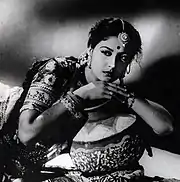
Vinod Mehta was working as a copywriter for the advertisement agency Jaisons—which was run by Harsh Jain and his four sons[1]—when Luis Vaz of Jaico Publishing House approached Mehta to offer him writing a biography on the actress and poet Meena Kumari, as soon as her death in March 1972.[2] He had previously written Bombay: A Private View (published a year before), about his experiences in Bombay during the 1970s and earlier decades. The book, finished within less than eight months at his apartment, was self-published and distributed by Thacker and Company. Costed ₹5 (equivalent to ₹190 or US$2.50 in 2020), the book turned out to be a commercial success, and a total of 3,000 copies for the first edition were sold out after six days. Although still continuing his occupation as a copywriter in the period, this gave him, who initially had little expectations of the book, motivation to write more books in the future.[3]
Mehta subsequently accepted Vaz's offers, with ₹500 (equivalent to ₹19,000 or US$250 in 2020) as his advance. He revealed in his 2011 memoir Lucknow Boy that he took the opportunity to broaden the scope of his work, though he almost had no insights about Bollywood at the time nor met the actress.[4][5] Mehta noted in the book's foreword that it was hard to collect information about Kumari since she has died when he starts writing the biography. Within six months, Mehta had finished the manuscript with he interviewing her sisters, her husband, and her contemporaries such as the actors Ashok Kumar, Khwaja Ahmad Abbas, Nargis, Raaj Kumar, and Rajendra Kumar.[4] Mehta also had many meeting appointments with the actor Dharmendra, whom he called "the love of her life". However, none of which the latter kept and Mehta described it as "a big void" of the book.[2] The writer also collected information from available magazine copies, including those for Filmfare, Filmindia, and Screen.[6]
The book follows the writing style from several writers, including that of the American novelist and journalist Norman Mailer in the non-fiction novel The Armies of the Night (1968), in which the author is placed as the narrative's core and the use of the pronoun I is common—which often called New Journalism.[7] In Meena Kumari, the subject is generally referred to by the author as "my heroine".[8] He said, though still journalistic, the style is "heavily author-centric" and "highly personalized".[7] He added that he "stole" their idea, asserting that, since he was a new writer that time, he had only a "few original or interesting" ideas.[2] "All the solecisms and structural weakness were cringingly visible, but ... it was not as bad as I thought. My self-created proximity to the subject posed an obvious and clear danger. Nevertheless, despite the naivety and exhibitionism and hurried judgements, I thought I had managed to capture some fleeting essence of the controversial actress", he said.[7]
Release and reception
By October 1972, seven months after Kumari's death, Mehta had finished the manuscript and sent it to Jaico Publishing House. It was subsequently published as a paperback book that was costed ₹5 (equivalent to ₹190 or US$2.50 in 2020) the same month in Bombay, India. It was received positively by many critics;[9] Abbas, whom Mehta met to interview for his research, wrote a review of the book for the weekly tabloid Blitz in December. Abbas called it "the most objective, the most sympathetic, the most comprehensively researched, and the most readable book" on Kumari, even if there were more books on the same subject published. He complimented Mehta's effort to write the biography, and praised her for his ability to write on her explicitly with "restrained and civilised language".[10]
The book's second edition was published by HarperCollins on 10 July 2013 on Amazon Kindle;[11] the paperback version was released on 13 August the same year.[12] Re-titled Meena Kumari: The Classic Biography, this edition has another foreword from Mehta dated May 2013. Prior to HarperCollins, many publishers had approached him to re-issue the book but he rejected all the offers since he believed it does not "[merit] the honour"; he later described the book as a part of his "mediocre past".[13] While its original edition was acclaimed by book reviewers, critical reception to Meena Kumari: The Classic Biography was mixed. Jai Arjun Singh noted it has many grammatical mistakes,[14] and Rasheeda Bhagat of Business Line added: "... a poor caricature of the actress whom Mehta keeps calling, to my great irritation, 'my heroine', through the entire book. What somewhat redeems this atrocious narrative, in which he largely appears cocky at best and flippant and ignorant at worst, is the shy at honesty in the introduction to the new edition."[15]
Mumbai Mirror's Chandrima Pal believed it "is as relevant today as it was at that time".[16] Describing it as an "unusual work", Baradwaj Rangan saw Mehta's writing makes the book looks more like an autobiography rather than a biography.[17] The journalist and social commentator Ziya Us Salam praised the writer for "[bringing] alive memories of an actress and her illustrious career".[18] A writer of The Hindu called it a "riveting account" about Kumari.[19] Frontline magazine concluded it would need talent equal to that of Billy Wilder to write a book on her, and this book "has suggested a possibility of how it might be done".[20] Utpal Kumar from The Pioneer asserted, "So far so good, but the book is not a biography in the true sense, far from being a 'classic' biography. It's a pacy, juicy and engaging account of the country’s greatest tragedienne and her marriage and affairs."[21] Writing for a review for India Today, Biswadeep Ghosh believed "reading this biography will be a fulfilling experience".[22]
Publication history
| Region | Release date | Format | Publisher | Ref. |
|---|---|---|---|---|
| India | October 1972 | Paperback | Jaico Publishing House | [9] |
| 10 July 2013 | Amazon Kindle | HarperCollins | [11] | |
| 13 August 2013 | Paperback | [12] |
References
- Mehta 2011, p. 73.
- Mehta 2013a, pp. vi–vii.
- Mehta 2011, pp. 74–75.
- Mehta 2011, p. 76.
- Mehta 2013a, p. 166.
- Mehta 2013a, p. 114.
- Mehta 2013a, p. vii.
- Mehta 2011, p. 78.
- Mehta 2013a, p. vi.
- Abbas 1972, p. 9.
- Mehta 2013a.
- Mehta 2013b.
- Mehta 2013a, pp. vii–ix.
- Singh 2013, Death and the.
- Bhagat 2013, Finding Meena... and.
- Pal 2013, Men who loved.
- Rangan 2013, An admirer's account.
- Salam 2013, After Mahjabeen turned.
- The Hindu 2013, Printpick.
- Frontline 2013, Two legends.
- Kumar 2013, Starry life, tragic.
- Ghosh 2013, An ode to.
Sources
- Abbas, Khwaja Ahmad (December 1972). "Meena Kumari by Vinod Mehta". Indian Book Industry. Vol. 7 no. 3. Retrieved 5 September 2021.
- Bhagat, Rasheeda (17 October 2013). "Finding Meena... and failing". Business Line. Archived from the original on 9 July 2021. Retrieved 9 July 2021.
- Ghosh, Biswadeep (28 July 2013). "An ode to tragedy queen Meena Kumari". India Today. Archived from the original on 3 September 2021. Retrieved 5 September 2021.
- Kumar, Utpal (18 August 2013). "Starry life, tragic tale". The Pioneer. Archived from the original on 3 September 2021. Retrieved 5 September 2021.
- Mehta, Vinod (9 November 2011). Lucknow Boy. New Delhi, India: Penguin Books. ISBN 978-06-70085-29-3. OCLC 783522585.
- Mehta, Vinod (10 July 2013). Meena Kumari. HarperCollins. ASIN B00E9Y3RX0.
- Mehta, Vinod (13 August 2013). Meena Kumari. HarperCollins. ISBN 978-93-50296-25-7.
- Pal, Chandrima (15 August 2013). "Men who loved and left Meena Kumari". Mumbai Mirror. Archived from the original on 22 October 2020. Retrieved 9 July 2021.
- "Printpick". The Hindu. Thiruvananthapuram, India. 28 August 2013. Archived from the original on 31 August 2013. Retrieved 10 July 2021.
- Rangan, Baradwaj (3 December 2013). "An admirer's account of Meena Kumari". The Hindu. Archived from the original on 27 February 2021. Retrieved 9 July 2021.
- Salam, Ziya Us (16 August 2013). "After Mahjabeen turned Meena". The Hindu. Archived from the original on 10 February 2014. Retrieved 10 July 2021.
- Singh, Jai Arjun (14 August 2013). "Death and the heroine: Vinod Mehta does Meena Kumari". Jabberwock. Archived from the original on 12 June 2021. Retrieved 9 July 2021.
- "Two legends". Frontline. 15 November 2013. Archived from the original on 21 January 2021. Retrieved 10 July 2021.