Meibomian gland dysfunction
#REDIRECT Meibomian gland#Clinical significance
- To a section: This is a redirect from a topic that does not have its own page to a section of a page on the subject. For redirects to embedded anchors on a page, use {{R to anchor}} instead.
Meibomian gland dysfunction (also known as meibomitis or posterior blepharitis) is an inflammation of the meibomian glands that causes the glands to be obstructed by thick, cloudy-to-yellow, more opaque and viscous-like, oily and waxy secretions, a change from the glands' normal clear secretions.[1][2] Besides leading to dry eyes, the obstructions can be degraded by bacterial lipases, resulting in the formation of free fatty acids, which irritate the eyes and sometimes cause punctate keratopathy.
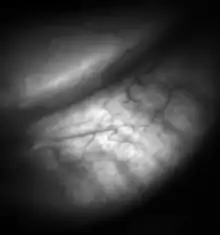
The dysfunction is more often seen in women, and is regarded as the main cause of dry eye disease.[3][4] Factors that contribute to the dysfunction can include things such as a person's age and/or hormones,[5] or severe infestation of Demodex brevis mite.
Treatment can include warm compresses to thin the secretions and eyelid scrubs with baby shampoo or eyelid cleanser,[6][2] or emptying ("expression") of the gland by a professional. Lifitegrast and Restasis are topical medication commonly used to control the inflammation and improve the oil quality. In some cases topical steroids and topical (drops or ointment)/oral antibiotics (to reduce bacteria on the lid margin) are also prescribed to reduce inflammation.[2] Intense pulsed light (IPL) treatments have also been shown to reduce inflammation and improve gland function. Meibomian gland probing is also used on patients who experience deep clogging of the glands.
The dysfunction may be caused by some prescription medications, notably isotretinoin. A blocked meibomian gland can cause a meibomian cyst known as a chalazion to form in the eyelid.
References
- Chhadva, Priyanka; Goldhardt, Raquel; Galor, Anat (24 November 2017). "Meibomian gland disease: the role of gland dysfunction in dry eye disease". Ophthalmology. 124 (11 Suppl): S20–S26. doi:10.1016/j.ophtha.2017.05.031. PMC 5685175. PMID 29055358.
- Peter Bex, Reza Dana, Linda Mcloon, Jerry Niederkorn (2011). Ocular Periphery and Disorders
- "Managing and Making Sense of MGD". Review of Ophthalmology. 2012. Retrieved 26 February 2014.
- "Rethinking Meibomian Gland Dysfunction: How to Spot It, Stage It and Treat It". American Academy of Ophthalmology. 2014. Retrieved 26 February 2014.
- "The Role of Meibomian Gland Dysfunction and Lid Wiper Epitheliopathy in Dry Eye Disease". American Academy of Optometry. 2012. Archived from the original on 9 October 2013. Retrieved 26 February 2014.
- Aryasit, Orapan; Uthairat, Yuwarat; Singha, Penny; Horatanaruang, Orasa (8 May 2020). "Efficacy of baby shampoo and commercial eyelid cleanser in patients with meibomian gland dysfunction". Medicine. 99 (19): e20155. doi:10.1097/MD.0000000000020155. PMC 7220370. PMID 32384504.