Member of Parliament (India)
es of MPs who serve in either house of India's bicameral federal legislature.
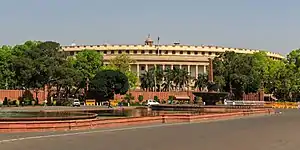
Member of Parliament, Lok Sabha
A Member of Parliament, Lok Sabha is a representative of Indian citizens to the Lok Sabha or the House of the People, the lower house of the Parliament of India. They are directly elected by citizens of India, through universal adult suffrage with the first-past-the-post system, who reside in delimited parliamentary constituencies. Currently, there are 543 Lok Sabha MPs. Each represents a single constituency and serves a term of five years unless the Lok Sabha is dissolved earlier.
All Lok Sabha MPs, per Article 84 of the Constitution of India, must be Indian citizens of at least 25 years of age. They must also be registered to vote (though not necessarily in the parliamentary constituency they represent). They may not hold any office of profit under the Government of India during their service.
Member of Parliament, Rajya Sabha
A Member of Parliament, Rajya Sabha is a representative of the Indian states to the Rajya Sabha or the Council of States, the upper house of the Parliament of India. Currently, there are 250 Rajya Sabha MPs. Each serves for a term of six years, with one-third of the membership's terms expiring every two years (akin to senatorial classes in the United States Senate).
Among the Rajya Sabha's 250 members, 238 are elected by legislative assemblies of the several states through elections with the 'single transferrable vote' system. Each such MP represents a state of the Union, with each state entitled to return multiple MPs per their shares of the national population. The remaining 12 MPs are nominated and appointed by the President of India, by and with the advice and consent of the Union Council of Ministers, on the basis of their expertise in "literature, art, science and social service."
All Rajya Sabha MPs, per Article 84 of the Constitution of India, must be Indian citizens of at least 30 years of age. By law, they must also not be convicted felons serving a sentence of imprisonment, undischarged insolvents (i.e., in payment of debts upon bankruptcy) and of an unsound mind (i.e., mentally disabled with a loss of reasoning ability). They may not hold any office of profit under the Government of India during their service.
Powers
Members of both the Lok Sabha and Rajya Sabha may introduce legislation (except money bills, which must be introduced in the Lok Sabha), raise questions to ministers in parliament, serve on joint parliamentary committees and serve in the Union Council of Ministers. Ministers who are MPs of one house have the right to participate in the proceedings of another house, though they may not vote on matters before that house. Additionally, MPs from both houses (except nominated members of the Rajya Sabha), together, constitute the electoral college for the Vice President of India and, along with state legislators, comprise the electoral college for the President of India. The Election Commission of India administers all elections to both the Lok Sabha and Rajya Sabha.
List of members
Rajya Sabha
- List of current members of the Rajya Sabha
- List of nominated members of Rajya Sabha
- List of Rajya Sabha members from Andhra Pradesh
- List of Rajya Sabha members from Arunachal Pradesh
- List of Rajya Sabha members from Assam
- List of Rajya Sabha members from Bihar
- List of Rajya Sabha members from Chhattisgarh
- List of Rajya Sabha members from Delhi
- List of Rajya Sabha members from Goa
- List of Rajya Sabha members from Gujarat
- List of Rajya Sabha members from Haryana
- List of Rajya Sabha members from Himachal Pradesh
- List of Rajya Sabha members from Jammu and Kashmir
- List of Rajya Sabha members from Jharkhand
- List of Rajya Sabha members from Karnataka
- List of Rajya Sabha members from Kerala
- List of Rajya Sabha members from Madhya Pradesh
- List of Rajya Sabha members from Maharashtra
- List of Rajya Sabha members from Manipur
- List of Rajya Sabha members from Meghalaya
- List of Rajya Sabha members from Mizoram
- List of Rajya Sabha members from Nagaland
- List of Rajya Sabha members from Odisha
- List of Rajya Sabha members from Puducherry
- List of Rajya Sabha members from Punjab
- List of Rajya Sabha members from Rajasthan
- List of Rajya Sabha members from Sikkim
- List of Rajya Sabha members from Tamil Nadu
- List of Rajya Sabha members from Telangana
- List of Rajya Sabha members from Tripura
- List of Rajya Sabha members from Uttar Pradesh
- List of Rajya Sabha members from Uttarakhand
- List of Rajya Sabha members from West Bengal