List of Mikoyan and MiG aircraft
This is a list of aircraft produced by Russian Aircraft Corporation MiG, previously Mikoyan, a Russian aircraft manufacturer.
Production
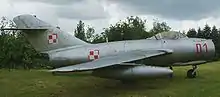
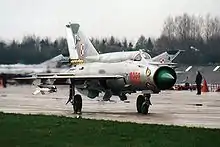
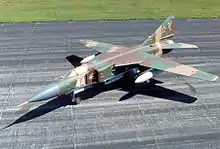
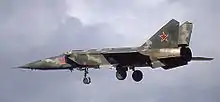
- MiG-1 - 1940 fighter
- MiG-3 - 1940 fighter and interceptor
- MiG-9 - 1946 fighter, MiG's first jet
- MiG-15 - 1947 fighter, the world's first modern jet, the world's most-produced jet
- MiG-17 - 1950 fighter (based on the MiG-15)
- MiG-19 - 1952 fighter, MiG's first supersonic fighter, the world's first mass-produced supersonic fighter
- MiG-21 - 1959 fighter and interceptor, the world's most-produced supersonic fighter, that would be widely exported and become the backbone of dozens of air forces
- MiG-23 - 1967 fighter and fighter-bomber, the world's most-produced variable-geometry aircraft
- MiG-25 - 1964 interceptor and reconnaissance-bomber aircraft, the world's fastest mass-production aircraft
- MiG-27 - 1970 ground-attack aircraft derived from the MiG-23.
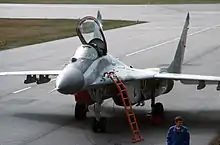
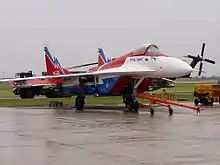
- MiG-29 - 1977 air superiority fighter and multirole fighter
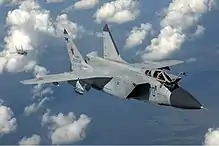
- MiG-31 - 1975 interceptor (based on the MiG-25)
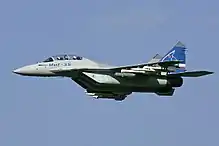
- MiG-35 - 2007 multirole fighter and air superiority fighter (based on the MiG-29)
Experimental
- DIS/MiG-5 - escort fighter prototype, 1941
- MiG-6 - reconnaissance/ground attack aircraft design, 1940; remained a paper project
- MiG-7 - MiG-3 re-engined with an AM-38 inline engine, 1944
- MiG-8 Utka - liaison aircraft prototype, 1945
- MiG I-200 - prototype for MiG-1, 1939
- MiG IP-201 - MiG-1 modified into a testbed for an experimental machine gun, 1941
- MiG I-210 - MiG-3 modified with a Shvetsov M-82 radial engine, 1941; also known as MiG-3-82, Aircraft IKh, and Article 65
- MiG I-211/MiG-9E - prototype high-altitude fighter developed from the I-210, 1942
- MiG I-220/MiG-11 - high-altitude fighter prototype, 1943
- MiG I-221 - high-altitude interceptor based on I-210, 1943
- MiG I-222 - I-221 modified with a pressurized cockpit, 1944
- MiG I-224 - high-altitude fighter prototype, 1944
- MiG I-225 - high-speed, high-altitude fighter prototype, 1944
- MiG I-230/MiG-3U - improved MiG-3, 1942
- MiG I-231 - high-altitude fighter prototype, 1943
- MiG I-250 (N) (aka "MiG-13") - motorjet fighter prototype, 1945
- MiG I-270 (Zh) - rocket-powered interceptor prototype, 1947
- MiG I-300 - prototype for MiG-9, 1945
- MiG I-301T/MiG-9UTI - prototype trainer version of MiG-9, 1947
- MiG I-302 - MiG-9 with relocated cannon, 1947
- MiG I-305 - MiG-9 with a single Lyulka TR-1 engine, 1947
- MiG I-307 - MiG-9 with RD-20F or RD-21 engines, 1947
- MiG I-310 - prototype for MiG-15, 1947
- MiG I-320 (R) - long-range all-weather interceptor prototype, 1949
- MiG I-340 - MiG-17 with Lyulka AM-5F engines, 1952
- MiG I-350 (M) - fighter prototype, 1951; first Soviet fighter to maintain supersonic speed
- MiG I-360 - 1952, precursor of MiG-19
- MiG I-370/I-1 - swept-wing supersonic fighter prototype, 1955
- MiG I-380/I-3 - fighter prototype, 1953; never finished
- MiG I-410/I-3P - all-weather interceptor prototype, 1954
- MiG I-3U/I-5 - 1956; converted from I-3
- MiG I-7U - heavy interceptor fighter prototype developed from the I-3, 1957
- MiG I-75 - swept-wing interceptor developed from the I-7, 1958; lost to the Sukhoi Su-9
- MiG SM-12 - 1957, developed into the MiG-21
- MiG SN - 1953
- Ye-2 - 1955
- Ye-4 - delta wing prototype of MiG-21, 1955
- Ye-5 - delta wing research prototype, 1956; initially known as I-500
- Ye-6T - prototypes based on the MiG-21F for testing the Vympel K-13 missile system, 1958
- MiG-21P-13/Ye-7 - two MiG-21s converted to use the K-13 missile as part of a project for a K-13 armed interceptor, 1958
- Ye-8 - supersonic jet fighter aircraft prototype, 1962; planned replacement of the MiG-21
- Ye-50 - experimental swept-wing high-altitude interceptor, 1956
- Ye-150 - interceptor prototype, 1958
- Ye-151 - cannon armed version of Ye-150
- Ye-152 - 1959, fighter
- Ye-166 - fictitious designation of Ye-152-1
- MiG-21 (first use of designation) - production version of Ye-5, 1956
- MiG-23 (first use of designation) – production designation of Mikoyan-Gurevich Ye-2A, 1956
- MiG-23 (second use of designation) – early name of Mikoyan-Gurevich Ye-8 (E-8/1 and E-8/2), 1960
- MiG-AT - advanced trainer/light attack prototype, 1996; lost to the Yakovlev Yak-130
- MiG-110 - proposed cargo/passenger aircraft, 1995; not built
- MiG MFI objekt 1.44/1.42 - 1986–2000
- MiG LFI project
- MiG-105 Spiral - 1965
- MiG-33
- Mikoyan MiG-2000 - ramjet-powered SSTO spaceplane, 1990s; lost to the Tupolev Tu-2000
- Mikoyan LMFS - proposed stealth light multirole fighter; developed into the Sukhoi Su-75
Planned aircraft
- Mikoyan PAK DP (MiG-41)
UAVs and drones
- Mikoyan Skat - stealth UCAV
Naming conventions
MiGs follow the convention of using odd numbers for fighter aircraft. However, this naming convention is maintained not directly by MiG, but by ordering institutions, such as Ministry of Defence or Council of Ministers' Military-Industrial Commission (before the dissolution of the Soviet Union). The original designations for MiG aircraft are 2- or 3-digit numbers, separated by a dot. 1.44 or 1.42 is an example of the original naming. Although the MiG-8 and MiG-110 exist, they are not fighters. The MiG-105 "Spiral" was designed as an orbital interceptor, contemporaneous with the U.S. Air Force's cancelled X-20 Dyna-Soar.